

The concept of hybrid learning has moved from the experimental niche of pedagogy into the mainstream of higher education strategy. By “hybrid learning in higher education”, we refer to the deliberate blend of in-person, on-campus instruction and virtual, online engagement. In other words, students may attend part of their course in person in the lecture hall or seminar room, and part remotely via video conferencing, discussion boards, or online modules. This balanced model offers the best of both worlds: the richness of face-to-face interaction and the flexibility of digital access.
The acceleration of this approach followed the global disruptions of the COVID-19 pandemic. Institutions that once relied almost exclusively on physical classrooms shifted overnight to remote delivery; the experience revealed both the limitations of fully in-person teaching during a crisis and the possibilities of online modes. According to an article by EDUCAUSE, the pandemic “accelerated the virtual education revolution by a decade,” forcing higher education faculties and institutions to rethink how teaching and learning are delivered. For many universities and colleges, that shift meant embracing a hybrid mode as the “new normal.”
At Edutech Global, we have been working alongside universities, colleges and other higher-education partners to promote “digital-first” campuses, where technology is built in from the ground up, not just bolted on as an afterthought. We aim to help institutions design learning environments that are flexible, student-centred, and globally accessible.
Read more: How Universities Can Upgrade Their Campus with Smart Technologies
Why Hybrid Learning Is the Future of Global Classrooms

Accessibility and Flexibility for International Learners
One of the strongest drivers of hybrid learning in higher education is the demand from a globally mobile student population. Many students now expect the ability to study part-time, from abroad or in their home country while accessing a campus elsewhere. Hybrid models make this possible by combining online components with periodic campus visits or synchronous sessions. The World Economic Forum reports that, when asked about higher education’s future, 49 % of adults across 29 countries believed it would be “split between in-person and online” within five years. For learners in Nigeria, West Africa or other regions where travel or relocation can be challenging, hybrid models open up possibilities for international engagement without full relocation.
Attraction of Local and Remote Students
For institutions, hybrid learning offers a compelling dual market: they can serve the local on-campus student body while simultaneously reaching remote students nationally or internationally. This increases enrolment potential, diversifies the student base, and strengthens global brand recognition. It also allows institutions to redesign programmes that leverage their unique campus resources (laboratories, studios, live seminars) alongside online assets. By doing so, they become part of a “global classroom” ecosystem rather than being restricted by geography.
Support for Sustainability and Efficiency
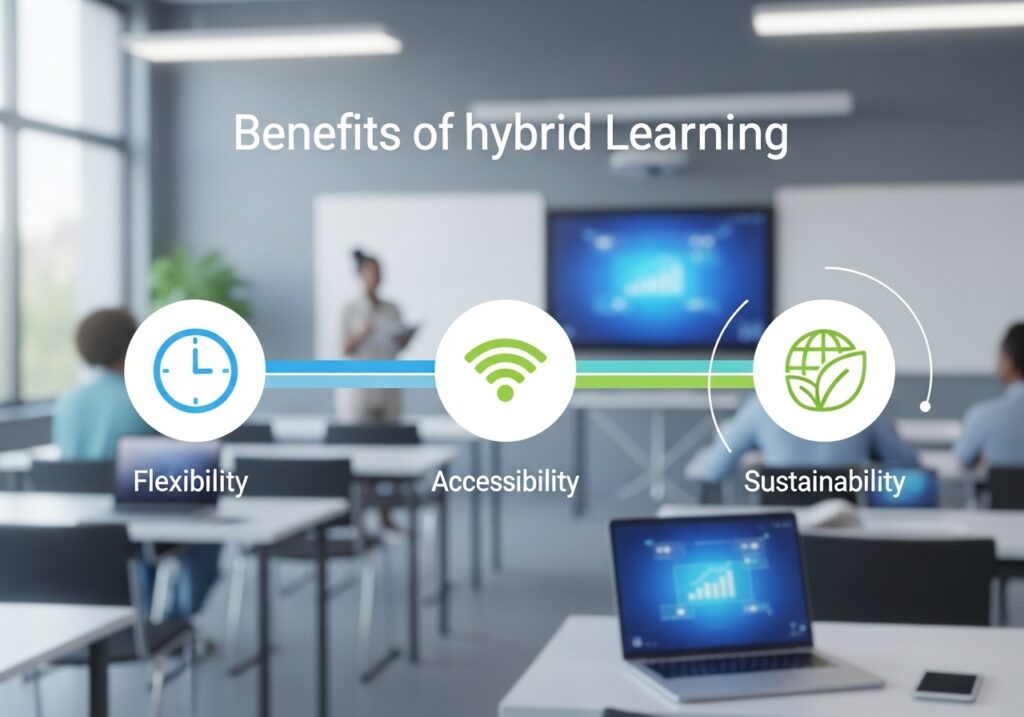
Hybrid learning also aligns with the sustainability agenda. When fewer students need to travel or relocate for extended stays on campus, institutions reduce the carbon footprint associated with transit and residence. At the same time, campuses can reduce infrastructure pressure (e.g., housing, large lecture halls) by balancing occupancy levels. A report by the Broadband Commission emphasises that hybrid learning strategies require deliberate planning and infrastructure, but also yield sustainability dividends by reducing travel and physical infrastructure dependencies. For government and institutional planners in Nigeria and elsewhere in Africa, this means hybrid learning could be a smart way to scale higher education access without replicating full‐scale bricks-and-mortar campuses everywhere.
How Technology Powers Hybrid Education Models
Learning Management Systems and Cloud Platforms
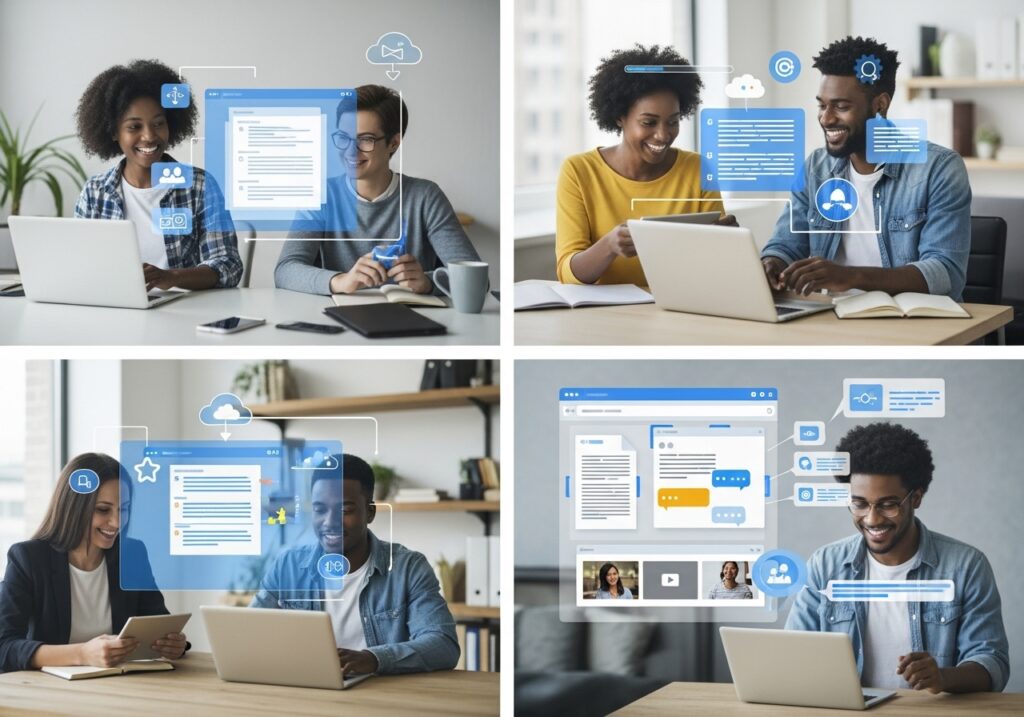
At the core of hybrid learning models lies the use of Learning Management Systems (LMS) and cloud-based platforms. These systems allow students to access course materials, submit assignments, participate in discussions and engage in asynchronous learning from anywhere. On the campus side, they integrate with face-to-face sessions and help faculty manage cohort tracking and student analytics. Research by EDUCAUSE shows that blended instruction has shown stronger learning outcomes than either fully online or fully in-person formats alone.
Video Conferencing and Real-time Collaboration Tools
Video-conferencing platforms and synchronous collaboration tools are equally critical. Platforms like Studio, Microsoft Teams for Education, Zoom, Webex and others enable live lectures, breakout sessions, remote guest-lecturers and hybrid seminars. For instance, institutions can stream a lecture from campus to remote students, pause for live Q&A, and then break into mixed groups of online and on-campus students. This helps bridge the gap between remote and in-person participation.
AI Tutors, Virtual Labs and Immersive Experiences
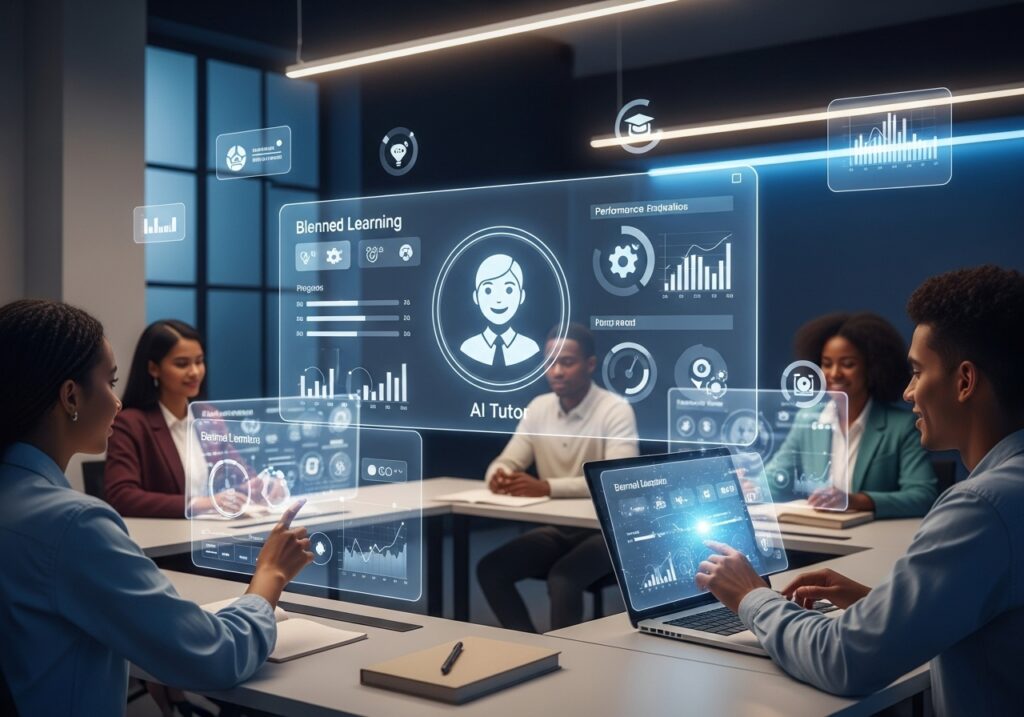
The next level of hybrid learning involves more immersive, technology-rich experiences. AI-driven tutors can provide personalised support to students, whether they are on campus or remote. Virtual labs and simulation platforms allow students to engage in experiments or practice scenarios regardless of their location. Immersive technologies such as Virtual Reality (VR) and Augmented Reality (AR) are now entering higher education as tools to close the gap between physical presence and remote access. The World Economic Forum highlights that VR is “a game-changer” for hybrid implementations, enabling collaborative and interactive experiences across distance.
Integration and Design Principles
However, simply having tools is not enough. Effective hybrid models require thoughtful design: flexible learning spaces, student agency, active learning, co-design of experiences and technology choices aligned with pedagogical goals. An EDUCAUSE article outlines design principles such as embedding student voice, authenticity of activities, and ensuring technology is simple and reliable. This is an area where Edutech Global supports institutions, helping them with pedagogy-technology alignment, platform selection, and training.
Challenges in Adopting Hybrid Learning Models
Faculty Adaptation and Digital Readiness
One of the biggest obstacles is human, not technical. Many faculty members entered the pandemic with limited experience in online teaching. A study found that, before the crisis, 34 % of faculty described themselves as “not at all experienced” in online teaching and only 22 % as “very experienced.” Adapting to hybrid modes means they must redesign courses, balance synchronous and asynchronous delivery, engage remote and on-campus students simultaneously, and adopt new assessment practices. Without institutional support, training and time allocation, this can be overwhelming.
Bandwidth and Infrastructure Issues in Developing Countries
In many parts of Africa and other developing regions, hybrid learning is challenged by inconsistent internet connectivity, power outages, limited access to devices and uneven digital literacy. The Broadband Commission report underscores that meaningful access and affordable connectivity are essential for hybrid-learning strategies to be viable.
Investment in Digital Infrastructure and Equity
Hybrid models require investment: upgraded Wi-Fi, cameras and microphones in classrooms, integrated LMS platforms, support services, remote access provisioning, and data-driven student support systems. Without this investment, hybrid delivery risks being unequal, where remote students receive an inferior experience compared to those physically on campus. Institutions must plan strategically, budget accordingly and ensure equity of access. The EDUCAUSE article “Hybrid Learning and Space Reimagination” argues that higher education leaders must reimagine hybrid spaces to promote student success and equity.
Cultural and Institutional Change
Shifting to a hybrid model is not only a technical transformation, it is a cultural one. Institutional leadership must commit to hybrid pedagogy, change reward systems (for teaching), rethink campus scheduling, update policies on presence and participation, and build a community ethos that spans remote and in-person students equally. Without such change, hybrid implementations may remain partial or ineffective.
The Future Outlook of Hybrid Classrooms
Blended Degrees and Global Recognition
We are already seeing the rise of truly blended degrees, programmes designed from the ground up to combine online and on-campus modules. These global programmes allow students to complete part of their degree in their home country, attend an intensive module on a partner campus abroad, then finish online. As regulatory bodies and accreditation agencies adapt, these blended degrees are gaining recognition. The World Economic Forum notes that education systems must become flexible, adaptable and personalised to prepare learners for tomorrow’s demands. For institutions in Nigeria and West Africa, this means an opportunity: partnering with global universities to offer locally-anchored yet globally-certified hybrid programmes.
Collaboration Between Global Universities
Hybrid learning dismantles geographical borders. Universities can share teaching modules, co-deliver courses, host joint seminars across continents and form consortia that pool resources. Students from different time zones and locations can join the same class, bringing diversity of perspective. This global classroom mode enriches peer learning, cross-cultural understanding and international networks.
Technology and Learning Spaces Evolving
The physical campus will not disappear. Instead, it will evolve. Hybrid classrooms may incorporate cameras, all-in-one conference systems, smart boards, group-work pods and flexible seating. On the online side, AI analytics will track engagement, virtual labs will allow remote experimentation, and immersive technologies will offer experiences previously only possible on campus.
Implications for Nigeria, Africa and Beyond
For regions like Nigeria and Africa at large, the hybrid model is a strategic pathway to expanding higher education access. Rather than building new large-scale campuses, institutions can leverage digital platforms to serve broader populations. They can partner with international universities for blended delivery, upskill faculty for hybrid pedagogy and use hybrid models to bridge urban-rural divides. But this requires investment, government policy support, infrastructure development and institutional leadership.
Sustainable, Inclusive Global Classrooms
Ultimately, the future of hybrid learning in higher education is not just about technology; it is about inclusion. The opportunity to deliver high-quality education to students regardless of location, socio-economic status or mobility is real. As global challenges (pandemics, climate change, economic shifts) continue, institutions that adopt hybrid models are better positioned to adapt. Education becomes not only global in reach but resilient, flexible and student-centred.
As you evaluate your institution’s strategy, ask: Are we ready for hybrid learning? Do we have the infrastructure, the faculty capacity, the student support and the mindset to design a global classroom? With the right preparation, we can move beyond simply reacting to change and instead lead the transformation of higher education for the digital age.
At Edutech Global, we believe the future of global classrooms is hybrid and that the institutions that embrace it will be the leaders of tomorrow.