

How you prove what you know, today, is changing fast. Traditional paper certificates, while still valuable, face growing challenges: risk of fraud, difficulty in verification across borders, and limitations in capturing the wide range of skills learners now acquire. The concept of digital credentials in education is emerging as a powerful solution: credentials that are issued and shared online, easily verified, and designed for the global age.
Digital credentials encompass everything from micro-credentials and digital badges to full digital diplomas and blockchain-based certificates. They give learners a modern, portable way to showcase their achievements, whether a short course in data analytics, a micro-credential in leadership, or a full academic qualification. At the same time, they give institutions a means to streamline issuance, improve trust, and expand recognition beyond traditional boundaries.
For universities, corporates and learners alike, this shift is not just about technology. It is about recognition that is global, transparent and flexible. It is about credentials that travel with the learner, not just the institution.
Read more: Blockchain in Education: Securing Credentials and Academic Records
What Are Digital Credentials?

At its core, a digital credential is a verified, shareable digital representation of an achievement. This includes digital badges, micro-credentials and blockchain certificates.
Digital badges are graphical tokens issued to a learner when they meet certain criteria. They typically include metadata: what was learned, what skills were demonstrated, and when the badge was awarded. A widely used example is through the Credly platform.
Micro-credentials reflect learning experiences that are shorter than a full degree or diploma. They might cover a specific skill or competency. According to the World Economic Forum, micro-credentials can help people of all ages, levels and backgrounds build and prove narrow but valuable skills.
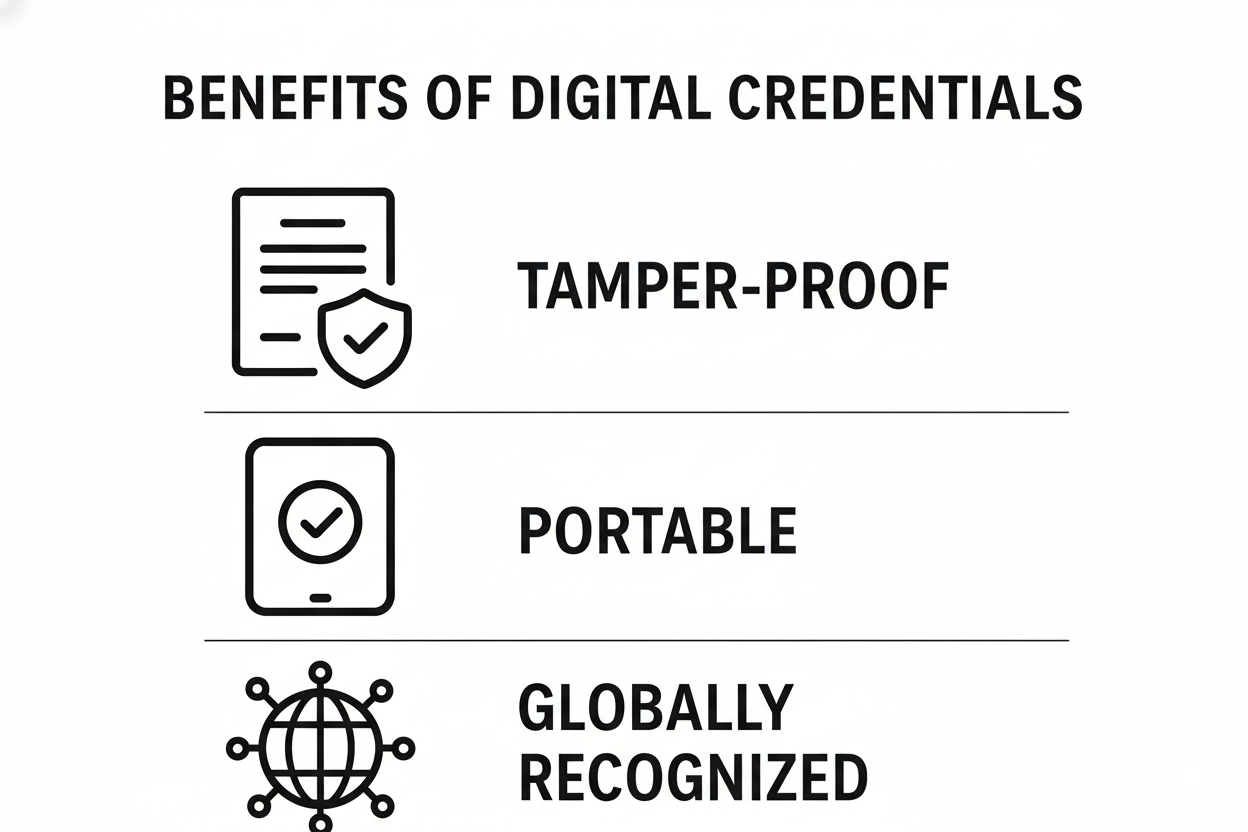
Blockchain certificates or blockchain-based digital credentials go a step further: they use the ledger technology behind blockchain to make credentials tamper-proof, verifiable in real time, and globally accessible. For example, the Organisation for Economic Co‑operation and Development (OECD) states that blockchain “has the potential to make credential verification substantially quicker and less administratively intensive.”
Why do these matter globally? Because education and learning are increasingly borderless. Learners may study online, move between countries, or engage in lifelong learning that doesn’t fit traditional degree timelines. Digital credentials support that world: they can travel, be shared, verified, and stacked in ways paper cannot. They allow a university in Nigeria, for instance, to issue a badge or digital diploma that an employer in Germany can instantly verify.
How Digital Credentials Improve Academic Transparency

One of the major problems in traditional credentialing is the risk of fraud and the opaque nature of verification. Paper certificates can be forged, lost or altered. Manual verification processes (calling universities, faxing transcripts) take time and cost money. Digital credentials attack both problems: authenticity and transparency.
Reducing Fake Degrees through Verifiable Systems
Blockchain-enabled credentialing and digital badge platforms embed verification directly into the credential. For example, Credly reports its digital credentials are “tamper-proof” and “easily shareable and verifiable” with metadata that outlines what a learner actually did.
The OECD emphasises that blockchain and open standards together can “eliminate credentials fraud and forgery.” Institutions and employers can trust that what is claimed is what was earned.
Offering Lifelong, Portable Proof of Achievement
Digital credentials do more than just replace paper. They empower learners with credentials that:
- Are portable: Learners carry their credentials digitally and share them online.
- Are stackable: Micro-credentials and badges can be combined or layered into larger qualifications.
- Are lifelong: Learners can build a portfolio of achievements over time, across contexts.
Technology Behind Digital Credentials
Implementing digital credentials hinges on a suite of technologies and standards. Three key elements deserve deeper attention: blockchain, open badge standards, and integration systems.
Blockchain Ensures Tamper-Proof Validation

Blockchain is a distributed ledger where each transaction (or credential issuance) is time-stamped, immutable and verifiable by third parties. In education, this means once a credential is issued, it cannot be retroactively manipulated or falsified. The World Economic Forum notes that blockchain allows credentials to be “instantly validated by educational entities worldwide.”
Moreover, the OECD highlights that digital credentials and degrees issued through unfalsifiable technologies like blockchain reduce administrative burden and increase trust.
In practical terms, when a university issues a digital diploma on blockchain, an employer or another university can verify the credential online, often in seconds. There is no need to contact the issuer manually, no delay, no risk of forgery.
Integration with Global Networks like Credly and Open Badges
Standards matter. The Open Badges Initiative defines a specification for the metadata behind digital badges: what they represent, who issued them, when, and under what criteria.
Platforms such as Credly provide the tools universities and institutions need to create, issue and manage digital credentials. According to Credly, they’ve managed over 100 million credentials across more than 48 million individuals.
This ecosystem of open standards plus platforms ensures interoperability: badges issued by one university can be recognised by another institution, by employers, by portfolio systems. It also allows integration with learning management systems (LMS), student information systems (SIS) and enterprise systems.
Data-Rich Metadata and Systems Integration
Unlike traditional certificates, digital credentials include rich metadata: what the learner demonstrated (skills, competencies), when, under what assessment criteria, the issuing institution, evidence of achievement, even expiry or renewal details. Credly emphasises this, noting that metadata “gives employers and professional networks clear evidence” of what the learner accomplished.
How Universities Can Implement Digital Credentialing
For universities looking to lead in this space, implementing digital credentials should be strategic, thoughtful and aligned with institutional goals. Here are key steps institutions can take.
Partner with Credentialing Providers and Platforms
Rather than building everything from scratch, many universities are partnering with credentialing platforms such as Credly or specialised providers that support blockchain certificate issuance. These partnerships bring best practices, established infrastructure and global networks.
For example, an institution could collaborate with a provider to issue digital badges for micro-courses, then gradually scale into full digital diplomas and blockchain-based credentials. The partner handles issuance, metadata design, verification systems and even analytics.
Pilot Programs for Online and Hybrid Learners
A sensible approach is to start with pilots. Choose a programme (online, hybrid or micro-credential) and issue digital badges or digital credentials to learners. Monitor:
- Uptake and learner behaviour
- Verification and sharing of credentials
- Employer and third-party recognition
- Integration with LMS and student systems
- Cost and operational challenges
Such pilots allow the institution to build internal capacity, address technical issues, refine metadata and credential design, and align policies around credentialing, authentication and data governance.
Ensure Institutional Readiness and Governance
Institutions must address several governance elements:
- What level of credentialing is eligible (badges, micro-credentials, full diplomas)
- Who approves the credential criteria, issuing policy and renewal mechanism
- Technical integration: LMS, SIS, credential platform, blockchain issuance (if used)
- Data privacy, identity verification, revocation and expiry policies
- Employer and external stakeholder engagement: Will the credentials be recognised? How will verification be handled?
At EduTech Global, we help institutions design the credential’s structure, implement the issuing platform (including blockchain if required), integrate with systems, and promote the credentials to global audiences.
Scale Gradually with Global Recognition in Mind
Once pilot programmes succeed, scale across online and hybrid programmes. Embed digital credentials as part of standard delivery. For international learners, ensure credentials are globally shareable, verifiable and designed for portability (including in multiple languages if appropriate). Consider partnerships and stacking pathways that allow learners to accumulate credentials that lead to a full qualification.
The Global Future of Academic Recognition
Looking ahead, digital credentials are not simply a technological novelty; they are foundational to the future of how academic achievement is recognised worldwide.
Standardised Global Credential Verification Across Countries
Imagine a world where a degree issued in Lagos can be verified in seconds by an employer in Berlin or a university in Seoul. That world is becoming real. The OECD notes that only 11 out of 29 surveyed countries had digital credential systems for school pupils, signalling much room for growth.
With open standards, blockchain validation and interoperable platforms, cross-border credential verification becomes efficient, transparent and trusted. This opens the path to more equitable access and global mobility.
Faster Employment and Academic Transitions
For learners, faster verification means quicker transitions into employment or further study. Employers can verify credentials in minutes. Universities can recognise micro-credentials or digital diplomas from partner institutions. Learners can stack credentials, transfer between programmes and present a lifelong portfolio of verified achievements.
For institutions, this offers a new competitive edge: global relevance, recognition and agility. Universities that embrace digital credentials position themselves as future-ready, learner-friendly and globally oriented.
Broadening Access and Lifelong Learning
Another important dimension is lifelong learning. Education no longer ends with a degree. Learners continually upskill, reskill and acquire new competencies. Digital credentials capture this evolving profile. They allow learners to show their learning journey: micro-credentials, short courses, professional development, and full degrees.
In regions underserved by traditional education or where mobility is constrained, digital credentials represent a powerful tool for upward mobility, international recognition and access to new opportunities.