

AI in university admissions has shifted from a theoretical possibility to an operational reality. Admissions offices globally are grappling with unprecedented application volumes, rising expectations from applicants, and demands for faster, consistent decisions. Traditional, manual review processes are increasingly mismatched with the scale and pace of today’s admissions cycles.
University admissions teams are not just sorting a few hundred applications anymore. Many institutions regularly handle tens of thousands of submissions. As a result, leaders are turning to automated admissions systems powered by artificial intelligence to augment human effort and streamline workflows without sacrificing fairness or quality.
Read more: Ethical AI in Education
Understanding how AI in university admissions works, why it is being adopted, where it provides real value, and what risks and limitations it brings is essential for administrators, educators, and policymakers.
AI in University Admissions Explained

At its core, AI in university admissions refers to the use of algorithms and machine learning models to support tasks that were once exclusively manual, from screening applications to answering applicant questions. These technologies can recognise patterns in large datasets, categorise content, and generate predictive insights, helping admissions teams focus on the most meaningful work.
For decades, admissions has been a labour-intensive process. With global application rates rising, often by double digits annually, traditional methods simply struggle to keep pace. Surveys show that around half of higher education admissions offices currently use AI tools, and an additional 30% plan to adopt them soon. The most common applications today involve transcript processing and recommendation letter review, even before considering essay evaluation or personalised outreach.
These tools do not replace human judgment, at least not in reputable implementations. Rather, they handle high-volume, repetitive tasks so human professionals can focus on qualitative evaluation, strategic goals, and student engagement. That distinction, augmentation rather than replacement, matters greatly in balancing efficiency with fairness.
Why Universities Are Adopting AI in Admissions
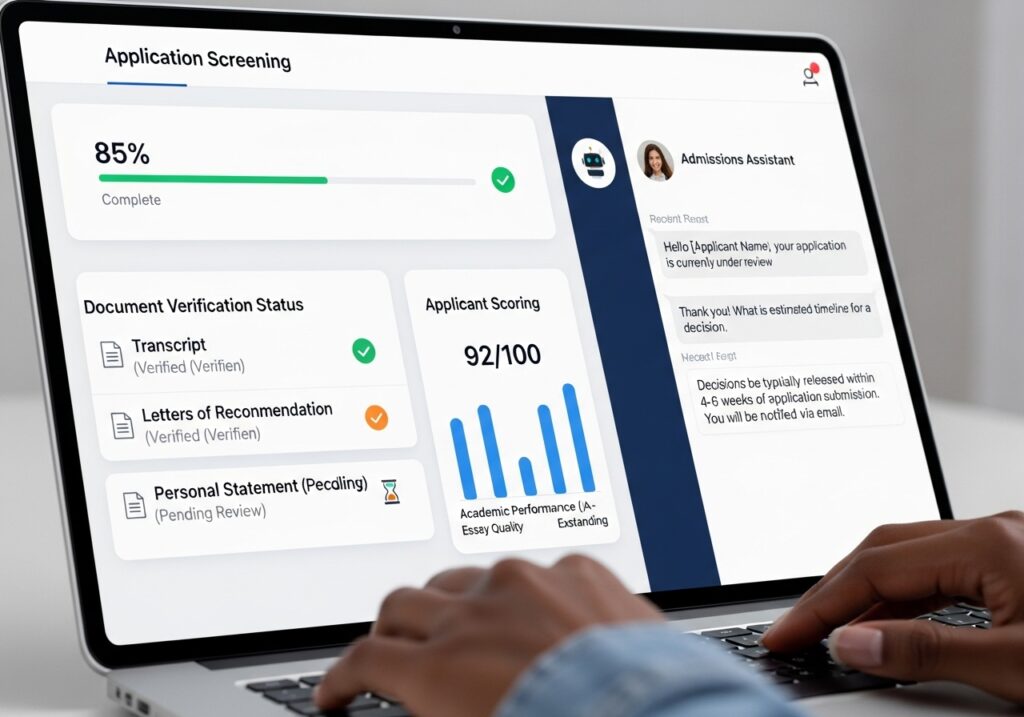
Several practical pressures are driving the adoption of AI in university admissions around the world:
Rising Application Volumes
Many universities now receive far more applications than they can feasibly process manually. In response, AI admissions automation helps teams manage large caseloads without proportionately increasing staff sizes. For example, certain AI systems claim they can analyse up to 250,000 essays in an hour, a volume impossible for human reviewers to match in the same timeframe.
Limited Admissions Staff
Higher education budgets are strained in many regions, and recruiting qualified admissions staff is competitive. Automating routine tasks lets offices focus their human capital on strategic decision-making rather than data entry or basic eligibility checks.
Faster Decision Timelines
Today’s applicants expect timely responses. Prolonged review cycles can damage yield rates and student satisfaction. By accelerating pre-screening, document verification, and applicant communication, institutions can reduce bottlenecks without lowering evaluative standards.
Consistency and Reliability
Human review, while essential, is susceptible to fatigue and inconsistency. AI, when properly designed and governed, applies standardised criteria uniformly across large datasets. This helps ensure similar applications receive similar treatment, particularly in early screening stages.
Read more: AI in University Admissions: What Actually Works at Scale
How AI Is Used in Admissions Processes

Higher education institutions are integrating artificial intelligence in higher education admissions in several distinct but complementary ways:
Application Screening and Evaluation
AI tools can automate initial screening steps by scanning transcripts, test scores, and academic histories against predefined thresholds. Natural language processing (NLP) algorithms also categorise unstructured text, such as personal statements, to extract thematic or keyword insights, saving reviewers hours of manual reading.
Document Verification
Ensuring the completeness and authenticity of supporting documents consumes significant staff time. AI systems can detect missing materials, flag inconsistencies, and escalate potential red flags for human verification.
Applicant Scoring and Prioritisation
Institutions increasingly use machine learning models to generate preliminary scores or profiles that help prioritise applications for detailed human review. These models can consider academic performance, demographic context, and historical enrollment data to suggest likely candidates for offers.
Chatbots and Applicant Support
AI-driven virtual assistants are becoming a frontline tool for applicant 67engagement. For example, at some universities, chatbots handle more than 80% of initial inquiry traffic, increasing responsiveness and freeing staff to focus on complex queries.
Predictive Enrollment Insights
Beyond admissions decisions, AI tools enable “yield forecasting,” which predicts a student’s likelihood of enrolling if admitted. These insights help universities optimise class composition, financial aid allocations, and outreach strategies.
Read more: Using Automation to Simplify Admissions and Enrolment Processes in Universities
Benefits of AI Admissions Automation

The adoption of AI admissions automation brings measurable benefits:
- Reduced Processing Time: AI dramatically accelerates mundane tasks such as data extraction, keyword tagging, and eligibility checks.
- Fewer Manual Errors: Automated checks reduce missed documents and inconsistent scoring due to reviewer fatigue.
- Better Applicant Experience: Faster responses and 24/7 chatbot assistance improve the prospective student journey.
- Data-Driven Decisions: Predictive analytics help recruiters identify trends and adjust strategies in real time.
- Scalability: AI systems scale effortlessly as application volumes grow, avoiding costly staff expansions.
These gains are why over 70% of higher education administrators view AI favourably for improving efficiency and supporting students.
Risks and Limitations of AI in Admissions
It would be incomplete to discuss AI in admissions without acknowledging serious concerns:
Bias and Fairness
AI models learn from historical data. If past admissions decisions reflected biases, racial, socioeconomic, or otherwise, AI systems can reproduce and even amplify these patterns unless explicitly safeguarded. For example, research shows that prediction algorithms can misestimate success outcomes for minoritised groups unless bias mitigation is part of model design.
Data Quality
AI outputs are only as good as the data they consume. Incomplete records, inconsistent formats, and poorly labelled inputs can degrade model accuracy.
Transparency and Trust
Stakeholders, especially applicants, increasingly demand transparency about how admissions decisions are informed. “Black box” AI systems that cannot be explained easily risk undermining confidence in the process.
Human Oversight Remains Essential
AI should assist, not replace, human professionals. Decisions with reputational impact, offers, rejections, and scholarship awards must be interpretable and accountable to human judgment.
The Future of AI in University Admissions Worldwide
The future of AI in university admissions points toward hybrid human-AI models, not fully automated decision engines. Global best practices emphasise responsible adoption frameworks that include ethics boards, bias audits, and transparent communication with applicants.
As policy frameworks evolve, institutions will likely standardise AI governance, balancing efficiency with fairness and accountability. Organisations like the United Nations Educational, Scientific and Cultural Organisation (UNESCO) and the World Economic Forum offer guidance on ethical AI use that higher education leaders can reference.
For admissions leaders, the next steps are clear: pilot AI tools in controlled contexts, build internal expertise on algorithmic oversight, and engage applicants and staff in open conversations about where AI adds value and where human judgment must prevail.