

Credibility is a powerful currency in academia today as the world becomes more hyper-connected. With transcripts and diplomas shifting from paper to pixels, how do we know what’s real? Fraudulent credentials are more widespread than most of us realise. Employers and institutions alike struggle with uncertainty, leading to time-consuming verification and sometimes even distrust. That’s where blockchain in education steps in as a game-changer. It doesn’t just modernise record-keeping; it reimagines trust itself.
The notion of blockchain often conjures up images of cryptocurrencies and complex algorithms. But at its heart lies a powerful principle: decentralised, tamper-proof certitude. In education, this translates into records that students own, secure, verifiable, and persistent across systems and borders. Schools, colleges, and training institutions can transition from bureau-driven mediation to digital empowerment by leveraging these immutable ledgers. And for students, it means control over their academic identity.
What is Blockchain in Education?
At its core, blockchain is like a digital ledger or notebook that is shared across many computers. Whenever something happens, like a student finishing a course or receiving a diploma, it gets written into a “block” in this notebook. Each new block is connected to the one before it, forming a chain. Once something is written, it can’t be changed or erased without everyone noticing. This makes blockchain much safer than traditional record systems, which can be hacked, tampered with, or lost if stored in just one place.
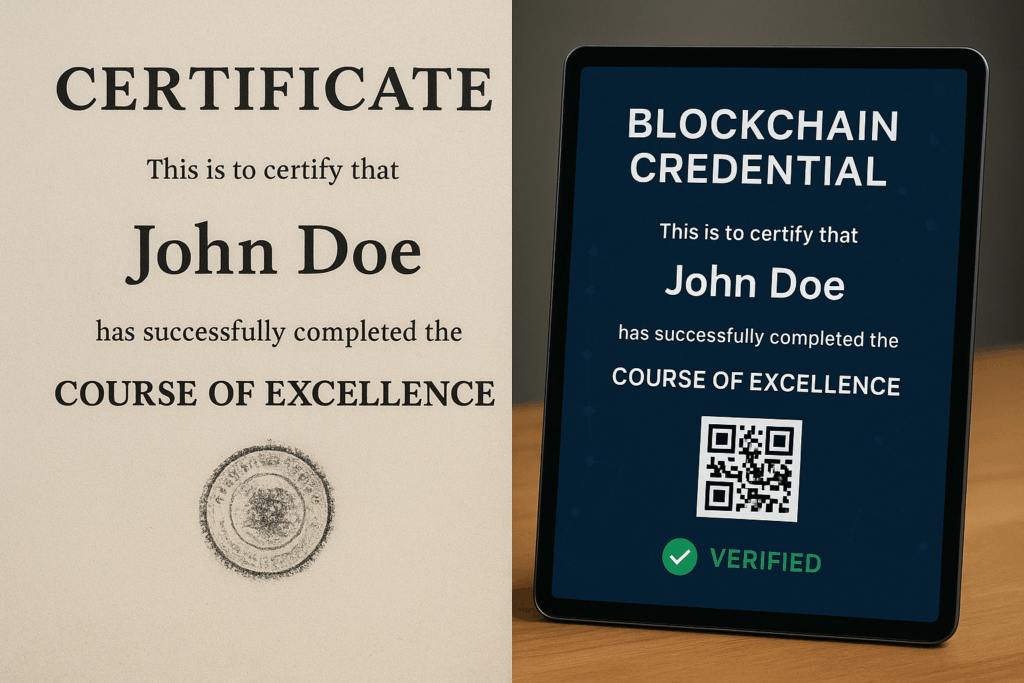
What this means for blockchain in education is that a school or institution can issue credentials that can’t be faked or tampered with. Universities and training institutions can log academic achievements on a ledger, and students receive cryptographically verifiable versions. This approach stands in stark contrast to traditional systems, where institutions independently store and oversee paper or PDF records, and external parties must contact them directly for verification.
For schools and colleges, blockchain offers a forward-looking alternative. It eliminates the need for intermediaries, reduces administrative overheads, and puts control in the hands of learners. That shift, from institutional control to student-centred sovereignty, is both principled and practical. High-level institutions, certificate issuers, vocational schools, and even training bodies can adopt blockchain to make credentialing smoother, faster, and more secure.
How Blockchain in Education Secures Academic Records
Immutable Record Storage
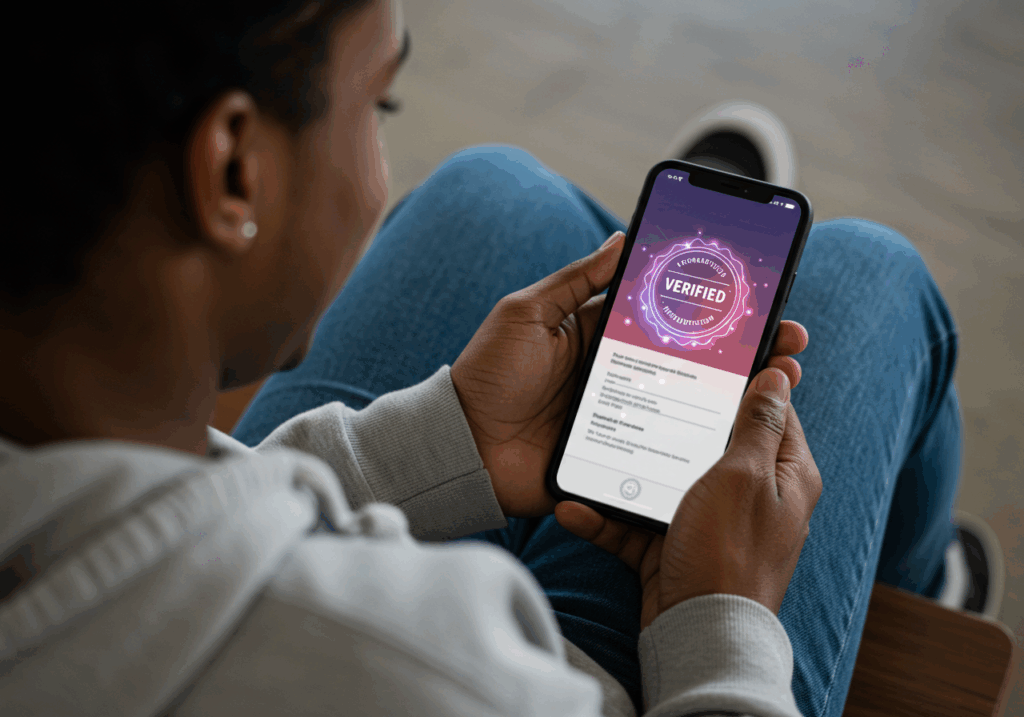
Blockchain ensures that once academic data, like diplomas, transcripts, or certifications, is recorded, it can’t be retroactively changed. This immutability is crucial for trust and longevity. Even if an institution closes, the blockchain-anchored record endures.
Seamless Verification
Imagine a recruiter requesting a credential that can be verified instantly, without a call or email to the Registrar’s Office. With blockchain, employers and peers can check the validity of a credential in seconds, via a link or digital upload, thanks to cryptographic verification powering the underlying ledger.
Fraud Reduction
Credential fraud undermines both educational institutions and professionals. Traditional paper certificates can be forged. Blockchain-anchored credentials, however, resist forgery because any tampering instantly breaks verification. This reduces fraud.
Benefits of Blockchain in Education for Students and Institutions

Blockchain isn’t just about security; it delivers meaningful advantages for all stakeholders.
- Learner Autonomy: Students can carry verified, tamper-proof credentials for life, share them anywhere, and at any time, without ever going back to an institution for validation.
- Operational Efficiency: Institutions face fewer verification requests, freeing up staff and reducing turnaround time.
- Employer Confidence: Hiring managers get instant trust in applicants’ academic records, without costly verification processes.
- Record Portability: Credentials become digital and decentralised. Students don’t have to wait for official transcripts, especially during urgent transitions.
Global Examples of Blockchain in Education
MIT’s Digital Diploma Initiative
One of the earliest and most celebrated implementations of blockchain in education comes from the Massachusetts Institute of Technology (MIT). In collaboration with Learning Machine (now part of Hyland Credentials), MIT’s Registrar’s Office launched a digital diploma pilot in 2017. Graduates were able to receive tamper-proof digital diplomas on their smartphones, delivered via the Blockcerts Wallet app, complete with cryptographic signatures logged on the Bitcoin blockchain. These credentials can be instantly verified by employers or institutions without needing to contact MIT directly.
MIT emphasised that students, not institutions, own and control these records: “People can own and use their official records, which is a fundamental shift.” The pilot reached initial cohorts of over 100 graduates and has since expanded. This initiative demonstrated a practical, secure, and future-focused application of blockchain in higher education.
Malta’s Nationwide Blockchain Education System
Malta made headlines by becoming the first nation-state to deploy blockchain in education on a large scale. In 2017, the Ministry of Education and Employment partnered with Learning Machine to pilot blockchain-based certificates across several institutions, including ITS, MCAST, and NCFHE.
Following the pilot, Malta signed a multi-year rollout in 2019 to extend blockchain credentialing to secondary school diplomas, vocational certificates, and more. Prime Minister Joseph Muscat declared Malta an emerging “blockchain island,” citing benefits including reduced bureaucracy, better data security, and learner empowerment.
Through Malta’s initiative, students received blockchain-anchored certificates and ownership of their data, while institutions issued verifiable credentials accessible anywhere, even with minimal context or institutional cooperation.
Nigerian Pilot Projects (Emerging)
In Nigeria, blockchain in education is beginning to take shape. A notable example is the School of Politics, Policy, and Governance (SPPG), which in partnership with Sterling Bank, recently launched a blockchain-based system to verify academic credentials. This initiative allows students and graduates to have their transcripts and certificates securely stored on a decentralised ledger, making verification faster, tamper-proof, and more transparent. While large-scale nationwide adoption is still in its early stages, projects like SPPG’s signal a growing interest in using blockchain to tackle issues of credential fraud and inefficient verification in Nigeria’s education sector.
Challenges of Blockchain in Education
While the benefits are clear, implementing blockchain systems in education comes with hurdles:
- High Adoption Costs: Many institutions, especially smaller colleges, may lack the budget or technical capacity to deploy blockchain systems effectively.
- Need for Global Standards: Without interoperable credentialing frameworks or consensus on standards, blockchain credentials risk fragmentation.
- Regulatory and Legal Ambiguity: Laws governing digital records and blockchain vary by region. Some countries lack clarity on the legal status of blockchain-based diplomas or transcripts.
- Technical Infrastructure: Institutions need robust infrastructure; digital wallets, key management, maintenance, which can be complex to implement and support.
The Future of Blockchain in Education
AI & Smart Contracts
Imagine credentials that automatically trigger scholarships, course enrollments, or professional recommendations, smart contracts embedded within blockchain credentials. AI could personalize credential recommendations, validation paths, or even learning pathways based on verifiable records.
Cross-Border Credential Recognition
With standardized blockchain formats, academic achievements become portable across borders, enabling seamless credit recognition, global admissions, and international professional licensing.
Aggregated Learning Records
Blockchain’s interoperability can consolidate credentials from multiple platforms: traditional degrees, micro-credentials, MOOCs, vocational training, into a unified, lifelong academic portfolio.
At EduTech Global, we’ve seen how emerging technologies like blockchain can anchor the future of learning systems. If you’re exploring how digital transformation reshapes education, you might enjoy our article on Digital Transformation Strategies for Higher Education Institutions.
We are committed to guiding institutions through this transformational journey. Want to chat about blockchain or future-forward edtech? Reach out through our Contact Us page.