

Universities around the world are under pressure to deliver more. More flexibility for students, more transparency in administration, more efficiency with limited budgets, and more relevance in a rapidly digitising world. In response, a term has gained steady traction across academic leadership conversations: digital campus in higher education.
At its simplest, a digital campus in higher education refers to an integrated digital environment where academic, administrative, and student services are connected through technology. But this definition only scratches the surface. A true digital campus goes far beyond online classes or campus Wi-Fi. It reshapes how universities operate, how decisions are made, and how students experience every stage of their academic journey.
The reason the term is now so widely used is that institutions have realised that digital transformation cannot live in silos. Investing in a learning management system alone does not solve fragmented admissions processes. Digitising finance without integrating student records creates new bottlenecks instead of removing old ones. A digital campus, by contrast, is about coherence. Systems talk to each other, data flows securely, and services are designed around real user needs.
Read more: Designing the Digital Campus: A Framework for University Modernisation
Importantly, this shift is not only about technology. It is about strategy, governance, and institutional culture. Universities that approach the digital campus as a long-term organisational model, rather than a collection of tools, tend to see stronger outcomes across learning, operations, and student satisfaction.
Digital Campus in Higher Education: A Clear Definition
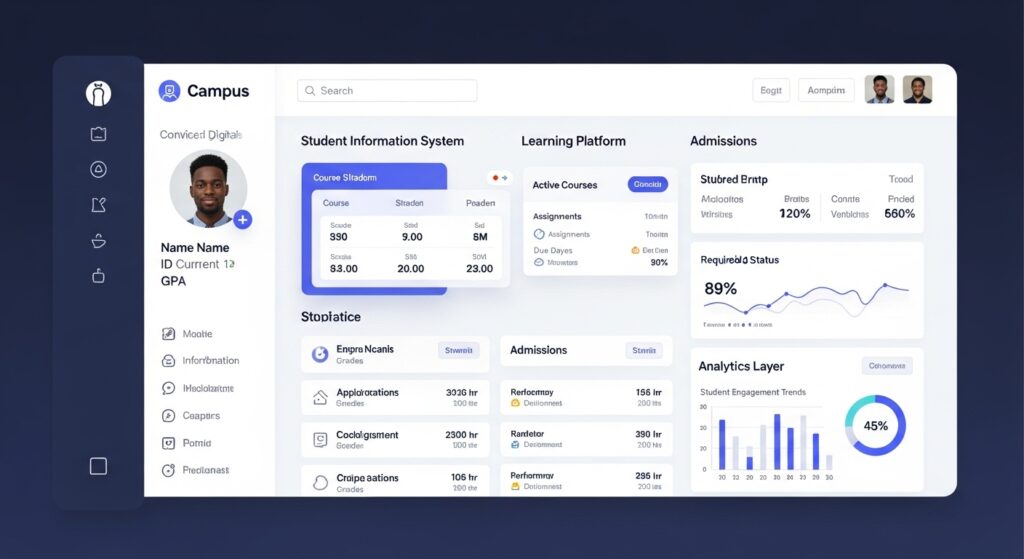
A digital campus in higher education is a connected ecosystem of digital systems, platforms, and data that supports teaching, learning, administration, and campus life in a unified way. It enables universities to manage academic and operational processes digitally, with consistency, visibility, and scalability.
This concept has become central to discussions around digital transformation in universities because higher education institutions are complex organisations. They handle admissions, records, learning delivery, assessments, finance, accommodation, alumni relations, and compliance, often across multiple campuses or countries. When these functions operate on disconnected systems, inefficiency is inevitable.
A digital campus strategy addresses this complexity by focusing on integration. Instead of asking, “What tool do we need?”, institutions ask, “How should information move across the university?” This shift in thinking is what separates surface-level digitisation from meaningful transformation.
Core Components of a Digital Campus

While no two institutions implement digital campuses in the same way, certain foundational components are common across successful models of digital campus in higher education.
Student Information Systems as the Core Record
At the centre of any digital campus sits the student information system. This is the authoritative source for student data, including personal records, enrolment status, academic history, fees, and progression. When well implemented, it becomes the backbone that other systems rely on.
In a fragmented environment, departments often maintain their own spreadsheets or databases. This leads to duplication, inconsistencies, and reporting errors. A unified student information system ensures that everyone is working from the same data, in real time.
Learning Platforms That Go Beyond Content Delivery
Learning management systems remain critical, but within a digital campus strategy, they serve a broader role. They integrate with student records, assessment tools, analytics dashboards, and communication platforms. This allows institutions to track learning engagement alongside academic outcomes, rather than treating teaching as a standalone activity.
Research published by EDUCAUSE consistently shows that institutions with integrated learning platforms are better positioned to support hybrid and flexible learning models.
Admissions and Enrollment Systems
Admissions is often the first interaction a prospective student has with an institution. In a digital campus in higher education, application portals, document verification, offer management, and enrolment workflows are digitally connected to core records.
This reduces processing time, improves communication, and gives leadership clearer visibility into recruitment performance. It also supports data-informed planning, particularly in competitive international recruitment environments.
Data and Analytics Layers
Data is what turns digital systems into strategic assets. A digital campus includes analytics layers that pull information from across platforms to support reporting, forecasting, and decision-making.
According to Gartner’s higher education research, institutions that invest in integrated analytics are significantly better equipped to respond to enrolment volatility and funding pressures.
Read more: How Universities Can Upgrade Their Campus with Smart Technologies
How Digital Campuses Improve University Operations

One of the most immediate benefits of a digital campus in higher education is operational clarity. When systems are connected, information no longer lives in departmental silos.
Centralised data access allows leadership teams to see patterns across admissions, retention, and academic performance. Decisions are made faster because data does not need to be manually compiled or reconciled. Routine processes such as course registration, results processing, and compliance reporting become more predictable and less error-prone.
Equally important is coordination. Academic affairs, registry, finance, and student services can work from shared workflows. This reduces duplication of effort and makes it easier to introduce policy changes without operational disruption.
For institutions dealing with resource constraints, this efficiency is not a luxury. It is often the difference between growth and stagnation.
Impact on Students and Faculty

From a student perspective, a digital campus in higher education creates continuity. Admissions flows naturally into enrolment. Course registration connects seamlessly to learning platforms. Requests for transcripts, results, or support services are handled through consistent digital channels.
This reduces administrative friction, a factor frequently cited in student satisfaction surveys. When students spend less time navigating bureaucracy, they spend more time engaging with learning and campus life.
Faculty also benefit. Access to accurate student data supports better academic advising. Integrated systems reduce repetitive administrative tasks, freeing time for teaching and research. Communication with students becomes more structured, reducing misunderstandings and missed deadlines.
The result is not simply convenience, but trust. When systems work reliably, confidence in institutional processes grows.
Challenges in Building a Digital Campus
Despite its benefits, building a digital campus in higher education is rarely straightforward. Many universities operate on legacy systems that were never designed to integrate. Migrating data, aligning workflows, and ensuring continuity can be complex and time-consuming.
Change management is another major challenge. Staff training, process redesign, and cultural buy-in are just as important as technology selection. Without adequate support, digital initiatives risk being underused or resisted.
Budget constraints also play a role, particularly in regions where public funding is limited. This is why a phased digital campus strategy, aligned with institutional priorities, is often more sustainable than large-scale, one-off implementations.
The Future of Digital Campus Models Worldwide
Globally, digital campus models are moving towards cloud-first architectures, interoperable systems, and AI-supported insights. Cloud infrastructure allows institutions to scale services without heavy upfront investment, while interoperability standards make it easier to connect best-in-class platforms.
Read more: The Role of Cloud Computing in Expanding University Capabilities
Artificial intelligence is increasingly used to identify students at risk, optimise resource allocation, and personalise learning pathways. The World Economic Forum has highlighted the role of digital infrastructure in building resilient education systems, particularly in the face of global disruption.
As these trends evolve, digital campus in higher education will continue to shift from being a competitive advantage to an operational necessity.
For university leaders, the next step is not to ask whether digital transformation is necessary, but how to approach it thoughtfully. Clear governance, phased implementation, and a strong focus on integration are what turn digital ambition into measurable outcomes.
Institutions exploring this journey can start by assessing existing systems, identifying integration gaps, and defining a digital campus strategy that reflects their academic mission.
For deeper insights and global perspectives on education technology, explore related analysis at Edutech Global’s Blog.