

Why Sustainability Matters in Higher Education
As the world grapples with mounting climate challenges, from soaring temperatures to shrinking biodiversity, universities find themselves at a crossroads. These institutions are more than just hubs of learning; they are powerful catalysts for societal change. By embracing sustainability, universities can demonstrate what’s possible and lead by example.
Over the last decade, global attention to climate change has intensified. From UN summits to grassroots activism, no sector remains untouched. Universities, which educate future generations and pioneer research, naturally shoulder even more responsibility. They’re being watched not just for what they teach, but how they act.
Institutions that weave eco-friendly operations into campus life reach far beyond public relations. Their actions ripple outward: lowering carbon emissions, reducing waste, inspiring students. When campuses operate sustainably, they teach responsibility by example and spark broader change.
What is Green Campus Technology?

At its core, green campus technology refers to the practical tools and systems that enable universities to operate in environmentally responsible ways. This includes hardware, software, and infrastructure, all designed to reduce resource consumption, limit environmental harm, and foster a healthier, sustainable campus ecosystem.
Technologies that reduce waste, energy use, and carbon emissions
This might involve solar panels soaking up energy, smart systems optimising heating and cooling, or water-saving fixtures minimising waste. It could even include buildings designed to produce more energy than they consume, or campus fleets transitioning to electric vehicles.
Digital tools for sustainability tracking
Technology isn’t just physical. Digital platforms, often cloud-based, track energy usage, analyse water consumption, and help administrators steer operations more wisely. They offer dashboards and analytics that make sustainability measurable and actionable.
Examples of Green Campus Technologies
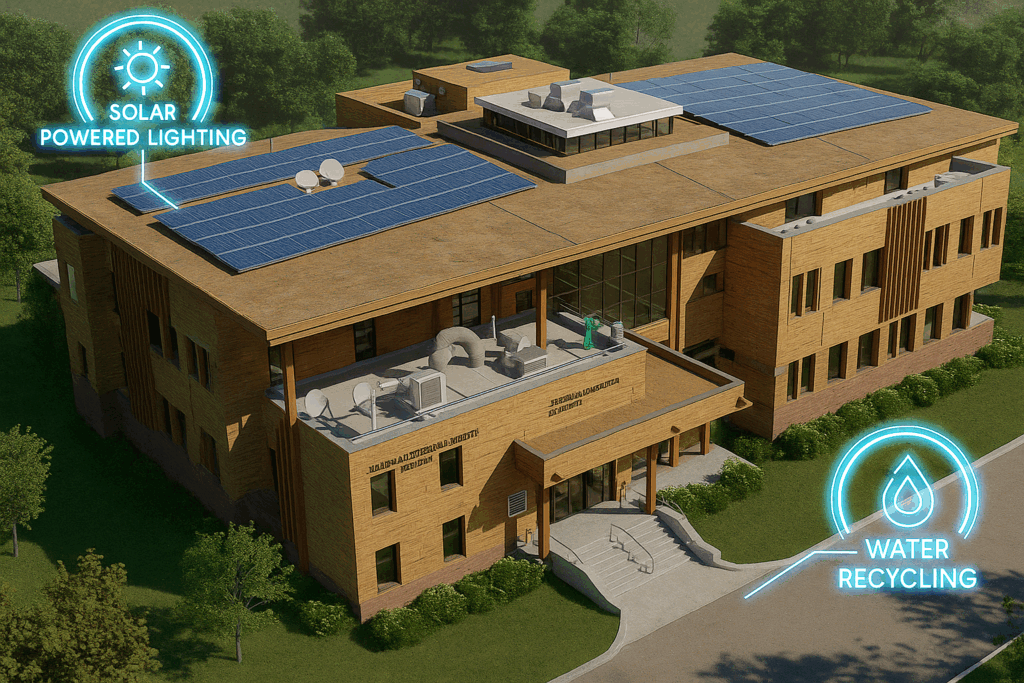
Smart energy management systems
Universities are increasingly adopting centralised platforms that monitor electricity, heating, and water usage in real time. These smart systems often reveal inefficiencies, like empty buildings being heated unnecessarily, and trigger corrective action.
Solar-powered buildings
Arizona State University generates over 24 MW of electricity from on-campus solar arrays. That’s thanks to more than 81,000 solar panels across multiple sites and an off-site installation that boosts their capacity to approximately 50 MWdc. Meanwhile, Hampshire College’s R.W. Kern Centre operates net-zero in energy, water, and waste, powered by rooftop solar and rainwater harvesting, and free from toxic “red list” materials.
E-learning replacing paper-heavy processes
Switching to digital platforms, online submission of assignments, digital textbooks, and virtual classes actively trims paper waste and streamlines operations. When universities shift administrative tasks onto digital systems, they reduce printing, postage, and manual processing.
Smart water usage systems
Water-efficient technologies such as sensor-based irrigation or automated fixture shutoffs prevent wastage. Although exact data in this area often varies by institution, the principle remains: conserve precious water resources through intelligent control.
Benefits of a Green Campus for Universities

- Lower energy and operational costs
Investing a modest amount upfront in green design often pays off in spades. According to the U.S. Green Building Council, spending just 2% more on green building design can lead to 20% in lifecycle cost savings. Hampshire College, for instance, is projected to save up to $8 million in electricity costs over 20 years, about $400,000 per year, thanks to its solar power initiative.
- Improved reputation among students and parents
Prospective students want their institutions to align with their values. UWTSD (University of Wales Trinity Saint David) discovered that sustainability is one of the top reasons students choose a university. And green buildings themselves enhance learning: classrooms with daylight reduce headaches by 27% and boost math performance by 20% and reading by 26%.
- Meeting sustainability goals and regulations.
Lancaster University has cut electricity and heating emissions by 50% since 2005 and is aiming for carbon net zero across all emission scopes by 2035. Such efforts help meet national and global environmental targets.
- Better student engagement in eco-friendly initiatives.
At UWTSD, students are directly involved in energy-efficiency projects, sustainability week events, and practical estate-based learning. Engagement builds community and ownership, and teaches sustainability in practice, not just theory.
How Students Benefit from Green Campuses
- Healthier learning environments.
Green buildings mean better lighting, cleaner air, reduced noise, making campuses places where students feel and study better. Natural light not only improves concentration but can even enhance learning outcomes.
- Active participation in sustainability programs.
Students learn by doing, whether it’s maintaining solar panels, measuring carbon footprint, or organising ecological awareness campaigns. UWTSD’s student-driven sustainability projects are a great example.
- Skill-building for green jobs and future careers.
Green campuses incubate knowledge and skills for tomorrow’s job market. Growing demand in climate-related careers is evident: U.S. universities are responding with specialised programs in climate change studies. These academic offerings reflect the real-world need for sustainability-savvy professionals.
Global Examples of Green Campuses
- Universities adopting renewable energy.
Florida Gulf Coast University installed a 2 MW solar field that will save $22 million over 30 years, slashing electricity costs from 10.5¢ to just 2¢ per kWh and significantly reducing emissions of CO₂, sulphur dioxide, and nitrogen oxide. At SUNY College of Environmental Science and Forestry, the Gateway Centre’s biomass-based combined heat and power system covers 65% of heating and 20% of electrical needs, reducing its footprint by 22%.
- Paperless administrative processes.
Though specific examples vary, many universities worldwide have shifted to fully digital administrative workflows, admissions, finance, and records, eliminating physical documents and associated resource waste.
- Green certifications in higher education.
The Living Building Challenge certification is rare, but Hampshire College’s Kern Centre proudly holds it, reflecting extreme green-building standards in water, energy, materials, and waste.
Future of Sustainability in Higher Education
- Role of AI and IoT in green campuses.
Emerging technologies like AI-driven analytics and IoT sensors will fine-tune energy use, predict maintenance needs, and automate sustainability. Smart campuses of the future will sense, learn, and adapt, conserving resources with uncanny precision.
- Government and policy support.
Regulations and funding will shape the green campus movement. When governments require carbon reporting, invest in renewable infrastructure, or offer incentives for sustainable design, universities respond. Platforms like UNEP, Sustainability Exchange in UK higher ed, and World Economic Forum emphasise such collaborations (SpringerLink, ScienceDirect, Times Higher Education (THE)).
- Towards carbon-neutral universities
We are seeing tangible progress. Technical University of Cluj-Napoca reduced per-person emissions from 0.378 to 0.362 tCO₂e and per-square-meter emissions from 31.2 to 30.3 kg CO₂e between 2022 and 2023. Universities like Lancaster are targeting net-zero by 2035. Data suggests more HEIs are building carbon footprint inventories and setting reduction strategies, especially targeting electricity (78%), transportation (74%), and fuel use (64%).
Building a Sustainable Future with Green Campus Technology
The moment for transformative action is now. Universities are uniquely positioned as crucibles of innovation and leadership. By investing in green campus technology, institutions don’t just reduce their own impact; they inspire a generation.
Creating a sustainable campus is not a one-off project. It’s a long-term commitment, woven into infrastructure, governance, and culture.
Edutech Global aims to support higher education institutions every step of the way. Together, let’s build campuses that teach, innovate, and sustain, not just today, but for generations to come. If you’re ready to begin or scale your campus’s green transformation, we’d love to hear from you: visit our contact page.