

Higher education marketing strategies must be smarter, sharper, and built around a digital-first student journey. The simple truth is this: prospective students no longer start with prospectuses and campus tours only. They begin with Google searches, social feeds, peer reviews, and webinars. Institutions that recognise this shift and redesign their recruitment playbooks win attention, applicants, and crucially, enrolments.
Competition is fierce. More than two thousand universities are ranked across global lists, and every institution now vies for attention on a crowded international stage. That creates a dual challenge: you must be discoverable where students search and credible where they decide. For many institutions, that means moving beyond one-size-fits-all campaign tactics to program-level messaging, measurable digital funnels, and sustained relationship-building. The payoff is measurable: better-qualified inquiries, higher conversion, and improved yield.
At the same time, student behaviour is changing. Social channels and search engines are research hubs. Gen Z expects quick answers, authentic voices, and content that answers practical questions, costs, career outcomes, and the day-to-day student experience. If universities want to grow enrolments, they must map those behaviours into a recruitment strategy that’s consistent, data-driven, and human-centred.
Read more: How Universities Can Attract More International Students Through Online Programs
Understanding the student journey online
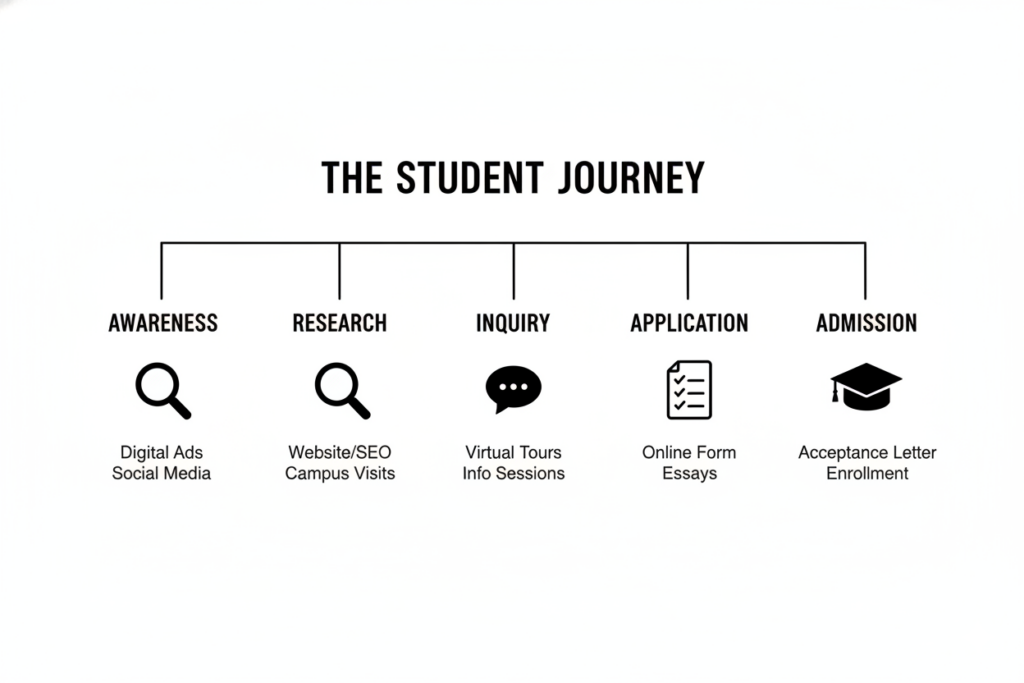
The student journey breaks down naturally into three stages: awareness, consideration, and decision. Each stage has different intent signals and content needs.
Awareness: Prospects are problem-aware. They know an interest area or career goal and begin broad research. Content that performs here is discoverable: program pages optimised for search, short explainer videos, and social posts that introduce fields of study.
Consideration: Prospects narrow options. They compare programs, faculty, costs, and outcomes. Here, deeper content wins: program guides, faculty Q&A, alumni stories, interactive ROI calculators, and recorded webinars that answer specific course-level questions.
Decision: Prospects evaluate fit and logistics. They want proof points and reassurance. Offerings that reduce friction at this stage include personalised application sequences, clear scholarship information, step-by-step admissions checklists, and one-to-one recruitment counsellor touchpoints.
Map content and channel to each stage and make movement between stages measurable. Track entry points, content consumption patterns, and which touchpoints lead to application starts. That visibility turns marketing from guesswork into optimisation.
Proven higher education marketing strategies that work
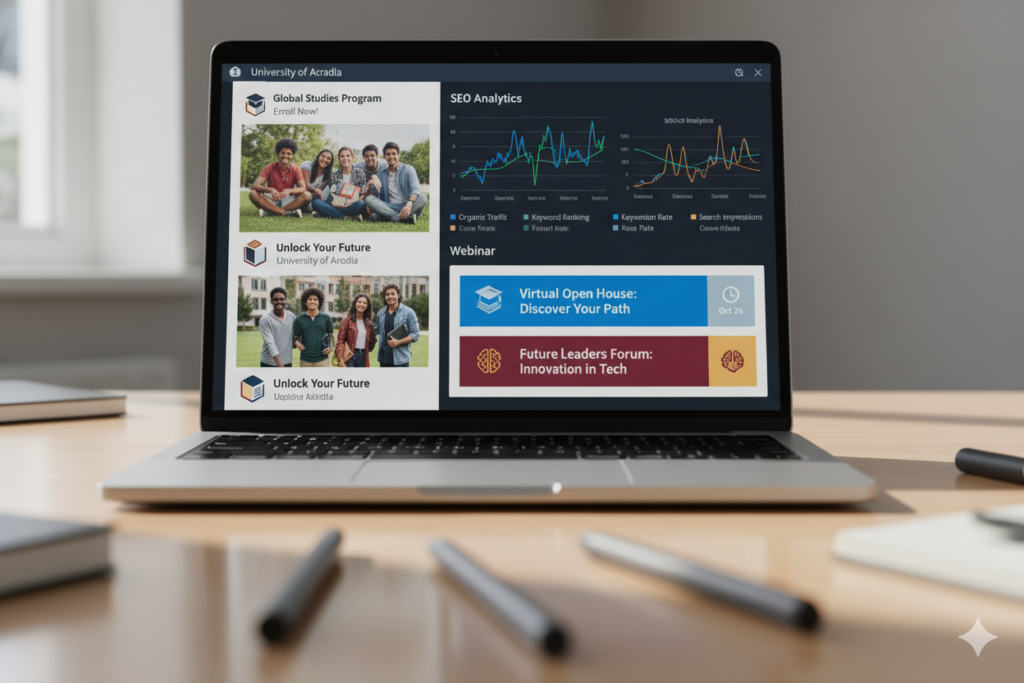
Below are the most reliable tactics we see working across global institutions. Each tactic is scalable and measurable when paired with the right tooling.
SEO-optimised content for program discovery
Write program pages and topical guides that answer search intent. Focus on program-level queries, e.g., “master’s in data science part-time UK” rather than only institutional brand terms. Structure pages for featured snippets, include clear outcomes and graduate profiles, and publish long-form guides that answer the practical questions prospects have about careers, visas, and funding. These assets become traffic hubs that feed the top of the funnel.
Targeted social advertising for awareness and retargeting
Paid social remains cost-effective for visibility, especially when audiences are refined by interest, location, and behaviour. Use short video creatives and testimonial snippets for awareness. Then retarget with program-specific messages and event invitations. Remember: organic content builds credibility; paid amplifies the signal to defined audiences. HubSpot and other marketing platforms provide playbooks and templates to translate leads from social into nurture streams.
Webinars and virtual events to convert intent into applications
Webinars are the highest-value digital event format for higher ed recruitment. They let faculty, alumni, and admissions staff answer real questions in real time. Capture registrants, score engagement, and create segmented follow-ups: attendees who asked specific questions get one sequence; registrants who didn’t attend get a recording plus a simplified Q&A.
Program-specific landing pages and conversion optimisation
Create short, dedicated landing funnels for each program or cohort. Include clear calls to action, application requirements, scholarship callouts, and a “contact admissions” microform. Use A/B testing on headlines, CTA copy, and hero images to improve form starts and submission rates. Small changes in microcopy can lift conversions materially.
International recruitment strategies
Localise messaging, highlight visa outcomes, and publish country-specific pages that address living costs, scholarships, and alumni in-market. Partner with local agents and run targeted ads during local application windows. QS and other student-insights publishers show social channels as a primary research tool for international prospects; institutions that lean into social and country-level content increase awareness and application volume.
Examples from across the world
Several universities and colleges have implemented higher education marketing strategies with striking success. Here are a few real-world cases that illustrate how data-driven, multi-channel approaches boost enrolment.
Tuskegee University – Email Marketing & Automation
Tuskegee University’s College of Agriculture, Environment & Nutrition Sciences (CAENS) revamped its recruitment efforts through a targeted email automation strategy. By combining segmented email campaigns, a dedicated microsite, and supporting content, such as videos, blog posts, and social sharing, they increased applicants to their agribusiness program by 204% and a 142% jump in qualified, committed applications.
North Carolina Central University (NCCU) – Personalised Automation & Webinars
NCCU adopted a highly personalised, automated campaign for admissions, combining smart email sequences, targeted social ads, in-app touchpoints, and online events like webinars and virtual open houses. They segmented prospects in the application funnel, continuously followed up, and used rich content tailored to each stage. The result? They influenced over 129,000 contacts, and notably increased paid deposits, helping drive their highest incoming class in more than a decade.
KCA University (Kenya) – SEO, Social Media & Email Impact
A study of KCA University in Kenya measured the real impact of digital marketing on enrolment. Researchers found that their use of social media (particularly Facebook), SEO, and email marketing was significantly correlated with higher student enrolment. For example, improvements in SEO explained 71.3% of the variance in their enrolment numbers, while effective email campaigns also strongly predicted application growth.
Read more: The Future of Global Classrooms: Where Online and On-Campus Meet
Leveraging data and automation in marketing campaigns
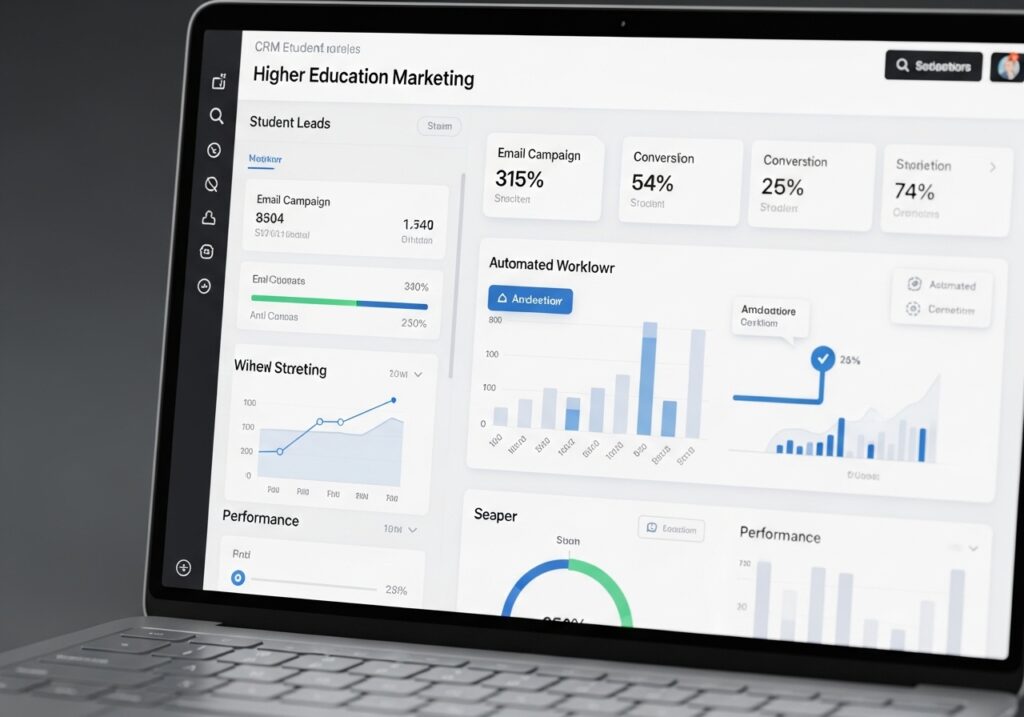
Data is the differentiator between activity and impact. Use a CRM built for higher education to track inquiries through to enrolment. A purpose-built higher ed CRM can connect website events, email engagement, event registration, and counsellor outreach into a single student record. That unified view supports segmentation, lead scoring, and automated nurture journeys that push the right message at the right time. EAB and similar providers continue to add recruitment and retention features that free teams to work higher-value tasks while the CRM manages routine sequences and reporting.
Analytics and attribution matter. Tie application starts and enrolments back to channels. Which social ads produced the most qualified applicants? Which blog topics lead to program applications? Use UTM tagging, conversion events, and cohort analysis. With those answers, you can reallocate budget to the channels and messages that move the needle.
Automation also improves yield. Automated reminders about deadlines, personalised scholarship nudges, and triggered outreach for students who viewed fee pages are simple automations that reduce friction and improve completion rates.
Building trust through transparency and engagement

Trust is the currency of decision. Prospects choose institutions that feel honest and open.
Alumni stories and real student testimonials should be more than marketing blurbs. Use video interviews that speak about outcomes, day-to-day life, and employability. Publish verifiable statistics about graduate employment rates, average starting salaries where available, and typical class sizes. Offer virtual campus tours and live Q&A sessions with current students to create unfiltered contact.
Transparency also means clarity on costs and admissions processes. Hidden fees or complicated application steps erode trust and increase abandonment rates. Make scholarship criteria explicit, provide step-by-step application guides, and give prospects a named admissions contact.
Practical checklist: quick wins for the next 90 days
- Publish three program-level SEO guides that answer the top queries your prospects use.
- Run two targeted social campaigns: one for awareness and one for retargeting past website visitors.
- Host a monthly webinar per faculty with clear registration-to-nurture flows. Use the recording in email sequences.
- Implement or audit a higher-ed CRM to ensure inquiry-to-enrolment tracking.
- Refresh your admissions pages to show clear costs, scholarships, and a contact person.
Higher education marketing strategies that work are not a single tactic. They are an orchestration: discoverability through SEO and social, credibility through content and alumni stories, conversion through webinars and optimised landing pages, and continuous improvement through data and automation. Institutions that treat recruitment as an end-to-end digital funnel, from first search to final enrolment, will be in the strongest position to attract and retain students in a competitive global market.