

Have you ever wondered how universities with multiple campuses manage to deliver the same quality of education across all their locations? It’s not easy. Different campuses often face different challenges, ranging from internet connectivity and staffing to curriculum delivery and student engagement. Without the right systems in place, things can quickly become fragmented. That’s where scalable EdTech solutions come in.
But what are scalable EdTech solutions? They are technology tools designed to grow and adapt as a school or university expands, especially when it operates across multiple campuses or serves many students. So, a scalable EdTech system can support a single campus or 50 campuses, a hundred students or a hundred thousand, without crashing, slowing down, or becoming disorganised.
Why Scalable EdTech Solutions Are Critical for Multi‑Campus Institutions
Avoiding tech silos
In a multi‑campus setup, it’s easy for each site to run its own systems, LMS platforms, communication tools, and scheduling software, leading to duplicated effort, training headaches, and disconnected data. These tech silos make central oversight nearly impossible and hinder cross‑campus consistency.
Enabling centralised control and local flexibility
Scalable EdTech bridges two needs: central governance and campus autonomy. Leadership needs insights into system usage, compliance, and outcomes. At the same time, campus leadership may require customised workflows, local content, or language adaptations. An ideal system delivers both.
Core Features of Scalable EdTech Systems
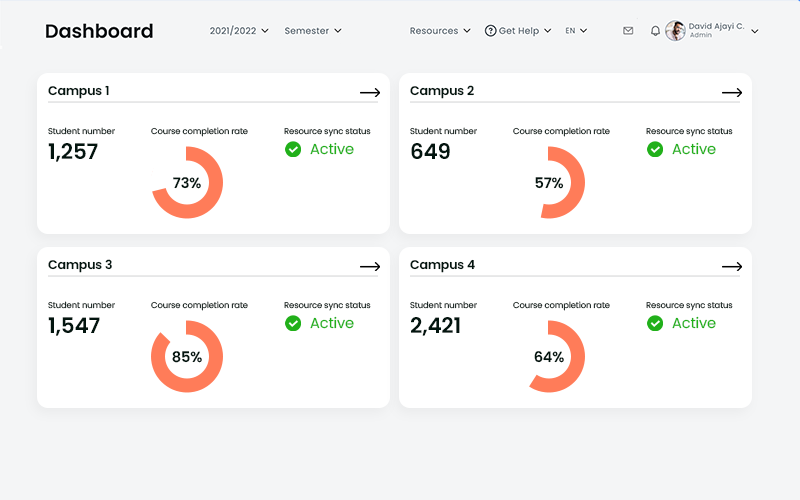
What should universities look for in scalable EdTech? Here’s a breakdown of key capabilities:
1. Multi‑location content sync
- Enables content creators at one campus to seamlessly publish and manage materials for all campuses.
- Ensures that updates, like syllabus changes, lecture recordings, or resource links, are immediately reflected across every site.
2. Central admin control with campus-level views
- Administrators should have dashboards with visibility into usage, student progress, and system health analytics.
- At the same time, campus admins can manage their own faculty, student groups, calendars, and branding within the single platform.
3. Integrated communication tools
- Features like global forums, announcements, and messaging should function across campuses.
- Enables collaborative classrooms and central-to-local communications without relying on third-party apps.
Challenges in Managing Distributed Learning Ecosystems
Many distributed institutions encounter common hurdles:
- System discrepancies
Different campuses may be using different hardware, network speeds, or older operating systems, causing inconsistent performance and support issues.
- Data silos
When campuses host data in isolated systems, it becomes hard to access student progress, compare performance, or detect issues in real-time.
- Hardware variations
Some campuses, especially those in remote regions, may rely on low-spec devices or poor internet connectivity, demanding resilient, lightweight EdTech solutions.
Enterprise LMS and Cloud‑Based Infrastructure

The importance of cloud‑first platforms
Cloud infrastructure provides critical benefits:
- Scalability: Resources can scale dynamically to handle thousands of students across campuses.
- High availability: Built‑in redundancy ensures uptime even if a data centre fails.
- Global access: Students and staff on different campuses access the same platform effortlessly.
Tools that scale across thousands of users
Leading enterprise LMS platforms offer features like multi‑tenant architectures, real-time analytics, and robust APIs for integration. They streamline onboarding, student registration, single sign‑on, and performance monitoring, all crucial in multi-campus settings.
Unified Student Experience Across Campuses
A scalable EdTech system should include:
- Single login access
With a universal identity provider (e.g., SAML, OAuth), students and staff log in once to access all courses, tools, and campuses.
- Synchronised academic calendar, grades, and resources
All campuses operate on unified academic terms, easily visible in the shared calendar. Grades and learning outcomes are consistent and accessible from any campus location.
Case for Centralised Analytics and Decision Support
- Campus-level dashboards
Administrators want visibility into engagement, attendance, assessment success, and technology usage, viewable by campus, department, or student demographics.
- Predictive modelling
Using real‑time data, systems can flag students at risk, forecast enrolment trends, and aid resource planning across campuses. This enables proactive intervention and smart allocation of faculty and support services.
Scalable EdTech Amid African Higher Education Expansion
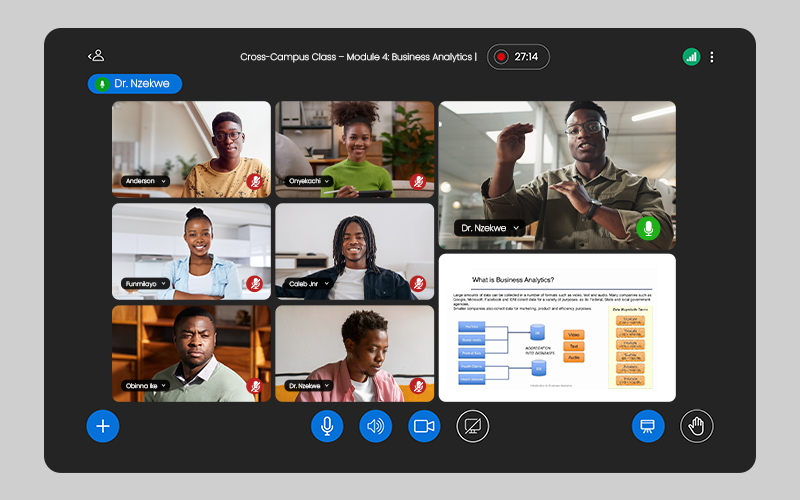
Large multi-campus systems, like Africa’s Higher Education Centers of Excellence (ACE), depend on scalable digital infrastructure. The ACE program spans over 80 centres in 50+ universities across 20 countries, supporting over 14,000 master’s & PhD students. Yet they struggle with connectivity:
- More than 15 million students and 500,000 staff lack reliable broadband access.
- During COVID‑19, 7 million African university students lost access due to connectivity issues.
Global organisations like GSMA respond by training 70 million+ individuals via the Mobile Internet Skills Training Toolkit (MISTT), and pushing for affordable mobile internet access, a vital base for scalable, distributed EdTech.
How to Select the Right Scalable EdTech Solution
Choosing the ideal scalable EdTech solution involves careful evaluation:
1. Integration‑ready systems
Select platforms with strong user directories, analytics APIs, real‑time data pipelines, and the ability to plug into centralised authentication and SIS systems.
2. Onboarding support & cross‑campus training
The vendor must provide not only initial deployment support but also resources to train diverse faculty and admin teams across campuses, ideally with multilingual tutorials and train‑the‑trainer programs.
3. Pilot and phasing approach
Start small: implement core features, like content sync and reporting, in one or two campuses, test system performance and user adoption, then scale across the network.
4. Robust redundancy and offline or mobile-first design
For campuses with limited connectivity, look for features like offline content access, local caching, and mobile-optimised interfaces.
Blueprint for Implementation
Here’s a step-by-step implementation roadmap:
- Assessment & alignment
Map existing systems, campus needs, content distribution workflows, and connectivity profiles. Define what centralised control and local flexibility mean for each site.
- Vendor selection
Evaluate platforms using demos against key criteria: multi-campus structures, centralised dashboards, single login, and offline/mobile support.
- Pilot deployment
Launch with one or two campuses, training local staff and integrating with existing SIS and identity systems.
- Evaluation and iteration
Assess usage, performance metrics, and campus feedback. Fix discrepancies in admin views, interoperability, and connectivity.
- Scale‑out rollout
Deploy system to additional campuses, continuously improving deployment tools, training modules, and support documentation.
- Establish governance
Define roles and responsibilities, who oversees global configurations, who handles campus-level tasks, and who monitors system performance and compliance.
Metrics and KPIs to Track
To ensure your system remains scalable, track:
- User adoption rates per campus
- System performance (uptime, response time) during peak usage
- Content update turnaround time
- Access patterns: mobile vs desktop, online vs offline
- Student outcomes across locations
- Training completion rates among staff
Scalable EdTech solutions empower multi-campus university systems to operate as cohesive, high-performing institutions that can deliver consistent quality, increase operational efficiency, and support better outcomes, no matter where campuses are located.
A future-ready multi-campus institution doesn’t just deploy technology; it orchestrates unified learning, harnessing data, connectivity, and people. With the right scalable EdTech model, universities can expand confidently, deliver shared excellence, and prepare students across all campuses for tomorrow’s world.
Ready to future-proof your multi-campus university with technology that grows as you do? At Edutech Global, we specialise in scalable EdTech solutions that bring consistency, clarity, and control to complex learning ecosystems. Whether you’re expanding to new campuses or looking to streamline existing operations, our enterprise-ready platforms are built to deliver unified, high-quality digital learning experiences. Contact us today to explore how we can support your transformation.