

Africa is home to the world’s youngest population. UNESCO data puts over 400 million young people between the ages of 15 and 35 on the continent, and each year, 11 million more enter a labour market where over 40% lack the skills needed for formal employment. The pressure on higher education systems to absorb this demand is immense, and the gap between supply and aspiration is precisely what drives outbound student mobility at scale. For international universities, this represents a significant and growing recruitment opportunity. But capitalising on it requires something that many institutions have not yet built: genuine trust.
That is where most strategies fall short. Many universities approach African markets with the same brand and messaging frameworks designed for Europe, North America, or East Asia, and wonder why conversion rates remain low despite recognisable names and impressive rankings. The reason is structural, not superficial. An effective university brand strategy for African student recruitment is not simply a matter of increasing ad spend or translating a brochure. It requires understanding how trust actually forms in these markets, and building the systems that earn it.
Read More: What the World’s Fastest-Growing Student Source Markets Have in Common
Why Western University Marketing Does Not Translate Directly to Africa
The assumption that a strong global brand travels automatically is one of the most expensive mistakes international universities make in African recruitment. Brand recognition and brand trust are not the same thing, and nowhere is that gap more visible than across Sub-Saharan Africa.
African student decision-making is deeply relational. Research from the Springer Nature journal on private education choices in Nigeria confirms that family dynamics, peer networks, and trusted advisors are among the most significant determinants of university selection. Parents are active participants in the process, not passive observers. A student may be personally convinced by a university’s reputation, but if their family cannot speak to a trusted person who has graduated from that institution and built a credible career, scepticism persists. Studies on peer influence in career decision-making among Ghanaian students confirm that peer validation is a statistically significant factor in higher education choices across the continent.
This means that universities relying entirely on rankings, digital advertising, or generic campaigns are competing on a dimension that does not fully determine the outcome. A globally ranked institution that cannot demonstrate local alumni success, accessible scholarship pathways, and responsive human communication will lose prospective students to lesser-known universities that can. University brand strategy Africa student recruitment demands a different framework entirely: one built on proof, community, accessibility, and ongoing presence.
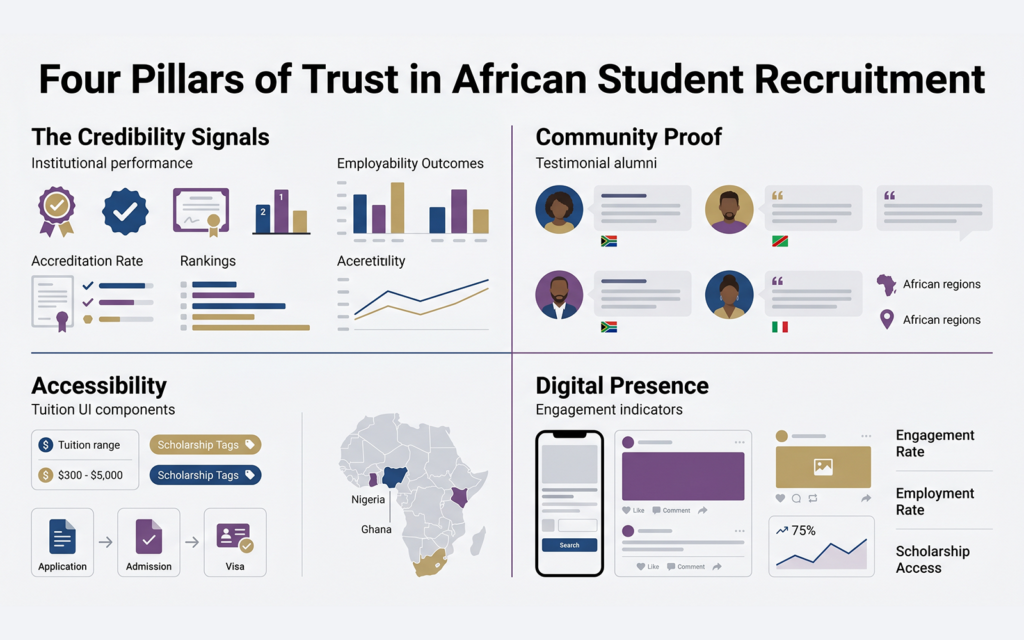
The 4 Pillars of University Brand Trust in African Markets
1. Credibility Signals
Students and parents want evidence, not slogans. Credibility comes from: accreditation and quality assurance transparency; rankings presented in context rather than in isolation; graduate employment outcomes with specific salary or career progression data; visa success rates for students from key source countries such as Nigeria, Ghana, and Kenya; and visible stories of alumni who have built careers after graduating.
The QS World University Rankings carry genuine weight with aspirational African families, but only when paired with ground-level proof that those rankings translate into real outcomes for African students specifically.
2. Community Proof
Students trust people who share their background and have walked the path before them. Local alumni networks are not an optional extra in African markets; they are a primary trust mechanism. A Nigerian student considering a university in the UK or Canada is not primarily asking “what does the institution say about itself?” They are asking, “Do I know anyone who went there, and how did it go for them?”
Institutions that invest in African student associations, structured alumni ambassador programmes, and country-specific testimonial content create social proof that no advertising budget can replicate. Peer referrals carry particular weight in markets where word of mouth travels fast through tight-knit communities.
3. Accessibility Signals
Complex application systems erode trust. Slow admissions responses, opaque scholarship criteria, and limited advisor access all signal to African students that they may not truly be welcome, regardless of what the marketing materials say. Accessibility signals include: scholarship information that is clear, specific, and communicated in plain language; mobile-optimised application platforms, given that smartphone access far outpaces laptop ownership across most African markets; responsive admissions support through channels students actually use; and advisor or agent access that provides human guidance at key decision points.
4. Presence
Presence does not require a physical campus. It requires consistent visibility in local channels, recognisable digital engagement, and trusted local representation. Universities that appear only during recruitment season and disappear afterwards signal a transactional relationship. Those that maintain ongoing content, community engagement, and local partnerships build the kind of long-term familiarity that moves prospective students from awareness to application.
Channel Strategy: Where African Students Actually Are
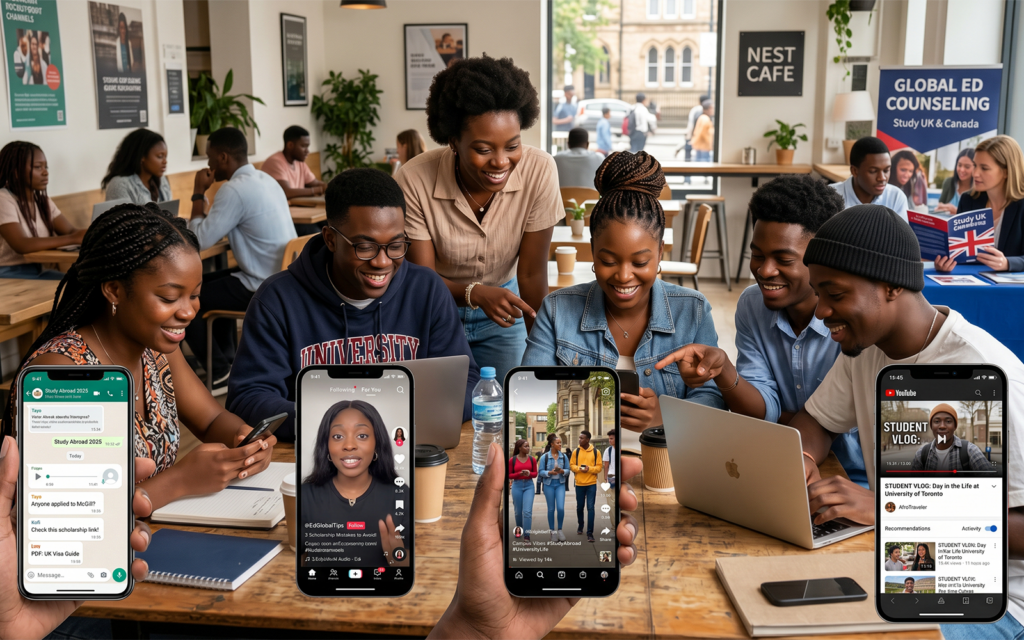
Understanding channel trust dynamics is more important than optimising for ad impressions. African students do not research universities through a single channel; they move across a network of touchpoints, each carrying different levels of credibility.
- WhatsApp communities: Peer discussions, scholarship sharing, application guidance, and visa updates circulate in WhatsApp groups before students ever visit an institutional website. WhatsApp is the dominant messaging platform in most African emerging markets, and its group functionality makes it a hub of informal but highly influential recruitment activity.
- YouTube: Long-form content performs well. Student experience videos, campus life documentation, and career outcome narratives give prospective students the material they need to build confidence in a decision that may represent a family’s largest financial investment.
- Instagram and TikTok: Short-form discovery, visa guidance content, and student creator influence shape early-stage awareness and first impressions. These platforms function as the top of a conversion funnel that other channels close.
- Education fairs and school counsellors: High-trust, face-to-face environments still drive strong conversion, particularly for families making a collective decision. The advisor who recommended the institution carries significant authority.
- Religious and community networks: Community leaders and religious institutions influence family decisions in ways that formal marketing cannot replicate. Universities with strong local relationships benefit from this organic credibility.
Read More: How EduTech Global Builds University Partnerships That Last: A Behind-the-Scenes Look
Content That Converts African Students Into Applicants
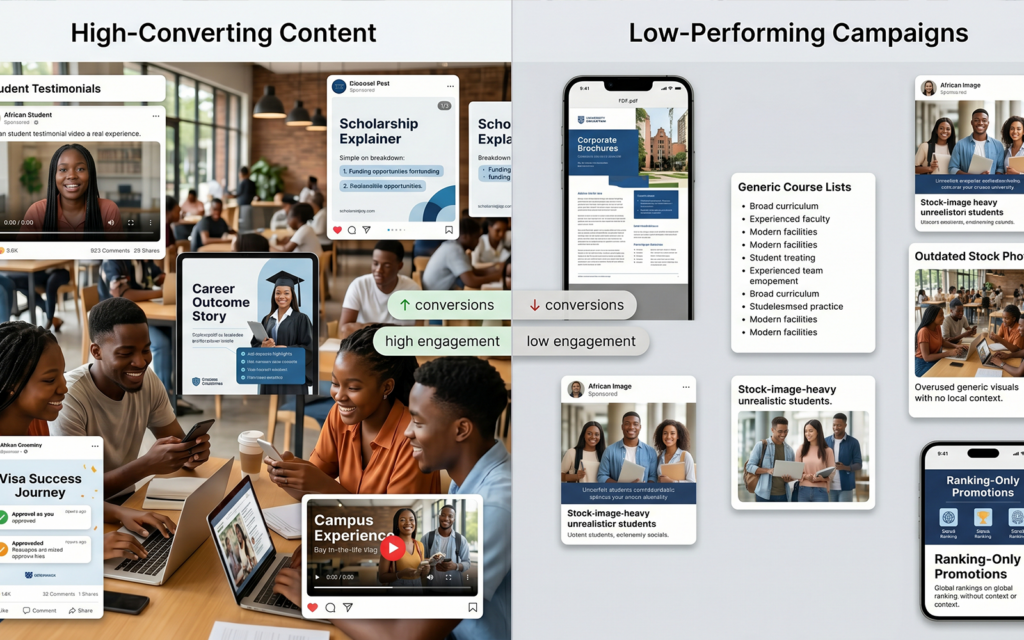
The gap between content that performs and content that does not is often a gap between institutional self-promotion and peer validation. High-converting content includes:
- Student success stories, ideally from students of the same nationality as the target audience
- Country-specific testimonials that address local concerns: visa approval, cost of living, scholarship access, post-study work
- Application walkthrough videos that reduce process anxiety
- Career outcome content showing graduates in employment, with specifics on industry and location
- Scholarship explainers in plain language, structured around real eligibility criteria
Low-performing content, by contrast, tends to be: heavily corporate in tone, ranking-focused without contextual relevance, built around generic stock imagery, or written for a global audience that does not speak to any specific audience at all.
Research on marketing higher education in Africa consistently points to engagement, co-creation, and student-centred content as the mechanisms that build genuine institutional connection. Students want to see themselves in the institution’s story. When they cannot find that reflection, they move on.
The Partner Amplification Effect
Local partnerships are not a shortcut; they are a structural advantage. Trusted local organisations bring cultural fluency, established community relationships, and on-the-ground insight that institutions operating from a distance cannot develop quickly or cheaply. They qualify leads more accurately, reduce application drop-off through guided support, and provide the regional credibility that makes a foreign university feel accessible rather than remote.
EduTech Global operates precisely at this intersection, helping universities build African market presence with localised student acquisition strategies, digital recruitment systems, and partnerships that generate qualified pipelines. The practical effect of a strong local partner is reduced acquisition friction: students receive better guidance, institutions receive better-qualified applicants, and both sides avoid the communication failures that quietly cost universities enrolments they should have won.
What Universities Getting Africa Right Are Doing Differently

The institutions seeing consistent pipeline growth in African markets are not necessarily the most famous. They are the most intentional. Their distinguishing behaviours include:
- Running scholarship campaigns localised by country, not by region, with clear eligibility and application guidance
- Featuring African alumni visibly in recruitment materials, not as a demographic box-tick but as strategic proof of outcome
- Operating mobile-first application systems with fast admissions response standards
- Maintaining year-round digital content and community engagement, not just seasonal recruitment pushes
- Building long-term partnerships with local organisations that have genuine credibility in their markets
- Treating Nigeria, Kenya, Ghana, and Ethiopia as distinct markets with different push factors, destination preferences, and trust architectures
The World Economic Forum’s research on Africa’s youth economy underscores how deeply local context shapes aspiration and behaviour across the continent. Successful institutions reflect that understanding in their strategy rather than defaulting to a single globalised campaign.
How EduTech Global Supports Universities Entering African Markets
EduTech Global is a strategic growth and recruitment partner for universities building African market presence. From regional positioning and university brand strategy, Africa student recruitment frameworks to digital enrollment system development and localised student engagement, EduTech Global helps institutions translate recruitment intent into consistent pipeline results. Explore current thinking and market intelligence on the EduTech Global blog.
FAQ
How do universities build trust with African students? By demonstrating credibility through accreditation, graduate outcomes, and alumni visibility; providing accessible scholarship information; maintaining responsive admissions communication; and building presence through trusted local channels and partners.
What marketing channels work best for African student recruitment? WhatsApp peer communities, YouTube student testimonial content, Instagram and TikTok for discovery, education fairs with trusted counsellors, and alumni ambassador networks. Channel trust matters more than channel reach.
Why do some universities struggle in African markets? They rely on global brand recognition rather than local trust-building, use generic campaigns without country-specific relevance, lack visible African alumni proof, and operate application systems that create friction rather than confidence.
How important are alumni and testimonials in African recruitment? Extremely. Community proof is one of the four core trust pillars. Students trust people who share their background and experience. Country-specific testimonials and alumni ambassadors consistently outperform institutional self-promotion.
What makes students trust international universities? Specific, verifiable evidence: graduate employment outcomes, visa success stories, clear scholarship pathways, and responsive communication from people who understand their context. Trust is earned through proof, not through positioning statements.
EduTech Global helps universities build a trusted brand presence across African markets. Connect with the partnerships team to create a localised recruitment and positioning strategy that drives long-term enrolment growth.