

Everywhere you look, you’ll find someone tapping away on a smartphone, scrolling through apps, messaging friends, or even browsing content. It’s not surprising that today’s students genuinely spend more time on mobile devices than on desktops. Smartphones have become windows not just to the social world, but to knowledge, news, and education.
The reality is that students expect learning to fit into their mobile-centric lifestyles. Whether they’re commuting, sitting in a quiet café, or even waiting in line, tapping through a lesson on their phone feels natural. That’s where mobile-first learning steps in, not merely as a delivery method, but as a philosophy. By designing education with mobile interfaces, short bursts of content, and interactive features, education becomes part of daily life rather than a separate, scheduled block of time.
Universities, educators, and edtech providers must not lag behind this shift. If today’s learners are most comfortable and engaged on mobile devices, learning platforms and course designs must meet them there. It’s no longer about optimizing desktop-first content for phones, it’s about thinking mobile-first. Doing so opens up learning to be more inclusive, more flexible, and more engaging for the next generation.
Read: Short Courses and Micro-Credentials: The Next Big Shift in Education
Why Mobile-First Learning Matters for Students
Accessibility
Mobile devices are practically universal. A study by the Online Learning Consortium shows that 72% of students access learning materials via mobile devices. When educational content is built with mobile in mind, learners can study wherever they are, on the bus, in rural areas, or even without constant internet if offline features are available. In many parts of Sub-Saharan Africa, mobile tablets or devices serve as vital alternatives where textbooks are scarce, digital content can cost just one-third to one-half of printed textbooks.
Flexibility
Mobile learning adapts itself to busy, fragmented modern lives, fitting lessons seamlessly into moments between classes, during lunch breaks, or late at night. Micro-learning modules, push notifications, and responsive design all make it easier for content to flex around schedules rather than demand them to change.
Affordability
Mobile-first learning can significantly decrease costs. Apps and digital content avoid printing, reduce logistics, and often cost far less than traditional schooling materials or even laptops. In areas facing digital poverty, mobile solutions are more economically viable, further lowering barriers to quality education.
Inclusivity
The mobile revolution is especially powerful for underserved communities. In regions where formal infrastructure is limited, mobile technology brings education to remote areas or to students with disabilities. Research has shown that assistive features, like text-to-speech, audio recording, and accessible interfaces, help learners with dyslexia, sensory sensitivities, or visual impairments to engage and absorb content more effectively.
Key Features of Mobile-First Learning

1. Responsive Design for All Devices
Every smartphone is different, screen sizes, operating systems, orientations. Mobile-first learning requires interfaces that adapt fluidly, ensuring no pinching or endless scrolling. When learning platforms prioritize responses for mobile, users stay engaged rather than frustrated.
2. Offline Learning Options
Internet access isn’t universal. Mobile solutions that allow content download and offline access can make a world of difference. Whether it’s videos, readings, or quizzes stored locally, offline functionality ensures uninterrupted learning, even in low-connectivity areas.
3. Interactive Apps and Push Notifications
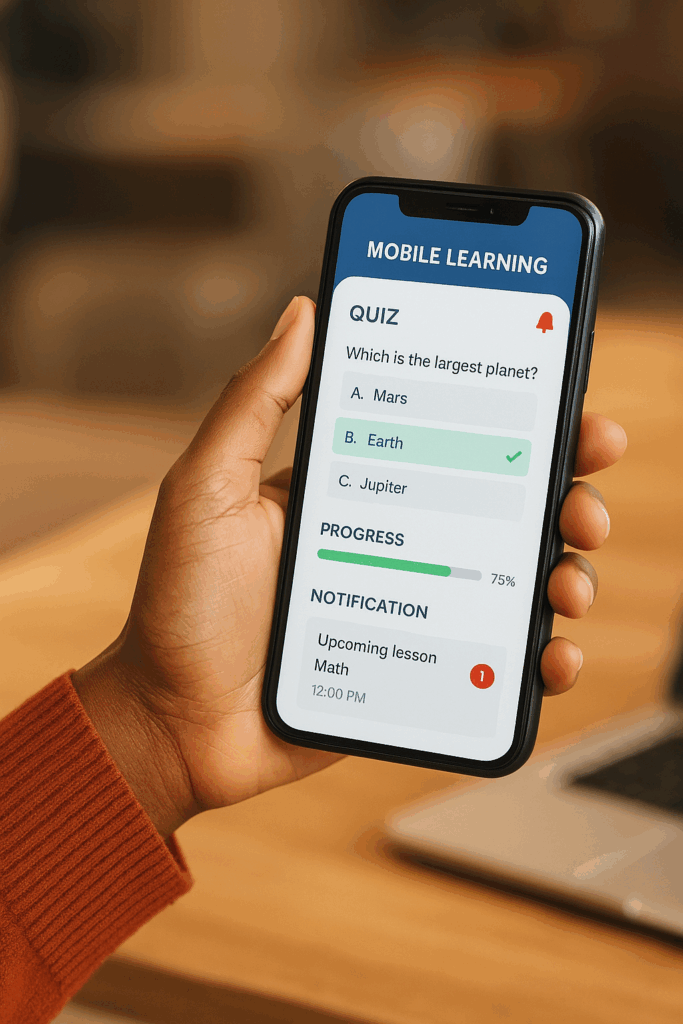
Unlike static PDFs or desktop portals, mobile apps can be interactive, combining touch gestures, real-time feedback, multimedia, and notifications. These features nurture habitual learning, gently reminding students when it’s time to continue or engage with content.
4. Gamified Learning Modules
Apps that incorporate game mechanics, points, achievements, levels, turn learning into an experience, not a chore. Data shows that 70 % of learners report higher motivation when using mobile devices for learning compared to computers, and gamified content improves retention by 45 % over traditional methods.
Challenges of Mobile-First Learning
Small Screen Limitations
Typographic layouts, long-form content, or complex charts can feel cramped on a phone. Designers must parse information into digestible visual chunks, hard to do, but essential.
Internet Connectivity Issues
Even with mobile ubiquity, data networks can be unstable or expensive. That’s why offline mode and low-bandwidth design are not optional, they’re necessary.
Distractions from Non-Learning Apps
A device that brings access to lessons also brings Facebook, TikTok, or messaging. Notifications can pull learners away. Thoughtful UX design, like focus modes or distraction-minimizing layouts, can help maintain attention.
Need for Mobile-Friendly Course Design
Not every lesson translates well to mobile. Courses must be redesigned: micro-learning, audio narration, interactive visuals, and frequent checks for comprehension should replace long sentences or dense slides.
Statistical Perspectives: Why Mobile Matters
To illustrate how pivotal mobile is in learning today:
- The global mobile learning market is projected to hit around US $156 billion by 2026, with a CAGR of 30.12 %.
- 64 % of students use their mobile devices for instructional purposes.
- Nearly 67 % of students now rely on mobile devices to complete online coursework.
- A mobile-first mindset improves retention, learning retention rates are 45 % higher vs traditional methods.
- Learner motivation is buoyed by mobile: 70 % feel more motivated, and 72 % find modules more engaging when accessed via mobile devices.
- 80 % of the world’s population use smartphones; reports show that 91 % of time spent on smartphones is in apps, but only 27 % of people use a computer exclusively, while 14 % use only a computer.
These stats make it clear: mobile isn’t just a convenience, it’s often the preferred, most effective learning medium.
Future of Mobile-First Learning for the Next Generation

AI-Driven Personalization
Mobile platforms are paving the way for hyper-personal learning. AI algorithms can adapt content pace, style, and difficulty in real time, making each learner’s journey unique and more effective.
Growth of 5G for Faster Streaming
High-speed networks like 5G reduce buffering, enabling smooth video lessons, AR/VR content, and rich multimedia learning. Ultimately, this makes immersive experiences more accessible on the go.
Expansion of Micro-Learning Modules
Tiny learning moments, 2–5 minutes long, are easier to digest and retain. Mobile-first design naturally aligns with micro-learning, making education fit life’s rhythms instead of demanding long sessions.
Integration with AR and VR for Deeper Engagement
Mobile-enabled AR (e.g., overlaying models onto the real world) and VR (via headset) unlock immersive learning. Imagine anatomy lessons that project systems onto your desk, or historical explorations through interactive simulations, all via mobile.
Mobile-first learning is an urgent shift. To educate the next generation effectively, we’ve got to deliver knowledge on the terms of today’s learners: on mobile, on demand, and in deeply engaging ways.
At Edutech Global, we’re building the future of learning: mobile-first, inclusive, and designed to empower the next generation of students. Whether you’re an institution seeking to transform your digital strategy or an organization exploring innovative education partnerships, we’d love to collaborate with you. Partner with us today to unlock smarter, more accessible learning solutions, and don’t forget to explore more insights on our blog for the latest trends shaping education worldwide.