

Why Cross-Institution Collaboration Tools Matter
Research is no longer a task for isolated labs or single universities. The global challenges we face, whether in climate science, health, education, or technology, demand diverse perspectives, complementary expertise, and shared infrastructure. Cross-institution collaboration tools make it possible for scholars separated by continents to work as if they were seated side by side. They break down barriers of geography, time, and resource constraints.
When universities adopt strong collaboration platforms, they accelerate discoveries. A researcher in Nigeria can draw on data from a lab in Germany, while a PhD student in Brazil can contribute experiments from home. These digital bridges help accelerate innovation. They open new opportunities for students and faculty: joint publications, co-supervision, shared labs, and exchange programs.
But this is more than convenience. In a global academic economy, reputation, funding success, and impact often depend on how well institutions can network, partner, and scale. Tools that enable cross-institution collaboration to become the backbone of academic exchange, supporting not just individual projects but global research ecosystems.
Challenges Universities Face Without Collaboration Tools

Despite good intentions, many universities struggle when they lack robust collaboration systems.
First, there are data silos. Departments or labs keep data on local drives, with no easy or secure way to share across institutions. This duplication leads to wasted effort, inconsistent datasets, and missed insights.
Second, when researchers try to share via email or portable drives, security and version control become major issues. Who has access to what, when? How do you ensure no one overwrites critical files or leaks sensitive material? Research in medicine, engineering, and social sciences increasingly involves ethically or legally regulated data. Without tools designed for cross-institution collaboration, sharing becomes risky or impossible.
Third, student and faculty exchanges or joint programs suffer. Without synchronized platforms, coordinating schedules, resources, and communication is a headache. Students may feel disconnected from remote supervisors. Faculty lose momentum in co-teaching or joint supervision.
Ultimately, the absence of collaboration tools limits innovation, narrows global reach, and confines institutions to inward-looking research. In contrast, institutions that invest in effective tools can unlock latent potential and elevate their academic standing.
Top Cross-Institution Collaboration Tools for Academic Exchange

Below are some of the leading platforms and digital spaces that universities and researchers use to collaborate across institutions.
Here’s a rewritten version that includes Studio alongside Microsoft Teams and Google Workspace:
Microsoft Teams, Google Workspace, and Studio
These are versatile productivity and communication platforms that have proven invaluable for academic collaboration. Microsoft Teams provides shared workspaces, chat, video conferencing, and seamless integration with Office applications. Google Workspace brings together Docs, Sheets, Slides, and Drive, enabling multi-user real-time editing and commenting. Studio is designed with education and research in mind. It combines video conferencing, collaborative whiteboards, and secure file sharing, making it a strong fit for virtual seminars, joint lectures, and multi-institution research meetings.
Why they matter: all three are low-friction tools that many users already know or can quickly adapt to. When adopted across institutions, they create a reliable environment for sharing drafts, holding meetings, co-developing projects, and archiving work. With strong access control features, each platform helps universities manage participation securely, ensuring that collaboration extends smoothly across institutional boundaries.
ResearchGate and Academia.edu
These are academic social networks focused on sharing publications, fostering connections, and exposing research globally. Researchers publish papers, create profiles, follow topics, and connect with peers.
These platforms help increase visibility of work across institutions. Scholars can discover collaborators, cite each other’s work, request full texts, and expand their networks. By bridging institutional boundaries, they support what might otherwise be “hidden” research.
Overleaf
Overleaf is a cloud-based LaTeX editor built for writing scientific and technical documents collaboratively. It allows multiple authors to work simultaneously on the same manuscript, see changes in real time, comment, compile PDF previews, and integrate reference management.
Especially for technically oriented research (mathematics, physics, engineering, computer science), Overleaf reduces the friction of version control and formatting. It supports institutional collaboration by allowing multiple institutions to join a shared project space.
Dataverse
Dataverse is an open-source repository platform for sharing, preserving, citing, and exploring research data. Each dataset uploaded to Dataverse includes metadata and is assigned a persistent identifier (such as a DOI).
Through Dataverse, institutions can host shared data collections accessible to partner institutions. Researchers can ensure reproducibility, comply with open data mandates, and enable others to reuse their data, all within controlled access where needed.
Colwiz
Colwiz is a research management and collaboration platform combining reference management, project planning, and networking. Users can store and share bibliographic references, manage tasks and deadlines, and collaborate on projects.
Though less famous than some others, Colwiz is suited for coordinating research workflows across collaborators in different institutions and regions.
Sakai
Sakai is an open-source learning, research, and collaboration environment used by many universities. It supports tools like wikis, mailing lists, document sharing, discussion boards, and project group sites. More importantly, institutions can host Sakai and configure “project” sites that span across partner universities.
Sakai can serve not only as a course management system but also as a shared workspace for cross-institution research teams.
Other Tools Worth Mentioning
While not always specific to academic research, tools like Miro or MURAL support visual collaboration and brainstorming sessions. Rocket.Chat is an open-source chat platform that is useful for facilitating cross-institutional discussions and integration. And ConferenceXP, though older, was designed for multi-party academic conferencing across institutions.
Selecting the right combination depends on your research domain, infrastructure, compliance needs, and the preferences of collaborators.
Features That Drive Effective Research Collaboration
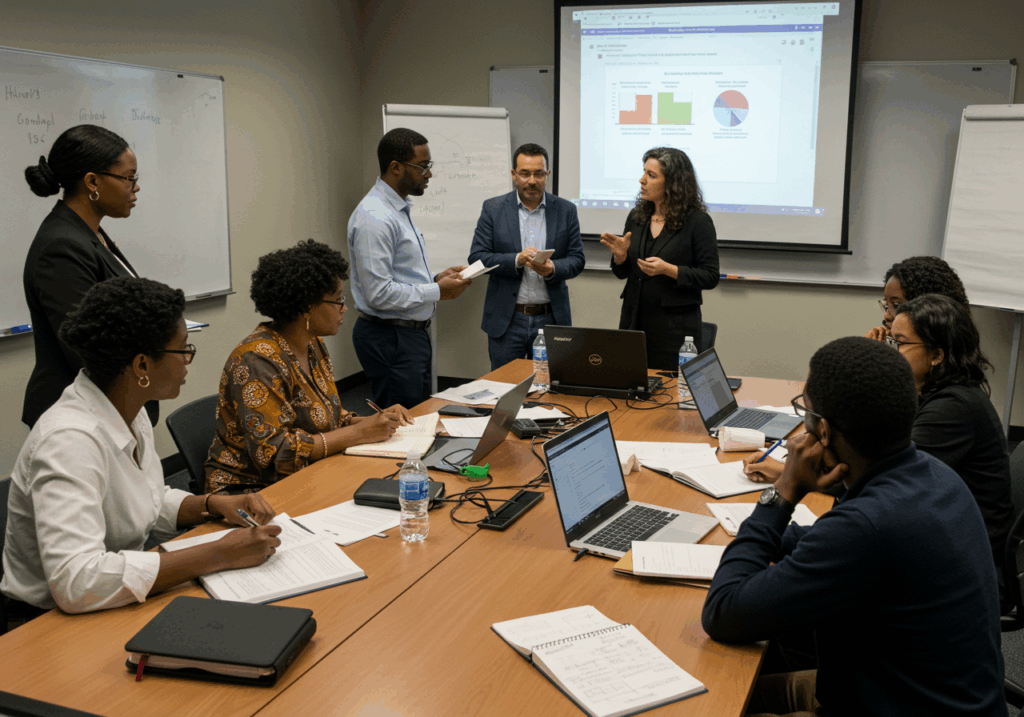
A tool is only as good as the features and policies around it. Here are key capabilities that cross-institution collaboration tools must have.
Secure File Sharing and Access Controls
The tool must allow granular permissions: read/write rights, embargo periods, institutional groups, and selective sharing. It should support encryption at rest and in transit. Audit logs and version histories are essential. These features guard against accidental data loss or unauthorized access.
Cloud Storage with Multi-University Access
Centralized cloud storage accessible to multiple partner institutions prevents fragmentation. Partners can pull or push large datasets, code, or documents without cumbersome transfers. The storage should scale and allow collaborators to mount or sync datasets locally.
Real-Time Communication and Project Dashboards
To manage progress, a shared dashboard with milestones, tasks, deadlines, and accountability is key. Real-time chat, threaded discussions, video conferencing, and notifications support coordination. Integration with calendar systems and email enhances workflow.
Co-Editing, Versioning, and Branching
Multiple authors need to edit documents concurrently. The system should manage versions, show diffs, merge edits, and ideally allow branching (parallel versions) with controlled merges. Overleaf is a strong example in this space for scientific writing.
Metadata, Indexing, and Discoverability
When partners host shared datasets or publications, the system should index content, allow search by tags, keywords, authors, and fields. Persistent identifiers (DOIs) aid citation and discovery. Dataverse, for example, supports metadata and indexing.
Interoperability and Integration
The tool should integrate with institutional authentication systems (e.g., single sign-on, federated identity), reference managers (e.g., Zotero, EndNote), analysis platforms, and publication repositories. APIs or LTI (Learning Tools Interoperability) support seamless workflows.
Case Studies: Successful Global and African Research Collaborations

Concrete examples help illustrate how cross-institution collaboration tools make a difference.
African–European Collaboration in Personalized Medicine
The EU-Africa PerMed initiative collects success stories of research collaborations between African and European institutions in personalized medicine. Projects like SALAMA (studying acute leukaemia mutations), OPTIMA (type 2 diabetes prevention), and PanMed initiatives showcase deep cooperation. African partners access advanced genomic sequencing, European partners gain diverse population data, and both sides contribute to global health solutions.
These collaborations depend heavily on digital platforms to share data, align protocols, coordinate experiments, and publish results. They also support capacity building through training and mentorship across continents.
Platform for African–European Studies (PAES)
This initiative brings together 22 universities (14 African, 8 European) in a co-designed program emphasizing knowledge co-creation and decolonized research methodologies. Rather than imposing a Eurocentric model, scholars jointly set agendas, revise curricula, and structure research. The platform underscores how infrastructure and collaborative tools enable more equal partnerships rather than asymmetrical ones.
Electrifying African Cities: OpenMod4Africa
This is a recent example of a collaboration between African institutions and European research centers under the EU’s Horizon Europe program. The team modelled electric vehicle deployment across African cities (e.g., Addis Ababa) by integrating local mobility data, solar power models, and demand simulations.
Because datasets, models, code, and results had to be shared across continents, collaborators used cloud platforms, version control, and shared storage. The collaboration also shows how access to shared computational resources and infrastructure can drive pan-African scientific innovation.
Broader Framework: EDCTP and Sub-Saharan Africa
The European & Developing Countries Clinical Trials Partnership (EDCTP) supports sustained partnerships between European and sub-Saharan African institutions to develop medical interventions. It funds networks of researchers across nations, enabling knowledge exchange, capacity building, joint trials, and data sharing across borders.
These examples underscore not only the tools, but also the institutional will, funding structures, and governance necessary to make collaboration work at scale.
Benefits for Students: Exchange, Internships, and Innovation
When universities adopt collaboration tools, students gain manifold advantages.
First, students can participate in international research without leaving their home campus. They can work with supervisors abroad, contribute to global teams, and gain exposure to diverse methodologies.
Second, joint degree programs become manageable. Students in one institution may take modules or co-supervised research from a partner institution. Scheduling, communication, and resource sharing become smoother when built on collaboration platforms.
Third, internship and exchange opportunities expand. Faculty can coordinate placements, monitor progress, and mentor remotely through shared dashboards and virtual supervision. Students develop cross-cultural teamwork skills.
Fourth, innovation and entrepreneurship flourish. Cross-institution hackathons, shared lab spaces (physical or virtual), joint startups, and cross-disciplinary capstone projects thrive when the infrastructure supports seamless coordination.
Finally, network effects matter. Students who engage in collaborative research early may carry those connections forward into postgraduate work, research careers, or global networks.
The Future of Cross-Institution Research Collaboration
As technology evolves, several trends promise to further transform how academic institutions collaborate.
AI Tools Simplifying Academic Networking
Artificial intelligence can help match researchers across institutions based on interest, methodology, and publication history. Tools could suggest collaborators, propose project ideas, and automate parts of the literature review or grant writing. AI-powered assistants may also help structure multi-institution project plans, detect overlap, and reconcile data schemas.
Blockchain Securing Shared Credentials
Blockchain or distributed ledger tech could allow institutions to issue and verify credentials, such as shared publications, data contributions, or project credits, in an immutable and decentralized way. This may help ensure transparency, attribution, and trust across institutions.
Digital Campuses Enabling Worldwide Research
Some universities are planning or building “digital campuses,” where students and faculty exist in hybrid physical-virtual spaces. Such campuses may span continents, with shared labs, virtual reality collaboration rooms, and seamless transitions between on-site and remote participation. In such settings, collaboration tools will be the foundation of the entire research lifecycle.
Federated and Decentralized Networks
Rather than one central platform, future systems may operate in federated networks. Each institution hosts its own node, yet they interconnect via shared protocols. This preserves autonomy while enabling collaboration. Data stays under institutional control but is discoverable and usable across the network.
Increased Emphasis on Equity and Decolonization
In global research partnerships, tools and governance must no longer perpetuate inequities. African and Global South institutions must become active co-creators, not passive data providers. Platforms must support equitable ownership, decision-making, and access. The case of PAES (Platform for African–European Studies) demonstrates how collaborative design can challenge power imbalances.
At its core, collaboration enables innovation. Universities that invest in cross-institution collaboration tools strengthen their capacity to tackle complex global problems. The right platforms become the scaffolding upon which joint research, student mobility, shared infrastructure, and global impact are constructed.
If your institution is ready to upgrade your campus, digital platforms, or research environment, read our blog on How Universities Can Upgrade Their Campus with Smart Technologies. To explore partnerships or tailor solutions, visit us at EduTech Global. You may also reach out to us directly.