

Many learners around the world are opting for online programmes delivered by universities abroad. For some, it’s a chance to access global credentials without relocating. But the real measure of value is how employers respond. Do they view online degrees from international institutions as credible? Do they treat them equally as they do conventional degrees?
The pandemic accelerated the adoption of remote learning and remote hiring. Suddenly, online delivery ceased being a novelty and became integral to how education and work happen. Universities expanded their online offerings; employers accepted remote work as the norm. That shift has brought international online degrees into sharper focus. Graduates holding such credentials often wonder: ‘will I face the same doors as someone with a campus-based degree?’
Read more: How Universities Can Attract More International Students Through Online Programs
The Evolving Perception of Online Degrees
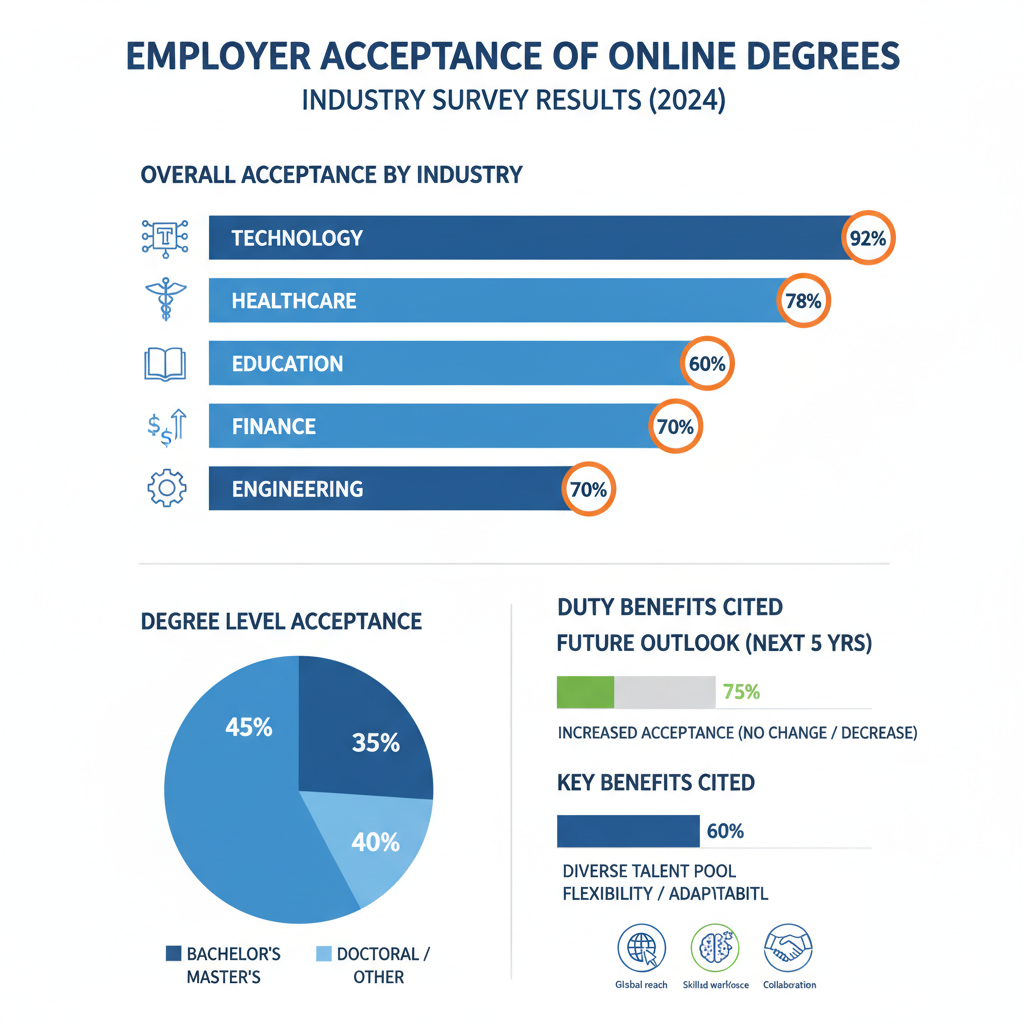
Over the last decade, the perception of online degrees has changed significantly. Previously, many employers held doubts about the rigour, interaction quality or authenticity of online programmes. According to a literature review, early findings suggested employers perceived online degrees as less rigorous, with concerns about academic integrity and student self-direction.
However, more recent data indicate growing acceptance, particularly outside the United States. For example, a report noted that 54% of employers in a global survey considered online and in-person degrees equally valuable. Another major survey found that around 87.4% of employers who track degree modality had hired graduates holding online degrees.
What this tells us is that the value of international online degrees is rising, but with caveats. The quality of the issuing institution, the reputation of the programme, accreditation status and how students present their learning all play critical roles. An online degree from a respected international university, delivered with robust support and interaction, is increasingly viewed as credible. In contrast, lesser-known providers may still face scepticism.
Employers have also had to adapt. The shift to remote work, global hiring and hybrid learning during and after the pandemic meant that remote-delivered credentials became more familiar. That normalisation has helped online degrees gain credibility. But perception varies by region, industry and individual employer. As a result, institutions offering international online programmes need to pay attention not only to delivery quality, but also to how their graduates are perceived in global hiring markets.
What Employers Value Most in Online Graduates

From the employer’s vantage point, the modality of a degree is less important than the competencies, behaviours and readiness of the candidate. When it comes to online graduates, especially those holding international online degrees, certain traits stand out.
Self-Discipline, Digital Literacy and Time Management
Online study demands a high degree of self-motivation, time management and digital comfort. Employers increasingly look for graduates who can manage asynchronous learning, engage with peers remotely, adapt to technology tools and meet deadlines independent of face-to-face oversight. A graduate who has succeeded in an online international programme has likely developed such skills, which are highly valued in the modern workplace.
Global Collaboration and Remote Teamwork Skills
Graduates of international online programmes often engage with peers, faculty and projects across borders. That experience cultivates global collaboration, remote communication, cultural awareness and flexibility. Employers hiring in remote-first or globally distributed teams look favourably on candidates who have already operated in a digital, cross-border learning environment.
Practical Skills over Credentials
Employers are moving beyond simply checking for a degree. According to recent labour-market studies, skills increasingly take precedence over credential type. One large-scale study found that for AI and green-jobs roles, the wage premium for formal degrees is lower than the premium for specialised skills. Another report noted that 20 % of job postings on LinkedIn do not list a degree requirement. What this means for online international degrees is that graduates must highlight what they can do, not just where they earned their degree. Showing project work, remote collaboration, digital fluency, and global awareness makes a difference.
Credibility, Institution and Accreditation
Even as skills matter, employers do still look at the issuing institution, its reputation and accreditation. The case-study research of employers in Chile found that willingness to hire a 100 % online degree graduate correlated strongly with the perceived equivalence in rigour, learning experience and institutional reputation. Thus, for international online degrees, the institution and accreditation matter. What is valued most is a credible programme backed by an institution that has global recognition.
Industries Leading in Online Degree Acceptance

Some industries are more advanced in accepting international online degrees than others. For learners and institutions, it is useful to understand which sectors are more open and why.
Technology and IT
The technology sector is among the most receptive. Tech firms tend to focus on what candidates can do, code, deploy, and solve problems, rather than exclusively on where the credentials came from. Global online degrees that emphasise digital and remote project work align naturally with this sector. Additionally, tech hiring is often global and remote, making international online credentials more visible and familiar.
Finance and Professional Services
Within finance and related professional services, acceptance of online degrees is growing, especially for international programmes offered by reputable universities. Firms in these sectors that are active globally value candidates who understand global markets, remote collaboration and cross-border regulation.
Education and Healthcare
In sectors like education and healthcare, where regulation and accreditation matter heavily, online degrees are accepted when the institution is accredited and the programme meets professional standards. In many African contexts, employers of distance and online learners express positive perception when the programme and student can demonstrate strong performance and system integration.
Case Examples from Africa and the U.S.

In Nigeria (and broader Africa), research into distance education graduates found that employers held positive perceptions toward online learning graduates, especially when the learners demonstrated ICT and self-management competencies.
In the U.S., the picture is more mixed: only 27 % of employers reported valuing online and in-person degrees equally.
These regional differences matter. For international online degrees targeting global recognition, recognising which industries and geographies lead to acceptance is crucial. It also highlights the role of reputation, accreditation, demonstration of work and skill, and alignment with industry needs.
The Role of Accreditation and Global Recognition
While the value of the online modality is rising, accreditation and global recognition remain core to employer trust. The institution’s credibility, the programme’s accreditation status and how the learning is delivered all influence employer judgement.
Employers rely on accreditation to assess quality. When a candidate presents an international online degree, hiring managers look for indicators: Is the programme delivered by a body recognised in its home country? Does it follow international standards? Is it delivered fully online or hybrid? Research in Chile found that when employers had to choose between a 100% online, a hybrid and a traditional campus degree, none chose the online degree unless they believed the learning experience matched in-person quality.
For institutions designing international online degree programmes, partnering with credible global institutions, ensuring transparent delivery modalities, meeting global standards and embedding strong digital pedagogy are essential. That is where organisations like EduTech Global play a role in helping universities build globally recognised online programmes with the right infrastructure, student support, quality assurance and accreditation alignment.
When learners hold an international online degree from a recognised institution, employers in global hiring markets are more comfortable. The degree becomes less about where it was delivered and more about what it means: that the graduate has demonstrated learning in a credible, rigorous, international setting.
The Future: Skills Over Degrees
The trend is clear: while degrees remain relevant, hiring is increasingly skills-based. Employers want proof of what a candidate can do, not just the title they hold. This has implications for international online degrees and how they are positioned.
Micro-credentials, professional certificates and stackable online credentials are gaining traction. They often complement or precede full degrees and allow learners to demonstrate specific competencies.
For institutions offering international online degrees, this means that curriculum design must emphasise skill development, employability, project work, remote collaboration and digital literacies. Degrees should include visible evidence of skill application, such as capstone projects, global teamwork, and digital portfolios. Learners should be able to articulate their skill set clearly to employers.
From the employer’s perspective, international online degrees work when they reflect real learning, verified performance, and portability of skills. The modality is less the issue than the demonstration of capability, adaptability and digital-world readiness.