
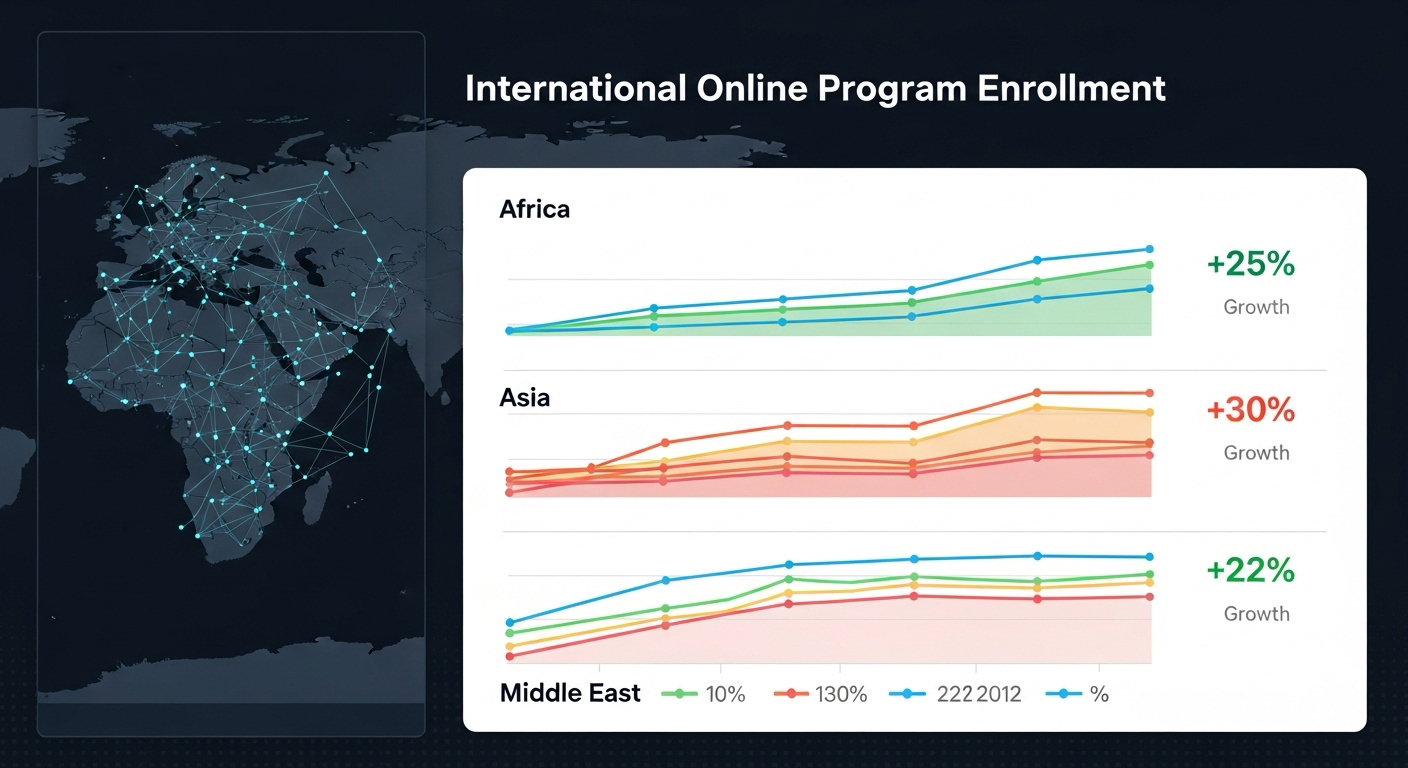
International Online Enrolment Grew Rapidly in 2025
In 2025, international online program enrolment hit new heights. Universities around the world leaned more heavily into remote-degree offerings, and the growth was not incidental; it was a strategic response to shifting global demand. As institutions came out of the pandemic-era pivot, many doubled down on recruiting students beyond their borders through fully online programmes, realising that the world was now their classroom.
This shift to online recruitment accelerated because universities understood that they could reach students across continents without the need to build physical campuses in every country. Rather than hosting students in dormitories or lecture halls, they could deliver high-quality education through digital platforms. For many institutions, that meant not just sustaining enrolment numbers but scaling them in entirely new geographies.
Importantly, the surge in international online enrolment was driven in large part by regions that had been underrepresented in traditional mobility flows. African and Asian markets, once thought to be highly tied to in-person study abroad, embraced online degrees more than ever in 2025. Working adults, mid-career professionals, and learners with family commitments found that distance learning gave them access to global education without uprooting their lives.
Read More: How Universities Can Attract More International Students Through Online Programs
Why Universities Invested in Online International Programs in 2025

There were compelling reasons behind universities’ renewed investment in online international programs in 2025. First, the global reach of online education is unmatched. Institutions realised they could tap into student populations in new markets at a fraction of the cost of opening physical campuses. For many universities, the economics were clear: invest in digital infrastructure, and you can enrol students from across the globe without building dorms, labs, or classrooms in every target country.
Second, online programs offered access to new demographics. Rather than relying solely on the youth market, high school graduates willing to relocate, universities began to cater more intentionally to working adults, cross-border learners, and professionals looking for career upskilling. These learners often value flexibility, credibility, and affordability. They are less interested in on-campus life and more interested in credentials that can boost their careers.
Third, this demand was real and growing. As the world becomes more interconnected, the appetite for globally recognised degrees delivered online has soared. In many emerging markets, the cost and logistical barriers of travelling abroad remain high, but the availability of online degrees provides an accessible alternative. Instead of waiting years to gain visa approvals or save for relocation, students could simply enrol and study from home.
Finally, funding models made sense. With online delivery, universities could scale without proportionate increases in fixed costs. They could offer cohort-based courses, run synchronous or asynchronous classes, and amortise course development across many students. This scalability meant that the return on investment for launching an international online program could be substantial, particularly in markets where student demand was untapped or underserved.
Strategies Universities Used to Boost International Enrolment in 2025

Universities deployed a range of strategies in 2025 to grow their international online enrolment. Three approaches stood out: digital marketing, partnerships with edu-agencies, and micro-credential pipelines.
1. Digital Marketing & Personalisation
Institutions turned to data-informed digital marketing to reach prospective students. Rather than broad, undifferentiated campaigns, universities leveraged customer-relationship-management systems (CRMs) to segment leads by country, program interest, and life stage. They then crafted personalised campaigns, landing pages tailored to students from Asia featuring testimonials from alumni in their region, dynamic email streams that offered micro-credential previews, or scholarship prompts that aligned with students’ financial capacity.
This personalisation paid off. According to ICEF Monitor, one of the 2025 trends was precisely this: institutions used their CRMs to track leads, send targeted communications, and offer custom content. Universities that invested in this sophistication saw higher lead-to-application conversion rates because their messaging resonated more with students’ real needs.
2. Edu-Agency Partnerships & Local Representation
Another major lever was partnerships with local student-recruitment agencies and in-country reps. These agents provided valuable on-the-ground intelligence, helping universities understand regional preferences, scholarship expectations, and visa concerns. Having local representation, especially in markets like Africa and Southeast Asia, made outreach more trustworthy and efficient.
ICEF’s 2025 outlook emphasised not just data, but the value of “on-the-ground local intelligence.” By working with agents and local reps, universities were able to build trust, offer webinars in local languages, and host virtual info sessions that addressed regional concerns like accreditation, financial aid, and regulatory frameworks. This boosted engagement and conversion in markets that could have been hard to reach with digital-only campaigns.
3. Micro-Credential Pipelines & Stackable Credentials
Micro-credentials: short, skills-focused courses or digital badges, became a strategic pathway into full degree programs. Many universities used micro-credentials as a funnel: students enrolled in a micro-master’s or certificate program, got a taste of the online learning experience, and then converted to full master’s or bachelor’s programs.
This pipeline delivered high conversion. Prospective students who began with a micro-credential already had a relationship with the institution, familiarity with the platform, and often a clearer sense of career value. Universities also benefited because these short programs were relatively inexpensive to run and could quickly generate revenue while feeding into longer-term, higher-value degree enrolments.
Challenges Universities Faced With Scaling Online Enrolment in 2025
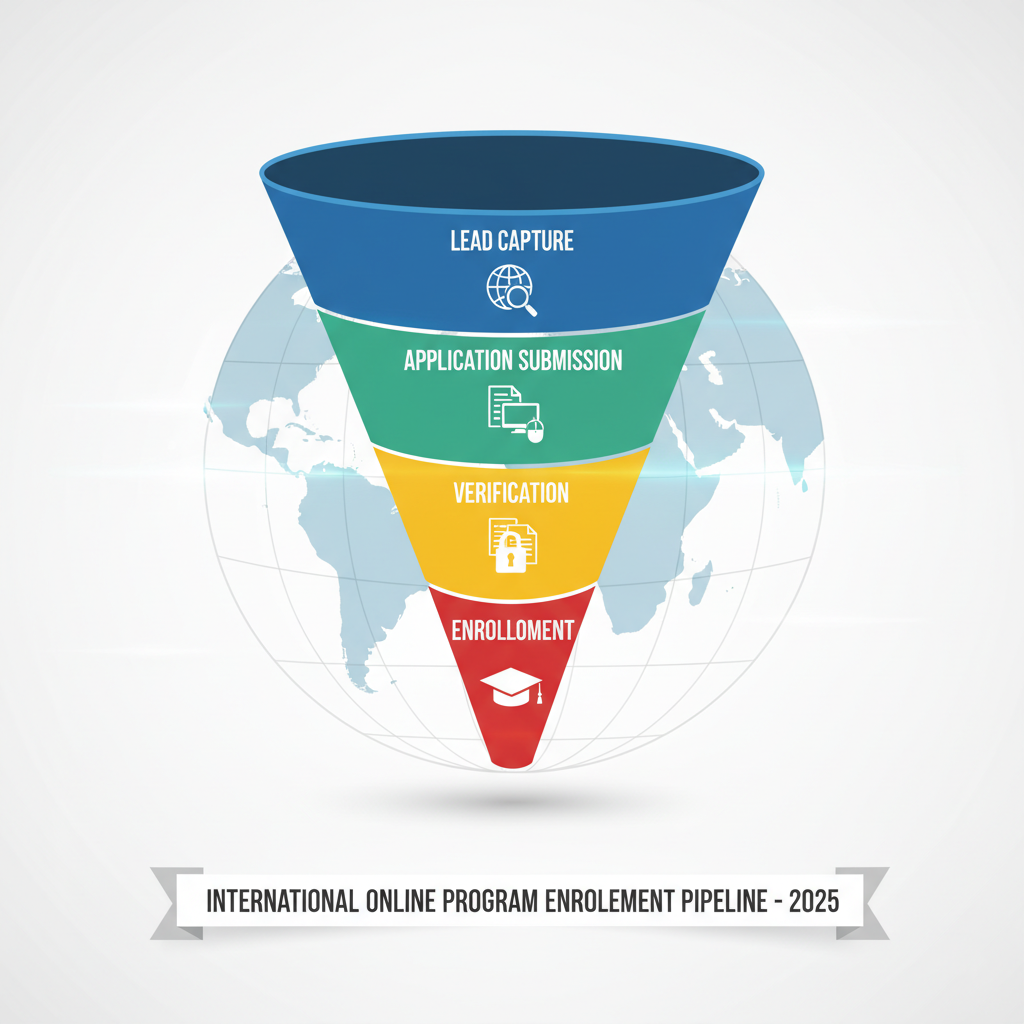
Despite the promising momentum, scaling international online enrolment in 2025 was not without its difficulties. Several institutions ran into operational, strategic, and financial challenges.
Lead Quality & Conversion Issues
Not all leads were created equal. Some universities attracted a large number of inquiries, but many of these leads were of low quality. Without rigorous qualifications, a big portion did not complete applications. ICEF Monitor noted that in some contexts, only a fraction of leads converted, and institutions struggled to nurture them effectively.
Additionally, universities found that they lacked structured follow-up processes. Manual workflows, siloed teams, and disjointed CRMs meant that many prospective students fell through the cracks. The lack of personalisation or timely responses often discouraged applicants from finishing their applications or paying deposits.
Operational Gaps & Manual Processes
Scaling online international programs required significant operational capacity. Yet, many institutions were unprepared for the volume of applications. Without automated systems, universities relied on manual reviewing, chasing down documents, and responding to queries via email. This inefficiency slowed down admissions, increased staff workload, and sometimes caused delays in offer letters.
In turn, those manual bottlenecks cost time and money. Institutions lost potential revenue when offers were delayed or when prospective students withdrew due to frustration or lack of clarity.
Retention & Student Lifecycle Management
Winning a student was only half the battle. Keeping them engaged throughout their program was another challenge. Universities often realised late that they lacked a holistic student lifecycle strategy, from onboarding, academic support, peer engagement, to career services. Without consistent engagement, dropout risk increased in online settings.
Some students reported feeling disconnected or unsupported; others struggled with self-paced learning. In the absence of strong wrap-around services, satisfaction and completion rates suffered, undermining the long-term value of growing international enrolment digitally.
How EduTech Global Helped Institutions Grow International Enrolment in 2025

At Edutech Global, we understand these trends and challenges deeply. In 2025, we stepped in to support universities to scale their international online enrolment at pace and at quality.
Technology Solutions & Recruitment Infrastructure
First, Edutech Global provided technology platforms that centralised recruitment and admissions workflows. We offered application-management systems integrated with a student information system, which automated lead capture, segmentation, and follow-up. Universities gained actionable dashboards, real-time analytics, and automated engagement journeys, helping them convert more qualified leads.
Market Access & Recruitment Support
We also connected our partner institutions with our network of international recruitment channels. Through our network of edu-agencies and local representatives, especially in high-growth regions such as Africa and South Asia, we helped universities reach students they might never have accessed otherwise.
Because we manage both demand generation and recruitment infrastructure, we reduced friction for both the institution and the student. Our agents ran virtual info sessions, supported applications, and helped launch marketing campaigns tailored to regional audiences.
Building the Pipeline & Managing the Student Lifecycle
EduTech Global didn’t stop at recruitment. We supported the full student lifecycle. We helped universities design micro-credential pipelines that fed into larger degree programs. We collaborated with institutions to create stacked credential journeys, from certificates to micro-masters to full online degrees.
Once learners were enrolled, we provided tools for onboarding, learning engagement, and retention. We powered student-engagement platforms that included mentorship, peer cohorts, and academic advising. We also helped universities build online student-services models, from orientation to career guidance.
If you’d like to learn more about how Edutech Global can help your institution grow international online enrolment, visit our homepage, check out our blog, or contact us.