

The conversation around education reform often begins with access, infrastructure, or funding. Increasingly, however, it ends with a harder truth: many graduates are leaving school unprepared for the realities of a digital economy. The digital skills gap is a structural challenge affecting employability, productivity, and national competitiveness.
Across continents, employers report difficulty filling roles that require even mid-level technology competencies. The World Economic Forum’s Future of Jobs Report 2023 estimates that 44 per cent of workers’ core skills will change by 2027, with analytical thinking, technological literacy, and AI-related capabilities among the fastest-growing demands. At the same time, six in ten workers will require training before 2027, yet only half currently have access to adequate learning opportunities.
Read more: EdTech Trends 2026: What Universities Must Prepare For
For school owners, university leaders, and policymakers, this presents a difficult reality. Institutions are expected to prepare learners for jobs that are evolving faster than curricula can be updated. Faculty members are asked to teach emerging technologies they may not have been trained in themselves. Students, meanwhile, assume that a qualification automatically translates into employability. Too often, it does not.
This is the digital skills gap in action. And addressing it requires more than adding a coding module to a course catalogue.
What Is the Digital Skills Gap?

The digital skills gap refers to the mismatch between the technology skills employers need and the competencies graduates and workers actually possess. It spans basic digital literacy, intermediate workforce digital skills, and advanced technical expertise, including data analytics, cybersecurity, cloud computing, and artificial intelligence.
At a foundational level, the OECD has noted significant disparities in adult digital problem-solving abilities across countries. In its Survey of Adult Skills, a considerable share of adults lacked even basic proficiency in using digital tools for workplace tasks.
The gap becomes more pronounced at higher skill levels. The European Commission has repeatedly highlighted a persistent ICT specialist shortage across the EU, with digital intensity increasing across sectors faster than the supply of qualified professionals.
This is not merely a labour market inconvenience. The World Bank emphasises that digital skills are foundational to economic transformation, especially in developing economies pursuing digital growth strategies. Without adequate human capital, investments in broadband and digital infrastructure yield limited returns.
In short, the digital skills gap is a systemic misalignment between education outputs and workforce digital skills demand. It affects employability, institutional reputation, and national economic resilience.
Why the Digital Skills Gap Is Expanding

Understanding why the digital skills gap continues to widen requires examining structural pressures within education systems.
Rapid Technology Evolution
Technology cycles are shortening. Artificial intelligence tools, automation platforms, and cloud systems evolve annually, not over decades. Academic governance processes, however, are designed for stability and quality assurance. Curriculum reviews often take years.
By the time a new course in data science or cybersecurity is formally accredited, industry standards may have shifted. This structural lag contributes directly to the education-employability gap.
Curriculum Lag and Academic Silos
Traditional curricula frequently emphasise theory over applied digital competencies. While conceptual foundations remain essential, employers increasingly expect graduates who can operate industry-standard tools, interpret data, collaborate in digital environments, and adapt quickly.
The challenge is not that institutions ignore technology, but that digital capability is often isolated within IT departments. Digital literacy should not belong only to computer science faculties. Business students need analytics skills. Health students require familiarity with digital health systems. Education majors must understand learning technologies.
When digital skills are siloed, the technology skills shortage becomes a cross-sector problem.
Faculty Training Limitations
Faculty development remains one of the most overlooked constraints. Many educators were trained before today’s digital tools became mainstream. Asking them to teach advanced analytics or AI applications without sustained professional development is unrealistic.
UNESCO has highlighted the need for systematic teacher digital competency frameworks to ensure educators are equipped to integrate technology meaningfully into pedagogy.
Without investing in faculty capability, institutional digital transformation efforts risk becoming surface-level technology adoption exercises.
Unequal Access to Technology
The COVID-19 pandemic exposed global inequalities in digital access. According to UNESCO, at the height of school closures, at least one-third of the world’s students lacked access to remote learning.
Limited access to devices, connectivity, and digital infrastructure compounds the digital skills gap. Students who cannot practice using digital tools cannot develop proficiency. This inequity translates directly into future workforce disparities.
Impact on Workforce and Economic Growth
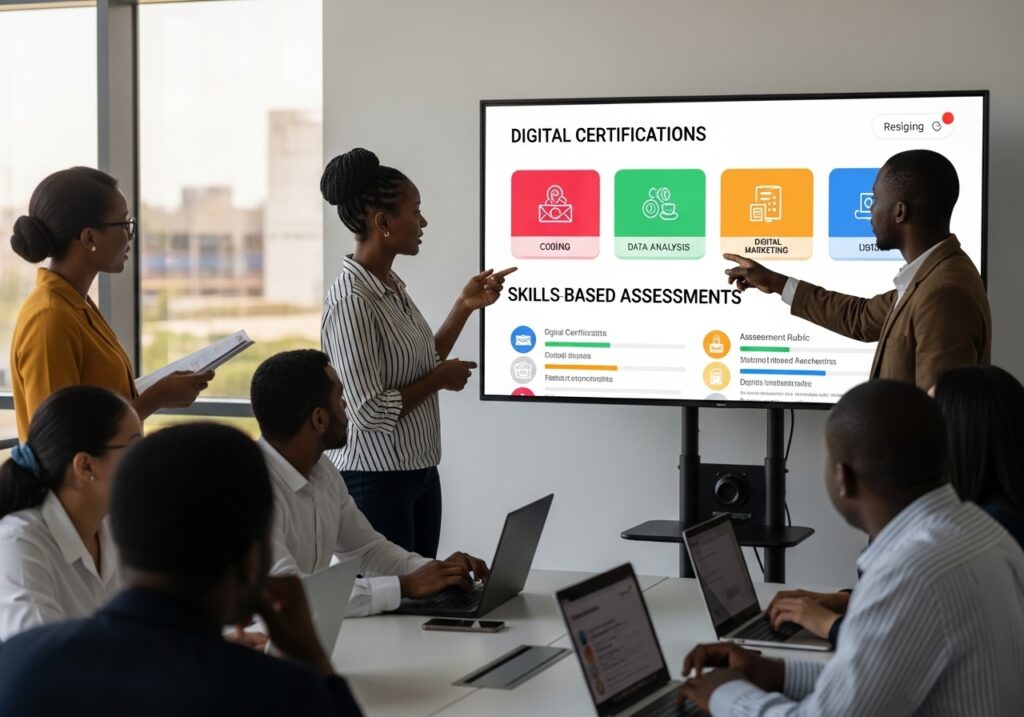
The consequences of the digital skills gap extend beyond individual employment outcomes.
Graduate Unemployment and Mismatch
The International Labour Organisation reports persistent youth unemployment challenges globally, often linked to skills mismatches rather than absolute job scarcity.
When graduates lack relevant workforce digital skills, employers either invest heavily in retraining or leave positions unfilled. Both scenarios reduce productivity and increase hiring costs.
Industry Productivity Gaps
Digital transformation drives productivity gains. However, without digitally competent workers, firms struggle to adopt new technologies effectively.
The OECD has noted that diffusion of digital technologies across firms is uneven, with skills constraints among the limiting factors.
In this way, the education employability gap becomes a macroeconomic issue. National innovation strategies depend on a pipeline of talent capable of sustaining digital ecosystems.
Innovation Slowdown
Startups, research institutions, and technology-driven industries require advanced technical skills. A persistent technology skills shortage can stifle entrepreneurial growth and limit research commercialisation.
Countries that fail to close the digital skills gap risk falling behind in global competitiveness rankings and foreign investment attractiveness.
How Education Systems Can Close the Digital Skills Gap

Closing the digital skills gap requires institutional redesign, not cosmetic reform.
Curriculum Redesign with Industry Input
Curriculum must be dynamic. Establishing advisory boards with industry representation ensures programs reflect evolving skill demands.
Competency-based frameworks that emphasise applied digital tasks alongside theoretical foundations create graduates who are adaptable, not merely knowledgeable.
Micro-credentials and modular learning structures allow institutions to update specific skill components without overhauling entire degrees.
Industry-Aligned Certification
Partnerships with technology providers can integrate globally recognised certifications into academic pathways. When students graduate with both a degree and validated digital credentials, the education employability gap narrows significantly.
These collaborations must be structured carefully to avoid vendor dependence while maintaining academic independence.
Skills-Based Assessment
Traditional examinations often measure memorisation rather than digital fluency. Institutions should incorporate project-based assessments, simulations, collaborative digital assignments, and portfolio evaluations that reflect real-world application.
Assessment reform signals seriousness about aligning education outcomes with workforce digital skills.
Lifelong Learning Models
The digital economy evolves continuously. Education cannot end at graduation. Universities and colleges must position themselves as lifelong learning hubs, offering flexible upskilling and reskilling programs for alumni and working professionals.
Stackable credentials and online delivery models support continuous engagement and reduce the long-term impact of the digital skills gap.
Policy-Level Interventions
Institutional reform must be supported by enabling policy frameworks.
National Skills Frameworks
Governments can establish national digital competency standards that align secondary, tertiary, and vocational education systems. Clear benchmarks reduce fragmentation and provide guidance for curriculum development.
Public-Private Training Models
Strategic partnerships between governments, industry, and education providers can fund large-scale digital training initiatives. The World Economic Forum highlights multi-stakeholder collaboration as essential for large-scale reskilling efforts.
Such models distribute cost, reduce duplication, and accelerate workforce readiness.
Digital Literacy Programs
Foundational digital literacy must begin early. National policies that integrate coding, computational thinking, and digital citizenship into primary and secondary education lay the groundwork for advanced skill development later.
Without early intervention, the digital skills gap becomes entrenched.
Long-Term Global Competitiveness
The implications of closing or failing to close the digital skills gap extend to national development trajectories.
Countries with strong digital talent pipelines attract foreign investment, foster startup ecosystems, and drive research innovation. Talent mobility increases when qualifications align with international standards. Digital economies become more resilient and adaptive.
Conversely, nations that underinvest in digital capability risk dependency on imported expertise and technology. The economic and strategic consequences are significant.
For education leaders, the responsibility is clear. Institutions must move beyond incremental technology adoption and toward systemic digital capability building. That means investing in faculty development, aligning curricula with workforce digital skills, strengthening industry collaboration, and embedding lifelong learning models into institutional strategy.
The digital skills gap is not simply a labour market statistic. It is a signal that education systems must evolve at the speed of the economies they serve. With deliberate policy alignment, strategic partnerships, and outcome-focused reform, education can close the gap and position learners not only for employment but for leadership in a digital future.