
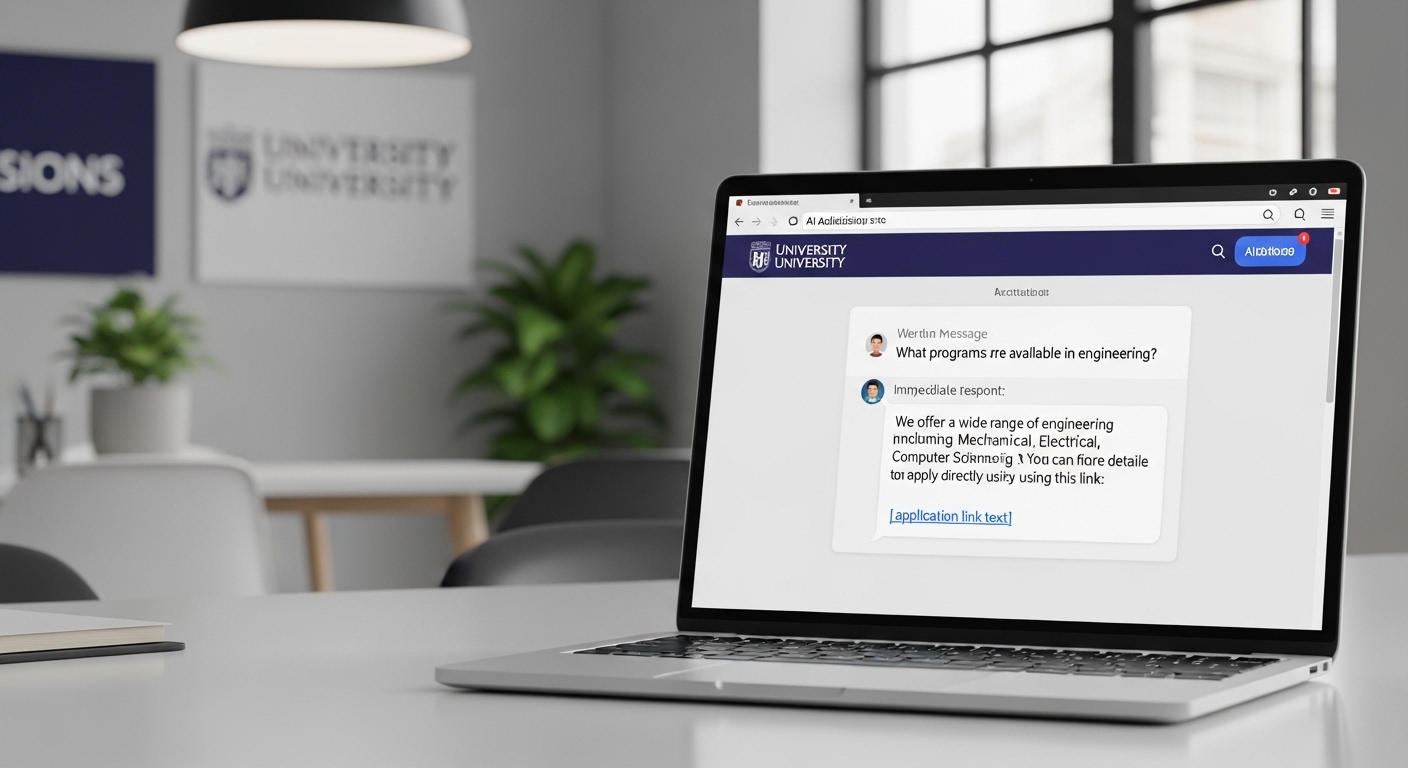
AI in student recruitment refers to the use of chatbots, automation tools, and predictive systems to manage student inquiries, respond instantly, and guide applicants through the admission process. Rather than relying solely on human counsellors to answer every query, universities and schools are deploying AI-powered systems that work around the clock, qualify leads, handle frequently asked questions, and move prospective students smoothly from first contact to completed application. The impact on response time is immediate; the impact on conversion rates, over time, is transformative.
This is not simply a technology trend. It is a structural shift in how educational institutions manage one of their most critical functions: turning interest into enrolment. Schools that understand this shift and act on it stand to gain a decisive competitive edge.
Why Student Inquiry Response Time Directly Impacts Enrolment
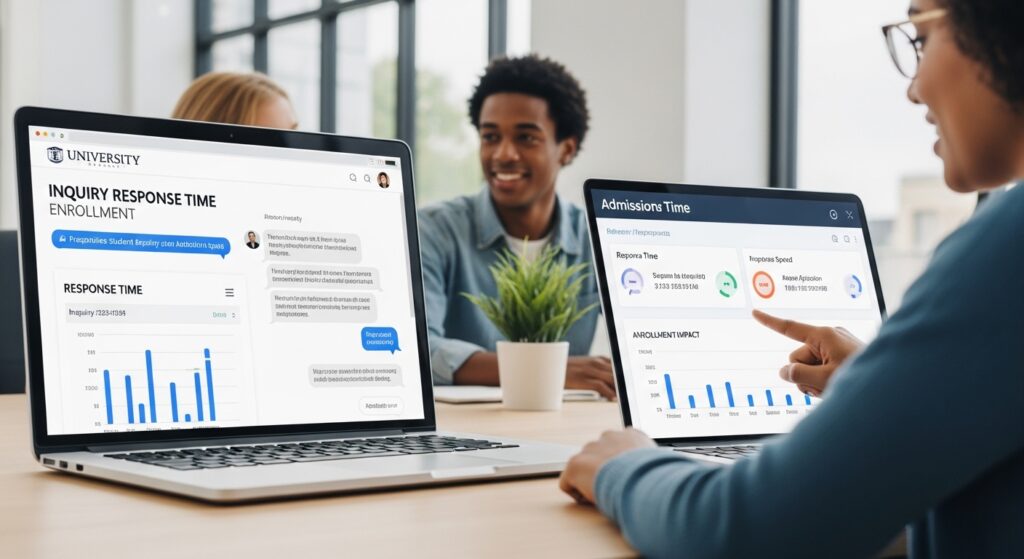
Speed matters more than most school leaders realise. Research from HubSpot consistently shows that the likelihood of reaching a lead decreases dramatically the longer a response is delayed, with the odds of a meaningful connection dropping sharply after the first hour. In a recruitment context, this translates directly to application drop-off. A student who enquires about your programmes at 11 pm on a Sunday is not going to wait until Tuesday to hear back. They have already opened three other browser tabs.
Read more: How AI Is Changing University Admissions Worldwide
The problem is particularly acute in international student recruitment. Prospective students from Nigeria, India, Vietnam, or Brazil are often navigating time zone differences of five to nine hours. When their inquiry arrives during your institution’s overnight hours, a manual support model cannot respond in time. Salesforce’s State of the Connected Customer report highlights that 88% of consumers now expect companies to accelerate digital initiatives, and educational institutions are not exempt from those expectations. Students are also consumers, and they are making decisions accordingly.
Beyond time zones, there is the sheer volume problem. A well-marketed institution may receive hundreds of inquiries per week during peak recruitment seasons. Even a fully staffed admissions team will struggle to respond personally to every one of them within an appropriate window. The result is a slow accumulation of missed leads, incomplete applications, and a conversion rate that never reaches its potential. Student inquiry management that relies entirely on human capacity has a ceiling. AI removes that ceiling.
How AI in Student Recruitment Automates Inquiry Management
AI in student recruitment does not simply send automated replies. A well-configured system creates an intelligent, personalised experience from the first moment a prospective student makes contact, long before a human counsellor enters the picture.
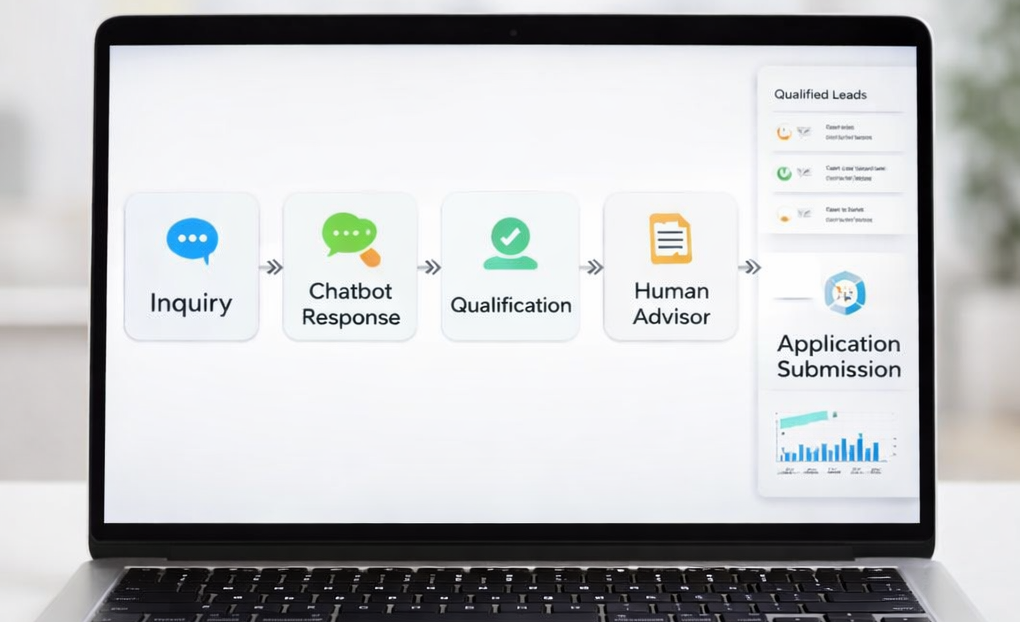
The typical workflow looks like this: a student visits your admissions page, asks a question in the chat window, and a chatbot responds immediately, regardless of the time of day. The bot draws on a structured knowledge base to answer questions about programme requirements, tuition fees, scholarship eligibility, and application deadlines. If the student’s query falls outside the bot’s scope, the system escalates it and flags it for a human counsellor during working hours, with full context attached.
Beyond that initial interaction, the system begins qualifying the lead. It identifies whether the student meets basic eligibility criteria, which programmes they are interested in, and how far along they are in the decision-making process. This is automated admission support working at its best: gathering structured data, filtering out unqualified leads, and ensuring that when a counsellor does step in, they are having a focused, productive conversation rather than starting from scratch.
The functionality extends further. Chatbots can walk students through document checklists in real time, explaining exactly what is needed for their application and prompting them to upload materials through an integrated portal. They can send reminders when documents are missing. They can point students towards scholarship pages, visa guidance, and accommodation information. All of this happens continuously, across thousands of simultaneous conversations, without any additional cost per interaction. An AI chatbot for universities is not a customer service gimmick. It is an operational infrastructure.
Read more: Ethical AI in Education
The workflow in practice:
Inquiry → Bot Response → Lead Qualification → Human Advisor Briefed → Application Link Sent
Each stage is tracked, logged, and measurable.
Chatbots vs Traditional Admission Support Teams
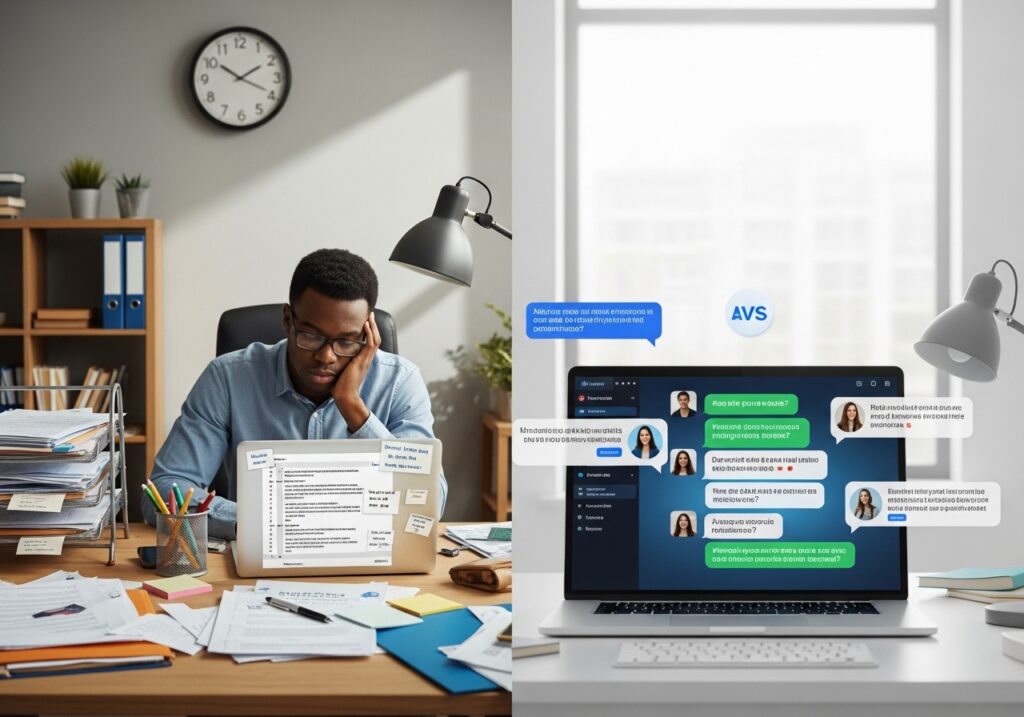
It is important to be clear about something: AI does not replace admissions counsellors. What it does is relieve them of the tasks that consume time without requiring genuine human expertise. Understanding this distinction is essential to implementing AI tools in a way that actually improves outcomes.
Traditional Admission Model
Typical characteristics include:
- Responses limited to office hours
- Manual email follow-ups
- Slow response times during peak periods
- Difficulty tracking large volumes of inquiries
- High workload for counsellors
This often results in missed opportunities. A student who does not receive a timely reply may simply move on.
AI-Powered Admission Support
By contrast, institutions adopting AI in student recruitment operate with a different structure:
- Instant chatbot responses
- Multi-language support for international applicants
- Automated reminders and follow-ups
- Continuous inquiry tracking
- Scalable systems capable of handling thousands of inquiries simultaneously
Importantly, the goal is not to eliminate human interaction. Instead, AI handles routine queries while counsellors focus on advising students, building relationships, and guiding complex application cases.
This combination improves efficiency while preserving the personal connection that students value during the admissions journey.
Reducing International Application Drop-Off with AI Automation
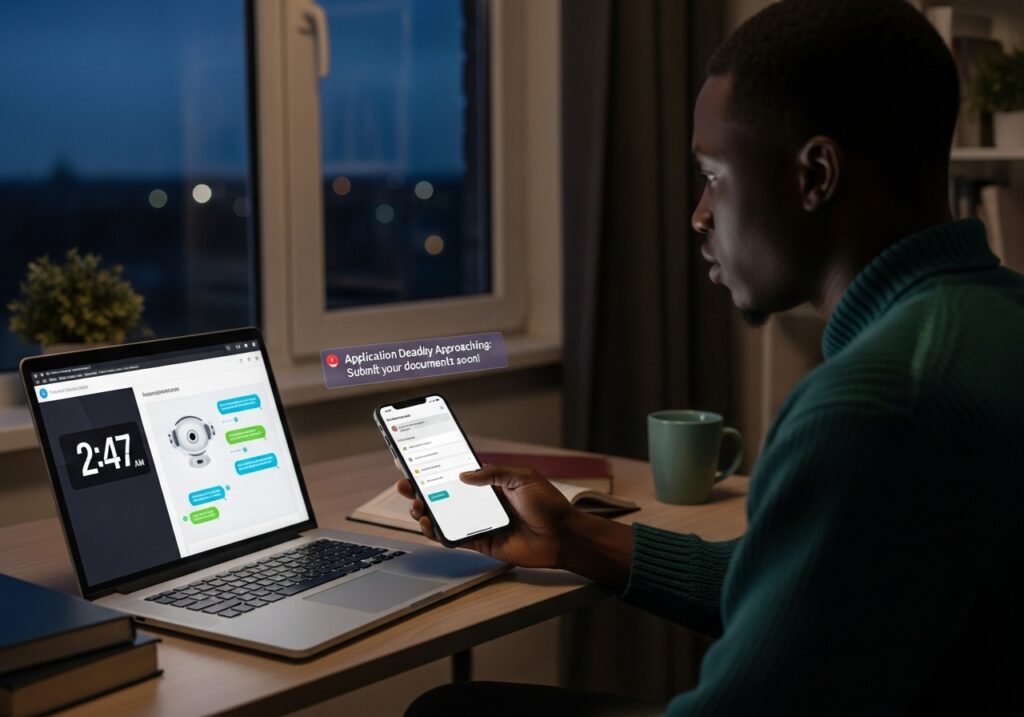
International student recruitment has a drop-off problem that most institutions are not measuring carefully enough. A student might express genuine interest, receive initial materials, and then go quiet. Without a structured follow-up system, that student simply disappears. The admissions team moves on. The enrolment opportunity is lost.
AI-driven systems address this through behaviour-based follow-up sequences. If a student opened your programme brochure but did not submit an application, the system will notice. It can trigger a personalised reminder at an appropriate interval, highlight a relevant scholarship, flag an upcoming application deadline, or share a testimonial from a student in the same country of origin. None of this requires manual intervention. It runs on defined triggers and decision logic that your team sets once and refines over time.
This kind of automated follow-up is particularly powerful for international markets, where the decision-making timeline is often longer and the barriers to application, such as visa complexity, financial verification requirements, and language concerns, are more significant. Reminder sequences, deadline notifications, and scholarship alerts keep your institution present in the student’s mind during a period when they may be juggling multiple options.
Retargeting integration extends this further. AI systems can be connected to your digital advertising platforms so that students who engaged with your chatbot but did not convert are served relevant ads as they browse other sites. The loop between AI in student recruitment and broader digital marketing becomes tighter, more measurable, and more effective.
Read more: Integrating AI Chatbots to Improve Student Support Services in Higher Education
Data Insights from AI-Driven Inquiry Systems
One of the most underappreciated benefits of AI-driven student inquiry management is not the automation itself. It is the data. Every inquiry that passes through an AI system generates structured, queryable information that manual processes simply cannot produce at scale.
A well-configured system tracks inquiry-to-application ratios by source, programme, and geography. It records average response times and flags when those times degrade. It identifies exactly which stage of the application process has the highest drop-off rate, whether students are abandoning the process at the document submission stage, the interview booking stage, or the offer acceptance stage. It monitors which lead sources produce the highest-converting inquiries and which produce high volumes but low conversion.
This data reshapes how you allocate your recruitment budget. If your inquiry analytics show that students from a particular country consistently convert at three times the rate of those from another, that is a signal to invest differently. If your drop-off data shows that 40% of applicants abandon the process at the financial documentation stage, that is a signal to redesign that stage or create targeted support content for it.
Conversion forecasting becomes more reliable as well. AI systems that have processed sufficient data can project how many of your current inquiries are likely to convert to applications, and how many applications are likely to convert to enrolments. That kind of forward visibility is enormously useful for planning purposes and supports more honest conversations between admissions teams and institutional leadership about recruitment pipelines.
Common Mistakes Universities Make When Implementing Chatbots

While the benefits of AI in student recruitment are substantial, poorly implemented systems can create frustration rather than efficiency. Universities adopting chatbots should avoid several common mistakes.
Poor scripting: Chatbots must be carefully trained with clear responses and structured decision paths. Generic or inaccurate answers quickly erode student trust.
Lack of CRM integration: Without integration into admissions systems or CRM platforms, chatbot conversations remain isolated and cannot support effective follow-up.
No human takeover option: Students should always have the option to speak with a human advisor when their questions become complex.
Over-automation: Not every interaction should be automated. Admissions decisions and personal guidance require human judgment.
Lack of personalisation: AI tools should use student data, programme interests, and geography to tailor responses rather than providing generic answers.
When implemented thoughtfully, AI chatbots for university solutions complement human admissions teams instead of replacing them.
Frequently Asked Questions
What is AI in student recruitment? AI in student recruitment is the use of intelligent tools, including chatbots, automation platforms, and predictive analytics, to manage prospective student inquiries, personalise communication, and guide applicants through the admissions process from first contact to enrolment.
Do chatbots replace admission counsellors? No. Chatbots handle repetitive, time-sensitive tasks such as answering FAQs, qualifying leads, and sending follow-up reminders.
How do AI chatbots improve application conversion? AI chatbots improve conversion by responding to inquiries instantly at any hour, maintaining consistent follow-up sequences, identifying drop-off points in the application journey, and personalising communication based on each student’s profile and behaviour.
To explore how Edutech Global can support your institution’s journey, get in touch with our team to discuss your admissions goals.