
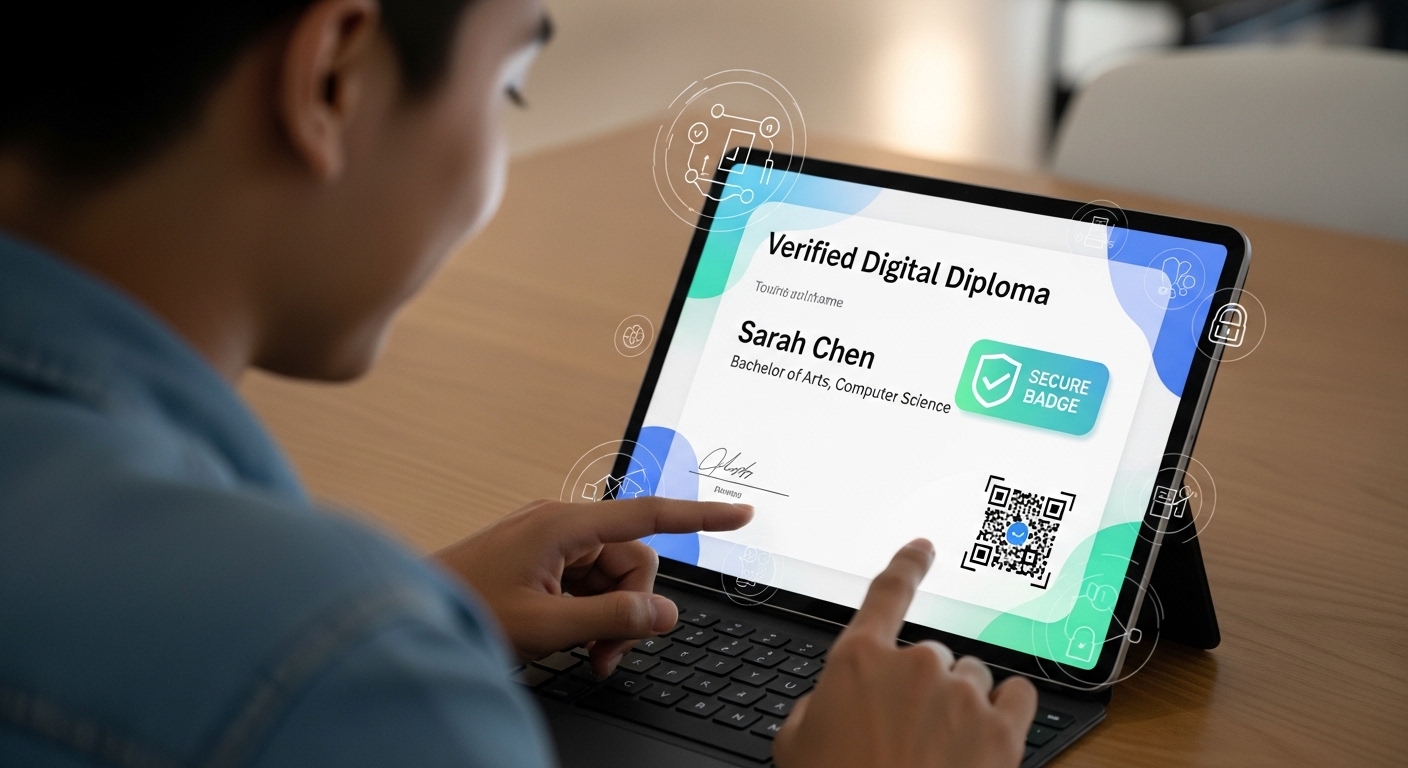
Ask any university registrar how long it takes to verify a graduate’s qualifications, and the answer is usually the same: weeks, sometimes longer. A former student applies for a role overseas, or seeks admission to a postgraduate programme, and the entire process stalls while emails are exchanged, paper records are located, and stamps are applied. For employers, the frustration is equally real. Hiring decisions are delayed. Fraud goes undetected. Documents that claim to represent years of academic achievement can be forged for the cost of a printer cartridge. The system that underpins global academic recognition is, in many institutions, still running on infrastructure designed for a different century.
Digital credentials in education represent the most substantive shift in academic certification in decades. Rather than issuing paper diplomas that are easily lost, damaged, or falsified, institutions are now issuing cryptographically secure, instantly verifiable records that students carry for life. The global digital credentialing market was valued at $1.7 billion in 2024 and is forecast to reach $7.8 billion by 2033, growing at an annual rate of 18.2%. That trajectory reflects something deeper than a technology trend; it reflects a fundamental reconfiguration of how learning is recognised, shared, and trusted across borders.
Read more: Blockchain in Education: Securing Credentials and Academic Records
What Digital Credentials in Education Actually Include
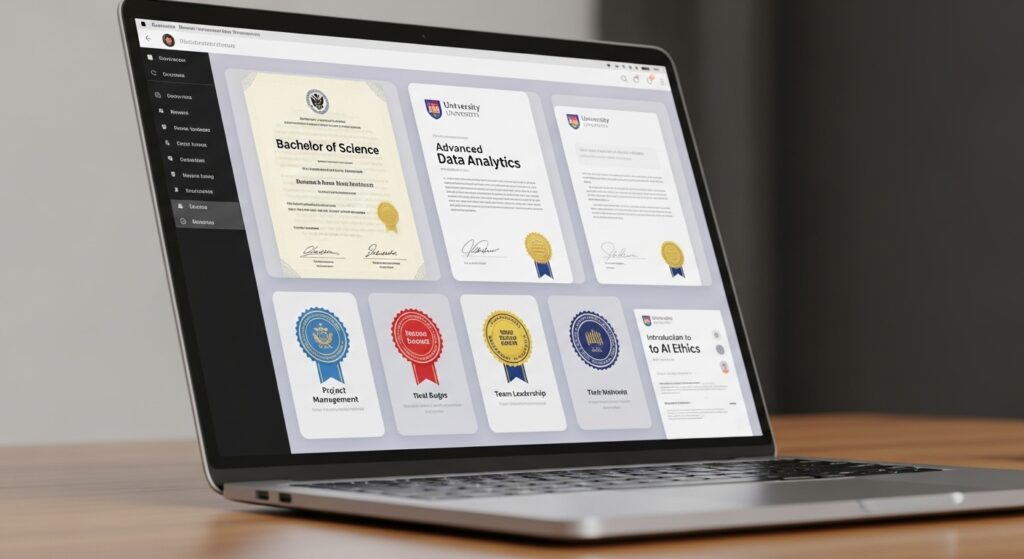
The term covers a broader spectrum of academic records than most people assume. It is not simply a PDF version of a paper certificate. Digital academic credentials encompass:
- Digital diplomas: Full degree awards issued in verifiable digital format, with embedded metadata confirming the institution, programme, and award date.
- Digital certificates: Course and programme completion records, typically for short qualifications or professional development programmes.
- Micro-credentials: Targeted, competency-based qualifications representing specific skills, stackable toward broader qualifications or used independently.
- Digital badges: Visual representations of verified skills or achievements, shareable across professional networks and platforms.
According to 1EdTech’s 2025 Badge Count, the number of digital badges available to learners has more than tripled since 2022, rising from 521,000 to over 1.7 million. Academic credentials, including digital diplomas, transcripts, and badges, represent approximately 41% of the total digital credentialing market. These are not peripheral formats; they are rapidly becoming the primary record of learning for millions of graduates worldwide.
Benefits of Digital Credentials in Higher Education for Institutions

For university leaders, the case is compelling on several fronts simultaneously.
Verification becomes immediate. When the National University of Singapore adopted a blockchain-based verification system, transcript verification time dropped from weeks to seconds. That is not an incremental improvement; it is a structural one. The registrar’s office stops being a bottleneck.
Fraud is significantly reduced. The counterfeiting of academic qualifications is a substantial and well-documented global problem. Blockchain-secured credentials are cryptographically signed and tamper-proof by design: any alteration to the record invalidates the hash, making forgery immediately detectable by any verification tool.
International recognition becomes clearer. With frameworks such as the European Qualifications Framework providing standardised qualification levels, and institutions adopting interoperable open standards, digital records can be assessed and recognised across jurisdictions far more reliably than paper equivalents.
Record sharing with employers accelerates. Graduates can share credentials directly and instantly, without routing requests through institutional offices. For institutions seeking to improve graduate employability outcomes, speed matters.
Benefits for Students and Employers

The student benefit is perhaps the most significant of all: ownership. With digital academic credentials, students hold their own records independently of whether their institution continues to exist, whether its systems remain accessible, or whether the relevant administrator is available to respond to a query. Credentials belong to the learner, for life.
For students pursuing global careers or international study, the portability of digital records removes a persistent friction point. An international employer or admissions office can verify a qualification from a university in Lagos, London, or Lahore in seconds, without correspondence delays or translation barriers.
Employers gain equivalent advantages. Instead of waiting on background checks that require third-party verification services, hiring teams can receive a credential link from a candidate and confirm its authenticity immediately. The entire verification process, which once took two weeks, can now take under a minute. For fast-moving recruitment pipelines, that matters enormously.
Read more: Digital Credentials: The Future of Academic Recognition
The Technology Behind Digital Credential Systems

Three interconnected technologies make modern digital credentials in education work.
Blockchain verification creates the underlying architecture of trust. A credential is not simply stored on a server; it is recorded as a cryptographic hash on a distributed ledger, making it immutable and independently verifiable. MIT’s Blockcerts initiative, developed by the MIT Media Lab, was among the first large-scale applications of this principle, issuing blockchain-based diplomas from 2017 and reducing verification from weeks to seconds.
Secure credential platforms manage the issuance, storage, and sharing workflow, providing the institutional infrastructure through which credentials are generated and distributed. Cloud-based deployment now accounts for approximately 69% of new installations, valued for scalability and cost efficiency.
Digital identity systems connect the credential to the individual. Open standards such as the W3C Verifiable Credentials Data Model provide a common framework ensuring that credentials issued on different platforms or blockchain networks remain universally readable and verifiable. Security and interoperability are not optional features; they are the entire point of the system.
Challenges Universities Face in Implementing Digital Credentials
The case for digital credentials in education is clear, but the implementation path is rarely straightforward.
Infrastructure fragmentation is the most common barrier. Student records, academic systems, and institutional databases often sit in separate, incompatible systems. Moving to digital credentialing requires those systems to communicate, which frequently means significant integration work before any credential can be issued.
Interoperability across platforms remains an active challenge. Without shared open standards, credentials issued on one platform may not be readable by the employer or institution using another. Governance bodies, including 1EdTech and the W3C, are working to address this, but standards adoption across sectors is uneven.
Regulatory compliance adds complexity, particularly in regions governed by GDPR. The way credentials are stored, who can access them, and how long they are retained all require careful policy design. Storing personal data on a public blockchain, for instance, can create genuine tension with data minimisation principles.
Institutional resistance to change should not be underestimated. For many academics and administrators, the paper diploma carries symbolic and cultural weight. Shifting to digital formats requires not only technical change but a sustained conversation about what credentials represent and why their security matters.
Read more: How Universities Measure the Success of Digital Transformation
Building a Digital Credentials Strategy for Universities

Institutions that approach implementation with a clear framework are far more likely to succeed than those that adopt platforms without the governance to support them.
A practical strategy should include:
- Mapping existing data systems to understand what integration work is required before credential issuance can begin.
- Adopting open standards such as Open Badges or W3C Verifiable Credentials ensures that issued credentials remain interoperable and future-proof.
- Establishing a governance framework that defines credential types, issuance criteria, access controls, and retention policies in compliance with data protection obligations.
- Piloting with a single cohort or programme before scaling institution-wide, allowing the institution to test workflows, resolve issues, and demonstrate value before committing to full deployment.
- Training staff and communicating with students so that the value of digital credentials is understood and the sharing process is straightforward from day one.
Edutech Global supports institutions at precisely this stage, helping senior leaders translate credential strategy into structured, scalable implementation. For further resources on institutional digital transformation, the Edutech Global blog covers the full range of higher education technology considerations.
The Future of Digital Credentials in Global Education
The World Economic Forum has identified lifelong learning records and skills-based recognition as defining features of the future labour market. Digital credentials in education sit directly at the intersection of those trends.
The developments that will shape the next decade include:
- Global credential networks, enabling real-time cross-border recognition through shared interoperability frameworks, building on work already underway through UNESCO and the European Qualifications Framework.
- Lifelong learning records, aggregating credentials from formal degrees, short courses, micro-credentials, and workplace training into a single portable record.
- Skills-based certification ecosystems, in which employers specify the competencies they need and graduates demonstrate those competencies through stacked, verifiable credential profiles rather than degree titles alone.
- Integration with digital identity systems, ensuring that credential verification is seamless within the broader digital identity infrastructure, particularly as national digital ID programmes expand.