

The global demand for cross-border education has never been stronger. According to the UNESCO Institute of Statistics, there were an estimated 6.9 million international students worldwide in 2022, up from just 2.5 million two decades earlier, and that number is projected to surpass 10 million by 2030. This is one of the most significant growth markets in higher education, and the institutions winning it are not necessarily the ones with the largest physical footprint. They are the ones with the sharpest international student recruitment strategy.
Here is the uncomfortable reality that most university leadership teams have yet to fully confront: students no longer discover universities at education fairs or through glossy brochures handed out by agents in Lagos, Mumbai, or Hanoi. They discover universities online, on YouTube, through comparison tools, in WhatsApp groups, and during late-night Google searches. If your institution is not visible, accessible, and responsive in those spaces, you are already losing ground to competitors who are. The good news is that building a world-class global acquisition engine no longer requires opening branch campuses or stationing recruitment staff on three continents. It requires systems, not just presence.
Read More: How Global Universities Run Pan-African Online Programs
Why Traditional International Recruitment Models Are Failing
For decades, universities relied on a familiar playbook: appoint education agents in key markets, attend international fairs, send brochures, and hope the pipeline fills itself. That model is fracturing under the weight of its own inefficiency.
The problems are structural. Agent networks are expensive to manage, inconsistent in quality, and difficult to monitor for compliance. International fairs are high-cost, low-yield events where a single institution might speak to hundreds of students but convert very few, with no reliable way to track who showed genuine interest and who simply picked up a tote bag. Manual follow-up processes mean that a student who enquired in January may not hear back until March, by which point they have enrolled elsewhere.
A broken international student recruitment strategy does not just mean fewer applications. It means wasted budget, missed targets, and an inability to identify which markets are performing and which are draining resources. Universities are essentially operating blind in markets they claim to prioritise.
What a Modern International Student Recruitment Strategy Looks Like

Effective global acquisition is no longer about touchpoints; it is about systems. A modern international student recruitment strategy connects three layers into a single functioning engine:
Digital-first discovery means students find your institution through search engines, targeted advertising, and content that answers their questions before they even know which university they want. SEO-optimised programme pages, YouTube explainers, and paid social campaigns in key source markets such as India, Nigeria, Vietnam, and Bangladesh form the top of this engine.
Centralised application infrastructure replaces the chaotic email trails and agent portals with a single, simple process. Students from any country complete one streamlined application, in their own time, on any device.
Automated communication ensures that no lead goes cold. From the first enquiry to the final enrolment confirmation, every touchpoint is triggered, timed, and personalised, without requiring a staff member to manually send every email.
The critical distinction here is that these are not three separate tools. There are three stages of a connected pipeline. Breaking them apart is what causes the drop-offs that cost universities thousands of potential enrolments annually.
The Digital Recruitment Funnel: Where Students Are Won and Lost

Understanding the digital recruitment funnel is essential for any institution serious about global student acquisition. Here is how each stage works, and where universities typically fail:
Stage 1: Awareness. Students learn that your institution exists through Google search results, Instagram or LinkedIn ads, and YouTube content. If your programme pages rank poorly or your ad targeting is broad and untested, you are invisible in the very moment students are forming their shortlists.
Stage 2: Interest. Once a student lands on your site, they need programme comparisons, scholarship information, alumni stories, and clear outcome data. Landing pages that are slow, cluttered, or vague will lose a student in under 30 seconds. This is where most universities haemorrhage qualified prospects.
Stage 3: Application. The application process must be fast and mobile-friendly. A student in Abuja applying at 11 p.m. on a smartphone will not complete a 14-step PDF-based form. Friction at this stage is the single biggest driver of drop-off in cross-border student enrollment.
Stage 4: Enrollment. Speed of decision matters enormously. Students who receive an offer within 48 hours are significantly more likely to accept than those left waiting for weeks. Automated onboarding, visa guidance, and pre-arrival communication keep the momentum from application to arrival.
Read More: How Partner Institutions Can Expand Global Enrolment Through EdTech Collaborations
Universities attempting to scale their international reach without fixing their underlying systems consistently run into the same three obstacles:
- No cross-market visibility: Institutions cannot see which countries, campaigns, or channels are producing their best applicants. Decisions are made on assumptions rather than data.
- Poor lead tracking: Enquiries arrive through multiple channels and immediately fall into silos, inboxes, spreadsheets, or agent reports that no one consolidates.
- Slow response times: Research consistently shows that the first institution to respond to an enquiry has a disproportionate advantage. Universities operating on manual workflows routinely respond days after a competitor has already made contact.
These are not resource problems. They are system problems. And they are solvable.
How Digital Platforms Enable Cross-Border Enrollment
The institutions growing their international numbers most effectively are those that have centralised their recruitment operations onto a single digital platform, regardless of how many countries they are targeting. A well-configured digital recruitment funnel for a university handles enquiries from Nigeria, India, and Colombia through the same pipeline, with localised communication, programme-specific follow-up sequences, and real-time dashboards showing where each prospect sits in the journey.
EduTech Global builds exactly this kind of infrastructure. Rather than asking universities to stitch together disconnected tools, a centralised pipeline removes the gaps where students are lost and gives institutions the visibility to make informed decisions about where to invest their recruitment budgets.
What Universities Gain: The Business Case
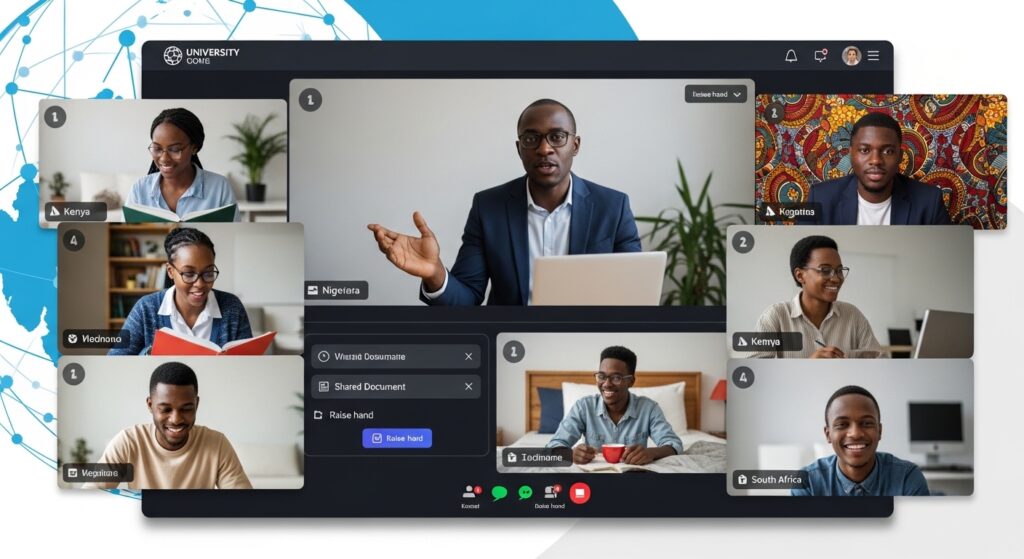
The impact of a well-built international student recruitment strategy is measurable and significant:
- Higher application volume from markets previously too costly or complex to serve through agents alone
- Better conversion rates because automated follow-up and faster decision cycles keep qualified prospects engaged
- Shorter enrollment cycles that reduce the time between first enquiry and confirmed enrolment, improving financial forecasting
- Cleaner data to inform strategy, budget allocation, and market prioritisation year over year
The OECD notes that international students represent a significant share of tertiary enrolment in leading destination countries, and their economic contribution extends well beyond tuition fees. For the 2024/25 academic year, international students in the United States alone contributed $42.9 billion to the economy. The revenue case for getting this right is compelling.
How to Build a Scalable Recruitment System: Practical Steps
Universities ready to move from ad hoc recruitment to a functioning global engine should focus on four actions:
Build the digital funnel first. Invest in SEO for programme pages, run targeted paid campaigns in your priority source markets, and ensure every ad leads to a landing page built for conversion, not just information.
Automate admissions communication. A CRM configured for international recruitment should send acknowledgement emails instantly, prompt applicants who have not completed their documents, and notify them of decisions without requiring manual intervention from admissions staff.
Improve response speed. Set an internal target of responding to every international enquiry within 24 hours. Then build the automation to make that target effortless rather than heroic.
Track everything. Funnel analytics should show you where students enter, where they drop off, and which channels produce the applicants most likely to enrol. Without this data, budget decisions are guesswork.
What Should Your University Do Next?

The right starting point depends on where your current gaps are:
- No international leads at all? Your visibility problem is the priority. Fix your SEO, launch targeted campaigns, and ensure your institution appears where prospective students are searching.
- Leads coming in but low applications? The funnel is leaking. Review your landing pages, simplify the application process, and check whether your enquiry-to-application response time is competitive.
- Applications arriving but students dropping off before enrolment? The process is too slow or too complex. Automate decision communication and build a structured pre-arrival journey.
EduTech Global supports institutions at each of these stages, building global student pipelines that are system-driven, measurable, and designed to scale. Whether you are recruiting from five countries or fifty, the infrastructure should work the same way: automated, trackable, and fast. Explore the EduTech Global blog for further insight on digital-first approaches to education management and student acquisition.
The window for getting ahead of this shift is narrowing. The universities that invest in the right international student recruitment strategy today will not just survive the next decade of global competition; they will define it.
Frequently Asked Questions
What is an international student recruitment strategy?
It is a structured, system-driven approach to attracting, engaging, and enrolling students from outside a university’s home country. An effective strategy combines digital visibility, streamlined application processes, automated communication, and data tracking to convert global interest into confirmed enrolments.
How can universities recruit globally without opening campuses?
By building a digital-first recruitment engine that includes SEO-optimised content, targeted advertising in key source markets, a centralised application platform, and automated follow-up sequences. Physical presence is no longer a prerequisite for global reach; digital infrastructure is.
What is the biggest challenge in global student acquisition?
The most common challenge is the absence of a connected system. Universities typically have some tools in place, but they operate in silos, meaning leads are lost between enquiry and application, and there is no visibility into which channels or markets are performing.
How can universities increase international enrolment?
By addressing the three key failure points in their current model: poor digital visibility, slow response times, and friction in the application process. Universities that fix these systematically, rather than symptom by symptom, consistently see significant improvements in both application volume and conversion rates.