

Most international university partnerships fail quietly. A memorandum of understanding gets signed, a launch event is held, and then, nothing. Twelve months later, enrolment targets remain unmet, student queries go unanswered, and both parties quietly move on. Research published on Wonkhe confirms what many education professionals already know: most partnerships are designed to preserve institutional autonomy rather than drive results, making meaningful collaboration nearly impossible from the outset. The consequence is predictable: low enrolment, poor student experience, and broken trust on both sides.
The global demand for higher education has never been stronger. UNESCO’s 2024 Higher Education Global Trends Report found that 269 million students are now enrolled in higher education worldwide, with international student mobility tripling over the past two decades. Africa remains significantly underserved: only 9% of young people in sub-Saharan Africa are enrolled in higher education. The opportunity is vast, but capturing it requires more than a signed agreement. It requires a structured, accountable university partnership model in international education built for the long term. That is precisely what EduTech Global has built.
Read More: Cross-Border Education Partnerships: How Universities Expand Globally
Why Most University Partnerships Fail Within 18 Months

The failure pattern is well-documented. Institutions enter partnerships with vague intentions and little operational infrastructure to back them up. The specific reasons are consistent across the sector:
- Unclear expectations: No agreed enrolment targets, no defined roles, no accountability framework.
- Weak student support: Students are recruited but receive little guidance post-admission, leading to drop-offs and reputational damage.
- No local presence: International partners operate remotely, without on-the-ground advisors who understand the student’s context.
- Poor communication: Reporting is irregular, issues escalate slowly, and strategic misalignment sets in early.
- Technology gaps: Enrolment processes remain manual and fragmented, creating friction at every stage of the student journey.
The impact is felt at every level. Universities miss revenue targets. Students receive a substandard experience. Agents lose confidence. And the relationship deteriorates precisely when it should be growing. For universities serious about international growth, the answer is not to avoid partnerships, but to choose a university partnership model in international education that removes these structural weaknesses from the start.
How EduTech Global Structures Its University Partnerships
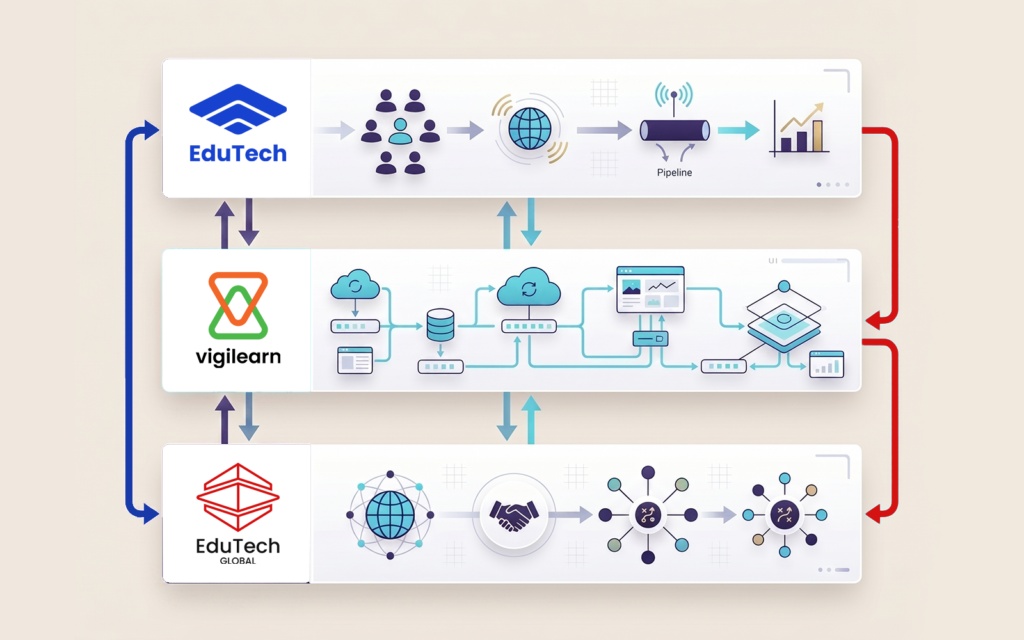
What sets EduTech Global apart is its full-stack approach: one ecosystem that covers every layer of international enrolment, from first enquiry to enrolled student. The model operates through three integrated entities.
EduTech Business manages the student-facing side: recruitment, lead management, and application processing. Advisors work directly with prospective students across African markets, guiding them through programme selection, documentation, and submission.
Vigilearn provides the technology backbone: digital enrolment systems, application portals, and data infrastructure that streamline the journey for both students and university administrators.
EduTech Global leads strategy and manages all university-facing relationships, ensuring alignment between institutional goals and on-the-ground execution.
The result is a university partnership model in international education with no operational gaps. Universities are not handed a lead sheet and left to convert it themselves. Every stage is managed, tracked, and accountable.
The Onboarding Process: From Conversation to Live Enrolment
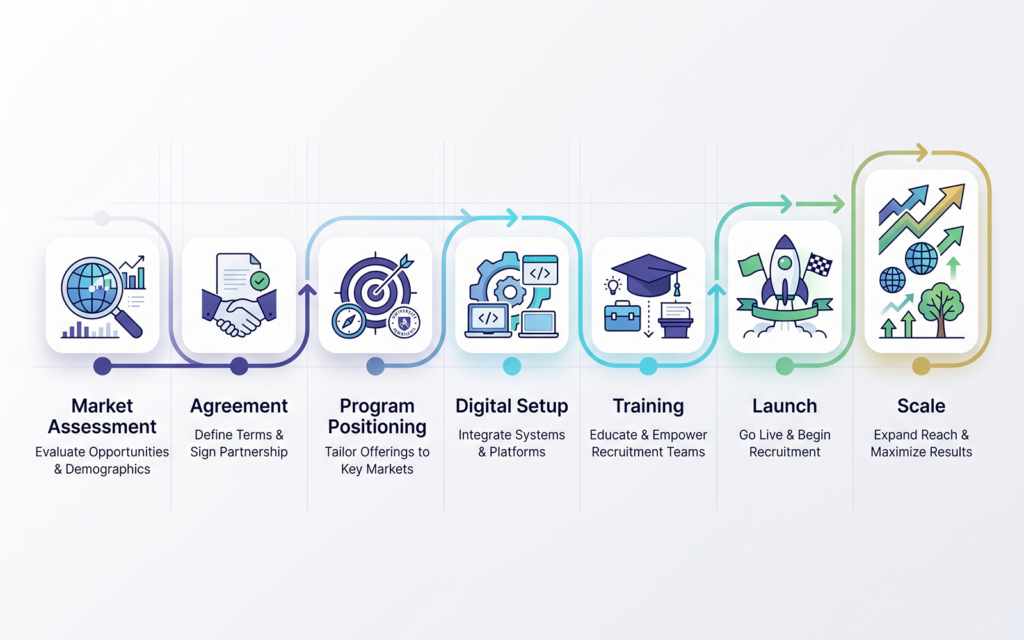
For universities considering a partnership, the process is deliberate and structured. It moves through seven clear stages:
- Market fit assessment: Understanding which of the university’s programmes have genuine demand in target markets, particularly across Africa.
- Agreement structure: Establishing clear enrolment targets, responsibilities, and timelines in a formal higher education partnership agreement.
- Programme positioning workshop: Collaboratively shaping how the university’s offerings are communicated to African students.
- Digital enrolment setup: Integrating the university’s processes with Vigilearn’s technology infrastructure.
- Advisor and agent training: Ensuring every frontline advisor deeply understands the university’s programmes, culture, and requirements.
- Pilot cohort launch: A controlled first intake to test systems, identify gaps, and build confidence on both sides.
- Scale phase: Full rollout with optimised processes and expanded outreach.
This is what distinguishes a serious international student recruitment partnership from a loose referral arrangement.
Read More: Public-Private Partnership in Education: Models and Impact
What Universities Get Access To

When a university partners with EduTech Global, they gain immediate access to a suite of resources that would take years to build independently:
- A student distribution network concentrated across Africa, one of the fastest-growing regions for international enrolment, recording the highest growth rate among all world regions for two consecutive years according to IIE data.
- Digital enrolment systems that reduce friction, accelerate processing, and generate real-time data.
- Trained advisors who understand both the student’s context and the university’s expectations.
- Marketing and positioning support to differentiate the university’s programmes in competitive markets.
- Real-time reporting dashboards giving university administrators visibility into pipeline performance at any point.
The outcome is faster enrolment, better-prepared students, and a measurably improved experience from first enquiry through to programme commencement.
Partnership Governance: How Accountability Is Maintained
This is where many university enrollment partnership Africa models unravel: accountability. EduTech Global builds governance directly into the partnership structure. There are no vague commitments.
Accountability is maintained through agreed enrolment targets, regular performance tracking, quarterly strategy reviews with university leadership, student feedback mechanisms, and clear escalation processes when standards are not met.
University boards and international enrolment teams have full visibility into what is working and what needs adjustment. This level of transparency is rare in the sector, and it is foundational to how EduTech Global sustains long-term partnerships rather than simply launching them.
EduTech Global: A Long-Term Partner, Not a Lead Generator
The university partnership model in international education that EduTech Global operates is fundamentally different from the transactional models that flood the market. This is not a lead-generation service. It is a structured, technology-enabled, accountable growth partnership designed to scale with the university’s ambitions.
For university leaders and board members assessing their international enrolment strategy, the question is not whether to pursue international growth. With OECD data showing over 2.1 million students newly moving to OECD countries in 2023 alone, demand is undeniable. The question is whether your current partnership model is built to capture it.
Book a confidential strategy call with EduTech Global to understand your growth potential in African and international markets. Explore more insights on international higher education strategy on the EduTech Global blog.
Frequently Asked Questions
What is a university partnership model in international education? It is a structured arrangement between a university and an international recruitment or education partner, defining how students are recruited, supported, and enrolled across international markets. A strong model includes clear targets, technology infrastructure, trained advisors, and governance mechanisms.
How do universities partner for student recruitment? Universities typically engage recruitment agents, education consultancies, or specialist partners such as EduTech Global to reach students in target markets. The most effective partnerships go beyond referrals to include application management, student support, and performance reporting.
What makes a strong international enrollment partnership? Clear expectations, local market presence, end-to-end technology support, trained frontline advisors, and structured accountability through regular performance reviews. Without these elements, most partnerships stall within 18 months.
How long does it take to start seeing results? With EduTech Global’s structured onboarding, universities typically complete their pilot cohort launch within the first enrolment cycle. Consistent pipeline growth follows as processes are refined and the advisor network deepens its market presence.