

Somewhere right now, a university is celebrating a new international partnership. There will be a signing ceremony, a photograph of two Vice Chancellors shaking hands, and a press release describing a strategic alliance that will transform mobility between two continents. In eighteen months, nothing will have come of it. Here is exactly why.
This is the conversation that rarely makes the press release: a great many university international partnerships fail, and they fail quietly, long after the cameras have gone home. The Memorandum of Understanding has become the most celebrated and least useful document in international higher education. It is treated as the finish line when, in truth, it is barely the starting gun. Ask any international office director who has lived through several partnership cycles, and they will describe the same arc: enthusiasm at signing, a flurry of emails in the first quarter, then a slow drift into silence that nobody quite announces. Understanding why university international partnerships fail begins with a hard look at what that document does, and does not do, once the ink is dry.
None of this happens because institutions lack goodwill; most partnerships are signed with genuine intent and a defensible strategic rationale. What follows is the honest conversation that tends to happen only after the press release has been forgotten, once a partnership has quietly stalled.
Read More: How EduTech Global Builds University Partnerships That Last: A Behind-the-Scenes Look
The MOU Problem: Why University International Partnerships Fail Before They Start

An MOU is, by design, a statement of intent rather than a plan of action. It signals goodwill and a shared direction of travel, but typically carries no funding commitment, no operational structure, no accountability mechanism, and no timeline against which progress can be measured. That is not a flaw in the document; it is what an MOU is meant to be, a first handshake before deeper commitments are negotiated. The trouble starts when institutions treat the signing as the achievement itself, rather than the opening move in a longer negotiation about who does what, and by when.
Recent analysis of higher education alliances published by Wonkhe makes a similar argument about why so many collaborations stall: they are frequently structured to let institutions appear cooperative while each side remains entirely self-directed, which limits what the partnership can ever produce. The International Association of Universities has reached comparable conclusions through its successive Global Surveys on internationalisation, which have repeatedly identified limited funding and a lack of genuine interest between prospective partner institutions as among the most persistent barriers to meaningful cooperation.
Several recurring faults show up across the partnerships that stall:
- Unclear ownership, where each side assumes the other will drive implementation.
- No budget attached, so momentum dies once the novelty of signing fades.
- Misaligned incentives, where what one institution needs is not what the other is positioned to offer.
- Hierarchy delays, with proposals stuck in approval chains that outlast the energy generated at signing.
- No dedicated partnership manager, so responsibility is spread so thinly that nobody actually owns it.
The Real Cost of Failed Partnerships
A failed partnership is not a neutral outcome. It is tempting to treat an unproductive MOU as a low-risk experiment, since no obvious damage follows from a quiet drift into inactivity. That framing understates what has actually been spent. Senior leadership time goes into signing ceremonies and delegation travel; legal and international office teams spend weeks drafting and reviewing terms that may never be operationalised; and every hour spent nurturing a partnership that was never going to move generates an opportunity cost, since a better-matched partner might have used those same resources productively.
Then there is the pipeline promised internally but never realised, the cohort of students that a Vice Chancellor mentioned to the board that simply never arrived. And if the stall becomes visible externally, whether to a regulator, a rival institution, or a partner doing due diligence, there is a reputational cost that outlasts the partnership itself. This explains why university international partnerships fail to translate into anything beyond reputational risk: the energy spent on a relationship that goes nowhere erodes confidence in the institution’s broader international strategy, making the next genuine opportunity harder to pursue with conviction.
Read More: Cross-Border Education Partnerships: How Universities Expand Globally
What Actually Makes University Partnerships Work
The shift from ceremonial agreement to working partnership rests on a handful of structural conditions, and they are conditions, not aspirations. Both institutions need a shared commercial logic: a specific, articulable reason the partnership benefits each of them financially or strategically, rather than a vague sense that collaboration is generally good practice. The World Economic Forum has noted that collaboration between academic institutions and external partners is increasingly treated as a necessity rather than a best-practice extra, citing schemes such as the UK’s Prosperity Partnerships, which pair universities with industry around defined, resourced challenges rather than open-ended goodwill.
Working partnerships also need operational infrastructure from day one: agreed workflows, a shared or interoperable student management system, and a defined application and enrolment pathway that does not depend on goodwill to function. They need a named, accountable contact on each side, not a committee, since shared responsibility tends to dissolve into no responsibility at all. A revenue-sharing or cost-sharing model changes the dynamic considerably, because both institutions then have something tangible at stake rather than a reputational interest alone. A 90-day activation milestone, written into the agreement itself, forces an honest reckoning early: if no student movement has occurred within three months of signing, the partnership is at risk and needs intervention. Finally, an honest market fit assessment before signing, verifying real demand rather than assuming it, prevents institutions from formalising relationships that were never going to produce students.
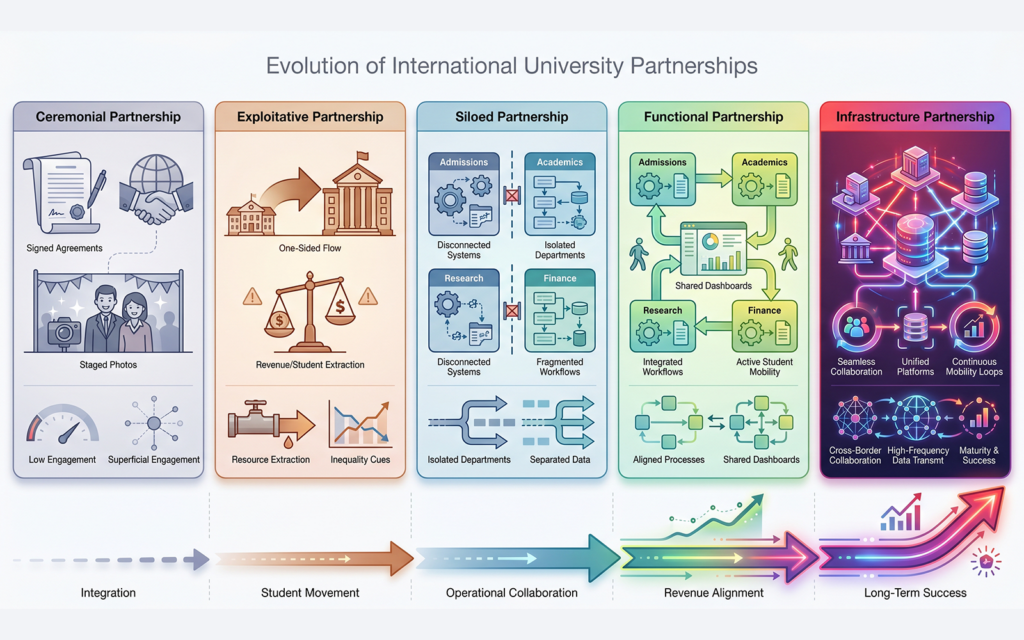
The Five Partnership Archetypes: Which One Are You Building?

Most international partnerships fall into one of five recognisable patterns.
- The Ceremonial Partnership. The MOU is signed, the photograph is taken, and both sides quietly move on within a year.
- The Exploitative Partnership. One party extracts value while the other supplies it, usually ending in resentment.
- The Siloed Partnership. Both institutions work in parallel but never integrate their systems or efforts, producing limited results.
- The Functional Partnership. Operational and sustainable, it produces modest student movement without being transformative.
- The Infrastructure Partnership. Deeply integrated and commercially aligned, this model compounds results year on year.
Most institutions can identify, with some discomfort, which archetype describes their current portfolio. The honest question is not whether a partnership looks impressive on paper, but which of these five categories it will actually become within twelve months.
The Enrolment Question Most Partnership Conversations Never Ask

Most partnership conversations open with questions about prestige alignment, geography, and academic compatibility. Almost none open with the question that actually determines success: how many students will move through this partnership in the first twelve months, and what operational infrastructure will make that happen? International student mobility has grown substantially over the past decade, with the number of internationally mobile students across OECD countries rising from around three million in 2014 to over 4.6 million by 2022. That growth represents an enormous opportunity, but only for institutions whose partnerships are structured to capture it operationally rather than aspirationally.
Enrolment velocity, not signing ceremony enthusiasm, is the defining indicator of partnership health. A working pipeline requires a shared lead generation and recruitment strategy, coordinated admissions processing so applications do not stall between two systems, clear communication to prospective students about what the partnership offers them, and regular reporting on pipeline status to both institutions. Without these, even a well-intentioned agreement between compatible institutions will struggle to produce a single enrolled student.
How EduTech Global Builds Partnerships That Last
EduTech Global approaches partnership-building differently because every agreement begins with a market fit assessment, not a signing ceremony. Operational infrastructure, including enrolment systems, student communication pathways, and application processing, is established before launch rather than negotiated afterwards. Revenue-sharing models align incentives on both sides from the outset, and a dedicated partnership manager owns implementation from day one, rather than leaving accountability to a rotating committee. A 90-day enrolment milestone is built into every agreement, so progress, or its absence, is visible early rather than discovered eighteen months later. The result treats the MOU as the opening conversation it was always meant to be, not the deliverable.
The Honest Checklist: Before Signing Your Next Partnership Agreement
Before the next signature goes on the page, institutional leaders should be able to answer the following:
- Who on both sides owns implementation?
- What is the 90-day activation milestone?
- How will student applications move through this partnership operationally?
- What does each side gain commercially?
- What happens if no students move in the first twelve months?
- Is there a shared technology or operational infrastructure already in place?
If any of these questions cannot be answered before signing, the agreement is closer to a ceremonial partnership than a functional one, regardless of how the press release reads.
From Signing Ceremony to Operational Reality
Going back to the question of why university international partnerships fail, the answer is rarely about academic incompatibility or insufficient prestige. It is almost always about what happens, or fails to happen, after the signature: no named owner, no budget, no infrastructure, and no honest measure of progress. Organisations such as the British Council have found that trust, shared vision, and long-term commitment separate partnerships that deliver real outcomes from those that exist only on paper, and those qualities must be built into the operational design of an agreement, not assumed from goodwill alone.
For Vice Chancellors and international office directors evaluating the next proposal on their desk, the discipline is straightforward, even if it is rarely applied: treat the MOU as a beginning, insist on named ownership and a funded plan, and build in a milestone that forces honesty within ninety days. Most university partnerships fail quietly.
EduTech Global builds the ones that do not. Explore our partnership model and discover how we structure international education agreements around operational infrastructure, commercial alignment, and measurable enrolment outcomes from day one, or contact our partnerships team directly to discuss what a working partnership could look like for your institution.
Read More: Public-Private Partnership in Education: Models and Impact
Frequently Asked Questions
Why do most university international partnerships fail? Most fail because the MOU they signed was never designed to carry operational weight. Without a named owner, dedicated budget, and a measurable timeline, even well-intentioned agreements drift into inactivity once the initial enthusiasm fades.
What is the difference between an MOU and a real university partnership? An MOU is a statement of intent. A real partnership has operational infrastructure, shared systems, a funded implementation plan, and a named contact with the authority to act on both sides.
How do you build a successful international education partnership? Start with an honest market fit assessment, agree on commercial terms that benefit both sides, assign a dedicated partnership manager, build in a 90-day activation milestone, and establish enrolment infrastructure before launch rather than after.
What should a university look for in an international education partner? Look for a partner who asks about enrolment mechanics and operational fit before discussing prestige, and who is willing to put resourcing and accountability structures in writing rather than relying on goodwill.
How long does it take for a university partnership to produce results? There is no universal answer, but a partnership that has not produced any student movement within ninety days of signing should be treated as at risk, not simply early-stage.
What is a revenue-sharing university partnership model? It is an arrangement in which both institutions have a direct financial stake in the partnership’s enrolment outcomes, which tends to align incentives far more effectively than a purely reputational or academic agreement.