
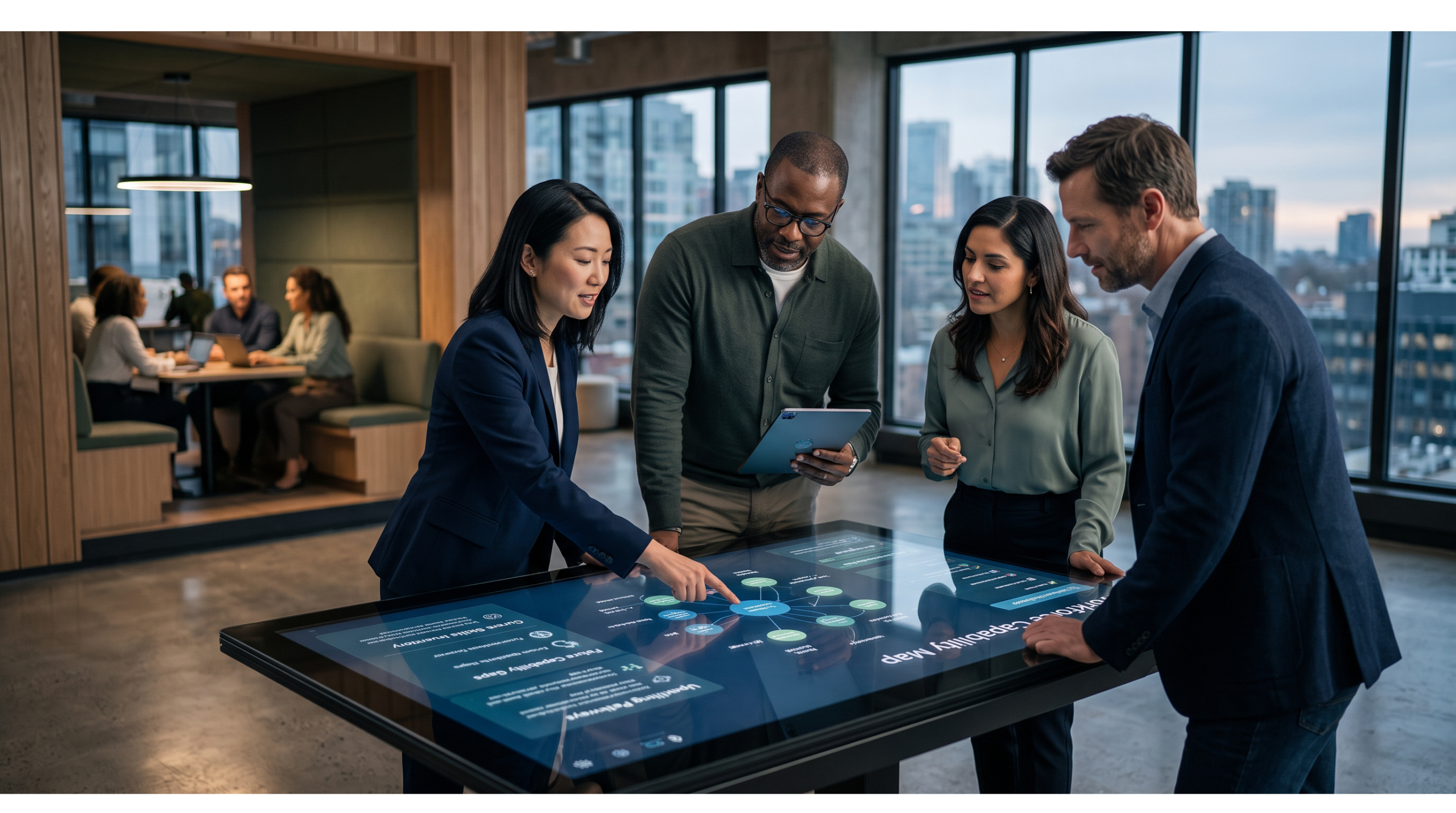
The pace at which jobs are changing is making reskilling and upskilling less of an HR initiative and more of an operational necessity. New technologies are changing the tools people use, the tasks they perform and, in some cases, the skills a role requires in the first place. A person who was fully equipped for their job a few years ago may now need to learn new skills simply to keep pace with it. For companies, the challenge is no longer just finding people with the right skills. It is keeping those skills relevant as the work itself changes.
That requires more than adding courses to a learning catalogue or sending employees to occasional training sessions. Companies need to know which skills they have today, where the gaps are emerging and how employees can move from their current capabilities to the ones the business will need next. Done well, reskilling and upskilling become part of how an organisation plans its workforce, rather than something that happens after a skills gap becomes a problem.
For business leaders, HR teams and L&D professionals, this shift raises a more practical question: how do you build a workforce that can keep learning as the business keeps changing? The answer lies in treating workforce development as an ongoing system of identifying, building, measuring and validating skills.
Read More: Certificate Verification: Why Institutions and Employers Can’t Afford to Trust Paper Anymore
Reskilling and Upskilling: What’s the Difference?
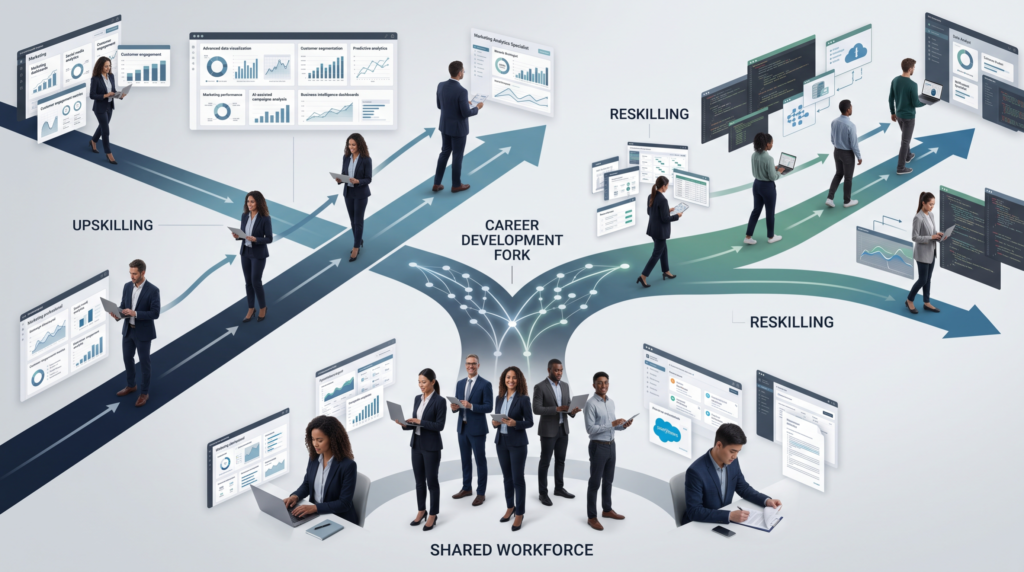
The two terms get used interchangeably, but they describe different interventions. Upskilling helps employees develop new or more advanced skills for their current or evolving roles: a marketing professional learning AI-powered analytics tools to do their existing job better. Reskilling prepares employees to move into a substantially different role: an operations employee retraining to become a data analyst as their original function is automated.
| Upskilling | Reskilling | |
| Primary purpose | Improve existing capabilities | Prepare for a different role |
| Employee direction | Deeper or broader in current role | Move into another role |
| Example | Marketing professional learning AI analytics | Operations employee training for a data analyst role |
| Business objective | Improve current productivity | Build internal talent for emerging roles |
Most organisations need both running simultaneously. Upskilling keeps existing roles productive as tools and expectations change; reskilling protects the business, and the employee, when a role is disappearing faster than a replacement can be hired externally. Treating them as a single undifferentiated “training” budget line is usually where workforce reskilling programmes start to lose focus.
Why Workforce Skills Are Changing Faster Than Before
The pace of change is not a perception problem; it shows up clearly in the data. The World Economic Forum’s Future of Jobs Report 2025 found that employers expect 39% of workers’ core skills to change by 2030, and that if the global workforce were represented by 100 people, 59 would need reskilling or upskilling within that period, with 11 of them unlikely to receive it. The report also found that 77% of employers plan to prioritise upskilling as their primary response to AI-driven and other workforce changes, more than any other strategy, including new hiring.
AI, automation, new technology stacks and shifting customer expectations are compounding each other rather than arriving one at a time, which is why static, annual training calendars struggle to keep up. A course designed around last year’s tools is often obsolete before the cohort finishes it. McKinsey’s research on learning and development in the AI age makes the same point from the employer side, arguing that L&D needs to become part of the engine of organisational performance and resilience rather than a support function that reacts once a skills gap has already cost the business money.
Crucially, future of work skills are not purely technical. The World Economic Forum’s research consistently finds that analytical thinking, resilience, and leadership and social influence sit alongside technology skills such as AI and data literacy among employers’ top priorities, which means an effective reskilling and upskilling strategy has to build human capabilities alongside technical ones, not instead of them.
Read More: Digital Credentials: The Future of Academic Recognition
The Cost of an Unresolved Skills Gap
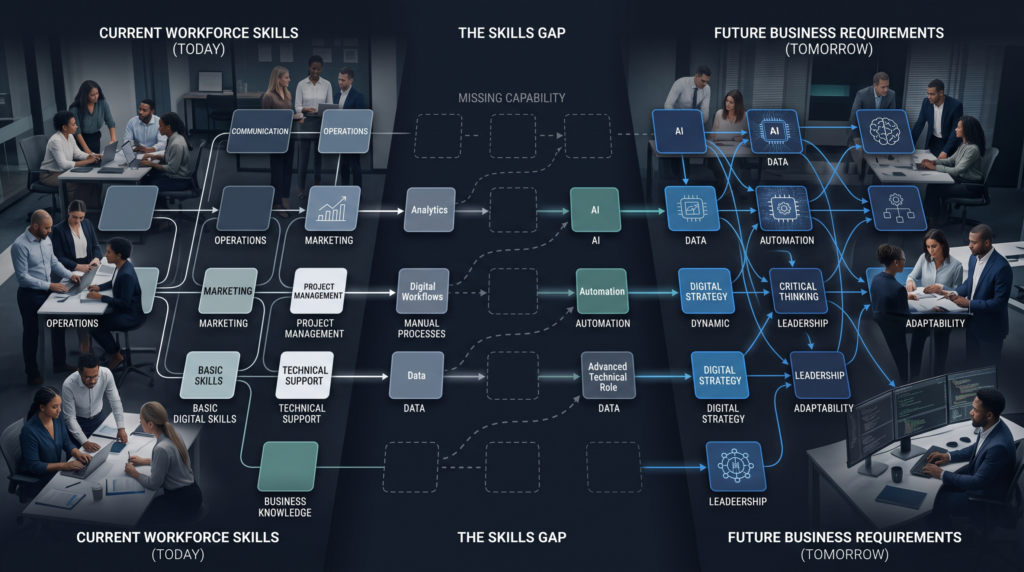
Employers are not underestimating the scale of the problem. The World Economic Forum’s research identifies skills gaps as the single biggest barrier to business transformation, and notes that the share of the global workforce completing training as part of long-term learning strategies has risen to 50%, up from 41% in 2023, a sign that skills gap training is shifting from occasional initiative to standing practice. That still leaves roughly half the workforce without structured development, which is precisely the gap that widens fastest during periods of technological change.
External hiring alone cannot close that gap. Specialist skills are scarce and expensive to recruit for, new hires need months to reach full productivity, and every vacancy filled externally is institutional knowledge that has to be rebuilt from scratch. Existing employees already understand the business, its systems and its customers; the “build versus buy” calculation increasingly favours investing in the people already on the payroll, which is exactly the logic behind reskilling as a workforce development strategy rather than a fallback option. Organisations that treat workforce development as core infrastructure, rather than an HR side project, tend to weather skill disruption with far less operational strain than those relying on the external market alone.
How Companies Identify Which Skills They Need
A credible workforce reskilling programme starts with a clear-eyed map, not a training catalogue. That typically draws on several inputs working together:
- Business strategy and where the organisation is heading over the next two to three years
- Role-by-role analysis of tasks likely to be automated, augmented or newly created
- Workforce data, including performance records and skills inventories already held by HR
- Manager input and employee self-assessments, which often surface gaps that data alone misses
The output should be a current-state versus future-state capability map: which skills the organisation has today, which it will need, and which of those gaps are critical enough to require immediate investment versus trainable over time. Without that distinction, corporate learning budgets get spread thinly across everything rather than concentrated where the business risk is greatest.
Designing an Effective Corporate Upskilling Strategy
Once priority skills are identified, the design work matters as much as the content. A sound corporate upskilling strategy typically includes:
- Segmenting employees by current skill level rather than running one course for everyone
- Building learning pathways that mix formal instruction with informal, on-the-job practice
- Giving employees protected time to learn, rather than expecting it to happen around a full workload
- Connecting each pathway explicitly to a business outcome or role requirement
Reskilling programmes need an additional layer: identifying which roles are likely to change, which adjacent skills are genuinely transferable, and building assessed, practical transition pathways that lead somewhere concrete, ideally a real internal role, not a certificate with no destination.
Personalisation and a Continuous Learning Culture
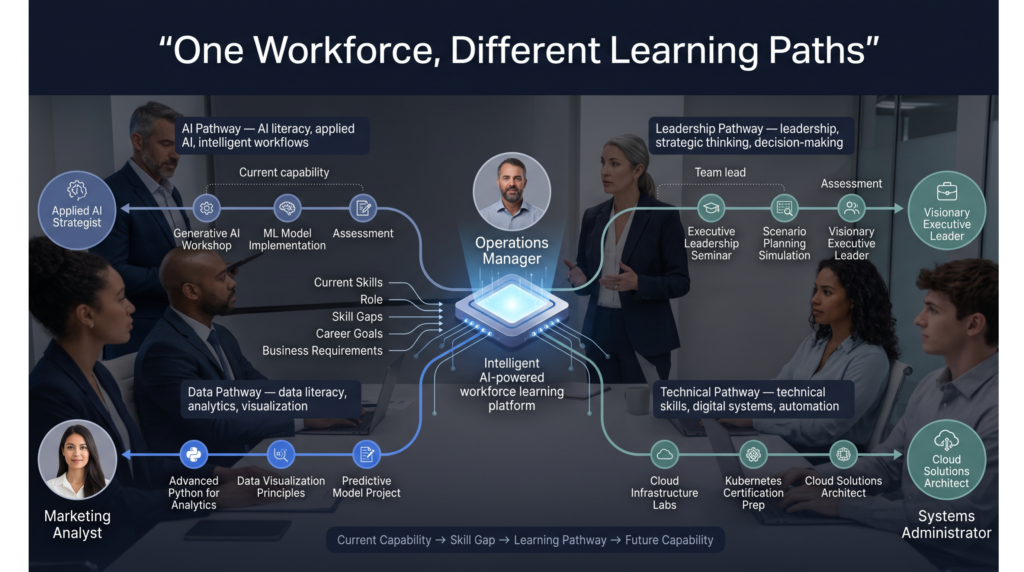
A single training programme rarely fits an entire workforce, because employees arrive with different starting points and different roles ahead of them. Personalised learning pathways, adaptive content and skills-based recommendations help close that gap, and AI-assisted tools are increasingly used to match individual employees to the right next module rather than a generic curriculum.
That only works, though, inside a culture where learning is not confined to an annual event. The strongest organisations embed short-form learning, peer communities of practice and manager coaching directly into daily workflows, and they reward experimentation rather than only rewarding finished credentials. Employee skills development sticks when it is woven into how work actually gets done, not bolted on as a separate obligation, and organisations that invest visibly in employee skills development also tend to see stronger retention, since people are more likely to stay where their growth is genuinely supported.
Read More: What Global Employers Really Think About Online Degrees
Measuring Whether Training Actually Works
Course completion rates and hours logged are the easiest numbers to collect and the least useful for judging impact. More meaningful measurement tracks skills genuinely gained through assessment, changes in productivity and quality, time to proficiency in a new role, internal mobility rates and, ultimately, retention and business performance. Reskilling and upskilling investment that cannot be connected to any of these outcomes is difficult to defend at budget time, however popular the programme feels internally.
Internal mobility deserves particular attention here. When newly developed skills are matched to real internal opportunities, organisations reduce dependence on external recruitment, improve retention and build visible career pathways, turning corporate learning from a cost into a talent pipeline the business can see and plan around.
From Training Department to Workforce Capability Engine
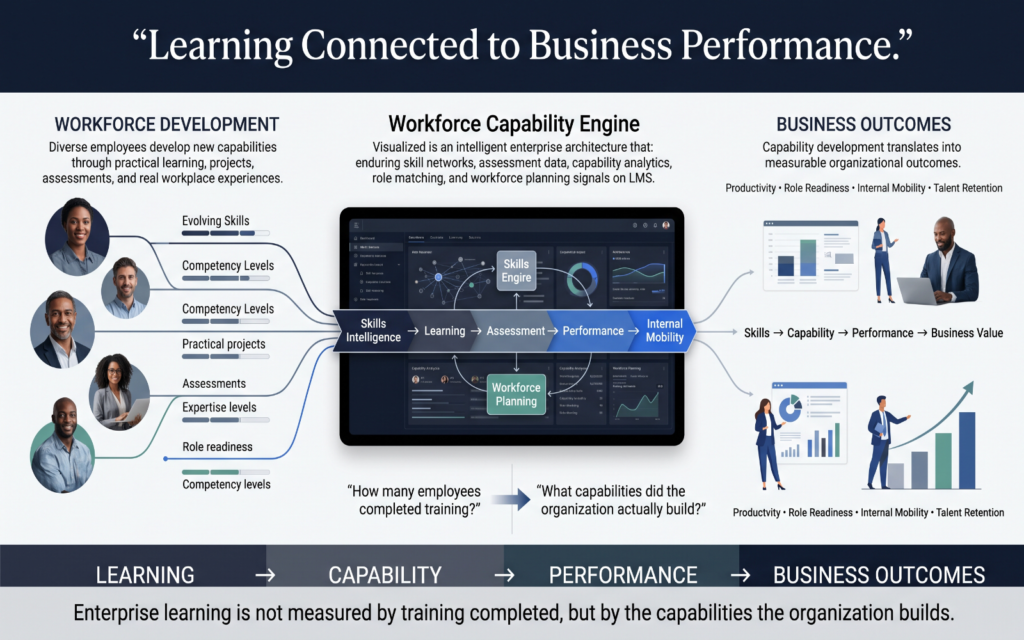
AI is changing how this work gets done, through learning assistants, adaptive content and analytics that infer skills gaps from performance data rather than relying solely on self-reported surveys. Used well, AI supports a reskilling and upskilling strategy; it should not become the strategy itself, since technology cannot substitute for a clear view of business priorities and genuine investment in employee time.
The organisations pulling ahead are shifting from a training department that delivers courses to a capability function that maintains a live picture of workforce skills, feeds that picture into workforce planning, and gives leadership real visibility into where the organisation is strong and where it is exposed. That shift positions enterprise learning as a productivity investment rather than a compliance line item.
Where EduTech Global Fits In
This is the space EduTech Global’s enterprise learning and Workforce Capacity Market proposition is built for: helping organisations map skills against business strategy, deliver scalable, technology-enabled training across large and distributed workforces, and connect that learning to verified skills and internal mobility rather than course completion alone. For organisations managing AI transformation or growing skills gaps across large teams, that combination of skills intelligence, personalised learning pathways and measurable outcomes is what turns enterprise L&D into workforce capacity that can be planned around.
Reskilling and Upskilling as an Ongoing Capability
Reskilling and upskilling are no longer discretionary employee benefits; they are strategic infrastructure, as central to business continuity as any other operational capability. The World Economic Forum’s own data makes the stakes plain: nearly two in five core skills will shift by 2030, and the organisations that treat this as a one-off training push rather than a continuous capability will fall behind those that do not.
The organisations that adapt fastest will be those that can continuously identify changing skills, develop their people and connect learning directly to business performance. If your organisation is exploring how to build that kind of future-ready workforce at scale, EduTech Global’s enterprise learning and workforce-capacity solutions are a useful place to start that conversation.
FAQ: Reskilling and Upskilling
What is the difference between reskilling and upskilling? Upskilling develops new or advanced skills for an employee’s current or evolving role; reskilling prepares an employee to move into a substantially different role.
Why are reskilling and upskilling important for businesses? Because skill requirements are changing faster than hiring cycles can keep up, particularly with AI reshaping tasks across most roles; internal development closes gaps hiring alone cannot.
How do companies identify skills gaps? By combining business strategy, role analysis, workforce data, manager input and employee self-assessment into a current-state versus future-state capability map.
How can companies measure training ROI? By tracking skills gained, productivity and quality changes, time to proficiency, internal mobility and retention, rather than relying on completion rates alone.
How is AI changing workforce skills? AI is accelerating how quickly core skills change and increasing demand for both technical skills and human skills such as analytical thinking and adaptability, while also enabling more personalised, adaptive learning delivery.