
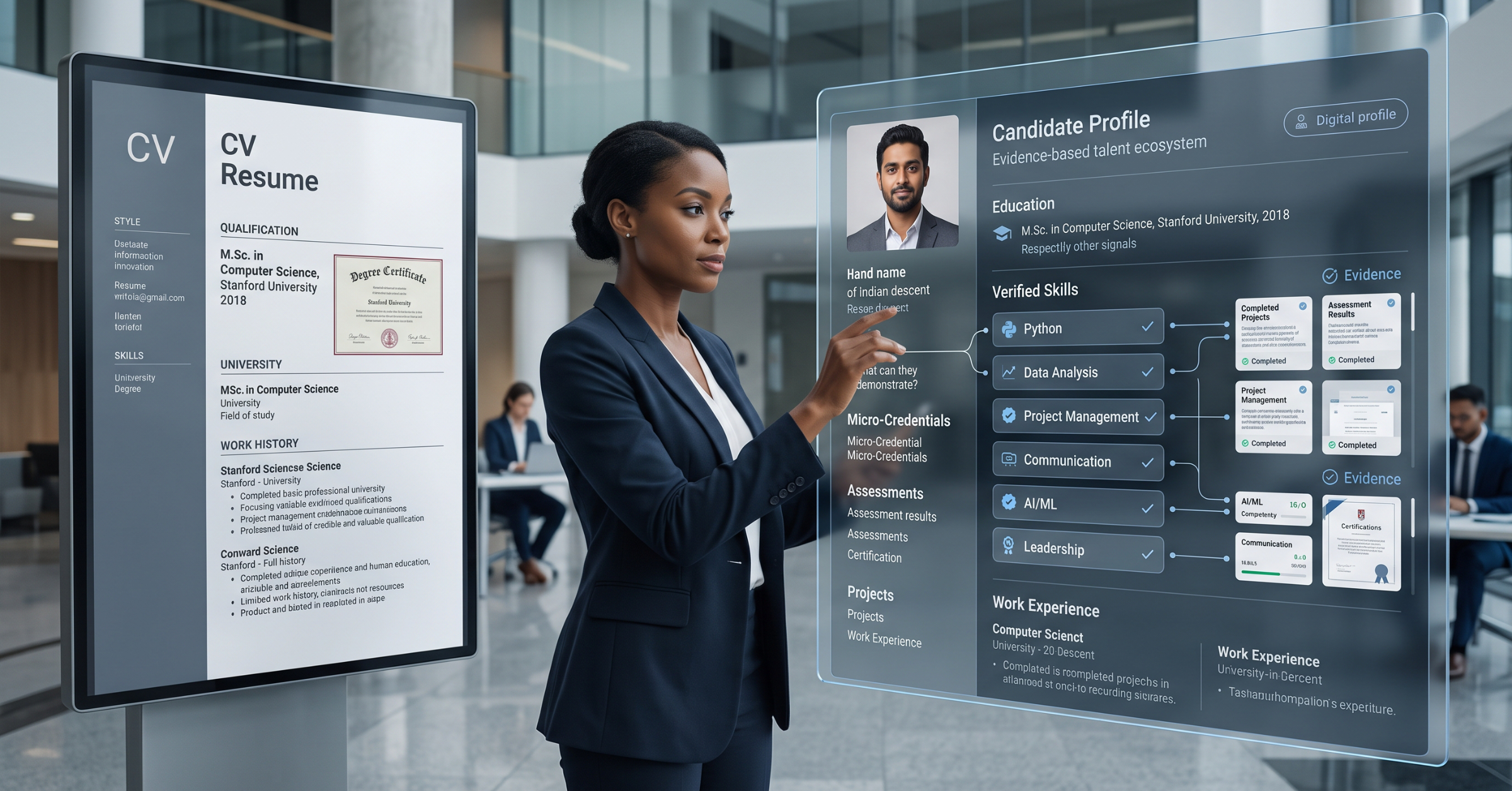
A degree can tell an employer where someone studied and what they studied, but it does not always tell them what that person can actually do. Skills-Based Hiring is changing what employers look for when they evaluate candidates. As more organisations remove degree requirements from certain roles, they are putting greater weight on demonstrable skills, practical experience and what candidates can deliver. That shift creates an important question: when a candidate says they have a particular skill, how can an employer verify it?
This is where the conversation around skills-based hiring becomes more complicated. Removing a degree requirement does not, by itself, make hiring more accurate or equitable. It replaces one familiar signal with a need for better ones. Employers still need credible ways to assess what candidates know, what they can do and whether their credentials and experience can be trusted.
For universities, banks, governments and the platforms supporting education and employment, this has implications far beyond recruitment. If skills are becoming as important as qualifications, the systems used to record, verify and communicate those skills need to evolve too. The question is no longer simply whether employers should hire for skills rather than degrees. It is whether there is enough reliable infrastructure to prove those skills when it matters.
Read More: Micro-Credentials in Higher Education: The Future of Skills-Based Learning
What Is Skills-Based Hiring?
Skills-based hiring is an approach in which employers evaluate candidates primarily on the competencies required to do a job, rather than defaulting to degrees, job titles or years of tenure as proxies for capability. In practice, that might mean a coding assessment replacing a computer science degree requirement, or a structured work sample replacing a request for “five years’ experience.”
This is not the same as skills-first hiring in its purest, degree-free form. Most employers running skills-based hiring programmes still value degrees; they simply no longer treat a degree as the only, or even the primary, evidence of readiness. A civil engineering graduate and a self-taught project coordinator might both be assessed against the same competency framework, with the degree serving as one data point among several rather than an automatic pass or fail. Some organisations describe this narrower version as competency-based hiring: building the entire process, from job description to interview rubric, around a defined set of competencies rather than years of experience or a specific qualification.
Why Employers Are Moving Beyond Degree Requirements
Several forces are pushing this shift simultaneously. Persistent skills shortages in technical and digital roles have made rigid degree requirements a liability rather than a safeguard, particularly as employers compete for a shrinking pool of graduates in fast-moving fields. The World Economic Forum’s Future of Jobs Report 2025 found that employers expect 39% of workers’ core skills to change by 2030, and that skills gaps are now the single biggest barrier to business transformation, cited by 63% of employers.
Roles themselves are also changing faster than curricula can track. Artificial intelligence is reshaping what “competent” looks like in fields from customer service to financial analysis, often within a single budget cycle. Meanwhile, degree requirements have historically excluded large segments of otherwise capable talent: in the United States alone, roughly 62% of adults do not hold a four-year degree, a pool few employers can afford to overlook when vacancies persist.
Skills-based recruitment, done properly, widens that talent pool without lowering the bar. It simply asks employers to specify what “the bar” actually is in terms of demonstrated ability, rather than assuming a credential guarantees it.
Skills-Based Hiring Is Growing, But Adoption Is More Complicated Than It Looks
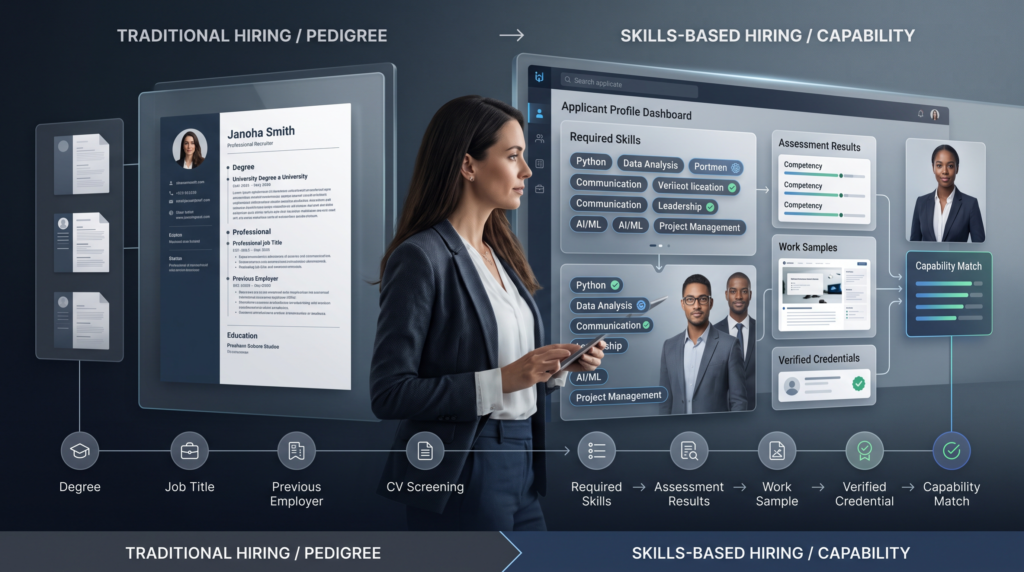
The headline numbers are genuinely striking. According to NACE’s Job Outlook 2026 survey, 70% of participating employers now report using skills-based hiring, up from 65% the previous year, and 71% of this year’s adopters use the approach at least half of the time. Employers are leaning on it most heavily during interviewing, cited by 87% of respondents, and screening, cited by 65%, where it has partly displaced GPA: just 42% of employers now screen by GPA, down from 73% in 2019.
| Traditional hiring | Skill-based hiring | |
| Primary | Degree, GPA, Job title | Demonstrated competencies |
| Evidence used | Resume, credentials | Assessments, portfolios, work samples |
| Talent pool | Degree holders only | Degree holders and skilled non-graduates |
| Risk | Excludes qualified non-graduates | Requires rigorous, validated assessment |
That growth is real. But adoption at the policy level and adoption at the point of an actual hiring decision are two different things, and the gap between them is where most organisations get stuck.
Read More: Digital Credentials: The Future of Academic Recognition
The Gap Between Removing Degree Requirements and Actually Hiring Differently
This is where the more sobering research comes in. A joint study by Harvard Business School’s Project on Managing the Future of Work and the Burning Glass Institute examined more than 11,000 roles at large firms that had publicly dropped degree requirements. The finding was blunt: removing a line from a job posting rarely changed who actually got hired. Across the roles studied, hiring of candidates without a bachelor’s degree rose by only 3.5 percentage points, and because that shift applied only to the small share of roles where the requirement was genuinely dropped, the researchers estimated the net effect at fewer than 1 in 700 hires overall.
The same research sorted employers into three groups: roughly 37% were genuine leaders, driving nearly all of the measurable change; about 45% changed their job postings “in name only,” with hiring managers and applicant tracking systems continuing to filter by degree informally; and the rest saw short-lived gains that faded within a year or two. The lesson for HR leaders and workforce platforms is straightforward. A policy change is a starting point, not a strategy. Without new tools for evaluating candidates, recruiters and hiring managers simply fall back on the proxy they know best, which is the credential the policy was meant to de-emphasise.
Verification: The Missing Layer in Skills-Based Hiring

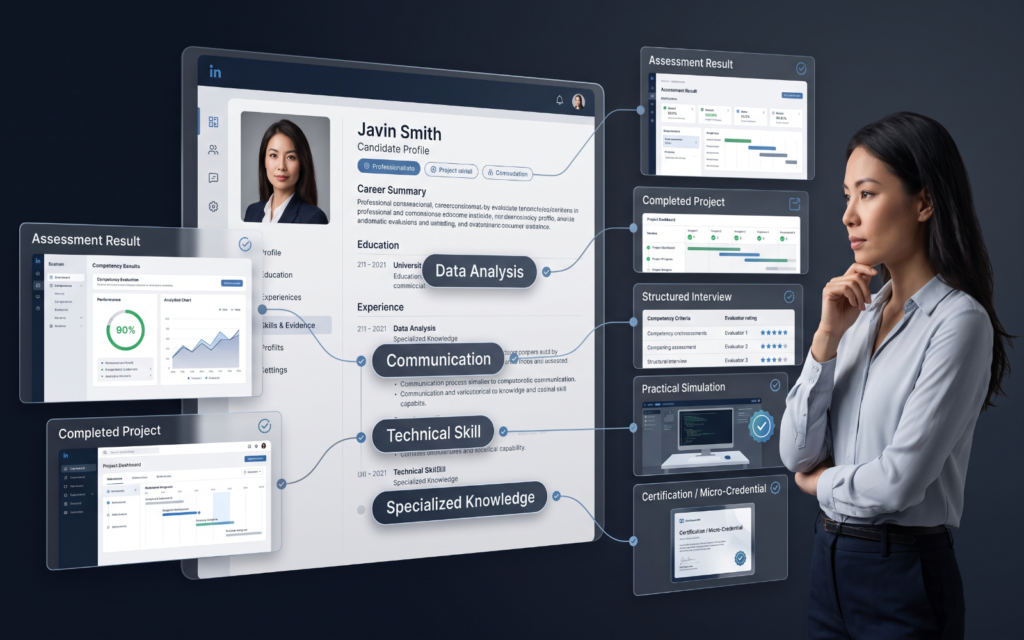
This is the heart of the matter. A candidate can claim proficiency in data analysis, project management or a dozen other competencies on a CV, but a claim is not evidence. Employers pursuing genuine competency-based hiring need mechanisms that make skills verifiable, not just statable.
LinkedIn Talent Solutions recommends a layered approach: structured, objective tests for hard skills such as coding or writing; behavioural and situational interviews to assess soft skills; and on-the-job simulations, such as asking a candidate to deliver a short presentation or work through a realistic scenario, to see how they actually perform rather than how they describe their performance. Portfolios and prior work samples add another layer of evidence, particularly in creative, technical and analytical roles where output speaks more clearly than a resume line.
Micro-credentials and verified skills credentials sit alongside these methods as a scalable form of proof. A well-designed micro-credential certifies a specific, assessed competency rather than time spent in a seat, and its value depends heavily on two things: who issued it and how rigorously the underlying skill was assessed. Digital credential verification, checking issuer identity, assessment methodology, date of achievement and any renewal requirements, is what separates a credible micro-credential from a decorative badge. Without that layer, credential fraud and unverifiable claims quietly undermine the entire premise of skills-based recruitment, since employers end up trusting certificates as blindly as they once trusted degrees.
Skills verification, in other words, is not a nice-to-have bolted onto skills-based hiring. It is the mechanism that makes the whole approach credible. An employer that removes a degree requirement but has no reliable way to confirm a claimed skill has not solved the trust problem; it has simply relocated it from the credential to the CV.
Read More: Certificate Verification: Why Institutions and Employers Can’t Afford to Trust Paper Anymore
Degrees and Skills Credentials Do Not Have to Compete
None of this makes degrees obsolete. A degree still demonstrates sustained academic engagement, breadth of foundational knowledge and the ability to complete a long, demanding programme, qualities that a single skills assessment cannot easily capture. What is changing is the assumption that a degree is sufficient evidence of job readiness on its own.
It also helps to separate what employers are actually trying to measure. A degree speaks to broad knowledge and academic persistence. A technical skill, whether coding, financial modelling or data analysis, speaks to a specific applied capability. Soft skills such as communication and problem-solving speak to how someone works with others under pressure. These are different constructs, assessed in different ways, and no single credential covers all of them well.
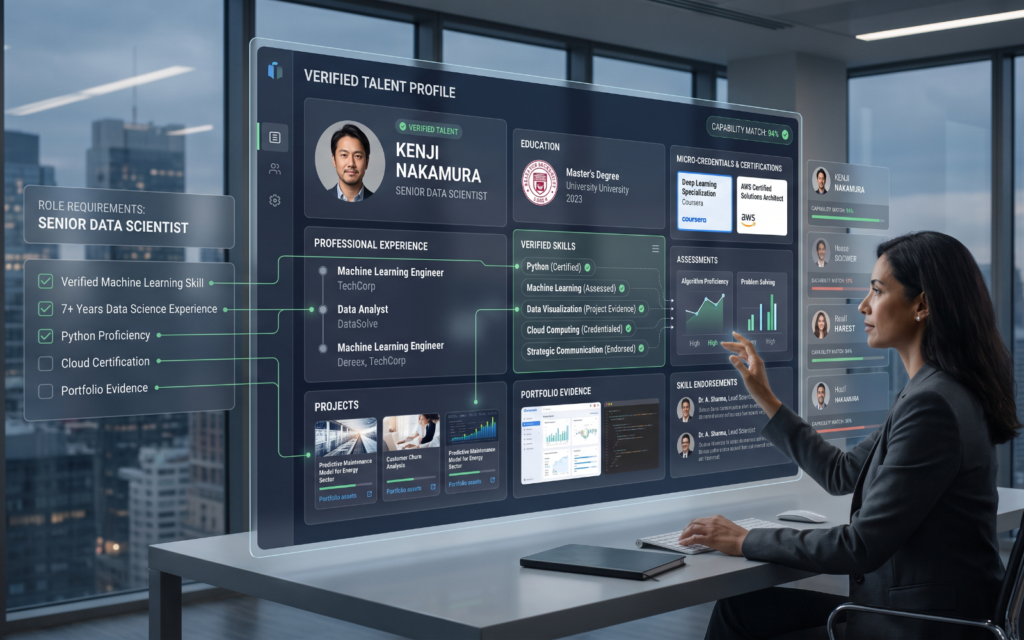
The more useful frame, then, is a multi-signal talent profile: education establishes foundational grounding, verified skills credentials and micro-credentials demonstrate specific, current competencies, and portfolios or work samples show applied capability in practice. Layered together, these signals give employers a far richer picture than any single credential could, and they give candidates, including career changers and non-graduates, more ways to prove what they can actually do. For recruiters, a verified talent profile built this way also makes it easier to match people to roles based on what they can demonstrably do, rather than the job titles they have previously held.
Where EduTech Global Fits In
This is precisely the ecosystem EduTech Global is built to support. Through The Hub’s Verified Talent badges and micro-credentials built in partnership with institutions and employers, EduTech Global helps turn a claimed skill into a verifiable one, backed by clear issuer identity, assessment methodology and credential metadata that hiring teams can actually check. Combined with talent-matching approaches that connect verified capabilities to specific role requirements, the goal is to help employers, universities and governments move past the binary of degree versus no degree, and towards a talent infrastructure where verified skills, credentials and education work together rather than in competition.
Skills-Based Hiring Only Works When Skills Can Be Trusted
The future of hiring is not credential-free. It is credential-aware, skills-focused and, above all, verification-driven. Skills-based hiring has clearly moved from experiment to mainstream practice, but the NACE and Harvard Business School research together tell a more nuanced story than either headline alone: adoption is genuinely growing, and it is genuinely harder to embed than a policy announcement suggests.
For employers, HR leaders and education providers navigating this shift, the practical takeaway is to treat verification as the foundation, not an afterthought. Build skills-based recruitment around assessments, work samples and micro-credentials that can actually be checked, and pair them with degrees and experience rather than discarding either. If your institution or organisation is exploring how verified credentials and talent matching can make skills more visible, demonstrable and trustworthy, EduTech Global’s team is a useful place to start that conversation.
FAQ: Skills-Based Hiring
What is skills-based hiring? An approach to recruitment that evaluates candidates primarily on demonstrated competencies rather than degrees or job titles alone.
Are degrees becoming irrelevant? No. Research shows employers still value degrees; they are simply pairing them with other verified evidence of capability.
How do employers verify skills? Through structured assessments, work samples, simulations, portfolios and verified digital credentials that confirm issuer identity and assessment method.
What is competency-based hiring? A close relative of skills-based hiring that focuses specifically on measurable competencies tied to defined job requirements, often assessed through structured tests or simulations.
Do micro-credentials help employers identify qualified candidates? Yes, provided they are issued by credible bodies using rigorous, verifiable assessment methods rather than time-based completion alone.