
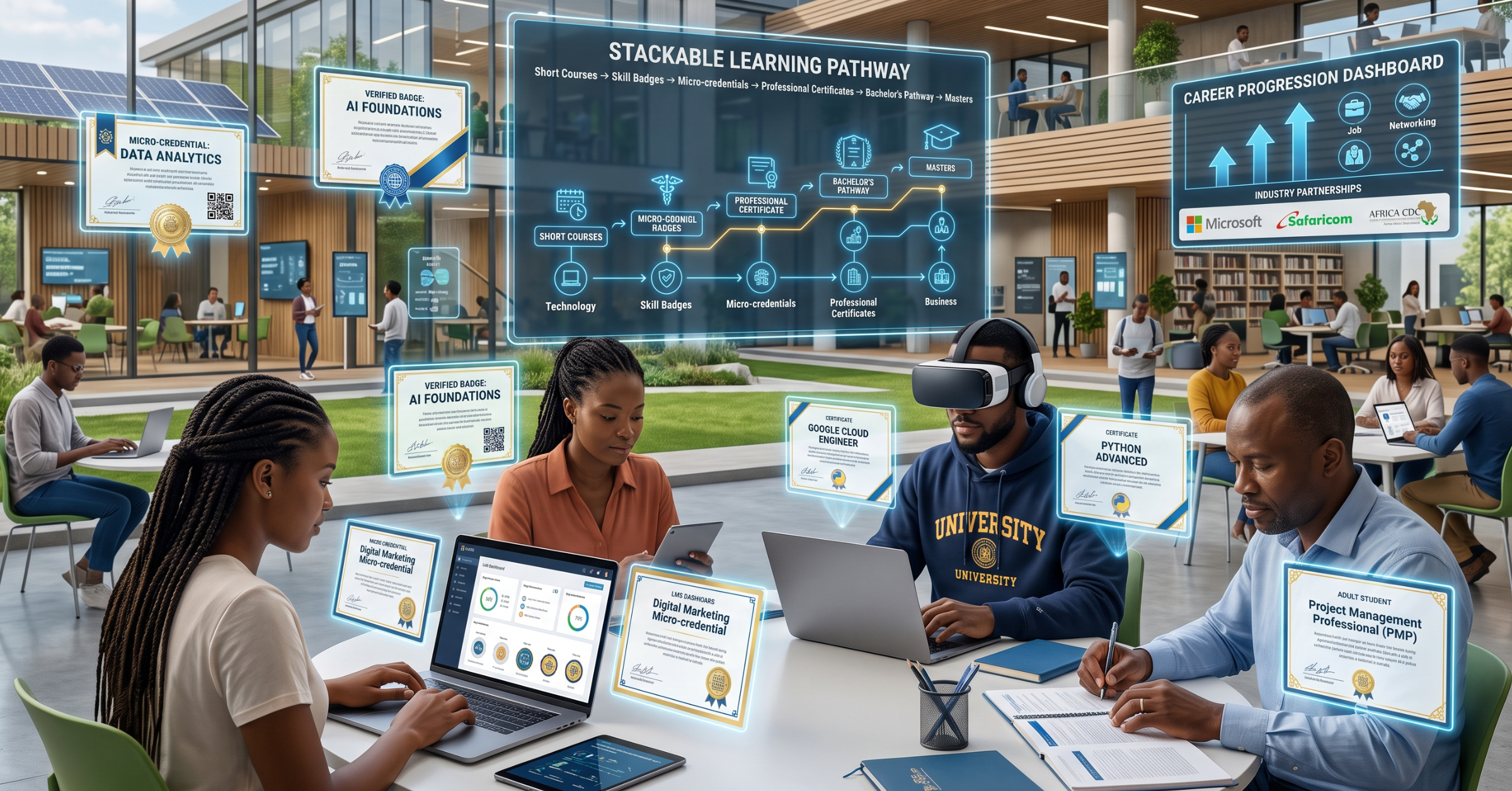
For most of the last century, the degree was the single currency of employability. A graduate walked out with a qualification, and employers trusted it to signal readiness for work. That trust is fraying, not because degrees have lost academic value, but because workplaces are changing faster than a three- or four-year programme can track. Micro-credentials in higher education have emerged from that gap, giving universities a way to keep degrees relevant while giving learners proof of specific, current skills.
This is not a marginal trend confined to online learning platforms. Vice-chancellors, provosts, and boards are now treating micro-credentials in higher education as a genuine strategic question: how to build shorter, verifiable, stackable learning pathways without diluting institutional standards or academic identity. Coursera’s Micro-Credentials Impact Report 2026, drawn from more than 3,500 learners, employers, and higher education leaders, found that 98 per cent of employers now use some form of skills-based hiring, and nearly six in ten academic leaders believe institutions without embedded micro-credentials face real strategic risk. For decision-makers, the question is no longer whether to engage with this shift, but how to do so well.
Read More: Digital Credentials: The Future of Academic Recognition
Why Higher Education Is Moving Beyond Traditional Degrees
The workforce that graduates now enter looks different to the one their tutors trained for. The World Economic Forum’s Future of Jobs Report 2025 found that employers expect 39 per cent of workers’ core skills to change by 2030, and that if the global workforce were represented by 100 people, 59 would need training within that period. Skills gaps are now considered the single biggest barrier to business transformation, cited by 63 per cent of employers.
This has driven a shift toward skills-first hiring, assessing candidates on demonstrated competence rather than pedigree alone. Several forces are converging:
- Skills-first hiring is now mainstream. Coursera’s research found 98 per cent of employers use skills-based hiring in some form, and 86 per cent rely on it extensively for entry-level roles.
- Career mobility has accelerated. Workers change roles, sectors, and skill sets more frequently than previous generations, and expect education to support that movement rather than assume a single, linear career.
- Continuous learning is now an expectation, not a bonus. Employers increasingly want proof that graduates and employees can keep learning, not just what they learned once.
For universities, this creates both pressure and opportunity. Institutions that continue to offer only long-cycle degrees risk becoming disconnected from the labour market their graduates enter; those that build flexible, credentialed pathways alongside their degrees position themselves as genuine partners in lifelong learning.
Read More: Blockchain in Education: Securing Credentials and Academic Records
What Are Micro-Credentials in Higher Education?
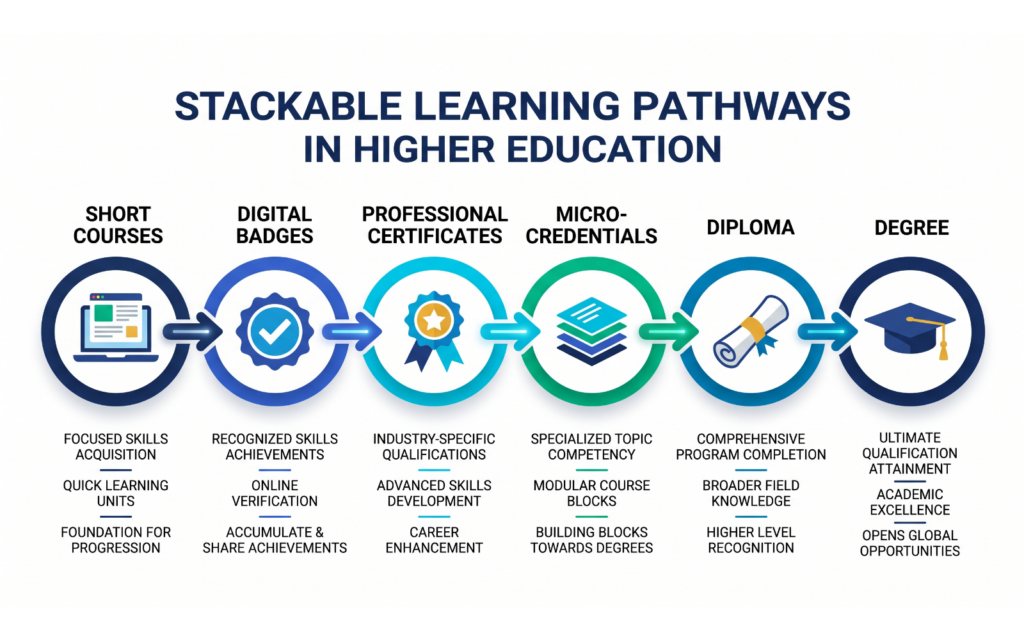
Micro-credentials in higher education are short, focused, competency-based qualifications that verify a learner has mastered a specific, well-defined skill or set of skills, typically through assessment rather than time served in a classroom.
Unlike a traditional degree, which certifies broad, multi-year academic attainment, a micro-credential certifies something narrower and more immediately usable. In practice, they take several forms:
- Digital badges, are verifiable, shareable digital records of a specific skill or achievement, often embedded in a learner’s online profile or digital portfolio.
- Certificates, awarded for completing a short course or programme, sometimes carrying academic credit.
- Industry certifications, developed with or endorsed by employers, signalling direct relevance to a specific role or sector.
- Competency-based assessments, which test applied ability rather than course attendance, closer to a demonstration of skill than a record of study.
The distinguishing feature of a well-designed micro-credential system is stackability: individual credentials can be combined over time to build toward a larger qualification, including, in many institutions, a full degree. The OECD’s research on micro-credential innovation has tracked this shift closely, noting that institutions worldwide are experimenting with recognition frameworks that let learners accumulate credit through smaller, more flexible units of learning rather than committing to a full programme from day one.
Why Universities Are Investing in Micro-Credentials in Higher Education

Graduate employability is the most direct driver. Coursera’s 2026 report found that 94 per cent of employers are willing to offer higher starting salaries to graduates with micro-credentials, and 92 per cent say entry-level hires with micro-credentials perform better in their first year. Embedding recognised, industry-aligned credentials into a degree gives graduates tangible proof of applied skill alongside their academic record.
Industry partnerships deepen as a result. Building credible micro-credentials requires universities to work directly with employers on curriculum design, which strengthens relationships that can extend into internships, research collaboration, and graduate recruitment pipelines.
New revenue streams open up. Short, modular programmes can reach working professionals, alumni, and employer-sponsored learners who would never enrol in a full degree, without requiring the infrastructure of an entirely new qualification. This diversifies income beyond traditional tuition cycles.
Flexible lifelong learning becomes possible at scale. Learners no longer need to choose between a single, front-loaded degree and no further formal education. Universities that offer stackable, credit-bearing micro-credentials can support alumni and mid-career professionals returning for targeted upskilling, deepening the institutional relationship well beyond graduation.
Global competitiveness is increasingly tied to this agility. Institutions competing for international students and employer partnerships are judged partly on how directly their programmes connect to employment outcomes. The EDUCAUSE community has flagged skills-based and modular learning as a growing priority for technology and academic leaders navigating this competitive landscape.
Coursera’s data also shows why institutional hesitation carries a cost: when degree programmes include credit-bearing micro-credentials, 71 per cent of students say they are likely to enrol, compared with just 35 per cent for programmes without them, and 91 per cent of students report greater motivation when coursework leads to industry-recognised credentials.
Stackable Credentials: Building Flexible Learning Pathways
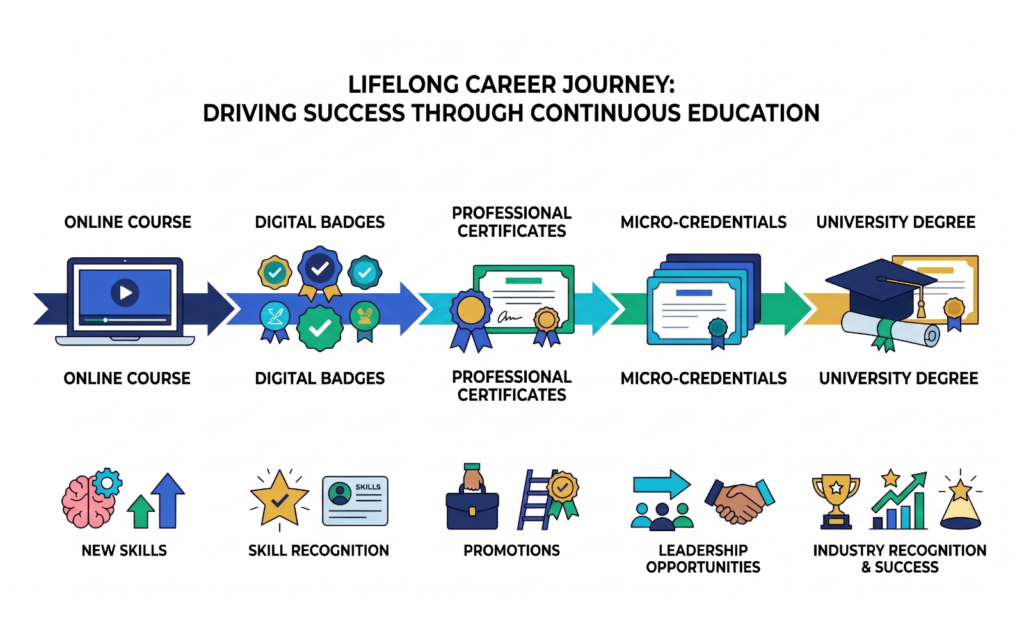
Stackable credentials allow a learner to build qualifications progressively, rather than committing years upfront to a single outcome. A typical pathway might move a learner through:
- A short course introducing a foundational skill.
- A certificate consolidating several related short courses into a coherent competency.
- A diploma or professional qualification building on that certificate with deeper, assessed learning.
- A full degree pathway, where accumulated credits from earlier stages count toward formal academic credit.
This model suits learners who cannot commit to a full programme immediately, whether because of cost, time, or uncertainty about direction, while still leading somewhere substantial if they continue. It also suits working professionals who want to upskill in defined increments without stepping away from employment.
For universities, building genuinely stackable pathways requires clear internal recognition systems: consistent credit values, transparent progression rules, and quality assurance that applies as rigorously to a six-week micro-credential as to a full degree module. Without that infrastructure, credentials risk becoming disconnected add-ons rather than a coherent ladder.
What Employers Actually Want
Employers are not abandoning academic rigour; they want clearer, more current evidence alongside it. Coursera’s research found that 87 per cent consider micro-credentials highly important in hiring decisions, ranking them above traditional signals such as GPA or alma mater, and 95 per cent say they help differentiate between similar candidates.
Employers consistently prioritise:
- Verified skills over self-reported ability, ideally through assessment rather than course completion alone.
- Practical competencies that map directly to job requirements, not abstract theory.
- Evidence of continuous professional development, showing a candidate keeps learning after graduation.
- Digital portfolios that make skills visible and shareable, rather than buried in a transcript.
- Industry-recognised credentials, developed with or endorsed by employers themselves.
Soft skills remain part of the picture. The strongest micro-credential programmes balance technical, verifiable competence with communication, collaboration, and adaptability, since employers consistently rate both as necessary rather than substitutable.
Read More: Short Courses and Micro-Credentials: The Next Big Shift in Education
Building a Successful Micro-Credential Strategy
A credible institutional strategy does not start with a learning platform; it starts with labour market demand and works outward. A practical framework includes:
- Labour market analysis, identifying genuine, durable skill gaps rather than chasing short-lived trends.
- Industry collaboration, co-designing curriculum with employers so credentials carry real signalling value.
- Curriculum design, built around clearly defined, assessable competencies rather than repackaged lecture content.
- Digital credential platforms, providing verifiable, shareable records that integrate with learners’ professional profiles.
- Assessment, prioritising project-based or applied evaluation, which Coursera’s research shows both students and employers prefer over content-only alternatives.
- Quality assurance, applying the same institutional rigour to micro-credentials as to full qualifications, to protect long-term credibility.
- Marketing, communicating clearly to prospective learners and employers what a credential represents and where it leads.
- Scalability, designing systems and governance that can grow beyond a handful of pilot programmes into a genuine institutional offering.
The Future of University Credentials
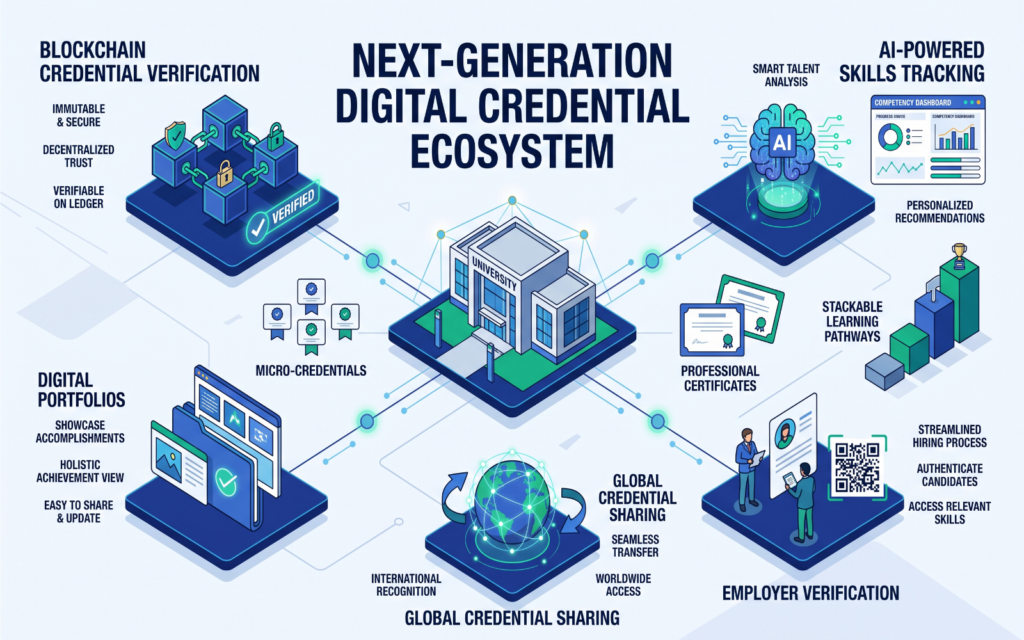
Several developments will shape this shift’s next phase. AI is beginning to personalise learning pathways, recommending credentials based on a learner’s existing skills and career goals. Digital skills passports, aggregating verified credentials across institutions and employers into a single portable record, are gaining traction as a response to fragmented recognition. Blockchain-based credentialing is being piloted to make verification tamper-proof and instantly checkable. Meanwhile, growing pressure for global credential portability, echoed in UNESCO’s work on recognition of qualifications, means institutions that build interoperable, well-documented credential systems now will be better placed as international recognition frameworks mature.
Building Credential Ecosystems That Last
Micro-credentials in higher education are not a replacement for the degree; they are an extension of what a university can offer across a learner’s working life. The institutions that will benefit most are those that treat credentials as part of a coherent ecosystem, built on genuine labour market insight, employer partnership, and rigorous quality assurance, rather than as isolated pilot courses.
EduTech Global works with institutions to design credential ecosystems that align academic strength with workforce need, from higher education digital transformation to broader workforce development initiatives. If your institution is weighing where to start, book a Credential Innovation Strategy Session with our team, or explore more thinking on the EduTech Global blog.
Frequently Asked Questions
What are micro-credentials? Short, competency-based qualifications that verify mastery of a specific skill, often through assessment, and typically shorter than a traditional degree.
Are digital badges recognised? Increasingly, yes, particularly when issued by credible institutions or industry partners and backed by verifiable assessment rather than course attendance alone.
Can micro-credentials count toward a degree? In many institutions, yes. Stackable models allow credit earned through micro-credentials to accumulate toward diplomas or full degree programmes.
What are stackable credentials? A progressive sequence, from short courses through certificates and diplomas to full qualifications, where each stage builds on and counts toward the next.
Should every university offer micro-credentials? Not identically, but most institutions benefit from some form of credentialed, skills-based offering aligned to their strengths and the labour markets they serve.