

Technology Doesn’t Transform Universities. Leadership Does.
Every year, universities sign contracts for new platforms: a fresh student information system, an upgraded LMS, an analytics dashboard promising to finally make sense of enrolment data. And every year, a good number of these projects quietly underdeliver, not because the software was faulty, but because nobody addressed how people would actually work differently once it arrived. Higher education digital transformation is regularly treated as a procurement decision, when in reality it is an organisational one, and that mismatch is where most of the disappointment begins.
For the vice chancellor or registrar who has to answer to a board about return on investment, this gap is uncomfortable and familiar. The business case looked sound, the vendor demonstration was impressive, and yet a year later the same complaints persist: students still chase paper trails between departments, staff still maintain shadow spreadsheets alongside the new system, and the promised efficiency gains never quite materialise in the budget review. The instinct is often to blame the technology and start evaluating a replacement. That instinct is usually wrong, and it is expensive to indulge repeatedly.
So what does digital transformation in higher education actually mean, in practical terms, for the person who has to answer to a board about it?

It means a coordinated shift in leadership, governance, culture and technology together, not a rolling series of IT purchases that happen to touch the same institution. McKinsey’s long-running research into transformation efforts found that only 16 per cent of digital transformations both improved performance and sustained those improvements over time, a figure that should give any vice chancellor pause before signing off on the next system purchase. Universities that get this right treat transformation as a leadership discipline with technology in support, not the other way round.
Read More: Digital Transformation Strategy for Universities: A Guide for Higher Education Leaders
What Higher Education Digital Transformation Actually Means

Digitisation and transformation are often used interchangeably, and that confusion causes real damage. Digitisation is converting an existing process into digital form: replacing a paper application with an online form, or a printed transcript with a PDF. It is useful, sometimes essential, but it changes very little about how the institution actually functions. Transformation is different in kind, not just degree. It means redesigning how the institution makes decisions, serves students and allocates resources, using digital capability as the enabler rather than the destination.
EDUCAUSE frames this distinction as a series of deep, coordinated shifts in culture, workforce and technology that produce new educational and operating models, rather than a single project with a defined end date. That framing matters because it sets expectations correctly from the outset. A university that digitises its admissions form has completed a task. A university that redesigns its admissions process around a shared student record, clear ownership and continuous measurement has begun a genuine university digital strategy, and the two should never be reported to a board as the same kind of achievement.
Consider a simple example. A university introduces an online application portal, which is digitisation: a paper process moved onto a screen. Higher education digital transformation, by contrast, would mean connecting that portal to the student information system, the finance platform and the communications tools so that an applicant’s status, fees and correspondence are visible in one place to every member of staff who legitimately needs to see them, without a single manual handover between departments. The first delivers convenience. The second changes how the institution actually operates.
This distinction also explains why the scope of transformation is inherently wider than any single department can own. It touches teaching, student services, finance, data governance and institutional culture simultaneously, which is precisely why it cannot be delegated entirely to an IT department, however capable, without senior academic and administrative leadership sitting alongside it.
Why Most Higher Education Digital Transformation Projects Fail
Failure in this space rarely announces itself. Systems get delivered, budgets get spent, and yet the institution behaves largely as it did before. Several recurring patterns explain why.
- Weak leadership. When senior leaders treat transformation as somebody else’s initiative rather than their own mandate, staff notice immediately and calibrate their effort accordingly. According to Gartner’s 2025 CIO and Technology Executive Survey, only 48% of digital initiatives across organisations meet or exceed their intended business outcomes, and Gartner attributes the gap largely to how closely technology leaders and other executives collaborate, not to the technology itself.
- No institutional vision. Without a clearly articulated destination, individual departments each pursue sensible local goals that fail to add up to anything coherent for the institution as a whole. Staff cannot align behind a vision that leadership has not actually written down.
- Department silos. Admissions, learning technology, finance and student services frequently commission systems independently, each solving its own problem while creating new integration debt for the institution to pay down later.
- Poor governance. Decisions about priority, budget and data ownership need a clear home. When no one is accountable for the transformation as a whole, every difficult trade-off gets deferred, diluted or quietly dropped.
- Staff resistance. Faculty and administrative staff who were not consulted, or who were given a new system with no time to adjust their working habits, will often route around it rather than adopt it, regardless of how capable the platform is.
- Technology-first thinking. Selecting a platform before the underlying problem has been properly defined is one of the most common and most avoidable mistakes; it optimises for a demonstration rather than for the institution’s actual needs.
These causes reinforce one another. Weak leadership tends to produce poor governance, which in turn leaves silos unresolved and staff resistance unaddressed, so a transformation that starts poorly rarely course-corrects on its own.
Read More: How Universities Can Acquire International Students Without Physical Presence
The Six Pillars of Successful Transformation
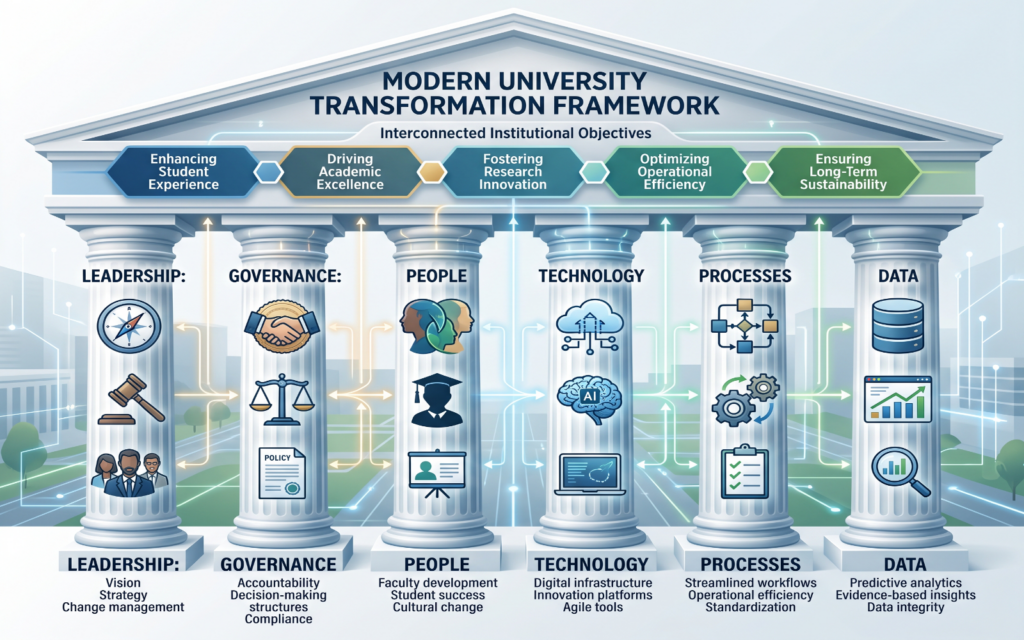
Institutions that succeed tend to build deliberately across six interdependent pillars, rather than concentrating investment in one and hoping the rest follow. Skipping any single pillar tends to surface as a specific, predictable symptom: technology without governance produces shadow systems; governance without people produces resistance that governance alone cannot resolve.
- Leadership. Genuine transformation needs visible, sustained sponsorship from senior leadership, not a single kick-off announcement. Leaders need to keep articulating why the change matters, particularly once the initial enthusiasm fades and the harder, unglamorous implementation work begins.
- Governance. A named senior owner, a clear decision-making structure spanning IT, academic leadership and finance, and defined accountability for data and outcomes give a transformation somewhere to resolve the disagreements that inevitably arise. Without this, university technology leadership ends up negotiating institutional politics on an ad hoc basis, project by project.
- People. Staff need training, time and a genuine role in shaping how new systems will work, not simply notification that they will use them from next term. Institutions that involve staff early in defining requirements see markedly higher adoption than those that present a finished system as a fait accompli.
- Technology. Platforms matter, but only once priorities and processes are settled. The right technology choice is the one that integrates cleanly with what already exists and supports the redesigned process, rather than the one that looks most impressive in a vendor demonstration.
- Processes. Transformation should redesign how work actually happens, not simply move the existing paper-based process onto a screen. Admissions, advising and financial workflows all benefit from being rebuilt around the student’s journey rather than around departmental boundaries.
- Data. Reliable, well-governed data underpins every other pillar. Without a single trustworthy source of student information, analytics become guesswork and leadership decisions rest on instinct rather than evidence, however sophisticated the reporting tools appear on the surface.
Measuring Transformation Success

Institutions that measure transformation well tend to track a small, deliberately chosen set of indicators rather than an exhaustive dashboard that nobody reviews. Useful measures typically include:
- Student satisfaction, tracked consistently over time rather than through a single annual survey.
- Retention and progression rates, particularly among groups known to be at higher risk of withdrawal.
- Operational efficiency, such as reduced processing times in admissions or finance.
- Digital maturity, benchmarked periodically against sector frameworks such as those published by EDUCAUSE.
The common thread across institutions that measure well is that leadership defines success criteria before implementation begins, not afterwards, when it becomes tempting to redefine success around whatever the system happened to deliver. A board that only asks whether the new system was deployed on schedule is asking the wrong question; the more useful question is whether the metrics leadership committed to at the outset actually moved, and by how much, over a defined period.
Future Trends
Several forces will shape the next phase of higher education digital transformation. Artificial intelligence is moving from pilot projects to genuine institutional infrastructure, supporting everything from personalised learning pathways to administrative automation, though UNESCO’s research shows that while 92% of higher education professionals report using AI tools, confidence in using them well lags well behind adoption. Predictive analytics is increasingly used to flag retention risk earlier, giving advisors a genuine window to intervene rather than a post-mortem after a student has already withdrawn. Digital credentials and micro-credentials are gaining currency with employers, pushing institutions to think about verification and portability alongside teaching design. Cloud infrastructure continues to displace on-premises systems as the default, and the World Economic Forum’s education work points to personalised learning, powered by better data foundations, as one of the defining shifts institutions will need to plan for over the coming years.
EduTech Global works alongside governments, banks, schools and universities as a transformation partner, not simply a technology provider. Read more on our blog, including our related pieces on the digital campus, university digital strategy and international enrolment strategy, or visit edutech.global to learn more about how we support institutional change.
Ready to lead transformation rather than simply buy technology? Book a Digital Transformation Consultation with EduTech Global.
Frequently Asked Questions
Where should universities start? Start with an honest assessment of current systems, data quality and institutional readiness, then define what success will look like before selecting any technology.
How long does transformation take? Meaningful transformation typically unfolds over several years rather than a single project cycle, since it involves redesigning processes and building new institutional habits, not simply installing software.
Who should lead it? Transformation needs a senior institutional owner, working alongside IT rather than delegating entirely to it, with a governance structure that includes academic leadership and finance.