
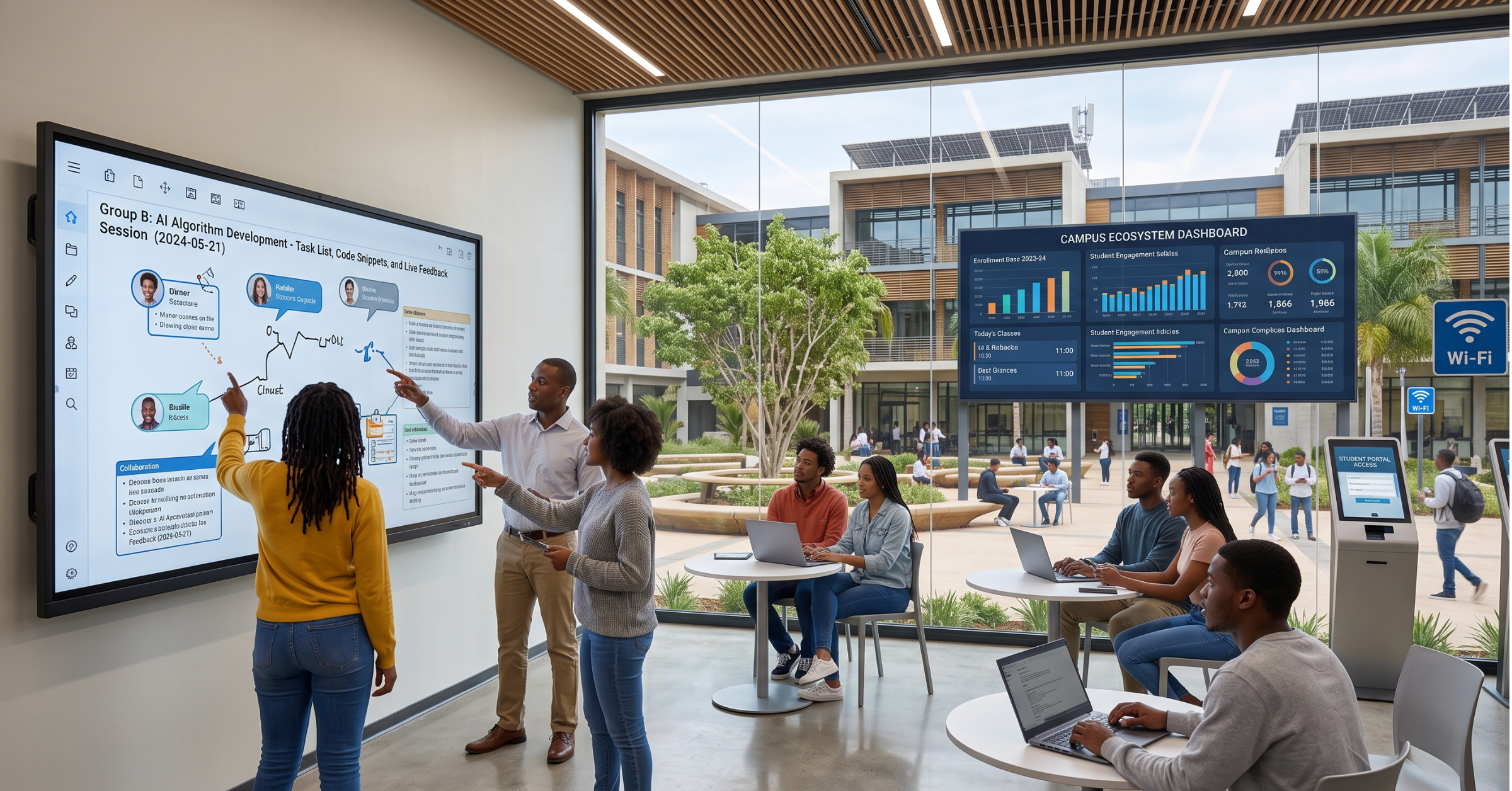
A university’s reputation used to rest on its lecture halls, its library and the quality of its professors. Those things still matter, but they are no longer what a prospective student, a government funder or an international partner judges first. Increasingly, that judgement happens online, long before anyone sets foot on a physical quad, and what it reveals is whether an institution has built a genuine digital campus or simply bolted a handful of apps onto an ageing administrative core.
This distinction matters more than most university leaders realise. A 2025 EDUCAUSE survey found that students who regard their institution’s technology as cutting-edge report satisfaction rates of 85%, compared with roughly a third of students at institutions seen as lagging. The gap is not cosmetic; it shapes enrolment decisions, retention and, ultimately, institutional reputation. For governments and boards weighing where to direct scarce capital, a properly built digital campus has become the clearest signal of whether a university is prepared for the next decade, or still governing the last one.
Read More: The University That Never Closes: How Always-On Education Is Redefining What a Campus Actually Is
Why Universities Can No Longer Operate as Physical Campuses Alone
Student expectations have shifted permanently. Applicants who grew up managing their banking, health and social lives through a single app now expect a university to offer comparable convenience: one login, one portal, one coherent digital university strategy rather than a maze of disconnected logins for admissions, timetabling and finance.
Hybrid learning has compounded this shift. Even fully residential universities now run blended timetables, recorded lectures and online assessment, so institutions without dependable higher education technology struggle to deliver a consistent student digital experience across modes. At the same time, competition has gone global. Prospective students increasingly compare institutions across borders rather than merely within a home region, with QS’s Global Student Flows research projecting the international student population will reach roughly 8.5 million by 2030. A university’s digital presentation, from first enquiry to onboarding, is now part of how it competes for that talent. Institutions that delay building a smart campus are not simply behind on IT; they are losing ground on recruitment, retention and long-term relevance in a market that no longer waits for laggards to catch up.
What Is a Digital Campus?
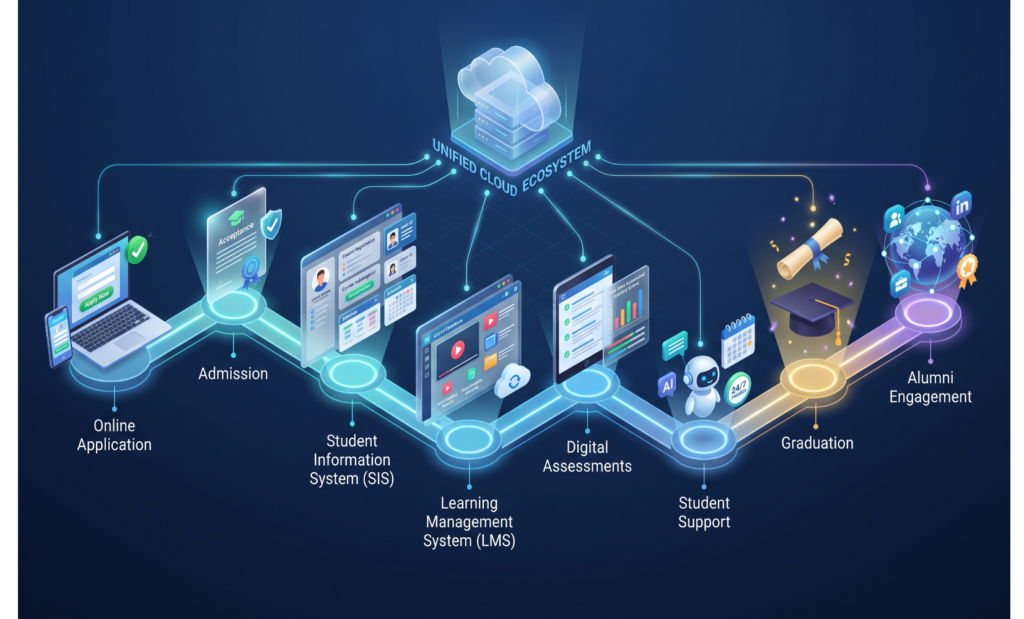
A digital campus is the integrated set of technologies, data and processes that allow a university to operate, teach and support students as one connected institution rather than a collection of separate departments running separate systems. It is easy to mistake this for a learning management system with a fresh coat of paint, but a genuine connected campus technology strategy extends far beyond learning software.
It spans the full institutional lifecycle: digital admissions that let applicants track their status without emailing a registrar; a student information system that holds one accurate record per learner; learning platforms that connect to that record rather than sitting beside it; analytics that give leadership early warning on retention risk; finance systems that reconcile fees and disbursements without manual re-entry; communication tools that reach students on the channels they actually use; and support services that a student can access at eleven at night as easily as during office hours. EDUCAUSE’s own framing of digital transformation describes this as a coordinated shift in culture, workforce and technology, not a single procurement decision. That is precisely the point: this is an operating model, not a product category, and it needs to be architected as one from the outset. Universities that treat it as a shopping list of software end up with modern tools operating on essentially the same fragmented logic as the paper systems they replaced, only with better fonts.
The Five Pillars of a Digital Campus
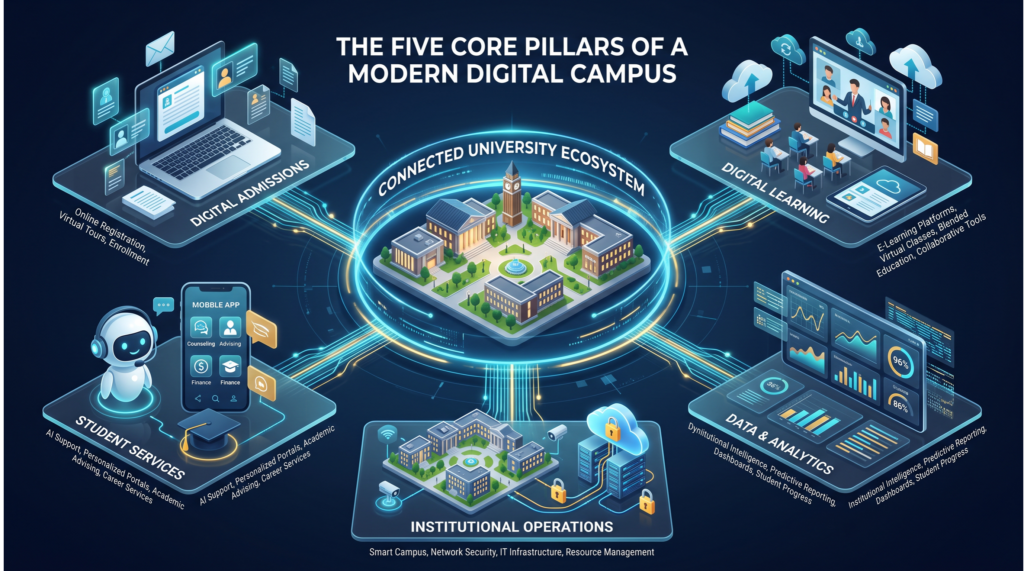
A working digital campus rests on five pillars that reinforce one another. Weakness in any one undermines the rest, however well-funded the others may be.
- Digital admissions. This is a prospective student’s first real encounter with an institution, and it sets expectations for everything that follows. A modern admissions pillar allows online applications, automated document verification, real-time status tracking and instant communication, replacing the paper-heavy processes that still frustrate applicants at many universities and quietly cost institutions enrolments before a course has even begun. Delays at this stage are rarely noticed internally, yet they are precisely the moments at which a hesitant applicant chooses a competitor instead.
- Digital learning. This goes beyond hosting course content online. It means learning platforms that adapt to how a student is actually progressing, that surface early signs of disengagement to tutors, and that work as smoothly for a part-time distance learner as for a student living on campus. The 2025 EDUCAUSE Horizon Report points to this kind of connected, adaptive infrastructure as central to how institutions will need to respond to shifting learner expectations over the coming years, particularly as artificial intelligence reshapes what students expect from feedback and pacing.
- Student services. Admissions, timetabling, accommodation, wellbeing support and financial aid have traditionally sat in separate offices with separate systems. A connected campus technology approach links these so a student query raised in one place is visible, with appropriate permissions, wherever it needs to be resolved, rather than being re-explained at every office door. For a student already under pressure, that difference is not a convenience; it is often what determines whether they persist.
- Data and analytics. A well-built digital ecosystem generates enormous amounts of data on attendance, engagement and academic performance. The pillar that matters is not the volume of data collected but the institution’s capacity to turn it into early, actionable insight, particularly on retention risk, which remains one of the most consequential and expensive problems in higher education. Dashboards that nobody reads are not analytics; they are decoration.
- Institutional operations. Finance, HR, procurement and facilities management are the least visible pillar to students but among the most consequential for institutional resilience. Integrating these systems with the rest of a university’s technology estate reduces duplicated administrative work and gives leadership a single, trustworthy view of institutional performance rather than five conflicting spreadsheets circulated before every board meeting.
Read More: From Pilot to Scale: How Universities Grow From 50 to 5,000 International Students
Benefits Beyond Technology
The case for building this kind of connected institution is ultimately institutional, not technical. Universities that integrate their systems well report higher student satisfaction, because a coherent experience reduces the friction that erodes goodwill even when the underlying education is strong. Administrative staff spend less time reconciling data between systems and more time on work that actually requires judgement, which is where genuine operational efficiency comes from, rather than from simply digitising existing inefficiency.
Retention improves when advisors can see a fuller picture of a student’s engagement and intervene before a small problem becomes a withdrawal. Institutional agility increases too: a university with integrated data can respond to a funding change, a regulatory requirement or a sudden shift in demand in weeks rather than the better part of a year. And for institutions competing internationally, a smooth, digitally native experience, from first enquiry to graduation, has become a genuine differentiator in a market where, as the OECD’s analysis of student mobility trends makes clear, students increasingly weigh graduate outcomes and institutional reputation alongside course content when choosing where to study. None of these gains show up on a procurement invoice, which is exactly why they are so often undervalued at budgeting time.
Common Mistakes Universities Make
Most failures in this space are not technology failures; they are strategy failures. The most common mistake is buying disconnected software, department by department, so that a university ends up with a modern admissions tool, a modern LMS and a modern finance system that cannot speak to one another, recreating the old silos in newer packaging and at greater expense.
A second is weak governance: without a clearly accountable owner for the institution’s technology ecosystem as a whole, individual departments make good local decisions that add up to a poor institutional outcome. Poor integration follows naturally from this, since systems purchased independently are rarely designed to share data cleanly, no matter what their sales materials promise.
Technology-first thinking is another recurring trap, where institutions select a platform before they have properly defined the problem it needs to solve. And perhaps the most underestimated mistake is ignoring change management. Even excellent systems fail if staff are not trained, supported and given time to adjust their working habits around them; a rushed rollout can undo years of careful planning within a single academic term.
Building a Digital Campus Roadmap

A credible roadmap begins with an honest assessment of existing systems, data quality and institutional capacity, rather than an aspirational list of desired features. From there, leadership should prioritise the gaps that carry the greatest institutional risk, typically retention, admissions conversion or regulatory compliance, rather than the gaps that are simply easiest to fix.
Technology selection should follow priorities, not precede them, with a bias towards platforms that integrate cleanly rather than those that merely look impressive in a demonstration. Governance needs to be established early, with a named senior owner and a clear decision-making structure that spans IT, academic leadership and finance, so that difficult trade-offs have somewhere to be resolved. Finally, none of this is ever finished. It requires a continuous improvement cycle, with regular review against the outcomes it was built to achieve, because student expectations and available technology will both keep moving, often faster than any single procurement cycle can accommodate.
Read More: Digital Transformation Strategy for Universities: A Guide for Higher Education Leaders
EduTech Global works with governments, banks, schools and universities to design and deliver exactly this kind of connected infrastructure
Ready to move from disconnected systems to a genuine digital campus? Request a Digital Campus Strategy Session with EduTech Global.
Frequently Asked Questions
What is a digital campus? A digital campus is an integrated set of technologies and processes, spanning admissions, learning, student services, data and operations, that lets a university function as one connected institution rather than a collection of separate systems.
How much does it cost? Cost varies significantly with institutional size, existing infrastructure and scope, since this is a strategic programme rather than a single purchase. Institutions typically get the most reliable estimate from an assessment of their current systems, which identifies genuine gaps before any technology is selected.
Where should universities begin? Begin with an honest assessment of existing systems and data quality, then prioritise the areas of greatest institutional risk, such as retention or admissions conversion, before selecting technology.