

The most successful university in 2035 will not be the one with the best campus. It will be the one that does not need one. That sentence tends to produce two reactions among senior institutional leaders: quiet agreement from those already building toward it, and defensiveness from those who have spent careers justifying the infrastructure that surrounds them. The future of university education, always-on learning, is not a technology argument. It is a strategic one, and the institutions that understand the distinction are already pulling ahead of the ones still treating digital delivery as a contingency plan rather than a primary model.
Here is what is actually happening. The physical campus was never the university itself. It was the infrastructure required to deliver the university at a time when there was no alternative: when books were scarce, when expert faculty needed to occupy the same building as their students, when examinations had to be physically supervised, and when the academic community required geographical proximity. Every one of those constraints has been materially weakened. This is not a disruption to lament. It is a structural release from a set of limitations that were never ideological, only practical. Understanding the future of university education, always-on learning begins with recognising that the campus solved a distribution problem, and when distribution is no longer the constraint, the campus becomes optional rather than essential.
Read More: The Invisible University: How Millions of People Are Already Getting Degrees Without Anyone Noticing
What Always-On Education Actually Means in Practice

The term always-on is sometimes reduced to a conversation about online lectures, which misses the point almost entirely. A truly always-on university is defined by five structural characteristics that together represent a different institutional model, not simply a different delivery channel.
- 24-hour accessibility. Learning available at any time, unconstrained by timetables or time zones.
- Geographic unboundedness. Students enrolled regardless of physical location, with no expectation of campus presence.
- Asynchronous delivery. Content is consumed when the learner is most cognitively ready, not when a lecture hall happens to be available.
- Persistent learning records. Academic progress that follows a student across institutions and borders, rather than resetting at each transfer.
- Continuous enrollment cycles. Rolling admission throughout the year, replacing the single September intake that structures most institutions’ entire operational calendar.
None of these are hypothetical. They are already operating in the most forward-moving institutions globally, and the future of university education always-on learning is, in practice, already a present one for those institutions.
What Students in 2026 Actually Expect
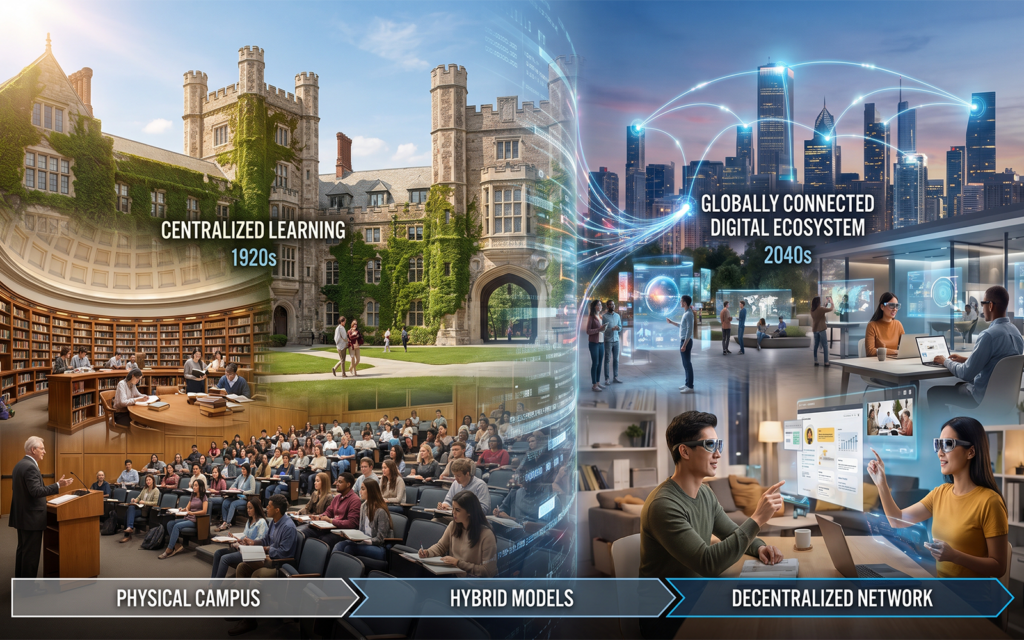
The expectations of today’s students were not shaped by universities. They were shaped by Spotify, Netflix, Amazon, and Uber, organisations that deliver exactly what a user wants, when they want it, with responsive feedback and no queuing. Universities are now competing with that experience standard, even though they were built for a world that predates it by centuries.
The documented expectations reshaping demand are consistent and accelerating. Students want flexibility to study alongside full-time employment. They expect mobile-first access to both course content and administrative processes. They look for responsive communication, not email chains and posted letters. They want modular learning that builds progressively over time rather than a fixed three-year commitment that may not fit a life that is already full. And they increasingly want recognition of prior learning and professional experience rather than being told their existing skills do not count toward a credential.
According to UNESCO’s first Higher Education Global Trends Report, global higher education enrollment reached 269 million students in 2024, more than double the 100 million enrolled in 2000. That demand is growing fastest in the regions least served by traditional campus infrastructure: Sub-Saharan Africa currently has a gross enrollment ratio of just nine per cent, compared to a global average of 43 per cent. The students who will drive the next phase of global enrollment growth are largely people for whom a residential campus in a major city was never a realistic option. Always-on delivery is not an alternative for them. It is the only realistic route.
The Institutions Already Building the Always-On University
Western Governors University, founded in 1997 by nineteen US state governors who concluded it was easier to build a new institution than reform existing ones, now serves more than 175,000 students at any given time across all fifty US states, on a competency-based model with no fixed semesters and a flat-rate tuition structure. It has grown by more than 230 per cent since 2011, a period during which overall US higher education enrollment declined. WGU’s growth came not from better marketing but from a model built explicitly around the working adult learner for whom the traditional campus calendar was never compatible with real life.
The Open University model, operating across the UK and replicated across Asia, Africa, and Latin America, has demonstrated for decades that learning without physical attendance is a different kind of excellence, one optimised for a different kind of student. In Africa specifically, digital delivery is not simply more convenient. Sub-Saharan Africa increased its count of higher education institutions by 153 per cent between 2006 and 2018, yet still serves only nine per cent of its eligible population. Always-on delivery is the mechanism by which the remaining 91 per cent might eventually be reached.
Read More: How Universities Can Acquire International Students Without Physical Presence
The Objections, and What the Evidence Actually Says

The case for campus-first higher education typically rests on four arguments, all of which deserve honest examination rather than reflexive dismissal.
The first is that the academic community requires physical proximity. Documented evidence across online institutions shows that learners build comparable peer networks when platforms are designed to support community formation rather than treating social connection as a byproduct of colocation.
The second is that practical and laboratory-based programmes cannot be delivered remotely. This is true for some disciplines, honestly acknowledged by every serious advocate for digital delivery. It is not true for the substantial majority of what universities teach.
The third is that employers do not value online credentials equally. This objection is weakening every year. A 2024 NACE survey found that 87.4 per cent of employers who track degree modality had hired graduates holding online degrees, and accreditation rather than delivery format has become the dominant quality signal. The OECD’s Trends Shaping Education 2025 report notes that the skills a graduate demonstrates matter increasingly more to hiring decisions than the mode through which they were developed.
The fourth objection, that the campus experience is intrinsic to a degree’s value, carries real weight for a particular kind of traditional school-leaver. It carries essentially none for the working professional, the parent, the distance learner, or the first-generation student in a region where no campus exists within reasonable reach.
The Strategic Decisions Facing Institutional Leaders in the Next Three Years

The future of university education, always-on learning, is not coming at a pace that allows institutions to defer these questions until a more convenient moment. University leaders need to resolve five decisions within their current strategic cycle, or find them resolved by default.
- Delivery model. Will the institution build always-on capability as a primary strategic commitment, or remain campus-bound and accept the enrollment ceiling that implies?
- Market reach. Will geographic expansion happen through physical infrastructure, which is slow and capital-intensive, or through digital infrastructure, which scales without proportional cost?
- Technology ownership. Will the institution own its digital delivery infrastructure, or depend on platforms it does not control and cannot customise?
- Partnership model. Will the institution build alone, or through strategic partners with existing distribution, enrollment infrastructure, and operational capability?
- Revenue model. Will growth come from charging more to fewer students, or from reaching significantly more students at accessible price points?
The World Economic Forum has consistently emphasised that the institutions best positioned for the next decade are those treating digital transformation as a strategic infrastructure investment rather than a service layer on top of an unchanged physical model. The strategic planning prompt here is straightforward: which of these five questions can your institution currently answer with confidence, and which are still open?
Read More: What Global Employers Really Think About Online Degrees
How EduTech Global Helps Institutions Build the Always-On Infrastructure
EduTech Global works with institutions navigating this transition, expanding enrollment reach beyond geographic constraints, building digital student acquisition and communication infrastructure, and establishing the operational systems that support asynchronous and remote learning at scale. The goal is to create partnership models that grow enrollment without the proportional capital expenditure that physical expansion demands, and to do so within a financial and operational framework that institutional leadership can confidently present to a board. The positioning is deliberate: EduTech Global is the strategic partner for institutions that want to build the university of the next decade, rather than defend the one that was built for the last century.
The Campus Is Not Going Away. It Is Becoming Optional.
This is not a prediction that physical campuses will close. Many will remain excellent, valued, and appropriate for the students they serve. What is changing is their status: from essential to optional, from the only model to one model among several, from the default to a considered choice. For Vice Chancellors and institutional strategy teams, the question is not whether to acknowledge the future of university education always-on learning, but how quickly to build toward it. The institutions defining the next era of higher education are building always-on infrastructure today. Start a strategic conversation with EduTech Global about expanding your institution’s reach, growing enrollment, and building the digital delivery model that serves the next generation of learners.
Frequently Asked Questions
What is the future of university education? The trajectory points toward always-on models that deliver learning at any time, from any location, through asynchronous and modular formats, while physical campuses evolve into optional rather than essential infrastructure.
What does always-on learning mean for universities? It means building the infrastructure to serve students who cannot attend a fixed schedule or physical location, including working adults, distance learners, and students in regions without nearby campuses.
Will universities without campuses become mainstream? Institutions without traditional campuses already serve hundreds of thousands of students. The question for most universities is not whether to engage with always-on delivery, but how to build that capacity alongside existing provision.
How should universities prepare for asynchronous learning demand? By investing in digital delivery infrastructure, designing courses for asynchronous consumption, building student support systems that operate outside office hours, and partnering with organisations that already have the operational capability in place.
What will universities look like in 2030? A mixed model: some primarily campus-based institutions competing on residential experience, others operating as fully digital providers, and a growing number of hybrid institutions with always-on delivery as their primary growth engine.
How are leading universities expanding beyond physical campuses? Through competency-based online programmes, continuous enrollment cycles, modular credentials, and strategic partnerships that provide enrollment infrastructure and student acquisition capability without proportional capital investment.