

We decided electricity was an infrastructure in the 20th century. We have not yet decided the same about education. That needs to change. Every society that ever extended infrastructure to its citizens did so because it recognised that certain things cannot remain privileges: that roads, clean water, electricity, and telecommunications are not rewards distributed according to ability to pay, but conditions required for a society to function at the level its people deserve. The education as public infrastructure argument makes the same claim for higher education, and it makes it now, at the precise moment when the technology to act on it finally exists, when demographic pressure makes inaction a generational catastrophe, and when the economic evidence for investing has never been clearer.
This is not a utopian proposition. It is a practical one, grounded in the same logic that produced every other infrastructure decision the modern world has taken for granted. What follows is the case as it stands today: moral, economic, and operational. It does not shy away from the implications.
Read More: Public-Private Partnership in Education: Models and Impact
What Infrastructure Actually Means, and Why Education Qualifies
Infrastructure, defined precisely, is what a society decides everyone deserves access to regardless of their ability to pay. Something qualifies as infrastructure when four conditions apply: its absence creates a systemic disadvantage that compounds over time; the returns to society exceed the returns to any individual, making collective investment rational; rationing it by ability to pay produces structural inequality that is difficult to reverse; and it is a precondition for the broader economy to function at the level it otherwise could.
Roads meet this test. Clean water meets it. Electricity meets it. The internet has begun to meet it. Higher education meets every condition, and has met them for decades.
An economy whose workforce lacks advanced skills does not simply grow more slowly. It fails to generate the innovations, businesses, and tax revenues that educated workforces produce. It loses its most capable citizens to countries that can offer the education they seek. It reproduces inequality structurally, because the children of uneducated households are statistically less likely to access the education that might break the cycle. The education as public infrastructure argument does not ask societies to be generous. It asks them to be rational.
The Current System: How Access to Higher Education Is Still Rationed
Three mechanisms currently ration global higher education access, and none of them is based on merit.
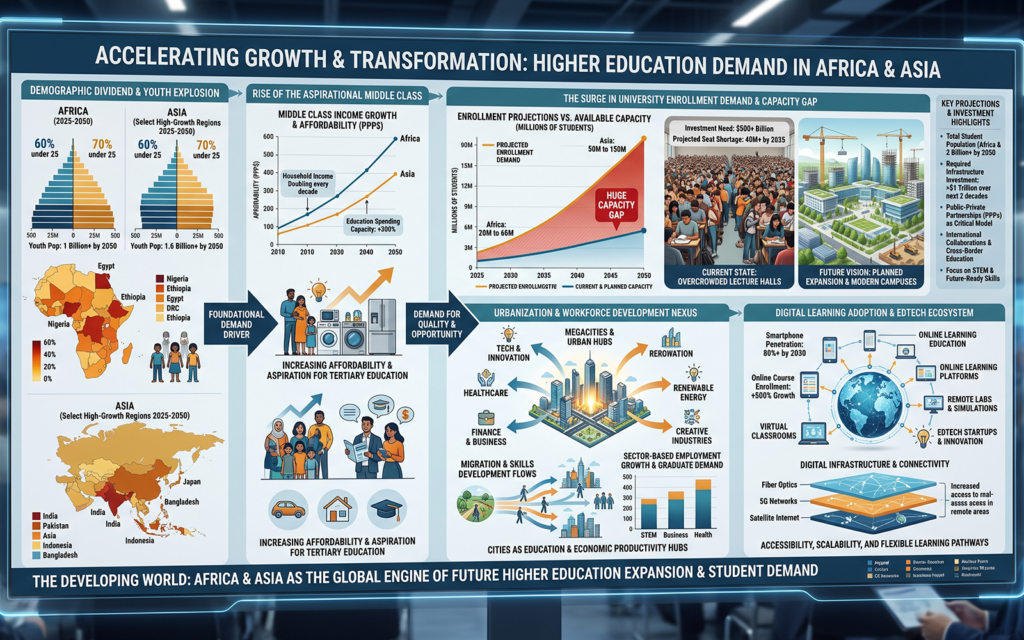
The first is geography. In large parts of Sub-Saharan Africa, South Asia, and Latin America, the nearest university is many hours away, and for a significant share of potential students, that distance is prohibitive. It determines whether a student can study, not whether they are capable of it.
The second is wealth. UNESCO’s 2022 World Higher Education Conference reaffirmed higher education as a public good and a right, yet tuition fees, accommodation costs, and the opportunity cost of not working during study mean that access remains inaccessible to much of the global population. The UNESCO IESALC report launched in 2024 found that marginalised groups, including low-income individuals, Indigenous peoples, and people with disabilities, continue to face substantial barriers to higher education across fifteen national case studies, despite decades of stated commitment to widening access.
The third is birth. Where you are born still determines, to a remarkable degree, whether you will access quality higher education. UNESCO’s 2026 Higher Education Global Trends Report puts the numbers plainly: 80 per cent of young people in Western Europe and North America are enrolled in higher education; nine per cent in Sub-Saharan Africa. This is not a meritocracy. It is a geography lottery.
The constraint on global higher education is not demand. Demand is enormous and growing. The constraint is infrastructure, and infrastructure is the one constraint that policy, investment, and technology can actually change.
The Economic Case: What Unequal Education Access Costs Everyone
Calling education an infrastructure is not sentiment. It is accounting. The economic costs of the current system are documented, and they are extraordinary.
At the individual level, the connection between educational attainment and lifetime earnings is among the most robust in economics. OECD data shows that the public net financial returns from tertiary education average approximately USD 127,000 per male graduate and USD 60,600 per female graduate in OECD countries, generated through higher income taxes and reduced welfare spending. Every student who is denied access to tertiary education represents not just a personal loss but a fiscal one: a smaller tax base, higher welfare costs, and a gap in the skilled workforce that the economy around them needed.
At the systemic level, the costs are larger still. A February 2026 World Bank report on human capital found that current deficits in education and skills development are costing low and middle-income countries 51 per cent of their future labour earnings. The learning crisis, measured across all levels of education, could cost this generation of children USD 21 trillion in lifetime earnings in present value, equivalent to 17 per cent of today’s global GDP. These are not marginal numbers. They are the cost of a decision not yet made: the decision to treat education as infrastructure.
The Technology Shift That Makes This Decision Possible

For most of human history, delivering quality education required physical buildings, expert faculty present in those buildings, students present at the same time, and capital-intensive infrastructure at every delivery point. That is precisely why the education as public infrastructure argument was historically impractical: the cost of delivering education at infrastructure scale was prohibitive for most governments and entirely unreachable for most communities.
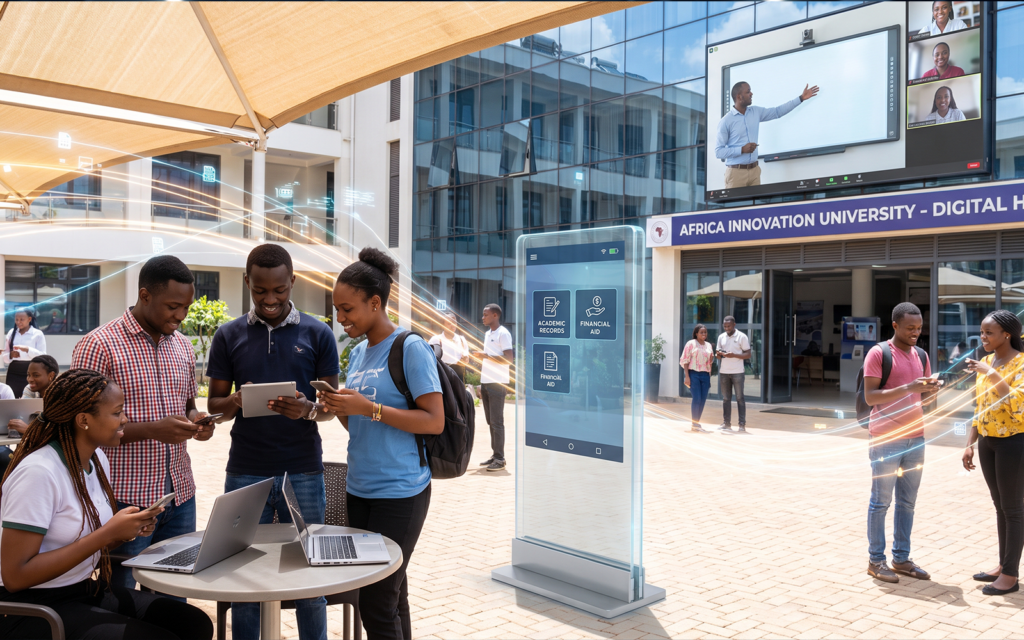
That constraint has dissolved. Digital infrastructure, built deliberately and deployed at scale, can deliver quality education to a student with a mobile phone in rural Ethiopia as readily as to a student on a campus in London. The delivery model has changed fundamentally. What has not yet changed are the institutional and political decisions that would give that technology its mandate.
The reason education has not been treated as infrastructure is no longer that it cannot be delivered at infrastructure scale. It is that the political will to decide it should be has not yet crystallised in the way it eventually did for roads, electricity, and clean water. That decision is overdue.
What Infrastructure-Level Education Would Actually Require
Naming education as infrastructure without specifying what it demands is gesture, not policy. The education as public infrastructure argument requires the following in concrete terms.
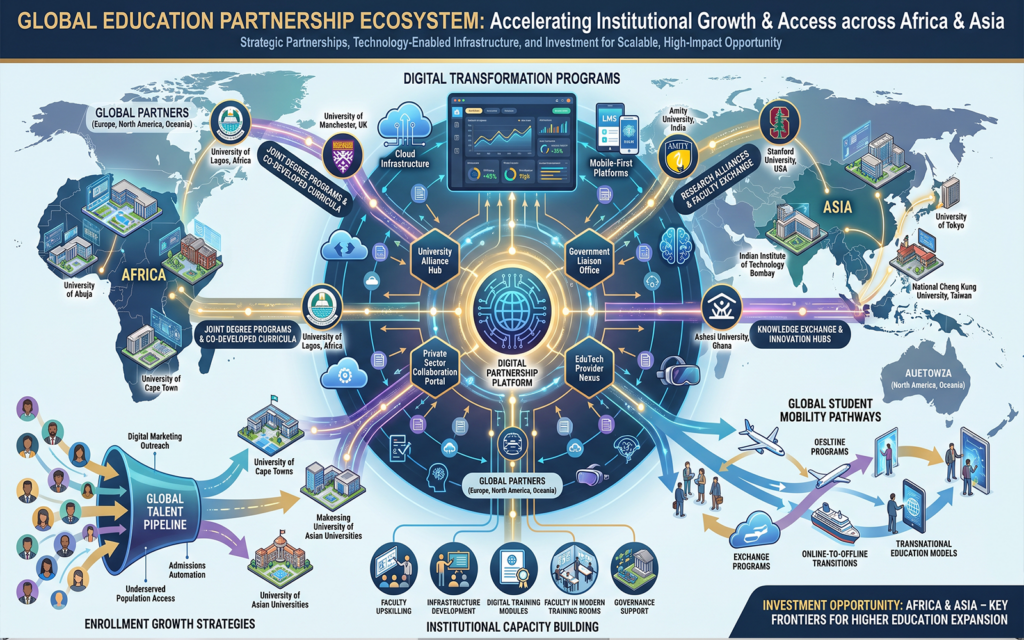
Government commitment to treating higher education access as a national priority with dedicated funding and regulatory frameworks that support scalable delivery, rather than treating it as a cost to be contained. Development finance on the scale that international institutions have historically applied to roads and energy infrastructure, recognising that the economic returns are comparable or superior. Digital delivery infrastructure built to serve hundreds of thousands of learners, including learning management systems, student information systems, and credential frameworks that work across borders and institutions. Policy alignment on cross-border credential recognition and quality assurance frameworks that make international digital delivery legally and institutionally coherent.
The Organisations Already Acting
The argument is not new. What is new is the coalition beginning to act on it. The African Union’s Digital Education Strategy 2023 to 2028 treats digital education infrastructure as a continental priority, with infrastructure development listed as its core strategic objective. The strategy explicitly frames digital delivery as the mechanism for meeting the demand that physical institutions cannot absorb. At a global level, the UNESCO Fortaleza Declaration of 2024, adopted by more than 50 ministers at the Global Education Meeting, called explicitly for “innovative financing” and affirmed quality education as a human right and a public good requiring structural rather than marginal investment. The ILO has consistently framed skills development as a systemic economic priority, not a welfare measure.
The direction is set. The institutional will is forming. The technology exists. What is still needed is the operational infrastructure to deliver at the scale the argument demands.
EduTech Global: Building as If the Decision Is Already Made
EduTech Global did not wait for the consensus to form. It was founded on the belief that education infrastructure should not be a privilege, and every product, partnership, and operational decision has been made with that thesis at its centre.
That means enrollment systems designed to serve hundreds of thousands of students, not hundreds. It means partnerships that extend institutional reach into markets previously out of reach. It means digital infrastructure built for the realities of emerging markets: low bandwidth, mobile-first, offline-capable. It means revenue models that make expansion possible without requiring capital expenditure from institutions that cannot yet afford it.
EduTech Global is not a company waiting for the world to decide that education is infrastructure. It is a company building as if it already is.
Read More: Digital Skills Gap in Education: A Global Policy Challenge
The Decision the World Has Not Yet Made
Every infrastructure decision that now seems obvious was once controversial. Governments were once told they could not afford to build roads to rural communities, electrify working-class homes, or extend clean water to populations deemed too dispersed to serve economically. Those arguments lost, and the societies that rejected them are better for it. The education as public infrastructure argument will follow the same arc. The question is not whether the world will eventually decide that university access is infrastructure. It is when. The next billion learners cannot wait for the consensus to arrive on its own schedule. If that urgency resonates with your institution, government, or organisation, contact EduTech Global. We are already building.
Frequently Asked Questions
Should higher education be treated as public infrastructure? The functional definition of infrastructure, something whose absence compounds systemic disadvantage, whose societal returns exceed individual returns, and whose rationing by wealth creates irreversible inequality, fits higher education precisely. The argument is as much economic as it is moral.
What is the economic case for universal education access? OECD data show that public net financial returns from tertiary education run to USD 127,000 per male graduate in tax revenues and reduced welfare spending. A February 2026 World Bank report found that education and skills deficits are costing low and middle-income countries 51 per cent of their future labour earnings.
Why is university access still unequal globally? Three rationing mechanisms persist: geography, which makes physical campuses unreachable; wealth, which makes tuition and living costs prohibitive; and birth, which determines access before any measure of ability or effort applies.
How can technology help democratise higher education? Digital delivery infrastructure can now serve learners on mobile devices in low-bandwidth environments as effectively as campus-based delivery, eliminating the physical distribution constraint that historically made infrastructure-scale education undeliverable.
What would infrastructure-level education access look like? Government commitment with dedicated funding, development finance at the scale applied to roads and energy, digital delivery systems built for hundreds of thousands of learners, and cross-border credential recognition frameworks that make international access legally coherent.
How should governments invest in higher education infrastructure? By treating it as they treat road, energy, and telecommunications infrastructure: as a long-term investment in economic productivity whose returns compound across generations, not as a cost to be contained within annual education budgets.