

One might ask, why should a university, built to teach eighteen-year-olds and award degrees, spend time and budget building corporate training programs for employers who already have graduates on their payroll? The honest answer is that the economics of higher education have changed, and employers have become one of the few genuinely growing sources of demand for what universities already know how to do well: design curriculum, assess learning and award credentials that carry weight.
For a provost or vice chancellor watching enrolment projections flatten while operating costs climb, this is not an abstract debate. The institutions already moving into workforce development are not doing so out of curiosity; they are doing so because the maths of relying solely on eighteen-year-old enrolment no longer works in enough markets to be a safe long-term strategy. Corporate training programs offer a rare thing in higher education finance: a revenue stream that grows precisely because the labour market is under pressure, rather than despite it.
Traditional tuition income is under pressure almost everywhere, from shifting demographics to tightening public funding, and university leaders are right to look for revenue that does not depend entirely on eighteen-year-old enrolment. Corporate learning has quietly become one of the fastest-growing segments in higher education, and the institutions building genuine employer relationships now are the ones diversifying their income while also making their graduates more employable in the process. This is not a marginal side business; it is a strategic response to a labour market that is reskilling faster than at any point in recent memory.
Read More: Designing High‑Impact Corporate Training Programs for African Businesses
Why Traditional Tuition Revenue Is No Longer Enough
Universities everywhere are contending with the same financial squeeze: rising delivery costs, tightening public funding, and a demographic outlook in many markets where the pool of school leavers is not growing fast enough to sustain enrolment-based budgets indefinitely. Relying on tuition alone leaves an institution exposed to a single, fairly narrow customer segment.
At the same time, competition for that segment has intensified. Students increasingly compare institutions on employability outcomes rather than prestige alone, and they are right to, given how quickly workplace skill requirements are shifting. Learner expectations have changed too: working adults want flexible, credentialed, career-relevant learning, not necessarily a three-year residential degree, and they are willing to pay employers or themselves for it if a university can deliver it well. Institutions that treat this shift as a threat to the traditional degree are missing the more useful reading, which is that it represents an entirely new customer base sitting adjacent to the one they already serve, with a very different set of buying criteria and a much shorter sales cycle than undergraduate admissions.
The Rise of Corporate Learning
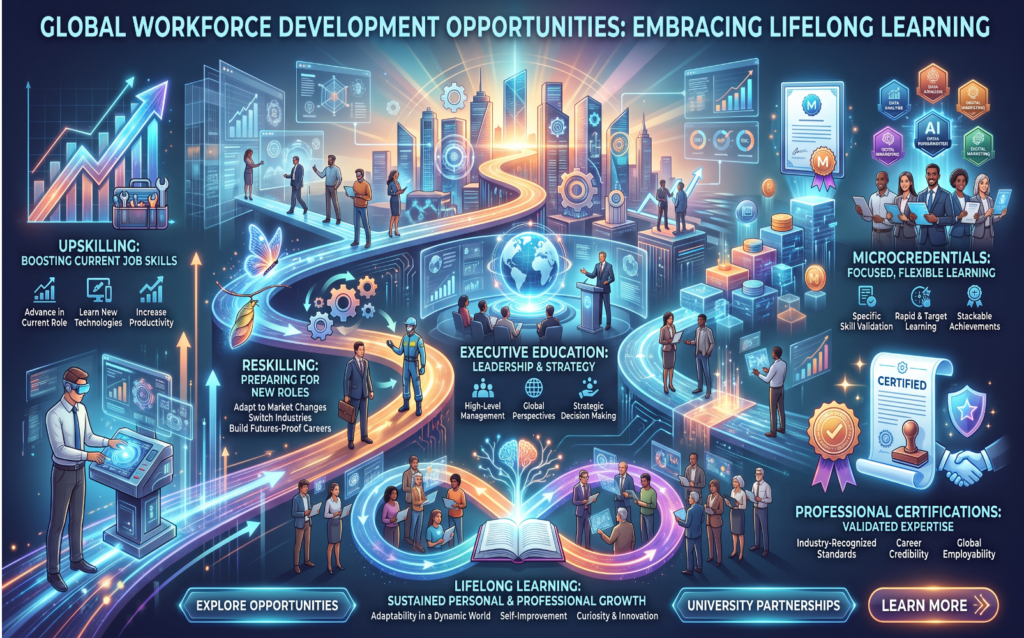
Corporate learning has moved from a nice-to-have training budget line to a central plank of workforce strategy, and the numbers explain why. The World Economic Forum’s Future of Jobs Report 2025 found that 85% of employers surveyed plan to prioritise upskilling their workforce over the next five years, and that on average, workers can expect two-fifths of their existing skill sets to be transformed or become outdated between 2025 and 2030. Employers are not debating whether to invest in workforce development; they are debating who to invest with, and universities are not always the obvious first answer.
This growth breaks down into several distinct categories that a university needs to understand separately, since each calls for a different delivery model:
- Upskilling existing employees to deepen capability in their current roles, often in fast-moving areas such as data analysis or digital tools.
- Reskilling employees whose roles are being displaced by automation or restructuring, moving them into adjacent or entirely new functions.
- Executive education, typically shorter, intensive programmes for managers and leaders, often commanding premium pricing because of the seniority of the audience.
- Microcredentials, short, stackable qualifications that certify a specific competency without requiring a full degree, increasingly recognised by employers as a legitimate signal of capability.
LinkedIn’s 2025 Workplace Learning Report found that half of employers now say providing learning is their top strategy for employee retention, and that 91% of learning and development professionals agree continuous learning matters more than ever for career success. That is a workforce development market actively looking for credible partners, and a university’s accreditation, subject expertise and assessment rigour are precisely the assets many corporate learning providers cannot easily replicate.
What Employers Want From Universities
Universities that succeed in this space tend to share a clear-eyed understanding of what employers are actually buying, which is rarely the same thing a prospective undergraduate is buying.
- Industry-aligned curriculum. Employers want content mapped directly to real job requirements and current tools, not an academic survey of a discipline. A programme that cannot explain, in one sentence, which workplace problem it solves will struggle to get budget approval from a learning and development director.
- Flexible delivery. Working professionals cannot attend three lectures a week in term time. Evening, weekend, asynchronous online and short intensive formats all need to be genuinely available, not offered grudgingly as an afterthought to the standard timetable.
- Stackable credentials. Employers increasingly want learning that builds towards something recognised, whether that is a postgraduate qualification, a professional certification or a portable microcredential that an employee can carry between roles. The OECD’s Skills Outlook 2025 specifically calls for transparent, portable credentials that recognise learning wherever it happens, a principle employers are increasingly holding their training partners to.
- Fast implementation. A procurement process that takes a university nine months to approve a bespoke programme will lose to a corporate learning platform that can deploy in weeks. Employers are used to commercial vendor timelines, and a university that cannot match reasonable speed will be quietly passed over, however strong its academic reputation.
Read More: What Global Employers Really Think About Online Degrees
Universities that treat these four expectations as constraints to be negotiated down, rather than genuine requirements to be met, tend to win a first contract and then lose the renewal.
Building Successful Corporate Training Programs
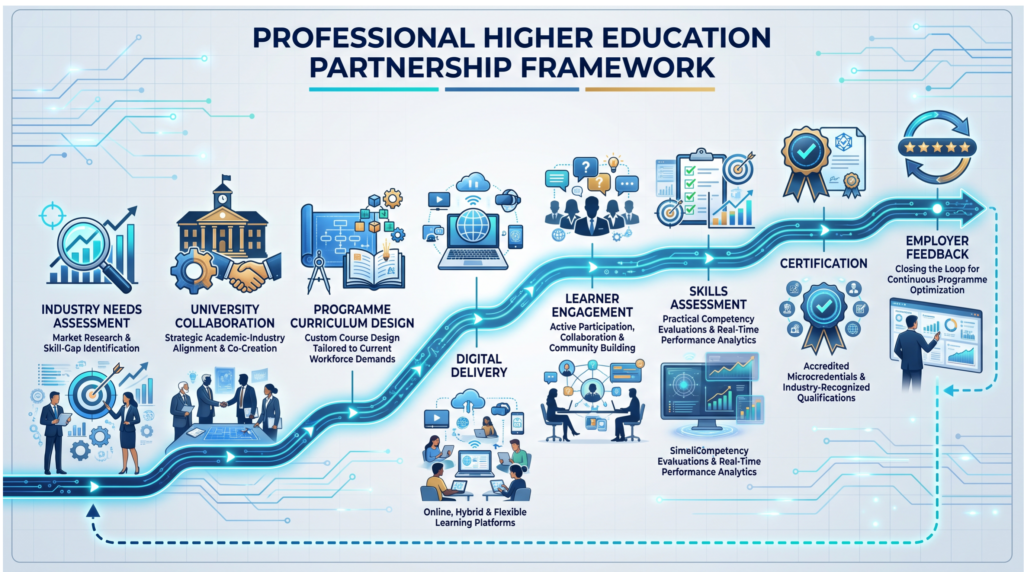
Institutions that build lasting corporate training programs generally follow a disciplined sequence rather than improvising department by department, since ad hoc bespoke programmes tend to consume disproportionate staff time for a single cohort and rarely repeat.

It starts with a genuine needs assessment, conducted with the employer rather than assumed on their behalf. This means understanding the specific capability gap, the number of employees affected, and how success will be measured, before a single module is designed. Skipping this step is the single most common reason bespoke programmes underperform.
Industry partnerships then need to be built as ongoing relationships, not one-off transactions. The strongest university corporate partnerships involve employers in curriculum advisory boards, guest input on programme design and, ideally, a multi-year agreement rather than a single cohort. A university that treats an employer as a repeat client, not a one-time buyer, earns the referrals that make this business genuinely scalable.
Programme design should be modular wherever possible, built from smaller units that can be recombined for different employers rather than a single fixed curriculum. This keeps development costs down and allows faster customisation, which matters given how quickly employer priorities shift.
Delivery models need to match how the target audience actually works: blended formats combining short online modules with occasional in-person intensives tend to perform best for time-poor professionals, while fully online delivery suits distributed workforces and international employers who need consistency across locations.
Finally, evaluation has to move beyond satisfaction surveys. Employers increasingly expect evidence tied to workplace outcomes: completion rates, skills assessments before and after, and, where possible, a link to performance or retention data. A university that can present this kind of evidence to a chief learning officer is negotiating from a position employers respect.
Revenue Opportunities From Corporate Training Programs
Corporate training programs open several distinct revenue lines, each with a different margin profile and sales cycle:
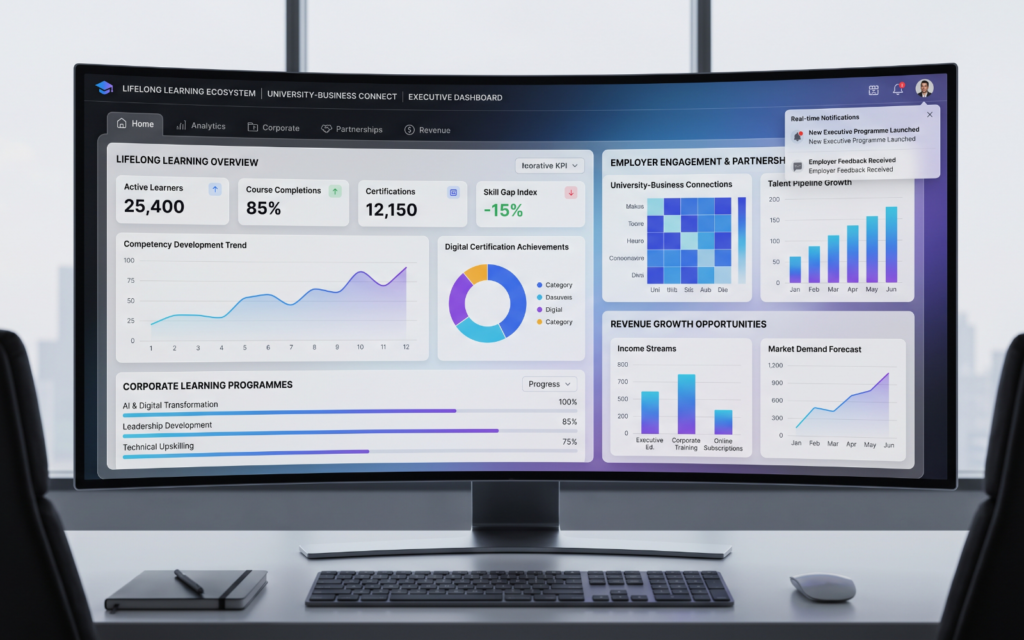
- Executive education, which commands the highest per-participant fees but requires strong faculty and brand credibility to sustain.
- Certification programmes, offering recurring revenue as professionals renew or stack credentials over a career.
- Subscription learning, where an employer pays an annual fee for ongoing access rather than purchasing individual courses, smoothing revenue across the year.
- Professional development courses, shorter and lower-priced than executive education but higher volume, often the easiest entry point for a new employer relationship.
- Government contracts, particularly for sector-wide reskilling initiatives, which tend to be larger in scale and slower to close but valuable for long-term institutional positioning.
The ILO’s work on skills and lifelong learning consistently frames employer-funded training as a shared public good, which is precisely the argument universities can make to government partners funding sector-level reskilling at scale.
The EduTech Global Partnership Model
EduTech Global works with universities as a partner in building this capability, not simply as a technology vendor, because the institutions that succeed here need help across the whole chain rather than a single missing piece.
Our approach spans programme development, helping institutions design modular, industry-relevant curricula rather than repurposing existing degree content. We support industry engagement, connecting institutions with employer networks and helping structure the advisory relationships that keep programmes relevant year over year. Our digital delivery infrastructure, drawn from our work across the Vigilearn ecosystem, gives institutions the flexible, scalable delivery employers now expect as standard. And through our international partnerships, we help universities extend corporate training programs beyond their home market, connecting institutions to employers and government bodies across the regions where workforce demand is growing fastest.
Corporate training programs are not a distraction from a university’s core mission; they are an extension of it, applied to a market that badly needs what universities do well. Institutions that build genuine employer partnerships, design for how working professionals actually learn, and measure outcomes the way employers expect will find a revenue stream that also strengthens their reputation for graduate employability. Those that treat this as a side project, staffed reluctantly and priced defensively, will find employers taking their budgets elsewhere.
EduTech Global helps institutions build this capability from the ground up. Explore our related work on corporate training programmes in Africa and digital transformation in higher education; read more on our blog to learn how we support institutions building workforce development strategies.
Ready to build a workforce development strategy that works? Schedule a Corporate Education Strategy Session with EduTech Global.
Frequently Asked Questions
How can universities expand revenue through corporate training? By building industry-aligned, flexible programmes that meet genuine employer capability gaps, rather than repackaging existing degree content, and by treating employers as ongoing partners rather than one-off customers.
Should every university offer corporate training? Not without a genuine capability to deliver flexibly and measure outcomes. Institutions with strong subject expertise and accreditation credibility are best placed, provided they invest properly in employer-facing programme design.
What do employers actually need? Industry-aligned curriculum, flexible delivery, stackable credentials and fast implementation, evaluated against workplace outcomes rather than satisfaction scores alone.