

Ask any university IT director what keeps them awake at night, and the answer rarely involves a single dramatic crisis. It is the accumulation of smaller pressures: a student information system that groans under enrolment spikes, a research team waiting weeks for compute capacity, a cybersecurity team stretched thin across ageing servers, and a leadership team asking why digital transformation always seems to cost more and take longer than promised. Cloud computing for universities has moved from a background IT conversation to a genuine strategic question for the people running these institutions.
For a vice chancellor or chief information officer, this is not an abstract technology debate. It shows up as a real trade-off every budget cycle: whether to fund another round of patches and replacement parts for a data centre nobody particularly wants to own, or to commit to a different operating model entirely. Institutions that keep deferring the decision tend to find the cost of standing still quietly rising each year, even when nothing has visibly gone wrong yet.
Today’s universities manage hybrid learning across multiple time zones, recruit students from dozens of countries, generate research data at a scale legacy systems were never designed for, and operate across several physical campuses, all while cybersecurity threats grow more sophisticated by the month. Traditional, on-premise infrastructure was built for a steadier, more predictable era of higher education, and it is now visibly straining under demands it was never designed to meet. Cloud computing for universities is not simply a faster server; it is a different institutional operating model, and the leadership teams that understand this distinction are the ones building genuinely resilient, future-ready institutions.
Read More: Digital Transformation Strategy for Universities: A Guide for Higher Education Leaders
What Cloud Computing for Universities Actually Means
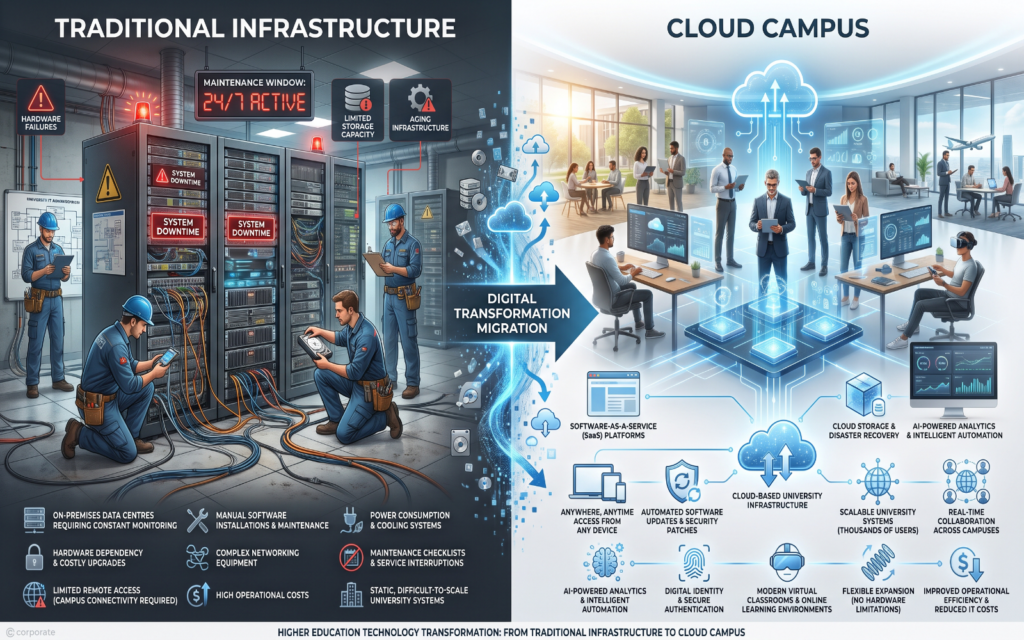
In simple terms, cloud computing for universities means accessing computing power, storage, software and data services over the internet from a specialist provider, rather than owning and maintaining the physical servers on campus. Instead of a data centre in a basement that a small IT team must patch, cool and replace every few years, institutions rent capacity that scales up or down as needed and pay largely for what they actually use.
Three service layers matter most for institutional leaders. Infrastructure as a Service provides the raw computing, storage and networking that would otherwise sit in a campus data centre. Platform as a Service gives development teams a ready-made environment to build and run applications without managing the underlying servers. Software as a Service for universities delivers complete applications, such as a cloud-based student information system, learning management system or finance platform, that staff simply log into and use. Underlying all three is secure hosting, remote accessibility for staff and students working from anywhere, and continuous updates that arrive automatically rather than through a disruptive, multi-week upgrade project.
The essential shift is one of posture. On-premise infrastructure asks an institution to predict its own future capacity needs years in advance and then live with that guess. Cloud computing for universities replaces that guesswork with elasticity: capacity that expands during clearing and enrolment peaks and contracts afterwards, without the institution ever having purchased servers it uses for six weeks a year and stores for the other forty-six.
The Five Biggest Benefits of Cloud Computing for Universities
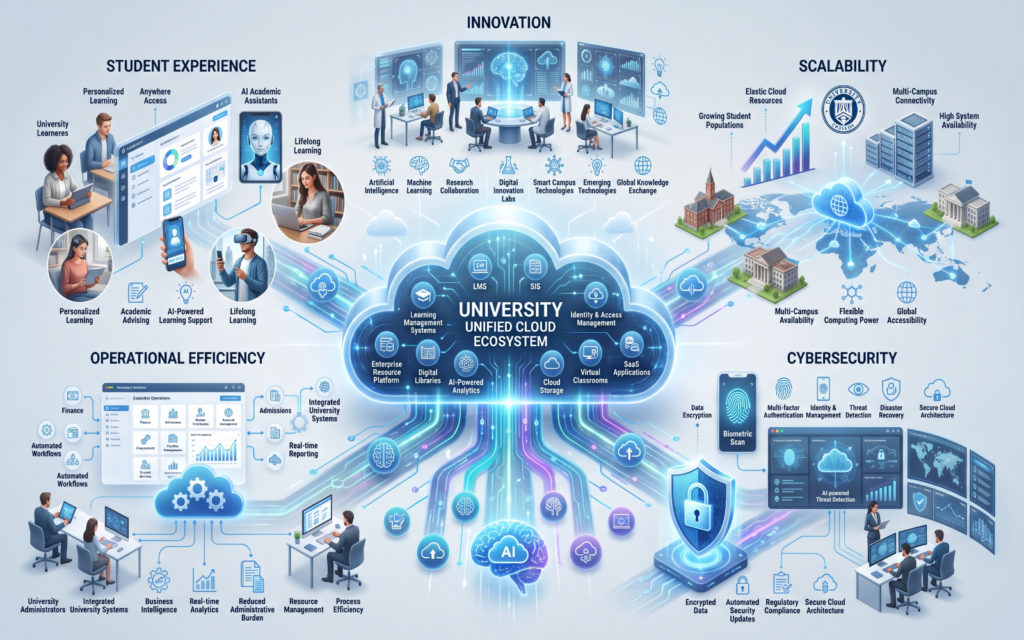
Scalability. Enrolment growth, clearing periods and new campus launches no longer require a major capital outlay months in advance. A university expecting a surge in applications can provision additional capacity for the admissions portal in hours rather than negotiating a hardware procurement cycle that outlasts the surge itself.
Security. Modern cloud providers invest in security standards, disaster recovery and compliance certification well beyond what most individual universities can justify building in-house. When the University of Newcastle in Australia moved its infrastructure to Amazon Web Services, it improved its disaster recovery framework with automatic failover across availability zones and cut infrastructure operations costs by 20%, while also automating threat detection that would have been costly to replicate on-premises.
Student experience. Cloud-based student information systems and learning platforms mean genuinely anywhere access: a mobile-first experience that treats a smartphone as a legitimate primary device, not an afterthought, and services that operate around the clock rather than within campus IT office hours. For a generation of students who expect the same responsiveness from their university as from their bank, this matters more than institutions sometimes credit.
Operational efficiency. Moving workloads to the cloud reduces the maintenance burden on internal IT teams, who spend less time patching servers and more time on work that actually serves students and researchers. The University of Notre Dame reduced its data centre footprint by half and saved over $1.5 million by adopting a well-architected cloud framework, freeing budget and staff time for higher-value initiatives.
Innovation. Perhaps most importantly, cloud infrastructure for universities is the precondition for everything institutions want to do next: artificial intelligence in admissions and advising, predictive analytics for retention, and automation of administrative processes that currently consume disproportionate staff time. None of these run well on legacy, on-premise systems designed a decade or more ago.
Read More: Cybersecurity in Higher Education Today
Common Challenges Universities Face During Cloud Migration
Migration rarely fails because of the cloud technology itself. It fails because of what surrounds it: the institutional habits, undocumented workarounds and staff anxieties that any major system change surfaces, regardless of how capable the destination platform is.
- Legacy systems built with sparse documentation and years of undocumented customisation are harder to migrate than anyone expects, and discovering this mid-project is a common source of delay.
- Data migration carries real risk: student records, research data and financial systems all need careful sequencing and validation, not a rushed weekend cutover.
- Staff training is frequently underestimated. A cloud platform that IT understands but faculty and administrative staff do not will sit underused regardless of its capability.
- Integration complexity arises when a new cloud system needs to talk to older systems that were never designed with modern interoperability standards in mind.
- Budget planning needs to account for the shift from large upfront capital spending to ongoing operational costs, a change that can complicate multi-year institutional budgeting if finance teams are not briefed early.
- Change management is the thread that ties all of the above together. A university that treats migration as a purely technical project, without genuine governance and staff buy-in, tends to under-deliver regardless of how capable the chosen platform is.
Governance, in short, matters more than the technology choice itself. The most sophisticated cloud platform cannot compensate for a migration with no clear owner, no phased plan and no honest conversation with the staff who will actually use it.
Building a Successful Cloud Strategy
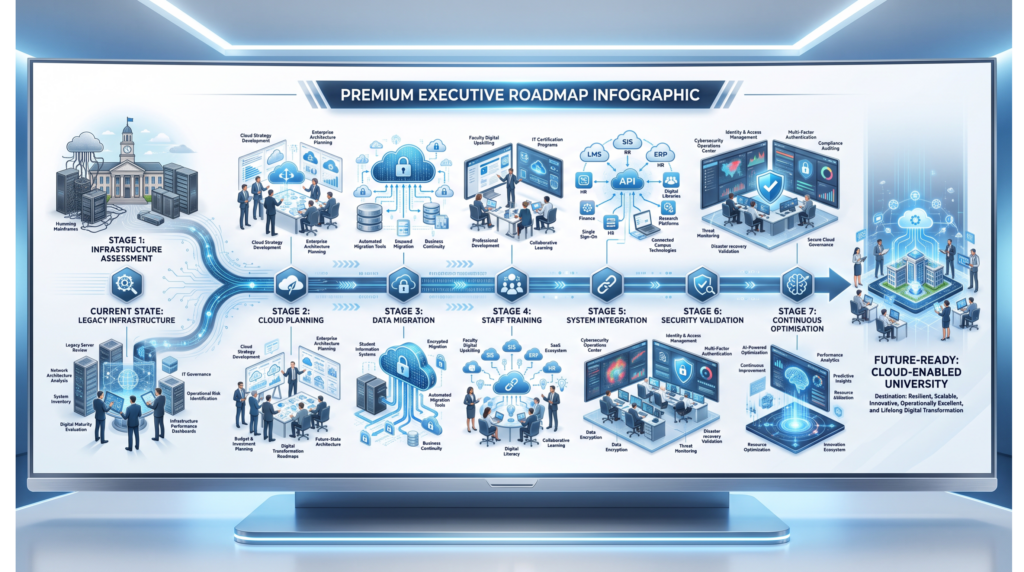
A credible cloud strategy follows a deliberate sequence rather than a single big-bang migration.
Start by assessing existing infrastructure honestly: which systems are ageing, which are business-critical, and which would be genuinely disruptive to move first. From there, identify priorities based on institutional risk and opportunity, typically student-facing systems with clear scalability pain points, rather than whichever system happens to be easiest to migrate.
Develop governance early, with a named senior owner and clear decision rights spanning IT, academic leadership and finance, so that the inevitable difficult trade-offs during migration have somewhere to be resolved. Choose trusted technology partners based on genuine higher education experience and security credentials, not simply the lowest quoted price; providers such as AWS, Microsoft Azure and Google Cloud all offer education-specific programmes worth evaluating on their institutional fit.
Pilot projects with a single, well-scoped system before committing the whole institution, then scale gradually, applying the lessons from that pilot to subsequent migrations rather than repeating the same avoidable mistakes across every department. Finally, measure outcomes against the goals set before migration began: cost, uptime, staff time saved and student satisfaction, so that a board can see genuine evidence rather than an assumption that “cloud is simply better.” A strategy built this way tends to earn continued investment precisely because each phase produces evidence the next phase can build on, rather than asking leadership to take the whole journey on faith upfront.
Read More: Data Governance in Higher Education: Why Universities Need Clear Data Strategies
The Cloud as the Foundation of the Digital Campus
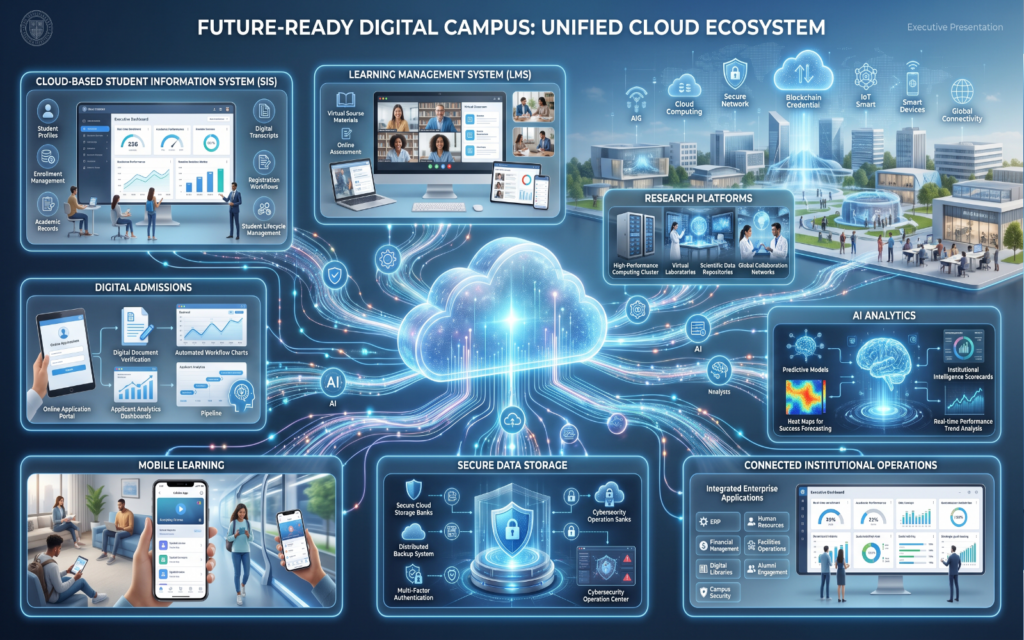
Cloud infrastructure is not one feature among many in a modern university; it is the backbone that everything else depends on. A cloud-based student information system gives every department, from admissions to finance, a single accurate source of student data instead of five conflicting spreadsheets. Digital admissions platforms scale cleanly during application peaks precisely because they sit on elastic cloud infrastructure rather than fixed on-premise capacity.
Learning management systems hosted in the cloud support genuinely flexible, anywhere access for hybrid and distance learners, while analytics platforms depend on cloud-scale data processing to turn raw engagement data into early warning signs of retention risk. Research computing, similarly, increasingly relies on cloud-based high-performance computing rather than campus clusters that sit idle much of the year and are overwhelmed during peak demand. And artificial intelligence, whichever specific application a university pursues next, requires the elastic, secure data infrastructure that only cloud computing for universities can practically provide at scale. Gartner predicts that by 2028, 75% of IT installations in higher education will be managed through cloud-based services, a trajectory that makes the cloud less a future option than a near-term institutional default.
Whether your institution is beginning its cloud journey or modernising existing infrastructure, EduTech Global helps universities design scalable digital ecosystems that support long-term institutional growth, operational excellence, and global competitiveness.
Ready to assess your institution’s cloud readiness? Request a Digital Infrastructure Strategy Session with EduTech Global and build a future-ready technology roadmap.
Frequently Asked Questions
What is cloud computing for universities? It means accessing computing power, storage and software over the internet from a specialist provider, rather than maintaining physical servers on campus, giving institutions scalable, pay-as-you-go infrastructure.
Is cloud infrastructure secure? Leading cloud providers invest in security standards, certifications and disaster recovery capability well beyond what most individual universities can build in-house, though institutions still need their own governance and data policies.
How expensive is migration? Cost varies with institutional size and the systems involved, and shifts spending from large upfront capital costs to ongoing operational expenditure, which needs early input from finance teams during budget planning.
Can universities migrate gradually? Yes, and this is generally the recommended approach: pilot a single system, learn from it, then scale gradually rather than attempting a single institution-wide migration.
What systems should move first? Student-facing systems with clear scalability pain points, such as admissions portals during peak application periods, tend to offer the clearest early wins.