

When a university in Accra decides it wants to teach working professionals in Abidjan, the first question is rarely about curriculum. It is about whether AfCFTA, the African Continental Free Trade Area, changes anything practical regarding licensing, accreditation and the degree certificate at the end. The honest answer is that it changes the policy context far more than it changes the paperwork, and that distinction is where most strategic thinking about cross-border education either succeeds or collapses.
Most coverage of the African free trade agreement focuses on tariffs, ports and manufactured goods. Yet the agreement also covers services, and education is a service. For institutions watching domestic enrolment pressure build while capacity stays fixed, that opens a genuinely interesting question: if the continent is deliberately lowering barriers to cross-border services, what does that mean for universities, professional training providers and the technology that carries learning across national lines? This article examines that question without pretending the answers are settled, because they are not.
Read More: Online Program Management: A New Financing Model for African University Expansion
What Is AfCFTA and What Does the African Free Trade Agreement Cover?
The Agreement Establishing the African Continental Free Trade Area came into force in May 2019, with a secretariat seated in Accra. Its ambition is a single continental market: goods, services, investment, competition policy and intellectual property, sitting alongside commitments to eliminate tariffs on the overwhelming majority of tariff lines over a phased period, as the African Union has set out.
A separate Protocol on Trade in Services governs the services side, which also entered into force in May 2019. It organises liberalisation around four modes of supply, and those four modes describe almost everything a university might do beyond its home market:
- Mode 1, cross-border supply: a programme delivered online into another country
- Mode 2, consumption abroad: a student travelling to study
- Mode 3, commercial presence: a branch campus or local entity
- Mode 4, presence of natural persons: academics and trainers working temporarily abroad
Crucially, AfCFTA liberalises services through schedules of specific commitments using a positive-list approach, meaning each country lists the sectors it is willing to open and the limitations it retains. TRALAC’s analysis is clear that market access flows from those schedules, not from the framework alone. The first negotiating round prioritised five sectors: transport, communications, financial services, tourism and business services.
Does AfCFTA Cover Education?
Education sits within the broader services economy, and negotiators flagged education early as an area of interest in the ongoing talks. Education is not, however, among the five priority sectors in the first round. This is where most commentary goes wrong.
A continental framework is not automatic permission to operate. National regulators retain the authority to licence institutions, accredit programmes, approve modes of delivery and set standards for student protection. The protocol itself recognises the sovereign right of states to regulate within their territories to meet national policy objectives. A Kenyan university does not acquire the right to award degrees in Senegal because both countries ratified a trade agreement.
Read More: The Future of Higher Education: Ten Trends Reshaping Universities Through 2030
What the framework does provide is direction of travel, plus one provision of direct relevance to education. Article 10 on mutual recognition allows a state party to recognise education, experience, licences, or certifications obtained in another member state, typically through sector-by-sector mutual recognition agreements. That is the mechanism to watch.
What Cross-Border Education Could Look Like
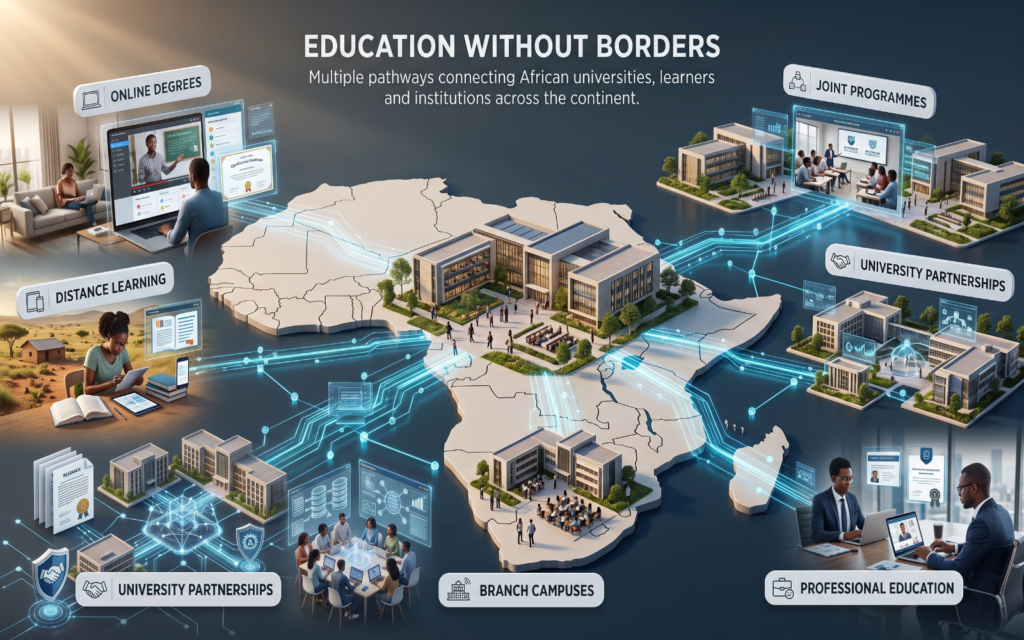
Transnational education, or TNE, describes any arrangement where learners study for a qualification awarded by an institution based in another country. It is not one model but several, and each carries a different regulatory weight:
- Fully online and distance programmes, where the learner never relocates
- Branch campuses, which require local establishment and usually local licensing
- Joint and dual degrees awarded with a partner institution
- Validated or franchised provision, where a local partner delivers an approved curriculum
- Professional and executive education, often shorter and less tightly regulated
- Faculty and student mobility supporting any of the above
Online and partnership models scale most easily because they demand less capital and fewer physical approvals. They also attract the sharpest scrutiny on quality assurance, precisely because scale is easy.
Why Africa Is Becoming a Larger Market for Education Services
The demand case does not rest on optimism. It rests on arithmetic. Sub-Saharan Africa’s gross tertiary enrolment ratio stands at roughly 9 to 10 per cent, well below the global average of around 38 per cent, which means most qualified school leavers simply do not find a place. UNESCO records that nearly 15 million students were enrolled in African universities in 2017, a figure that had almost doubled over the previous 15 years and is set to double again by 2030, while close to half a million African students study abroad.
Read More: The Digital Campus: Why Every Modern University Needs One to Stay Competitive
Set that against a young and growing population, persistent skills shortages in sectors such as health, engineering and data, and employers who increasingly value qualifications recognised beyond one national border. Meanwhile, intra-African trade remains only around 15 per cent of the continent’s total trade, compared with far higher shares in Europe and Asia. The gap in cross-border services Africa currently sustains is not evidence of weak demand; it reflects how much integration work remains.
Digital Education: The Infrastructure Behind Cross-Border Learning

Digital delivery is what makes Mode 1 realistic. It is also where institutional readiness is tested honestly. Reaching a learner in another country means running admissions, identity verification, enrolment, teaching, assessment, proctoring, support and credentialing at a distance, reliably, in conditions the institution does not control.
That is an infrastructure question before it is a pedagogy question. Nigeria offers a working illustration: EduTech Global is building the digital backbone for the University of Abuja’s open and distance learning programme, covering the learning management system, student information system, admissions, virtual classrooms, online examinations with remote proctoring, content digitisation and round-the-clock student support, as the institution targets a substantial increase in distance enrolment. The university retains its curriculum, academic staff and awarding authority. The technology extends reach.
Digital learning removes geography. It does not remove connectivity constraints, device affordability, data protection obligations, payment friction or the duty to support learners properly. Those requirements travel with you.
What Could Stop Cross-Border Education From Scaling

Trade integration does not dissolve regulation. AfCFTA does not change that, so institutions planning continental expansion should expect to work through national licensing rules, accreditation of foreign providers, restrictions on modes of delivery, professional licensing bodies in regulated fields, data residency and privacy law, language of instruction, cross-border payment and foreign exchange friction, uneven bandwidth, and student protection requirements covering refunds, complaints and teach-out arrangements. Any one of these can stall a launch. Several appearing together usually do.
Read More: Why University International Partnerships Fail: Beyond the MOU
Credential Recognition: The Trust Layer for a Continental Market
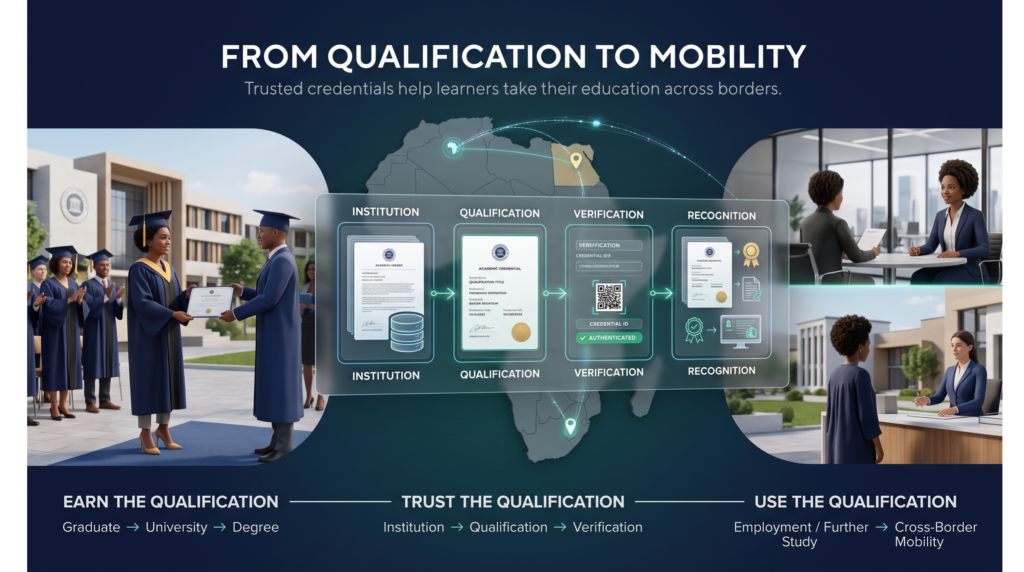
No education market grows faster than confidence in its qualifications. If an employer in Kigali or a postgraduate admissions committee in Cape Town cannot verify or interpret a degree issued elsewhere, mobility stops regardless of trade policy.
Two instruments matter here. The Addis Convention, UNESCO’s revised regional convention on recognition of qualifications, entered into force in December 2019 and has been ratified by 14 African states, a modest figure that tells its own story about pace. Alongside it, the African Continental Qualifications Framework is a ten-level reference framework whose policy document was validated by African Union member states in July 2023, designed to make qualifications comparable across national systems.
Institutions do not have to wait for either to mature. Verifiable digital credentials and accessible certificate verification give employers and registrars a direct route to confirm a qualification, which is the practical version of the same trust problem.
A Readiness Checklist for Universities
Before committing to a new market, work through the following:
- Regulatory research in the target country, covering foreign providers and permitted delivery modes
- Evidence of demand, by discipline and learner segment, rather than assumed demand
- Programme relevance, including local labour market and licensing requirements
- Quality assurance arrangements that satisfy home and host regulators
- Digital delivery capacity tested against local connectivity and device realities
- Learner support across time zones, languages and service expectations
- Credential verification that third parties can use without contacting your registry
- Payment and refund infrastructure that works in local currency
- Data protection compliance, including where student records are stored
- Local partnerships for recruitment, placement and academic collaboration
What AfCFTA Could Mean for African Higher Education
The realistic outlook is gradual rather than dramatic. Expect more regional partnerships, more online and blended provision reaching learners outside capital cities, growing cross-border professional education, and rising competition for students who now have alternatives. AfCFTA will not deliver that on its own. It creates the policy environment in which recognition agreements, qualifications frameworks and digital infrastructure can compound into something that genuinely resembles a continental market for education services.
For institutional leaders, the sensible posture is preparation rather than prediction. Get the regulatory research done, build delivery capacity that would survive scrutiny in a second country, and make your qualifications easy to verify. Those investments pay off domestically, whatever happens to the trade negotiations.
Africa’s education market is becoming increasingly connected, and universities that understand cross-border opportunities can prepare for a more integrated future. If you are thinking through what continental reach would require of your institution, explore EduTech Global’s education technology and digital infrastructure solutions or start a conversation with our team.
Read More: How EduTech Global Builds University Partnerships That Last: A Behind-the-Scenes Look
Frequently Asked Questions
What is AfCFTA? It is the African Continental Free Trade Area, an African Union agreement establishing a single continental market covering trade in goods, trade in services, investment and related areas. It entered into force in May 2019.
Does AfCFTA cover education? Education falls within the services economy addressed by the Protocol on Trade in Services, and education services have been raised in negotiations. It was not among the five priority sectors in the first negotiating round, and access depends on each country’s schedule of commitments.
Can universities operate across African countries automatically? No. National regulators still control licensing, accreditation and permitted delivery modes. The agreement provides a framework and a mutual recognition mechanism, not automatic market access.
What is cross-border education? Education delivered to learners located in a different country from the provider, whether online, through a local partner, at a branch campus or via student mobility.
What is transnational education? Provision where learners study for a qualification awarded by an institution based in another country, including online degrees, joint programmes, franchised delivery and branch campuses.
Why does credential recognition matter? Without confidence that a qualification will be understood and accepted by employers and other institutions, cross-border enrolment stalls. Recognition instruments and verifiable digital credentials both address this.