

The future of higher education is not waiting for a single breakthrough moment. It is being assembled now; in budget meetings, curriculum reviews and infrastructure decisions that rarely make headlines but quietly determine which institutions thrive over the next decade.
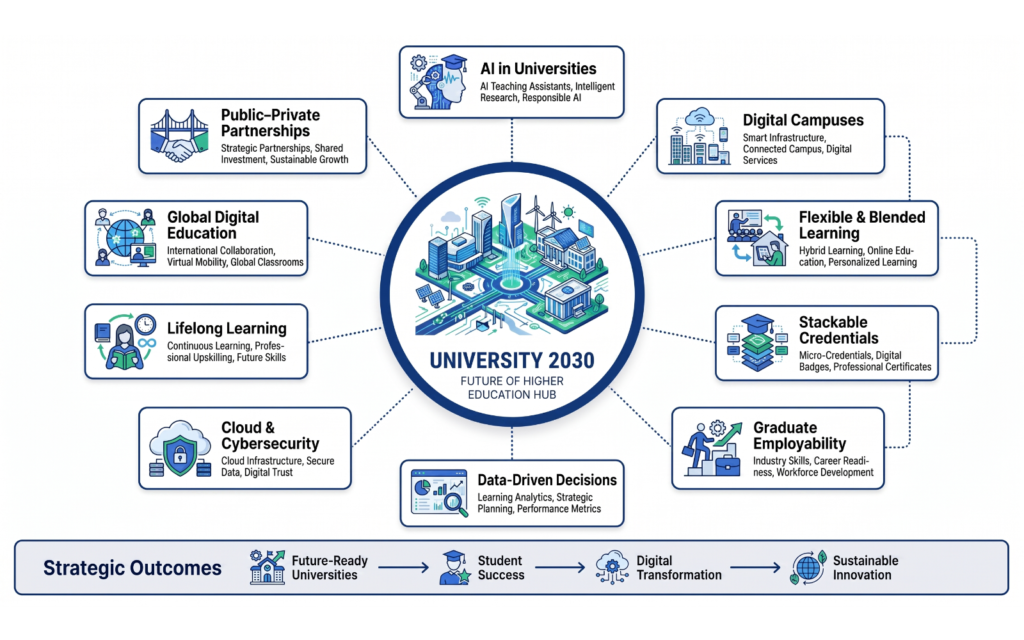
What makes this period different from previous waves of change is that the pressures are arriving together rather than in sequence. Artificial intelligence, shifting demographics, a volatile graduate labour market and learners who expect the flexibility of a streaming service are converging at once. No university can treat these as separate projects to be assigned to different committees. Some of what follows reflects immediate higher education trends 2026 is already grappling with; other elements are longer-horizon shifts that will only fully mature closer to 2030. This article sets out ten strategic trends shaping the future of higher education and what each one means for the people responsible for institutional direction. None of it is inevitable; all of it is worth preparing for, because the institutions that treat these as connected decisions, not isolated projects, are the ones most likely to still matter to students a decade from now.
Read More: The State of International Student Mobility in Africa: 2025–2026 Briefing
Trend 1: AI Moves From Experimentation to Institutional Infrastructure
Generative AI has moved past the pilot stage. It now touches teaching, assessment, student advising, research and administrative workflows, often simultaneously and without central coordination. Among emerging technologies in education, few have spread this quickly across so many functions at once. EDUCAUSE’s 2026 Top 10 places the human dimension of AI adoption above the technology itself, arguing that value only appears when staff and students can apply it with judgement rather than default settings. That framing matters because the temptation for many institutions has been to procure tools department by department, which leaves gaps in oversight and inconsistent student experience across faculties. The practical shift, and one of the clearer higher education technology trends of the moment, is from scattered tool adoption towards a governed, institution-wide AI strategy, covering policy, data protection and staff capability, that connects directly to conversations on AI governance already underway across the sector.
Trend 2: The Digital Campus Becomes the Operating Model
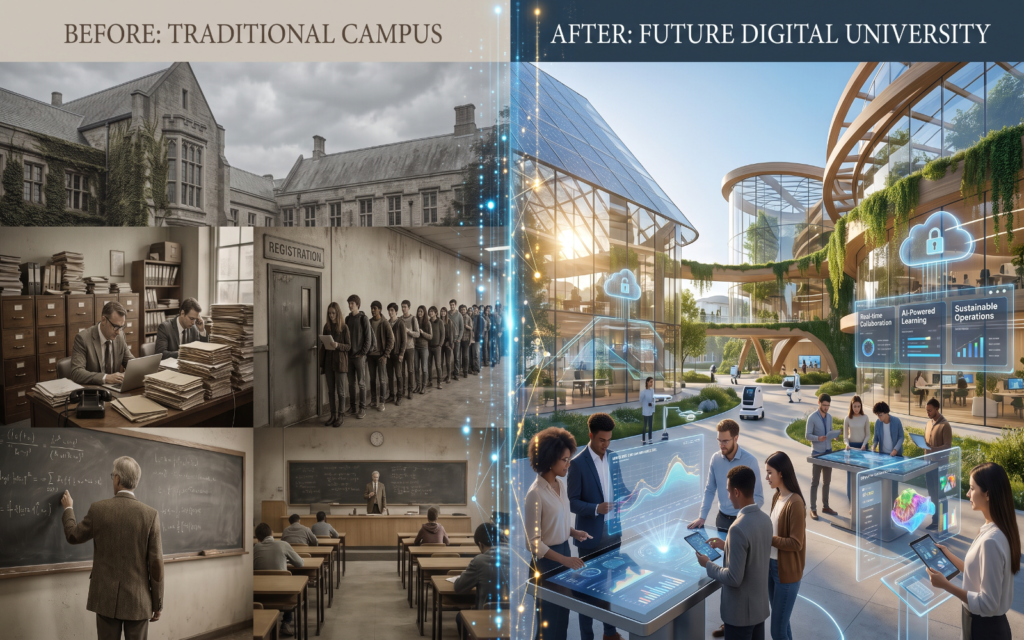
Digitising a process is not the same as building a connected institution. Admissions, academic records, learning platforms, communications and support services increasingly need to function as one coherent system rather than a collection of standalone tools stitched together with manual workarounds. This distinction is at the heart of digital transformation in higher education: an application form that feeds automatically into an academic record, a support ticket that a student advisor can see alongside attendance data, a finance system that talks to enrolment forecasts. Universities that treat their digital campus as the operating model, not an IT project, gain a clearer view of the student journey and can act on problems before they become attrition statistics, rather than discovering them in a term-end report.
Trend 3: Blended and Flexible Learning Becomes Standard
Purely online or purely on-campus delivery increasingly misses how learners actually want to study. Working adults, carers and students juggling employment need models that blend physical and digital delivery around their schedules rather than the timetable’s. HyFlex formats, once considered a pandemic-era workaround, are becoming a deliberate design choice for the future university: a lecture recorded and streamed live, a seminar available in person or remotely, an assessment that does not assume everyone can be in the same room at the same time. Institutions building this flexibility into core programme design, not as an afterthought bolted onto an existing timetable, are better placed to retain the learners that rigid formats push away, particularly in markets where working professionals make up a growing share of the student body.
Trend 4: Degrees Become More Flexible and Stackable

Micro-credentials and digital badges are no longer fringe experiments. HolonIQ estimates that global investment in micro and alternative credentials now exceeds ten billion dollars annually, drawn from more than one hundred million learners worldwide. This does not signal the end of the traditional degree; most evidence suggests shorter, stackable credentials are coexisting with degrees rather than replacing them, often becoming embedded within programme pathways. For university strategy trends over the next few years, building a credible short-course and micro-credential offering is becoming as important as protecting flagship degree programmes.
Trend 5: Employability Becomes a Core Measure of Institutional Value
Graduate outcomes are increasingly the yardstick by which prospective students, parents and policymakers judge an institution, alongside research reputation. League tables from organisations such as Times Higher Education and QS already weight employability indicators heavily, and that pressure filters directly into how institutions design their curricula. Work-integrated learning, employer co-designed curricula and structured industry partnerships are moving from optional extras to core strategy. This is not simply about adding a careers office; it means academic departments and employer relations teams planning curriculum content together, mapping modules against real skills gaps, so graduates leave with capabilities the labour market actually recognises rather than a credential that employers must interpret on faith.
Trend 6: Data Drives Institutional Decision-Making

Enrolment forecasting, retention risk and programme performance have historically been reported after the fact, once a term or an academic year has already closed. Institutional analytics are shifting that pattern towards prediction: identifying which students are at risk of withdrawing while there is still time to intervene, and which programmes are financially unsustainable before a crisis forces the decision. This transition from retrospective reporting to genuinely predictive planning is one of the more underappreciated higher education technology trends reshaping the future of universities, precisely because it rarely makes headlines the way AI or credentials do, yet it changes how quickly leadership can act on a problem.
Trend 7: Cloud and Cybersecurity Become Strategic Infrastructure
Infrastructure decisions once left to IT departments now sit squarely on the executive agenda. Cloud-first systems give institutions the scalability to expand programmes and absorb enrolment swings without rebuilding core systems each time. Meanwhile, cybersecurity has become a matter of institutional resilience rather than a purely technical concern, given how much sensitive student, research and financial data now sits on connected systems. Digital identity and business continuity planning belong in the boardroom, not only the server room.
Trend 8: Universities Compete for Lifelong Learners
The relationship between a university and a learner no longer ends at graduation. The World Economic Forum’s Future of Jobs Report 2025 estimates that 59 per cent of the global workforce will need reskilling or upskilling by 2030, with millions unlikely to receive it without deliberate investment. That gap is an opportunity institutions cannot afford to leave to private training providers. Executive education, corporate training partnerships and short-form reskilling programmes extend the learner relationship across an entire career rather than a single enrolment.
Trend 9: International Education Becomes More Digitally Distributed
Internationalisation is no longer defined only by how many students physically relocate. Transnational education, cross-border online programmes and remote delivery are growing steadily: the British Council reports that UK transnational education enrolments passed 660,000 students in 2024/25, up 7.8 per cent on the previous year, with growth increasingly spread beyond traditional markets. For institutions weighing global expansion, digitally distributed delivery is now as strategically significant as opening a physical branch campus.
Trend 10: Public-Private Partnerships Shape Education Infrastructure
Governments, universities, technology providers and development organisations are increasingly co-financing the infrastructure that underpins modern institutions, from connectivity and digital learning platforms to skills programmes tied to national development goals. This model matters especially in emerging education markets, including much of Africa, where institutions often face genuine infrastructure gaps rather than simply a preference for outsourcing. Public-private partnerships are helping these institutions build capability they could not fund alone, while giving governments a faster, more predictable route to workforce-ready graduates without carrying the full capital cost of digital infrastructure themselves.
Read More: Micro-Credentials in Higher Education: The Future of Skills-Based Learning
What University Leaders Should Prepare for the Future of Higher Education
Ten trends are only useful if they translate into decisions. For leaders navigating the future of higher education, a practical action framework matters more than a list of predictions:
- Assess institutional readiness. Understand honestly where systems, skills and governance currently stand before committing to new investment.
- Define strategic priorities. Not every trend deserves equal resourcing; choose the two or three that matter most to your institution’s mission and market.
- Modernise core infrastructure. Cloud, data and cybersecurity foundations need to be sound before AI or analytics initiatives can deliver reliably.
- Strengthen governance. Clear policy on AI use, data protection and credential standards protects the institution as adoption accelerates.
- Invest in people and capabilities. Technology adoption succeeds or fails on staff confidence and training, not procurement alone.
- Build external partnerships. Employers, governments and technology partners can extend institutional capacity faster than building everything in-house.
- Measure outcomes continuously. Track graduate employability, retention and programme performance as ongoing indicators, not annual reporting exercises.
Building Toward 2030 Deliberately
The future of higher education will not be decided by any single technology or trend. It will be shaped by how deliberately institutions connect strategy, infrastructure, people, partnerships, and student needs into a coherent whole rather than a set of disconnected initiatives. The higher education outlook through 2030 rewards institutions that treat these ten forces as one interconnected agenda, not a checklist to work through in isolation, and that begin building now rather than waiting for the picture to become clearer. It will not become clearer. It will simply arrive, and the institutions that started early will be the ones ready for it.
EduTech Global works with universities and education stakeholders to develop long-term strategies for digital growth, institutional resilience and new models of education delivery. Book a strategy session with EduTech Global to start mapping what these trends mean for your institution.
Frequently Asked Questions
What is the future of higher education? The future of higher education is being shaped by AI adoption, connected digital campuses, flexible and stackable credentials, employability-focused strategy, and deeper global and public-private partnerships, rather than any single technology.
What will universities look like in 2030? Expect universities in 2030 to run on connected digital infrastructure, offer a mix of full degrees and shorter stackable credentials, and serve learners across entire careers rather than a single enrolment period.
How will AI affect higher education? AI is moving from individual tools to institution-wide infrastructure, supporting teaching, assessment, student support, research and administration, provided institutions build the governance and staff capability to use it responsibly.
Will online learning replace universities? Evidence suggests blended models, combining physical and digital delivery, are becoming standard rather than online learning fully replacing campus-based education.
What are the biggest higher education trends? The most significant trends include AI-enabled infrastructure, digital campuses, flexible credentials, employability-focused strategy, data-driven decision-making, cloud and cybersecurity investment, lifelong learning models, digitally distributed internationalisation, and public-private partnerships.
Will traditional degrees remain relevant? Yes. Evidence from bodies such as HolonIQ suggests degrees are increasingly coexisting with micro-credentials rather than being replaced by them, with short credentials often embedded within degree pathways.
How should universities prepare for 2030? Institutions should assess readiness, define clear strategic priorities, modernise core infrastructure, strengthen governance, invest in staff capability, build external partnerships, and measure outcomes continuously rather than treating trends as isolated projects.