

Universities have spent the last decade building something remarkable: interconnected digital campuses that link admissions, learning management, research computing, and student services into a single, always-on ecosystem. That achievement has a shadow side. Every system added to the network is another door, and cybersecurity in higher education has become one of the defining governance challenges facing university leaders today, not because institutions have been careless, but because the digital campus they built for growth has quietly become one of the most attractive targets in the world for cybercriminals.
The scale of the problem is no longer theoretical. Institutions hold everything an attacker could want: financial records, health data, research intellectual property, and the personal details of tens of thousands of students and staff, often protected by underfunded IT teams stretched across sprawling, decentralised networks. Ransomware gangs and opportunistic phishing crews know this, and they have adjusted their targeting accordingly. For boards and vice-chancellors, cybersecurity in higher education is no longer an IT department’s concern; it is a strategic risk that touches finance, reputation, research funding, and the basic trust that students and families place in an institution.
Read More: Digital Transformation Strategy for Universities: A Guide for Higher Education Leaders
Why Universities Have Become Prime Cyber Targets
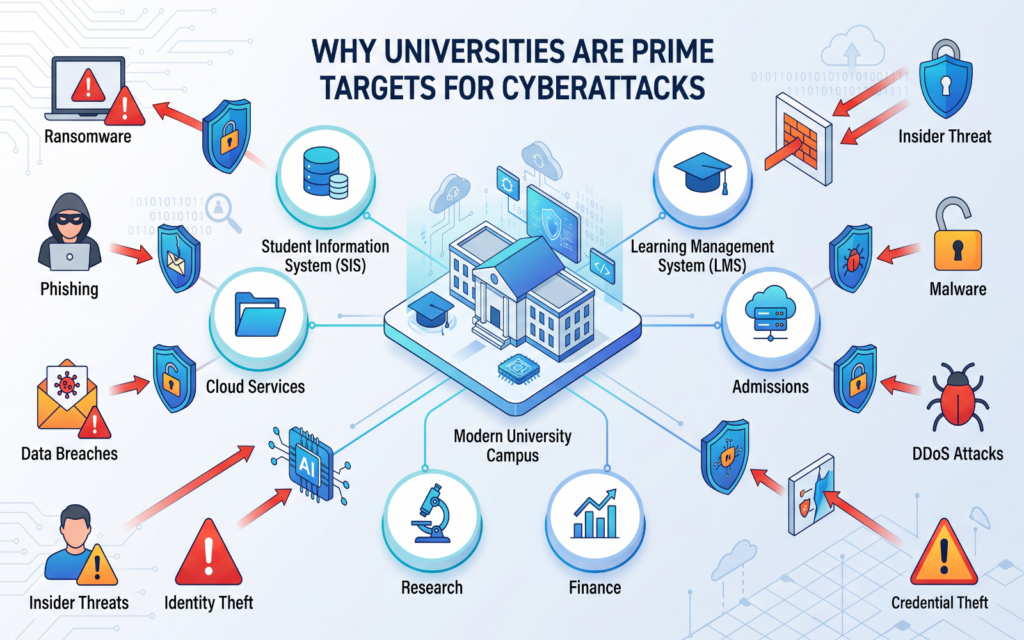
Higher education’s rapid digital transformation, cloud-based learning platforms, remote and hybrid delivery, connected research labs, and outsourced student information systems, has expanded the attack surface faster than most institutions have expanded their security budgets. Each new integration, from a payment gateway to a third-party EdTech tool, is a potential entry point.
Several factors make universities especially attractive:
- Valuable, varied data. Financial aid records, health information, and decades of research data sit alongside personal student information, giving attackers multiple ways to monetise a single breach.
- Open, decentralised networks. Universities are built for access and collaboration, not containment, which makes segmentation and monitoring harder than in a typical enterprise.
- Research value. Federally funded and commercially sensitive research is a growing target for state-linked and financially motivated actors alike.
- Legacy infrastructure. Many institutions run a patchwork of ageing systems alongside newer cloud platforms, creating gaps attackers can exploit.
The 2026 EDUCAUSE Top 10 places cybersecurity at the very top of the list of pressing issues facing higher education technology leaders this year, reframing it as a shared institutional responsibility rather than a purely technical one. That shift in framing reflects a hard truth: attacks are rising, and the traditional model of leaving security to a single department is no longer sufficient.
What Cybersecurity in Higher Education Really Means
In simple terms, cybersecurity in higher education is the combination of governance, people, technology, and policy that protects an institution’s data, systems, and operations from disruption, theft, or compromise, while keeping teaching, research, and administration running without interruption.
This is a broader remit than conventional IT security. IT security tends to focus on keeping infrastructure operational and secure at a technical level: patching servers, managing firewalls, maintaining uptime. Cybersecurity in higher education asks a different question: how does the institution as a whole, from the council chamber to the lecture hall, manage risk?
That means:
- Governance, so cyber risk is reported to and understood by university leadership, not buried in a technical dashboard.
- People, because staff, faculty, and students are both the greatest vulnerability and the first line of defence.
- Technology, covering the tools that detect, prevent, and contain threats across a distributed network.
- Policy and compliance, aligning institutional practice with data protection law, sector regulation, and funder requirements.
- Institutional resilience, the capacity to keep functioning, and to recover quickly, when an incident does occur.
Framed this way, cybersecurity stops being a cost centre and becomes a condition for institutional continuity.
The Biggest Cybersecurity Threats Universities Face
Ransomware remains the most disruptive threat to institution-wide operations. According to Sophos’s State of Ransomware in Education 2025 report, higher education institutions have made genuine progress: average recovery costs fell 77 percent, from $4.02 million to $900,000, and median ransom payments dropped from $4.41 million to $463,000 between 2024 and 2025. Yet nearly half of surveyed higher education providers cited unknown security gaps as the leading cause of attacks, a reminder that visibility, not just spend, is the real gap. Root causes remain consistent: exploited vulnerabilities and compromised credentials together account for the majority of incidents, according to BlueVoyant research cited by Varonis.
Student data breaches carry consequences well beyond the institution. Stolen personal and financial information exposes students to identity theft and can trigger regulatory scrutiny and reputational damage that outlasts the incident itself. IBM’s Cost of a Data Breach Report 2025 put the average breach cost in the education sector at $3.80 million, and notably, education was among the few sectors where costs rose even as the global average fell.
Phishing and social engineering exploit the sheer number of people with access to university systems: faculty juggling multiple platforms, staff processing sensitive records, and students who are frequent targets of scholarship and fee-payment scams. A single compromised credential can be the entry point for a much larger breach.
Research data theft targets a university’s most valuable and least visible asset. Intellectual property tied to federally funded or commercially sensitive research is attractive to both financially motivated criminals and, in some cases, state-linked actors, with implications for future funding eligibility and international partnerships.
Third-party and supply-chain risk is rising sharply. Cloud vendors, EdTech integrations, and outsourced service providers all extend an institution’s attack surface beyond its own perimeter. Comparitech data reported by Campus Technology shows attackers increasingly targeting service providers as a route into multiple institutions at once, making vendor risk management as important as internal controls.
Read More: Designing the Digital Campus: A Framework for University Modernisation
Building a University Cybersecurity Framework
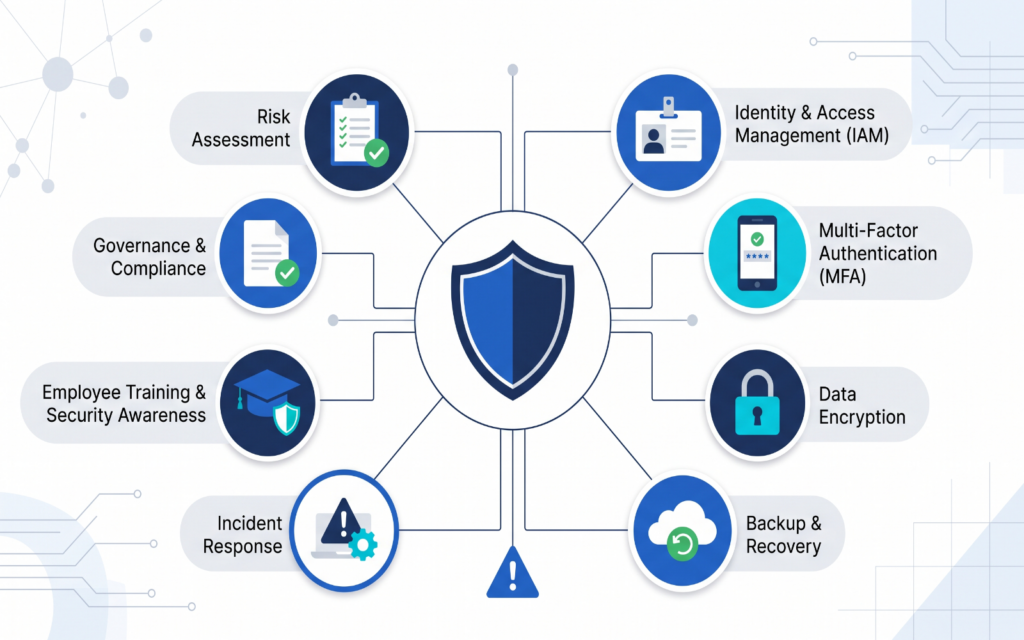
A credible university IT security framework does not start with software. It starts with governance, and works outward from there. The NIST Cybersecurity Framework 2.0 offers a useful structure, organised around six functions: Govern, Identify, Protect, Detect, Respond, and Recover.
Applied to a university setting, a practical roadmap looks like this:
- Risk assessment. Map critical assets, data flows, and third-party dependencies to understand where the institution is genuinely exposed.
- Identity and access management. Enforce least-privilege access so staff, students, and vendors only reach the systems they need.
- Multi-factor authentication. Apply it universally, particularly for email, financial systems, and student records, given how often compromised credentials feature in successful attacks.
- Data encryption. Protect sensitive data both in transit and at rest, including within third-party and cloud environments.
- Incident response planning. Build and rehearse a plan before an incident occurs, with clear roles for IT, communications, and senior leadership.
- Backup strategy. Maintain tested, offline, and immutable backups, the single factor most closely linked to fast ransomware recovery.
- Employee awareness. Run ongoing, practical training rather than annual box-ticking exercises, reflecting EDUCAUSE’s emphasis on shared responsibility.
- Governance. Report cyber risk to university councils and boards in business terms: financial exposure, reputational risk, and continuity, not just technical metrics.
This is where education cybersecurity strategy earns its keep: not as a static document, but as a living roadmap reviewed at board level.
Cybersecurity as Part of Digital Transformation

Security is often treated as the final step before a new system goes live, bolted on rather than built in. That sequencing is precisely what leaves digital campuses exposed. Whether an institution is rolling out cloud computing, a new student information system, or its first AI-powered advising tool, security decisions made at the design stage are far cheaper and far more effective than remediation after deployment.
Positioned this way, cybersecurity is not a barrier to innovation but the condition that makes innovation sustainable. An institution that embeds security into every digital initiative can move faster with cloud migration, AI adoption, and analytics, precisely because it is not constantly firefighting avoidable incidents.
Future Trends in Higher Education Cybersecurity

Several developments will shape university cyber resilience over the coming years. AI is now a factor on both sides of the equation: attackers are using it to craft more convincing phishing and to probe systems faster, while institutions are adopting AI-driven monitoring to detect anomalies earlier. Zero Trust architecture, which assumes no user or device is inherently trustworthy, is becoming a reference model for segmenting sprawling university networks. Cyber insurance is maturing into a genuine risk-transfer tool, though insurers increasingly require evidence of baseline controls before offering cover. Continuous monitoring and security automation are replacing periodic audits, and tightening privacy regulation globally means institutions must treat student data governance as an ongoing obligation, not a compliance event.
Building Long-Term Digital Resilience
Cybersecurity in higher education is not a project with an end date. It is an ongoing discipline that must evolve alongside every new platform, partnership, and policy an institution adopts. The universities that treat it as a governance priority, rather than a technical afterthought, will be the ones best placed to protect their students, their research, and their reputation over the long term.
EduTech Global works with institutions building digital campuses and leading broader higher education digital transformation to make sure security is designed in from the outset, not added on afterwards. If your institution would benefit from an outside view of where the gaps are, get in touch to request a Cybersecurity Readiness Assessment, or explore more insights on the EduTech Global blog.
Frequently Asked Questions
Why are universities targeted by hackers? They hold valuable, varied data across research, finance, and student records, often protected by decentralised, resource-constrained IT teams.
What data should universities protect? Student personal and financial information, health records, staff data, and research intellectual property.
How can institutions prevent ransomware? Through layered defences: multi-factor authentication, tested backups, patched systems, and rehearsed incident response.
What cybersecurity framework should universities follow? The NIST Cybersecurity Framework 2.0 offers a widely adopted, adaptable structure.
What is Zero Trust security? A model that verifies every user and device continuously, rather than assuming trust once inside the network.