

Credential recognition is the quiet gatekeeper of cross-border education. A graduate can hold a genuine, well-earned degree and still find the door closed because the institution, employer or regulator on the other side of the border does not know what to make of it.
As more African students study online, transfer between institutions or take qualifications abroad, this stops being a technical footnote and becomes central to whether cross-border education actually works. A qualification is only as useful as the confidence others place in it, and that confidence depends on three related but distinct things: whether the credential is genuine, whether it is understood and accepted, and how it compares to a qualification the recipient already knows. Keeping those apart, rather than treating them as one problem, is where clear thinking on this topic begins.
Read More: Certificate Verification: Why Institutions and Employers Can’t Afford to Trust Paper Anymore
What Is Credential Recognition?
Credential recognition is the process by which an institution, employer or regulatory body accepts that a qualification earned elsewhere is valid for a specific purpose. It is deliberately purpose-bound, which is the detail most people miss.
A master’s degree recognised for postgraduate admission at one university may still need separate professional recognition before its holder can practise medicine, law or engineering. Recognition by an employer assessing general competence is a different exercise from recognition by a licensing body applying statutory criteria. Four related processes tend to get folded into one another, so it helps to separate them plainly:
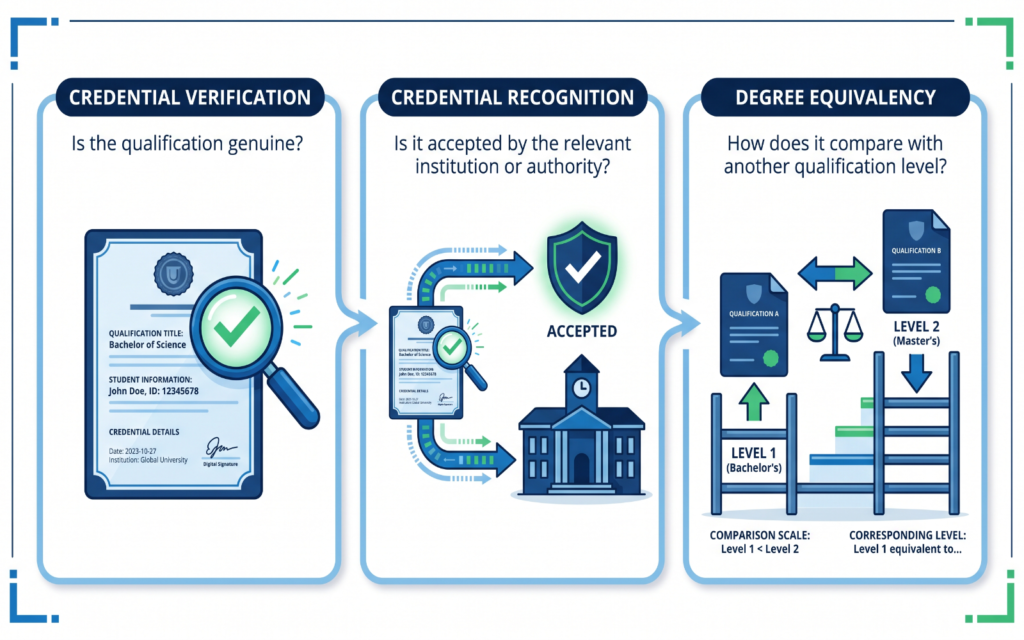
- Credential verification confirms a qualification is genuine and was actually issued by the named institution.
- Credential recognition determines whether that qualification is accepted by a particular institution, employer or regulator.
- Degree equivalency compares a qualification’s level against another country’s system, such as mapping a Nigerian HND against a bachelor’s degree.
- Accreditation is a separate judgement, made in advance, about whether the institution or programme meets defined quality standards.
A verified degree is not automatically a recognised one. Recognition itself does not establish equivalency in every context. Keeping these distinctions straight avoids a great deal of confusion, for students and institutions alike.
Why Cross-Border Degrees Are Difficult to Compare

Education systems were not designed with cross-border comparison in mind, and the mismatches are structural. Degree structures vary, so a three-year bachelor’s degree and a four-year equivalent rarely map cleanly onto each other. Credit systems, programme duration, entry requirements and terminology all vary by national tradition, so a “Higher National Diploma” or “Bachelor of Technology” means something specific in one jurisdiction and nothing self-evident in another. Quality assurance regimes differ too: a rigorous programme in one country may sit alongside a similarly named but far weaker one elsewhere, with no easy way for an outside admissions officer or employer to tell them apart. This is precisely the gap regional qualification frameworks and recognition instruments exist to close, and why Africa’s own qualification recognition Africa infrastructure matters as much as any single institution’s reputation.
Read More: Cross-Border Education Partnerships: How Universities Expand Globally
Africa’s Push Toward Greater Qualification Transparency
Regional integration only works if the credentials people carry across borders are legible to the systems receiving them. This is now an explicit strand of African Union education policy, sitting alongside the continent’s wider free movement and free trade agenda, and expressed through two main instruments: the African Continental Qualifications Framework and the Addis Convention.
What Is the African Continental Qualifications Framework?
The African Continental Qualifications Framework (ACQF) is a ten-level reference framework intended to make qualifications across the continent more comparable and transparent. It is the largest regional qualifications framework of its kind, designed to coordinate across 55 African countries and eight regional economic communities, and it is unusual in operating at two levels at once, connecting with both national and regional qualifications frameworks rather than replacing either.
Its policy document was validated by African Union member states in July 2023, with stated aims that include enhancing comparability, quality and transparency of qualifications, and facilitating recognition of diplomas and certificates in complementarity with existing national systems.
It is important to be precise about what the ACQF is not. It is not a single continental accreditation authority and does not itself accredit institutions or award degrees. It is a comparability tool, a shared reference point helping a qualifications authority in one country understand where a qualification from another sits, which makes national implementation, not the framework alone, the decisive factor in any individual recognition decision.
The Addis Convention and Recognition of Qualifications
Where the ACQF addresses comparability, the Addis Convention addresses recognition directly. Formally the Revised Convention on the Recognition of Studies, Certificates, Diplomas, Degrees and Other Academic Qualifications in Higher Education in African States, it is a UNESCO regional convention adopted in December 2014 and in force since December 2019.
The convention establishes a legal framework for the fair and transparent evaluation of higher education qualifications across the region, obliging ratifying states to assess foreign qualifications on their merits rather than dismiss them by default. It has been ratified by 14 African states to date, a modest number against 55 African Union members, and an instructive one for anyone assessing how far continental recognition has actually progressed. Its protections currently apply fully only between states that have ratified it, so checking a specific country’s status is a necessary step, not an assumption to make.
Read More: Fake Degree Certificates: How to Spot Them and Why They’re Still a Crisis in Nigeria
How Credential Recognition Supports Student and Graduate Mobility
Recognition is the mechanism that turns a qualification into something portable. It underpins a graduate’s ability to pursue further study abroad, transfer academic credit between institutions, gain postgraduate admission, secure employment, practise a regulated profession in another country, or take part in cross-border research collaboration.
Crucially, recognition outcomes are never generic. The same degree may be accepted without difficulty for one purpose and require additional evaluation for another, because the destination institution, employer or regulator each applies its own criteria. A university admissions office, a professional licensing board and a multinational employer are not making the same judgement, even when they are looking at the same certificate.
The Role of Digital Credential Verification

Digital credential verification is changing how quickly the first, foundational question- whether a document is genuine- gets answered. Secure digital records, tamper-resistant formats and QR-based verification links let an employer or institution confirm within minutes that a certificate was issued as claimed and has not been altered, addressing a problem that fake and fraudulently obtained certificates make persistently real across the sector.
This is where the earlier distinction matters most. Digital verification establishes authenticity. It does not, on its own, determine whether a qualification should be recognised for a particular purpose; that remains a judgement for the receiving institution, employer or regulator. Conflating the two oversells what technology can do and undersells what institutional processes still need to accomplish. Tools such as EduTech Global’s certificate verification infrastructure are built around that boundary rather than against it.
How Universities Can Improve Cross-Border Credential Trust
Institutions that want their graduates’ qualifications to travel well can take practical, largely low-cost steps:
- Standardise how qualification information is recorded and presented
- Maintain accurate, complete and consistently formatted academic records
- Move to secure digital records rather than paper-only certificates
- Make every credential independently and easily verifiable
- Clearly identify the awarding institution and its accreditation status
- Document full programme details, including credit load and duration
- Respond promptly and transparently to legitimate verification requests
Read More: Cross-Border Online Education: Opportunities and Policy Challenges
None of this replaces national accreditation or recognition processes. It does remove friction from the ones that already exist, and it signals institutional seriousness to anyone assessing a graduate’s credentials.
What Students Should Check Before Choosing a Cross-Border Degree
Before enrolling in a programme abroad, or accepting a job offer based on a foreign qualification, it is worth working through a short checklist:
- Is the awarding institution properly recognised in its home country?
- Is the specific programme accredited, not just the institution generally?
- Will the qualification be recognised in the country where you plan to use it?
- Can the credential be verified independently, without relying on the institution’s word alone?
- Are the programme’s content, credit load and duration clearly documented?
- Does the qualification meet any additional professional licensing requirements?
- Have you checked the destination institution’s or regulator’s specific recognition requirements, rather than assuming they mirror your own country’s?
Answering these before enrolling, not after graduating, is what turns cross-border study from a gamble into an informed decision.
Credential Recognition and the Growth of Transnational Education
None of this exists in isolation from the wider shift toward cross-border education. As online programmes, joint degrees, university partnerships and international providers expand across African markets, access to education is growing faster than trust infrastructure in many places. A student can now enrol in a programme delivered from another country with a few clicks; whether that qualification will be understood and accepted where they eventually need it to count is a separate question entirely. Expanding transnational education responsibly means building the recognition and verification layer alongside the access layer, not after it.
How EduTech Global Supports the Credential Verification Ecosystem
EduTech Global works at exactly this layer: digital credential infrastructure, verification workflows and secure academic records that make a qualification easy to check and hard to falsify. Through the wider Vigilearn ecosystem, including tools such as the Enroli student information system, institutions can maintain the accurate, structured records that verification and eventual recognition both depend on.
The distinction is worth restating plainly. Technology can support verification, record-keeping and information exchange between institutions. It cannot substitute for the institutional and regulatory judgement that recognition itself requires. Building good infrastructure and respecting that boundary are not in tension; they are the same discipline applied consistently.
Read More: Cybersecurity in Higher Education: Protecting the Modern Digital Campus
The Future of Credential Recognition in Africa

The direction of travel is toward greater interoperability: more digital credentials, stronger qualification frameworks, deeper alignment between national and continental systems, and faster, more reliable verification. None of that removes the underlying need for institutions, employers and regulators to make their own recognition decisions with confidence.
Africa’s education integration will ultimately require both things at once: wider student and academic mobility, and a trust infrastructure sturdy enough to support it. Credential recognition sits precisely at that intersection, which is why it deserves as much strategic attention as access and enrolment growth.
As education becomes increasingly cross-border, trust in qualifications matters just as much as access to education itself. Digital verification, transparent academic records and stronger qualification frameworks can help build a more connected and trusted African education ecosystem. Explore EduTech Global’s digital education and credential infrastructure solutions, or get in touch to talk through how this could work for your institution.
Frequently Asked Questions
What is credential recognition? The process by which an institution, employer or regulator accepts that a qualification earned elsewhere is valid for a specific purpose, such as admission, employment or professional licensing.
What is degree equivalency? An assessment of how a qualification from one education system compares in level to a qualification in another system.
How are foreign degrees recognised in Africa? Recognition typically runs through national qualifications authorities and higher education regulators, informed by regional instruments such as the Addis Convention and reference tools such as the ACQF.
What is the ACQF? The African Continental Qualifications Framework, a ten-level reference framework supporting comparability and transparency of qualifications across African countries. It is not an accreditation body.
What is the Addis Convention? UNESCO’s Revised Convention on the Recognition of Studies, Certificates, Diplomas, Degrees and Other Academic Qualifications in Higher Education in African States, in force since December 2019 and ratified by 14 African states to date.
What is the difference between credential verification and recognition? Verification confirms a credential is genuine. Recognition is a separate decision by an institution, employer or regulator about whether to accept that credential for a given purpose.
Why is credential recognition important for cross-border education? Without it, qualifications earned abroad have limited practical value, regardless of how good the underlying education was.
Can digital credentials improve recognition? They speed up and strengthen verification, which supports recognition decisions, but they do not replace the institutional or regulatory judgement recognition itself requires.