

A fake degree certificate rarely damages only the person who bought or forged it. It can cost an employer a bad hire, a genuine graduate their credibility by association, and an entire national qualification system a measure of trust it took decades to build.
Nigeria has confronted this problem publicly and repeatedly. In late 2023, an undercover newspaper investigation revealed how a journalist obtained a full bachelor’s degree from an institution in Cotonou, Benin Republic, within six weeks, and even proceeded through the National Youth Service Corps scheme using it. The Federal Government responded by inaugurating an eight-man inter-ministerial committee to investigate degree certificate racketeering involving both foreign and local private universities. It separately suspended the evaluation and accreditation of degrees from the Benin Republic and Togo while placing nine specific institutions under review. That episode, rather than any single statistic, is the clearest illustration of why verification now matters as much as the credential itself. This article sets out, calmly and practically, how a fake degree certificate differs from other forms of credential fraud, how to spot one, and what students, employers and institutions can each do about it.
Read More: The Future of Higher Education: Ten Trends Reshaping Universities Through 2030
What Is a Fake Degree Certificate?
The phrase covers several distinct problems, and treating them as identical makes the issue harder to solve rather than easier. A forged fake university certificate imitates a real institution’s format without that institution’s involvement. An altered certificate started genuine but has had details, such as grades or dates, changed after issue. A fraudulently obtained qualification may use a real institution’s real certificate template, but the underlying academic work behind it never happened, often through bribery or impersonation. A fake institution does not hold legitimate degree-awarding authority at all, regardless of how convincing its paperwork looks. And a misrepresented qualification usually involves a genuine certificate whose level, subject or classification has been exaggerated on a CV or application. Each requires a different kind of scrutiny, which is exactly why a single visual check is never sufficient on its own.
What Is a Diploma Mill?
A diploma mill is an operation that sells credentials with little or no genuine academic requirement behind them. Several characteristics tend to recur, and none on its own is proof of fraud, but together they form a useful pattern:
- Admission and graduation happen unusually fast, sometimes within weeks.
- Coursework, assessment, or attendance requirements are minimal or absent.
- Accreditation claims are vague, unverifiable, or reference bodies that do not actually regulate degree-awarding institutions.
- Marketing is aggressive, often promising guaranteed results or a degree “without stress.”
- Admission is effectively payment-based, with little attention paid to prior qualifications.
None of this means every fast, affordable or online programme is a diploma mill. Legitimate accelerated and distance-learning routes exist. The distinguishing factor is always whether a recognised regulator has actually accredited the institution and the specific programme, not how the marketing sounds.
How to Spot a Fake Degree Certificate
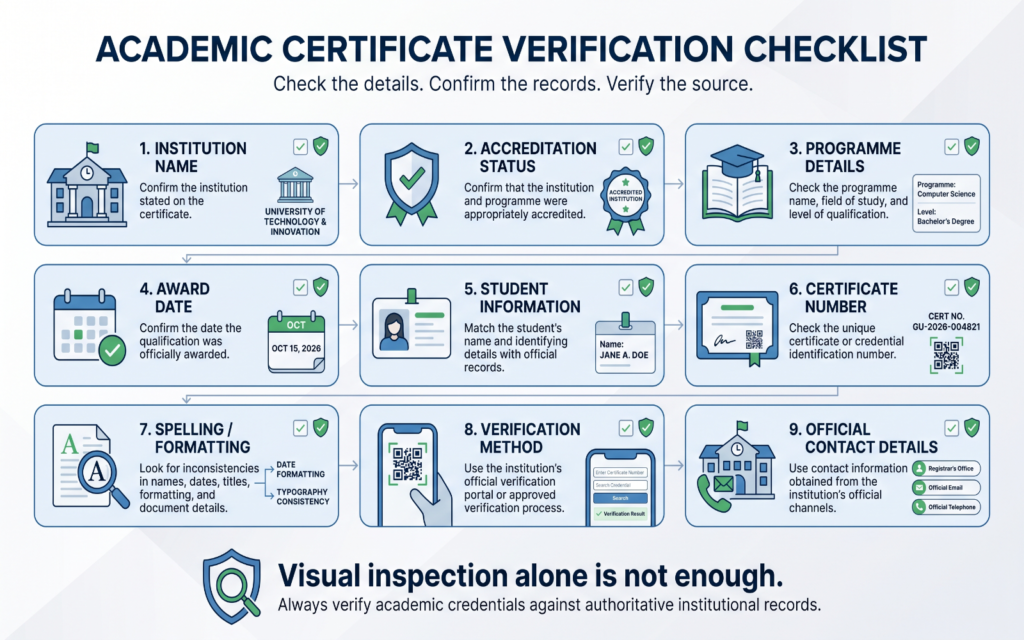
A practical checklist helps, though it should never replace formal verification. When reviewing a document, look closely at the following:
- Institution name: does it match the officially registered name exactly, without subtle misspellings or added words?
- Accreditation status: is the institution and the specific programme currently accredited, not merely “recognised” or “affiliated”?
- Programme and award details: do the qualification title, class of degree, and dates align with what the holder claims?
- Certificate number: is there a unique reference that can be checked against an issuing record?
- Spelling and formatting: are fonts, seals, signatures and layout consistent with genuine samples from that institution?
- Verification mechanism: does the certificate include a QR code, verification URL or contactable registry?
- Contact information and domain: does the institution have an official website domain, rather than a generic or recently registered one?
Visual inspection flags obvious problems, but a well-produced forgery will pass every visual test; only institutional confirmation settles the question.
Read More: Digital Credentials in Education: The Future of Academic Certification
How to Check Whether a Nigerian University Is Accredited
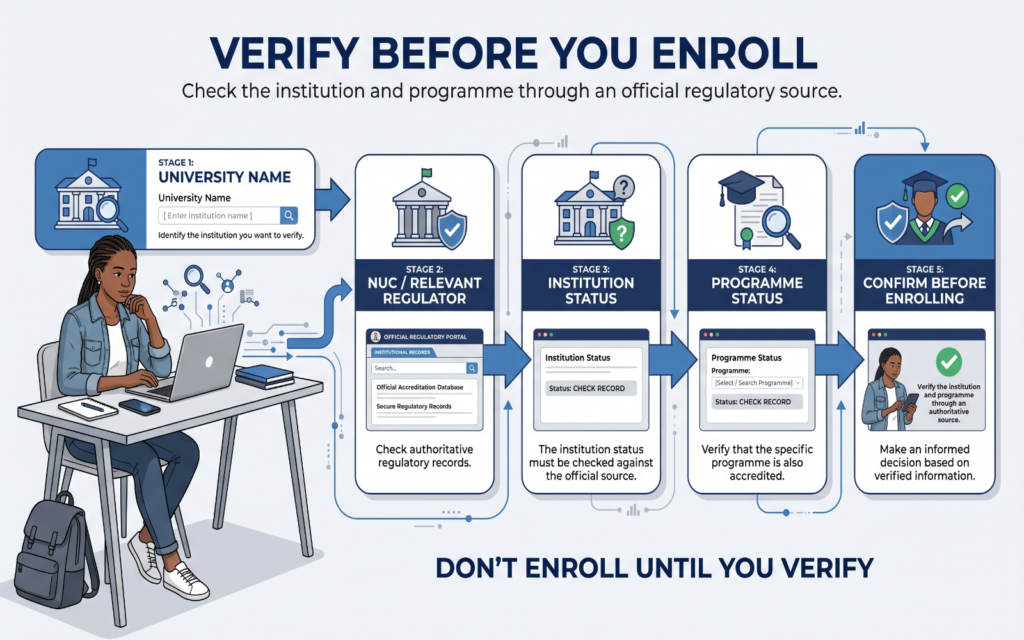
The National Universities Commission is Nigeria’s statutory regulator for university education, and it licenses institutions, accredits individual programmes, and publishes notices about illegal or unapproved operators. Because approvals change throughout the year, with dozens of newly approved private, state and federal universities added in recent cycles, no static unaccredited university list Nigeria roundup can be trusted for long. The safest approach for university accreditation Nigeria checks is always the current list published directly on nuc.edu.ng, not a cached search result or an institution’s own marketing material.
It also helps to separate four terms that get used loosely:
- Institution accreditation confirms the university is one of the NUC-accredited universities licensed to award degrees.
- Programme accreditation confirms a specific course within that university meets NUC’s curriculum standards, since an accredited university can still run an unaccredited programme.
- Recognition typically refers to whether another body, such as a professional council, accepts a qualification for licensing purposes.
- Affiliation describes a partnership between institutions and does not itself confer accreditation on either party.
A genuine NUC-accredited university with an unaccredited satellite campus or an unapproved postgraduate programme is a real and recurring pattern in Nigeria, which is why checking the specific programme matters as much as checking the institution’s name.
How Employers Can Verify Academic Qualifications
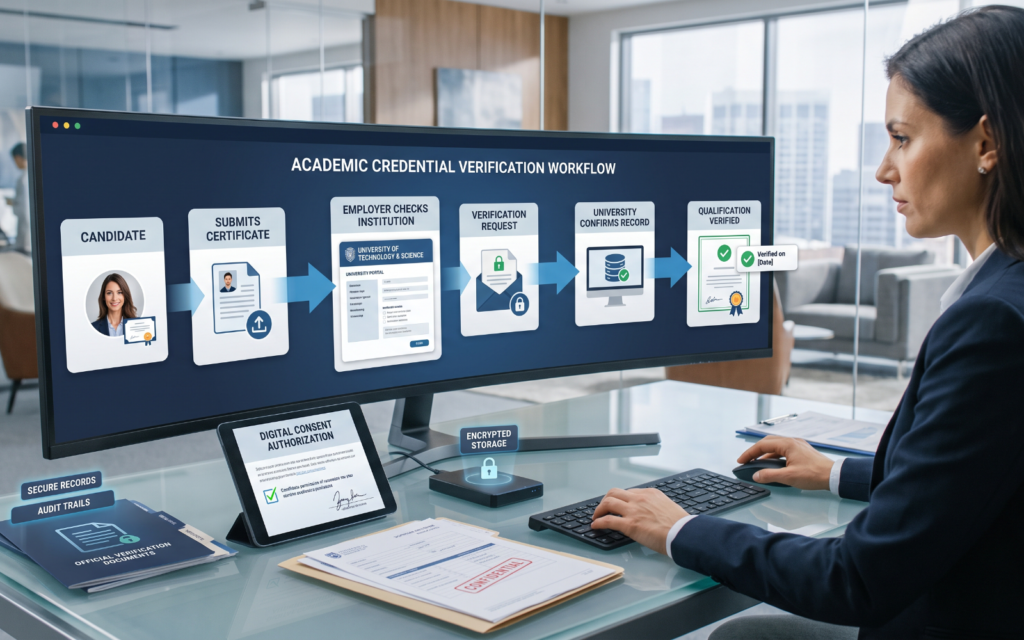
A structured verification workflow protects both the organisation and the candidate against fraudulent academic credentials. It typically follows a consistent sequence: the candidate submits their credential, the employer checks the issuing institution’s accreditation status, a verification request is sent to the institution’s registry, the institution confirms or disputes the record, and the outcome is documented for the hiring file.
Two practical points matter throughout this process. First, consent: under Nigeria’s Data Protection Act 2023, employers must obtain explicit consent before collecting and processing a candidate’s data for verification purposes, and should keep that consent, along with the verification outcome, on record. Second, international credentials require extra care, since a foreign qualification often needs a specialist evaluation service rather than a direct approach to an unfamiliar overseas registry.
Why Paper-Based Verification Is No Longer Enough
None of this means paper certificates are inherently invalid. The difficulty is speed and consistency at scale. A single verification request, sent by post or email to a university registry, can take weeks to receive a reply, longer still if the institution is abroad or the graduate finished many years ago. Forged documents can be difficult to distinguish from genuine ones without direct institutional confirmation. Cross-border requests add language and jurisdictional friction. And for any organisation hiring or admitting hundreds of people a year, manual verification becomes an administrative burden that grows faster than headcount can absorb it. This is the gap that structured degree certificate verification exists to close.
Read More: Higher Education Digital Transformation: Why Technology Alone Doesn’t Deliver Change
Digital Credentials and QR-Based Verification
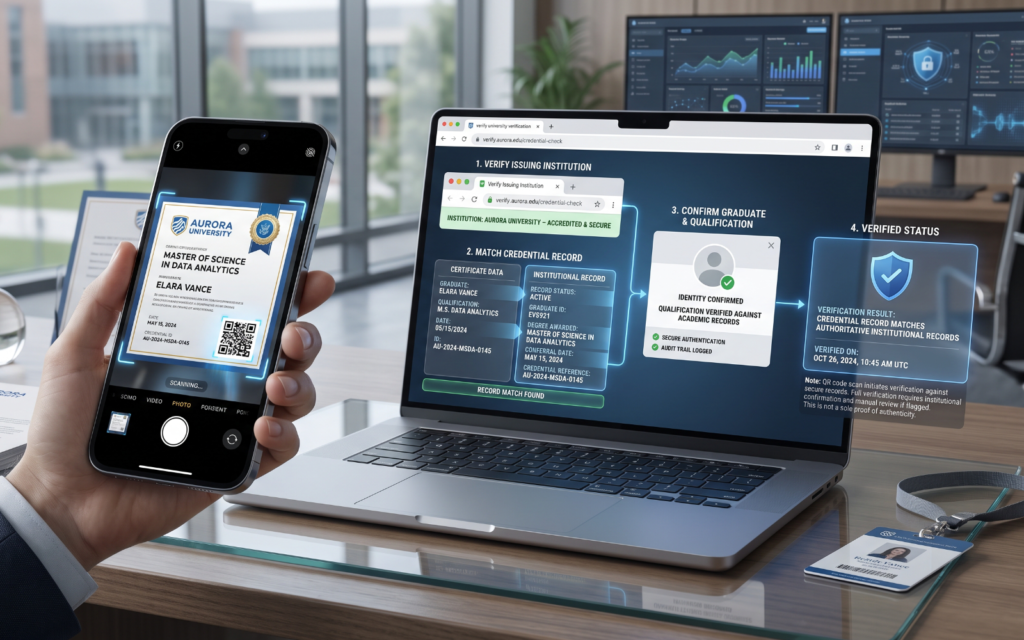
A digital certificate carries a unique identifier and, typically, a QR code that links directly back to the issuing institution’s record. The verification sequence is straightforward: scan the code, confirm the issuer is legitimate, match the credential details against the institutional record, and confirm the current status, including whether the award has since been revoked or amended. What makes this trustworthy is not the QR code itself but what it points to: an authoritative institutional database that the issuer actively maintains. A QR code linking to nothing more than a static image proves very little, so the underlying record matters more than the scanning technology.
How EduTech Global Can Strengthen Credential Integrity
This is the layer EduTech Global works to build for governments, banks, schools and universities: infrastructure that connects digital academic records, credential issuance, student identity and certificate verification into one coherent system, rather than leaving each as a separate, disconnected process. Where institutions are exploring verifiable credential capabilities as part of their broader digital campus strategy, this kind of infrastructure allows a certificate to be issued once and confirmed reliably many times over, without recreating the delays that paper-based systems struggled with. It is worth being direct about the limits here too: QR-based verification confirms that a specific credential record exists and matches, but it is one part of a wider integrity system, not a complete solution to every form of academic fraud on its own.
What Students Should Do Before Enrolling
Before committing time and money to any programme, it is worth working through a short checklist:
- Check the institution’s accreditation directly on the NUC’s official site.
- Confirm the specific programme, not just the institution, is accredited.
- Verify you are on the institution’s genuine official website.
- Confirm admissions requirements match what a legitimate university would expect.
- Check physical address and contact details independently.
- Treat unusually fast or guaranteed qualifications as a warning sign, not a convenience.
- Cross-check any accreditation claim with the relevant regulator directly.
- Keep every admission letter, transcript and payment record safely.
What Employers Should Do Before Accepting a Degree
Institutions and HR teams carry a parallel responsibility. Before accepting a qualification as the basis for a hire or promotion, it is worth verifying the institution’s current accreditation, confirming the specific programme completed, checking the credential itself against the issuing record, confirming the graduate’s identity matches the certificate, and using an authoritative channel, such as the registry or a recognised verification service, rather than accepting a photocopy at face value. Documenting each step protects the organisation if a qualification is later challenged.
Protecting Everyone the System Touches
A fake degree certificate is rarely a victimless act. It can place an unqualified person into a role with real consequences, damage a genuine institution’s reputation by association, and quietly erode public confidence in every legitimate qualification issued in Nigeria. None of this is cause for suspicion of the system as a whole; NUC-accredited universities and their graduates make up the overwhelming majority of Nigeria’s higher education output, and diploma mills remain the exception rather than the rule. But exceptions still need active, structured defences.
A university qualification should be more than a piece of paper. It should be a credential that an employer, institution or regulator can verify with confidence, quickly and without guesswork. EduTech Global helps institutions build the digital academic infrastructure that makes credentials easier to issue, manage and verify, so that the next headline about certificate racketeering does not have to involve your institution’s name. Get in touch with EduTech Global to discuss what stronger credential infrastructure could look like for you.
Read More: AI Governance in Higher Education: Why Universities Can’t Afford to Wait
Frequently Asked Questions
How can I spot a fake degree certificate? Check the institution’s name, accreditation status, programme details, certificate number and verification mechanism, then confirm everything directly with the issuing institution, since visual inspection alone cannot detect a well-made fake university certificate or forgery.
How do I check if a university is accredited in Nigeria? Visit the National Universities Commission’s official website at nuc.edu.ng and check the current list of NUC-accredited universities and programmes for university accreditation Nigeria queries, rather than relying on the institution’s own marketing claims or an outdated unaccredited university list Nigeria roundup found elsewhere online.
What is a diploma mill? A diploma mill is an operation that awards qualifications with little or no genuine academic work behind them, typically characterised by unusually fast graduation, minimal coursework and vague or unverifiable accreditation claims. Learning how to spot a fake degree of this kind starts with checking accreditation directly.
How do employers verify degree certificates? Employers typically confirm the institution’s accreditation, send a verification request to the issuing registry, and use degree certificate verification services or digital credential systems where available, always with the candidate’s consent.
Can a QR code prove that a certificate is genuine? A QR code can confirm a credential record exists and matches, provided it links to an authoritative institutional database, but it should be treated as one part of degree certificate verification rather than complete proof on its own.
What is certificate verification? Certificate verification is the process of confirming that an academic certificate genuinely represents the person, institution, programme and achievement it claims to, rather than being forged, altered or fraudulently obtained.
Where can I check accredited Nigerian universities? The National Universities Commission publishes the current, official list of NUC-accredited universities and programmes on nuc.edu.ng, which should always be checked directly rather than through third-party rankings or any unofficial unaccredited university list in Nigeria search results.
What should I do if I suspect a fake qualification? Report the concern to the National Universities Commission or the relevant regulator, avoid making public accusations without verified evidence, and rely on official verification channels to confirm or resolve suspected fraudulent academic credentials.