

Why Institutional Contracts Matter
Individual users and consumer-level subscriptions often receive the most visible attention when it comes to educational technology. However, the real growth, scale, and sustainability for serious EdTech enterprises come when you secure EdTech institutional contracts, that is, deals with governments, ministries, school systems, universities, and NGOs. These contracts bring in bigger revenue and also confer legitimacy, market access, and endurance. When an EdTech provider is chosen by a university or a national ministry, it signals to the rest of the market that the solution has passed rigorous evaluation.
Institutional contracts account for a significant portion of EdTech revenue around the world. A single government procurement for a national learning management system or digital assessment tool can dwarf many small B2C sales combined. Likewise, university partnerships for online degree programs, content licensing, or campus digital infrastructure often come with multi-year commitments and recurring revenue models. For many EdTech companies, landing institutional contracts is a turning point where they transition from startup to serious enterprise.
Governments and universities have unique demands, and these clients act differently from consumers. They demand compliance, security, scale, reporting, and strong value justification. Yet when done right, institutional contracts become growth engines. For companies in the EdTech space, the difference between surviving and thriving often lies in your ability not just to build a great product but to master EdTech institutional contracts.
At EduTech Global, we provide a hub of insights, strategy, and operational know-how to help EdTech companies break into institutional markets, scale sustainably, and close big deals.
Understanding Institutional Procurement

To succeed in the institutional arena, you must first understand how ministries, universities, and large NGOs think, plan, and procure digital education tools. Procurement in education is rarely fast. It involves multiple stakeholders, formal requests for proposals (RFPs), compliance reviews, pilot phases, and risk mitigation. Knowing the steps, criteria, and constraints gives your team a competitive edge.
The Institutional Buyer Landscape
- Ministries of Education and State Agencies. These are often the highest-level buyers for national policies, digital curricula, assessment platforms, or school-wide programs. Their procurement cycles may be annual or aligned with budget cycles, and they’re often constrained by public procurement laws and budget allocations.
- Universities and Higher Education Institutions. Universities procure for their learning management systems (LMS), student information systems, digital credentialing, e-learning content, analytics, and more. They often have decentralised procurement units or departments (IT, academic affairs, innovation offices) that vet vendors.
- School Districts, Boards, and NGOs. In many regions, districts or boards of schools issue their own RFPs. Nonprofits and NGOs (especially in low- and middle-income countries) often partner with governments or donor agencies to sponsor EdTech solutions.
- International Agencies and Multilaterals. Donor agencies, foundations, or institutions like UNESCO may use funds to procure EdTech solutions for pilot or large-scale deployment. Understanding their procurement rules and frameworks can open large funding avenues. UNESCO, for instance, follows common procurement guidelines in the UN system.
Key Evaluation Criteria
When an institution evaluates EdTech vendors, it typically assesses them along a few important dimensions:
- Compliance and Legal Fit. This includes meeting procurement law, public sector rules, anti-corruption standards, and contracts. Institutions often require precise legal terms, data protection guarantees, audit rights, and exit clauses.
- Scalability and Reliability. The product must scale across many users, handle performance peaks, provide uptime guarantees, and integrate with existing infrastructure. Any solution that breaks when thousands of students log in will be rejected.
- Data Security, Privacy, and Governance. Institutions are highly guarded about data protection. They demand encryption, access controls, compliance with local data regulation, audit trails, and clear ownership of data. UNICEF’s recent policy recommendations argue that data governance requirements must be embedded at the procurement stage. The 1EdTech Data Privacy & Security Agreement (DPSA) is one example of a standard used across K-12 and higher education to codify expectations.
- Cost Efficiency and Total Cost of Ownership (TCO). Institutions compare not just license cost but full costs: implementation, training, support, infrastructure, maintenance, and upgrades. They will often request ROI projections or cost-benefit analyses.
- Pedagogical and Learning Impact. The vendor must show evidence that the tool improves learning outcomes, engagement, retention or other measurable indicators. A vendor that can present pilot study data or a third-party evaluation is at an advantage.
- Localisation, Contextual Fit, and Support. The ability to adapt language, curriculum standards, regulatory compliance, and local integration is critical. Turnkey foreign solutions often fail because they are not aligned with local education policy or cultural norms.
- Support, Service Level Agreements (SLAs), and Escalation Paths. Your contract must clearly specify support response times, resolution paths, responsibility during outages, upgrade obligations, and escalation structures. Contracts should define exit rights, transitional support, and continuity.
- Sustainability & Long-Term Partnership Potential. Institutions often value vendors who commit to ongoing support, iterative improvement, stakeholder training, and long-term collaboration. If you’re seen as a one-off vendor, you’ll lose in renewals.
Institutions often require formal certification, audits, or standard compliance (ISO, local security standards). Being proactive about those matters can smooth your path.
The Procurement Journey

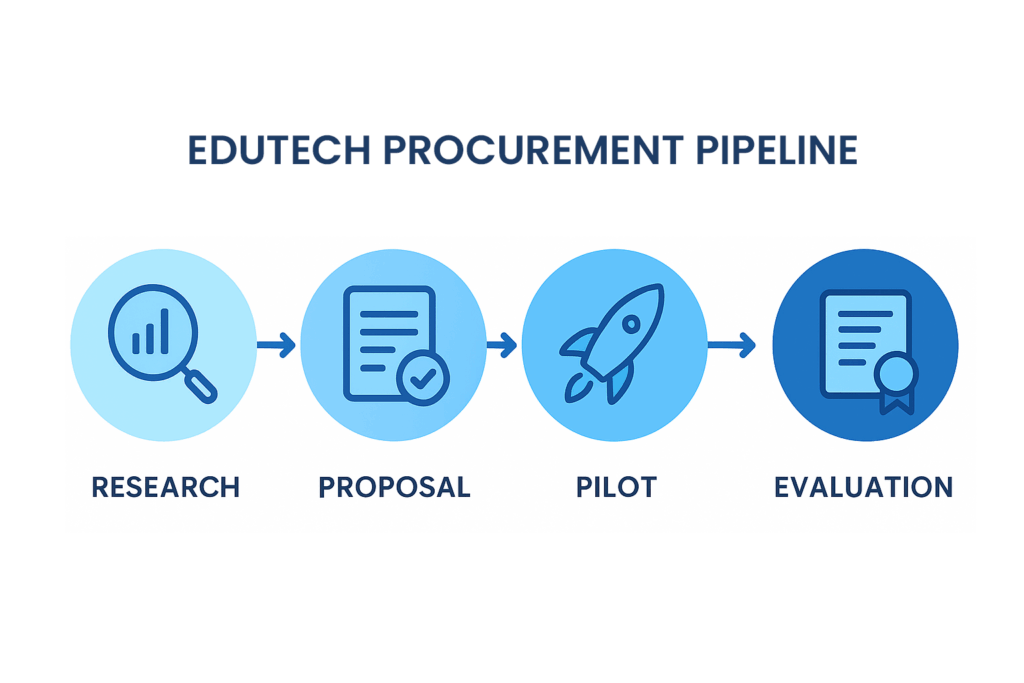
Typical steps in institutional procurement include:
- Needs identification and budget allocation. A ministry or university defines needs and allocates a budget for that purpose.
- RFP / Request for Information (RFI) stage. Institutions issue public RFPs or RFIs, asking for product specs, vendor credentials, compliance documents, and cost proposals.
- Proposal evaluation and shortlisting. Selection committees evaluate submitted proposals, shortlist vendors, and invite clarifications or presentations.
- Pilot/proof-of-concept (POC). The institution may run a small pilot or trial to validate the product in its context before full rollout.
- Negotiation and contracting. Legal terms are negotiated, SLAs defined, pricing and scope finalised.
- Implementation, training, rollout. Deployment, onboarding, training, integration, and ongoing support take place.
- Monitoring, evaluation, renewal or exit decisions. Institutions monitor outcomes, compliance, and performance, deciding whether to renew or terminate.
Each of these stages has pitfalls and opportunities. Your team must prepare for them proactively.
Strategies to Win Institutional Contracts
Winning EdTech institutional contracts is not about brute force; it requires strategy, patience, alignment, and trust-building. Here are key strategies to adopt.
1. Research Policy Frameworks & Public Procurement Laws
Before submitting any proposal, you must understand the legal, regulatory, and procurement framework in your target market. Every country, and often every region, has procurement laws, enabling legislation, templates for RFPs, and approved vendor lists.
Do thorough research: what are the thresholds for open bidding? Which procurement bodies are relevant? Which agencies oversee education? And how often are tenders issued? In some countries, small firms are excluded from large government contracts; you must know whether you must partner locally or bid through consortia. Understanding procurement cycles helps you time your proposals.
Monitor government portals, tender bulletins, procurement agencies, public sector budgets, and education ministry announcements. Being first in line when a call opens is an advantage.
2. Be Prepared with Compliance & Documentation
Institutional buyers will request extensive documentation: audited financial statements, proof of incorporation, security audits, data protection policies, performance certifications, and references from existing clients (especially in the public sector). Keep these documents updated and ready.
A vendor that can deliver a “compliance bundle” for procurement review gains trust and accelerates evaluation. This lowers friction and gives you the appearance of maturity and readiness.
3. Offer Pilot Programs or Trial Access
One of the best ways to reduce buyer risk is to propose a pilot or proof-of-concept stage. This allows institutions to test your solution on a small scale, collect data, and see real impact before a full rollout. If the pilot is successful, you often get a fast track to scaling.
When structuring a pilot, clearly define metrics, duration, responsibilities, scaling path, and expected outcomes. Use the pilot to gather user feedback and demonstrate learning gains. Offer support, training, and monitoring during the pilot to maximise the chance of success.
4. Emphasise Localised Value & Adaptation
Institutions strongly prefer solutions that are contextually adapted to their language, curriculum, regulatory environment, and culture. If your product supports local curriculum, uses local languages, aligns with assessment standards, or accommodates regional internet constraints, you gain a considerable advantage.
Sometimes foreign vendors fail because they deliver a “global version” that requires heavy customisation. Instead, design your platform so that contextual adaptation is possible and clearly position it as modular. Show prior instances of localised deployments or reference cases in similar settings.
5. Build Evidence & Stories of Impact
You cannot win serious institutional contracts by claiming you’re “innovative.” You must provide hard evidence: impact studies, usage metrics, pilot results, improvement in test scores, retention statistics, or third-party evaluations. These data points build credibility.
If possible, document case studies and testimonials from other institutions. Share narratives of how adopting your solution changed practices, supported teachers, and improved outcomes. Use visuals, charts, and metrics. These stories persuade procurement committees more than purely technical claims.
6. Develop Partnerships & Local Allies
In many markets, institutional contracts are achieved via partnerships. You may partner with local integrators, educational consultancies, regional resellers, or government-affiliated institutions. Local partners often know the procurement landscape, regulatory requirements, and institutional connections. They can also handle support and localisation.
Form consortia with firms that complement your strengths (for instance, combine local networks with your proprietary technology). In many public tenders, foreign vendors must partner with a local company or have a registered local entity. Use alliances strategically.
7. Engage Stakeholders Early & Educate Them
Institutional decision-making involves many stakeholders: ministry officials, procurement officers, IT leadership, academic staff, data/privacy officers, and user communities. You must engage them early. Conduct workshops, demos, roundtables, or webinars to educate them on your product’s value. Provide pilot users, pro bono trials, or workshops to build internal champions.
Create executive briefs tailored to each stakeholder’s pain points, for example: cost savings, learning outcomes, teacher empowerment, and accountability. Your pitch must address each constituency’s concerns.
8. Incorporate Outcomes-Based Contracting (OBC) Elements
A growing trend in procurement, particularly in progressive systems, is outcomes-based contracting, where part of your payment is tied to achieving educational outcomes (student growth, retention, completion, assessment gains). This shifts the risk partly back to the vendor but shows deep confidence and alignment with institutional goals.
If you’re able, propose a hybrid model: a fixed base fee plus performance payments for achieving agreed outcomes. This aligns incentives and helps buyers justify investment.
9. Be Transparent on Pricing & Total Cost of Ownership
Provide a detailed breakdown of all costs: licensing, infrastructure, onboarding, training, support, maintenance, updates, and potential scalability. Avoid hidden fees. Institutions prefer vendors who present the total cost clearly. Also, define price floors, volume discounts, and renewal terms.
10. Negotiate Strong Contracts with Safeguards & Clarity
Your contract must include strong but reasonable clauses: service level agreements, uptime guarantees, backup plans, exit strategies, data portability, escalation paths, versioning, and updates. Define clearly the responsibilities during upgrades, data migration, liability, and terminations. Institutions are risk-averse; clarity reduces friction.
Also, avoid over-committing to features or customisation outside your core roadmap. Leave room for negotiation without endangering your product’s integrity.
11. Plan for Long-Term Support, Scale & Renewal
Winning a contract is the start. To retain it, you must deliver high-quality support, continuous improvements, training, and responsiveness. Be proactive about scaling issues. Gather user feedback, publish updates, and maintain a roadmap that addresses evolving needs. This way, institutions see you as a long-term partner, not a one-time vendor.
In renewal cycles, provide metrics, usage reports, success stories, and new proposals for extension or expansion. Your renewal pitch should be a story of continuous value, not a new bid from scratch.
Case Examples & Lessons from Practice
To make this concrete, let’s look at examples, particularly in Africa and in global EdTech, where institutional contracts or partnerships have led to growth.
African EdTech Start-ups Winning Institutional Contracts
Across Africa, several EdTech companies have successfully secured institutional contracts by combining local relevance, compliance, and measurable impact. These examples illustrate how strategy and trust help turn innovation into scalable partnerships.
- Vigilearn Technologies, a subsidiary of Edutech Global, offers a strong model. Through its EdiifyLMS, the company powers the Ahmadu Bello University Distance Learning Centre (ABU DLC), one of Nigeria’s largest distance learning programs. The platform supports thousands of students nationwide with tools for application, enrolment, live lectures, assessments, and learner tracking. All ABU DLC degrees delivered through EdiifyLMS are NUC-accredited, ensuring academic legitimacy and long-term institutional trust. This partnership demonstrates how localisation, accreditation, and technical reliability can secure enduring EdTech institutional contracts.
- Similarly, uLesson, one of Nigeria’s leading learning platforms, obtained a government licence through the National Universities Commission (NUC) to launch Miva Open University, a fully accredited online degree-granting institution. The company’s strong reputation in K–12 education and regulatory alignment helped it transition into higher education under a legitimate institutional framework.
- And Snapplify continues to expand across South Africa and East Africa through partnerships with schools, universities, and government agencies for digital content delivery and e-library access. Its institutional-first approach, integrating procurement, local support, and compliance, has made it one of Africa’s most prominent enterprise EdTech providers.
- 2U contracts with non-profit universities to build and deliver online programs. Their long-term contracts allow universities to outsource online program operations and scale digitally. This is one model of enterprise EdTech: embedding deeply into institutional operations, not just as a tool but as a platform and service provider.
These case examples show that institutional contracts often reward deep alignment, not superficial product sales.
Overcoming Common Risks & Challenges
While institutional contracts offer high rewards, they come with risks and challenges. You must anticipate and mitigate them.
- Long sales cycles. Institutional procurement timelines can stretch for months or years. Your cash flow must sustain this. Build a pipeline of buyers at different stages.
- Procurement rejections or bureaucratic obstacles. RFPs may be cancelled, standards changed, or review committees blocked. Stay agile and maintain multiple leads.
- Over-customization. Tailoring too much can devour resources. Resist overpromising. Use modular architecture to localise where necessary.
- Data and security liabilities. Breach or misuse can damage trust and contract status. Invest heavily in compliance, security audits, and transparent practices.
- Vendor lock-in concerns. Institutions fear dependency. Provide exit clauses, portability, and transition support.
- Renewal losses. If your product fails to deliver, you may lose renewal. Monitor progress metrics and proactively fix issues.
- Financial risk. Badly structured contracts (e.g., heavily outcome-based) may result in downside losses. Model worst-case scenarios.
- Political changes. Governments change. A ministry contract won under one administration might be de-emphasised under another. Align with institutional bodies, not just individuals.
Addressing these risks in your proposals and contracts signals sophistication to institutional buyers.
Scaling with Institutional Trust
Securing EdTech institutional contracts is less a sprint and more a strategic investment in credibility, scale, and sustainability. These contracts are hallmarks of trust: they tell the market that your solution is reliable, respected, and robust. But to win them, you must align product, operations, and strategy with institutional realities.
At EduTech Global, we serve as your trusted partner in the business of learning. Whether you’re refining your strategy, strengthening your procurement readiness, or seeking connections with institutional decision-makers, our team is here to help. Explore our services or get in touch through contact EduTech Global.
To go deeper into securing funding for large campus or digital projects, you can also read Strategies to Secure Grants for Digital Campus Projects on our blog.