

The Power of Collaboration in EdTech
In educational technology, building a great product is not enough. Success often depends on how well an EdTech provider can partner with institutions, governments, nonprofits, and schools to embed its solution in real systems. Strategic EdTech partnerships enable a company to move from pilot to scale, from niche to mainstream, and from narrow impact to broader social influence. In short, the right collaborations are more than business growth levers; they are engines for systemic change.
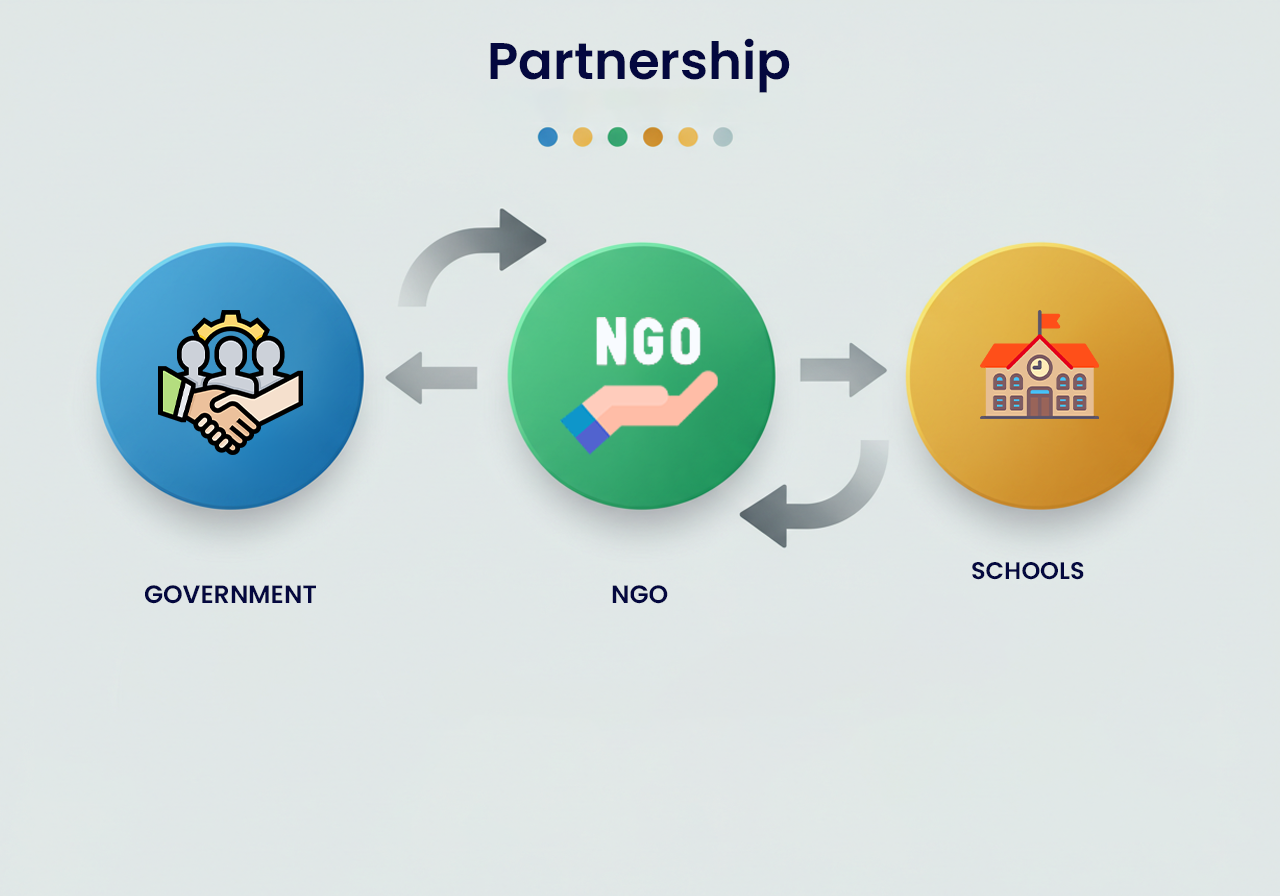
Partnerships unlock access. Through alliances with ministries of education, NGOs, or networks of schools, an EdTech provider can reach classrooms it would never reach alone. Partnerships also bring legitimacy: when a government endorses your platform or an international NGO backs your intervention, trust is built with schools, parents, and donors. Moreover, collaborations help share risk. No single EdTech can carry all the cost, complexity, or stakeholder relationships needed for large-scale deployment. Working with multiple actors spreads that burden, especially in challenging environments.
Recent global trends confirm that collaboration is not optional. The World Bank’s Education Finance Watch 2024 emphasises that, while education spending is rising in many low- and middle-income countries, inefficiencies and inequities persist. Government budgets alone cannot solve the learning crisis; new models of financing and implementation, such as public-private partnerships (PPPs) in education, are crucial. In this context, EdTech partnerships become structural levers to improve efficiency, equity, and scale.
Read more: Cross-Institution Collaboration Tools for Research and Academic Exchange
At EduTech Global, we see ourselves as connectors. We bridge innovative EdTech startups with ministries, NGOs, and networks of schools. We help founders translate pilot results into credible, large-scale collaborations. Through our platform, EdTechs gain access to capacity building, matchmaking services, and stakeholder alignment.
1. Government Collaborations

National Digital Education Reform: Context and Opportunity
Many governments now include digital education in their national development plans and education sector strategies. Policies for broadband in schools, digital teacher training, national learning management systems (LMS), and curriculum digitisation are becoming standard. These reforms create windows of opportunity for EdTech partnerships.
However, governments often move slowly, are risk-averse, and demand accountability. So an EdTech company seeking a government collaboration must align its solution with policy goals, regulatory norms, and long-term sustainability. It is insufficient to offer a flashy product; you must show how it supports the ministry’s priorities in learning, equity, cost efficiency, or system resilience.
In many countries, public-private partnerships (PPPs) are the formal vehicle for these collaborations. With PPPs, governments contract or co-invest with private providers to deliver services. In education, these sometimes include contracting for infrastructure (e.g. connectivity), operating digital platforms, teacher training, or content provision. The appeal of PPPs is that the government can leverage private sector agility while retaining stewardship of standards, reach, and oversight.
How EdTechs Collaborate with Ministries and MoUs
Here are some concrete pathways:
- Pilot into the MoU or Memorandum of Understanding
Start with a small-scale pilot in a region or set of schools. Collect data, refine your solution, and then approach the ministry with results. Propose an MoU to formalise cooperation, including roles, funding, timelines, and evaluation metrics. This is a low-risk route toward deeper integration.
- Contracting for National or Subnational Rollout
Some governments tender for national systems (for example, a national LMS). An EdTech provider may bid or partner with larger systems integrators to fulfil the contract. In some cases, the EdTech is responsible for content, analytics, user support, or teacher training modules within the contract.
- Co-investment or Revenue Sharing Models
Where budgets are constrained, structure models in which the government pays a share (or withholds payments until impact), or revenue is shared (e.g. subscription fees from schools or districts). This ensures both parties bear risk and incentivises performance.
- Embedded in Sector Reforms
Rather than being an external add-on, the EdTech should fit within the government’s digital education roadmap. This might mean integrating with national student information systems, aligning with curriculum standards, or supporting government monitoring and assessment systems.
- Technical Assistance and Advisory Roles
EdTechs with domain expertise may also position themselves as advisors or technical partners to ministries, contributing to policy design, implementation oversight, capacity building, and evaluation. This role strengthens credibility and gives deep insight into system priorities.
Example: LMS Rollout with a Ministry
Imagine a country planning a national platform to deliver digital lessons, assessments, and analytics. An EdTech firm might propose to the ministry:
- Use their adaptive content engine
- Localise content aligned to the national curriculum
- Provide teacher training modules
- Host the LMS under government governance (e.g. via APIs)
- Include dashboards for ministry monitoring
- Monitor adoption, usage, and learning outcomes over time
The ministry may offer co-funding, access to schools, data sharing, and integration with existing IT infrastructure. If the EdTech can show initial results in a few districts, that may open the door for scale.
In many contexts, governments require a tender or procurement process. EdTechs should be ready with clear budgets, technical documentation, contracts, and references. Aligning with government business cycles, budget cycles, and decision timings is critical.
Risks and Mitigation in EdTech Partnerships with Governments
- Slow processes and bureaucracy: Anticipate delays in procurement, legal review, and compliance. Mitigation: begin relationship building early, hire local advisors, and co-design roadmaps with ministry staff.
- Political changes: A change in government can shift priorities. Mitigation: build cross-party support, stress alignment with long-term national goals (e.g. SDG goals), not just current leadership.
- Sustainability concerns: Government budgets may get cut or reallocated. Mitigation: establish cost sharing, show cost-effectiveness, and design modular scaling.
- Equity and inclusion pitfalls: PPPs that favour higher-fee schools risk excluding marginalised learners. Some analyses warn PPP models may deepen inequality. EdTechs must ensure equitable access, affordability, and rigorous accountability safeguards in contracts.
Despite challenges, many PPPs have shown success. A systematic review of eight studies in Pakistan found that PPP schools increased enrolment and improved achievement outcomes compared to nearby public schools. Though cost-effectiveness remains harder to establish, these examples illustrate how public-private models can improve performance when well structured.
2. NGO & Non-Profit Partnerships

Why NGOs Matter in Education Collaborations
NGOs play vital roles in reaching underserved communities, bridging resource gaps, and piloting innovation. They often operate where governments have limited presence, in rural zones, remote areas, and conflict settings. NGOs bring legitimacy, mobilisation capacity, grant funding, field networks, and local trust.
For EdTechs, partnering with NGOs offers:
- Field reach into marginalised communities
- Local partnerships, knowledge, and relationships
- Complementary funding (grants or donor-backed)
- Programmatic integration with broader social or inclusion goals
- Co-branding legitimacy and donor alignment
Many NGOs maintain portfolios of education initiatives and are continuously looking for scalable EdTech solutions they can deploy or test.
Structuring EdTech Partnerships with NGOs
- Pilot Deployment in NGO Programs
NGOs often run programs in remote zones (e.g. literacy, remedial learning). EdTechs can integrate their platform into these programs to co-develop use cases, adapt content, and gather learning evidence.
- Joint Grant Proposals
EdTechs with a strong solution can team with NGOs to submit proposals to funders (e.g. GPE, Gates, USAID). The NGO may take the project management and operations role, while the EdTech handles tech, content, and monitoring.
- Capacity Building & Training Partnerships
NGOs often conduct teacher training or community engagement. EdTechs can embed within that training to build digital literacy, pedagogical adoption, or monitor usage.
- Market Access Partnerships
NGOs (especially global ones) may have relationships with ministries, donor agencies, or regional institutions. They can act as introducers or brokers for EdTechs to enter bigger systems.
- Data & Research Collaborations
NGOs may run evaluations and impact measurement. EdTechs can share data, co-analyse learning results, or publish evidence, boosting credibility in the wider sector.
Example: UNICEF & Rural Learning Digitisation
UNICEF is active in promoting digital learning globally. Through its Global Learning Innovation Hub, it identifies and scales EdTech solutions. UNICEF collaborates with EdTech Hub to improve learning outcomes using evidence-based digital learning interventions. One concrete initiative is the partnership with Airtel Africa, where UNICEF and Airtel work in 13 African countries to connect schools and provide free access to learning platforms.
An interesting partnership is that between ARM (a technology firm) and UNICEF, focusing on AI tools in education. They support literacy through AI-based solutions such as Bookbot and deploy micro:bit devices in pilot projects. This kind of cross-sector partnership illustrates how an EdTech with technological assets can plug into the NGO’s systemic scale and field access.
Challenges and Tips in NGO Partnerships
- Alignment of incentives: NGOs are often mission-driven and grant-funded; EdTechs may be revenue-driven. Negotiating mutual value is key.
- Time horizons: NGOs may view projects over 3–5 year grant cycles; EdTechs may seek quicker returns. Be clear on timelines.
- Data ownership and confidentiality: NGOs may have strict policies on data usage, consent, and privacy, especially with vulnerable populations. Agree early.
- Scalability beyond pilot: A pilot funded by an NGO must have a clear exit or scale path. EdTechs should plan to absorb projects or transition them.
- Sustainability funding: Many NGO grants are time-limited. EdTechs need to convert pilots into sustainable models (e.g. through local stakeholder uptake, governments, or social enterprise mechanisms).
3. School-Level Collaborations

Why Schools Matter
Schools are the direct points where learning happens. They are the frontline users of EdTech solutions: teachers, learners, and administrators. Collaborating directly with schools allows an EdTech to refine product fit, gather usage data, and build advocacy from within.
Moreover, networks of schools (private chains, parastatal school systems, or consortia) can become channel partners, amplifying reach beyond one-off sales. Schools also serve as credible references for governments, NGOs, and prospective clients.
Modes of Collaboration
- Content Licensing and Bundling
EdTechs can license curricular or supplementary digital content (lessons, assessments, animations) to schools. They may bundle with existing school subscriptions or offer it directly to schools as added value.
- Co-creation with Teachers and Schools
Invite teachers and school leaders into the design of content, assessment, and analytics workflows. When teachers contribute, they better adapt. Co-design also ensures contextual relevance and buy-in.
- Embedded Assessments and Analytics Tools
Many schools lack sophisticated analytics to monitor student performance over time. EdTechs offering dashboards, predictive analytics, or early-warning systems can partner with schools to pilot these tools. Schools may pay or commit to using data to shape instruction.
- Teacher Professional Development (TPD) Partnerships
EdTechs often struggle to ensure effective adoption. Partnering with schools or school districts to deliver integrated teacher training, face-to-face, blended, or online, helps usage uptake. Training can cover pedagogy, digital literacy, and instructional integration.
- Hybrid and Blended Programs
Schools increasingly look for blended models (combining digital and in-person instruction). EdTechs can partner in hybrid program design, with schools offering the physical infrastructure and EdTech delivering the digital component.
Best Practices for School Partnerships
- Start small, prove value: Pilot in a few classes or grades, collect testimonials and data, then scale across grades or branches.
- Offer flexible pricing: Schools have constrained budgets; offer modular pricing, per-student licensing, or bundled packages.
- Ensure teacher support: Without ongoing support, teacher adoption often fades. Provide help desks, coaching, or embedded champions in schools.
- Show data & insights: Provide dashboards or reports to school leaders about usage, learning gains, and areas needing attention.
- Build reference models: Use strong school partners as showcase models when engaging ministries or NGOs.
Partnerships in the EdTech industry are a foundational growth and sustainability strategy, which must be pursued intentionally, with alignment to mission, clear incentives, mutual trust, and well-defined models of value.
Whether you’re seeking to partner with a government ministry, co-create with NGOs, or integrate your tools within schools, EduTech Global can connect you to the right stakeholders and guide you through the process, from alignment to execution.
If you’re ready to scale your innovation through strategic partnerships that drive both growth and social impact, reach out to us today via Contact EduTech Global.