
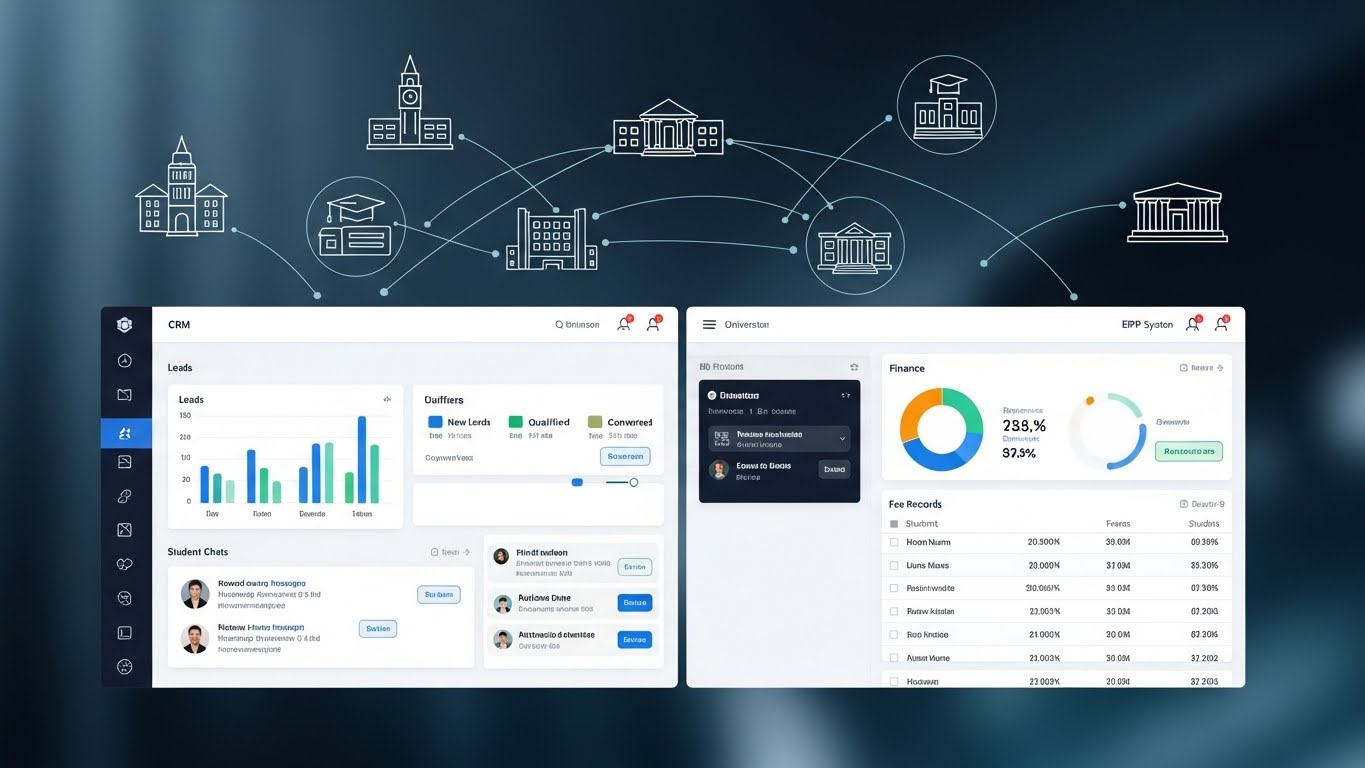
Running a single school campus is complex enough. Running multiple campuses, often across cities or even countries, introduces an entirely different layer of operational pressure. Admissions teams are juggling thousands of inquiries. Finance teams are trying to reconcile fees across locations. Academic records must remain accurate, accessible, and compliant. Leadership wants clear visibility, not fragmented reports stitched together at the end of every month.
This is usually the moment education groups start asking hard questions about systems. Do we need a CRM, an ERP, or both? Why does our admissions team feel like they are working in the dark, while finance insists the ERP already does “everything”? Why do reports never seem to tell the full student story from first inquiry to graduation?
Read more: Top Marketing Strategies for Higher Education Institutions to Boost Student Enrolment
The confusion is understandable. CRM and ERP platforms were not originally designed with multi-campus education groups in mind. Most institutions adopt them at different stages of growth, often for very specific pain points. Over time, these systems begin to overlap, break down, or quietly create operational blind spots that only show up when scale exposes them.
Understanding CRM vs ERP for Education
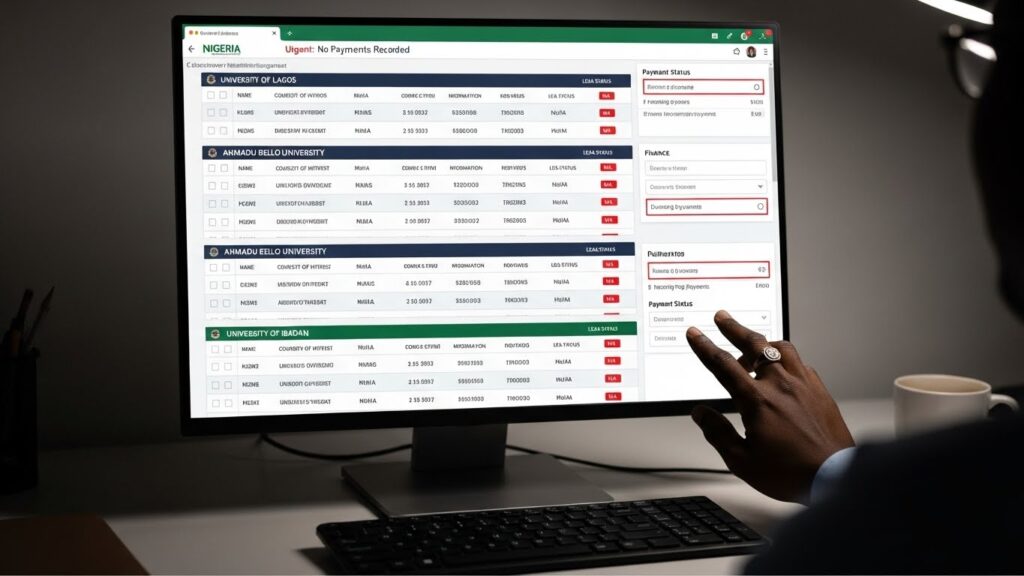
At a high level, a CRM focuses on relationships and interactions, while an ERP focuses on transactions and records. In education, that distinction becomes more nuanced.
An admissions CRM is built to manage inquiries, prospects, applicants, and the interactions that move them toward enrollment. It supports counsellors, marketing teams, and admissions managers who need speed, visibility, and context.
An education ERP system manages core institutional operations such as student records, billing, finance, human resources, and compliance. It prioritises accuracy, control, and consistency across the institution.
Problems begin when institutions expect one system to behave like the other.
When CRM Alone Breaks

CRMs are powerful tools for growth, but when they are used as the primary system of record for a multi-campus education group, cracks appear quickly.
High lead volume overwhelms pipelines. As campuses scale, inquiry volumes increase dramatically. Without deep integration into enrollment and finance workflows, CRMs become cluttered with leads that never fully convert into students. Admissions teams spend more time cleaning pipelines than nurturing prospects.
Multiple campuses create data silos. Each campus often configures its own processes, tags, or stages inside the CRM. Over time, reporting becomes inconsistent. Leadership struggles to compare performance across campuses because definitions of “application,” “offer,” or “enrollment” vary.
Finance data stays disconnected. CRMs are not designed to manage complex fee structures, payment schedules, or reconciliations across campuses. When finance data lives elsewhere, admissions teams lose visibility into who has paid, who is pending, and where bottlenecks exist.
Manual handoffs delay enrollment. Once a student is admitted, data is often exported manually into another system. These handoffs introduce delays, errors, and duplicated effort, all at the exact moment when student experience matters most.
Reporting lacks lifecycle visibility. CRMs excel at top-of-funnel reporting, but struggle to show what happens after enrollment. Retention, academic progress, and financial health remain invisible, making long-term planning difficult.
Read more: How Universities Expanded Enrolment Through Online International Programs in 2025
When ERP Alone Breaks
On the other end of the spectrum, many institutions invest heavily in an ERP and expect it to handle admissions and marketing by default. This approach creates its own set of challenges.
Admissions lacks inquiry tracking. ERPs are not built for high-volume, conversational engagement. They record students once they exist in the system, not while they are still exploring options. Valuable context about how a student found the institution or what questions they asked is lost.
Marketing attribution disappears. Without CRM-level tracking, institutions cannot reliably link enrollments to campaigns, channels, or counsellors. Marketing decisions become guesswork, not strategy.
ERPs move too slowly for leads. Admissions teams need real-time alerts, task reminders, and flexible workflows. ERPs prioritise stability and control, which makes them less responsive to the fast pace of recruitment.
Counsellor activity stays invisible. Calls, emails, meetings, and follow-ups are difficult to track inside an ERP. This limits performance management and coaching, especially across campuses.
Student communication remains manual. ERPs are not optimised for personalised, multi-channel communication. Admissions teams fall back on spreadsheets, inboxes, and external tools, increasing fragmentation.
What Each System Should Own
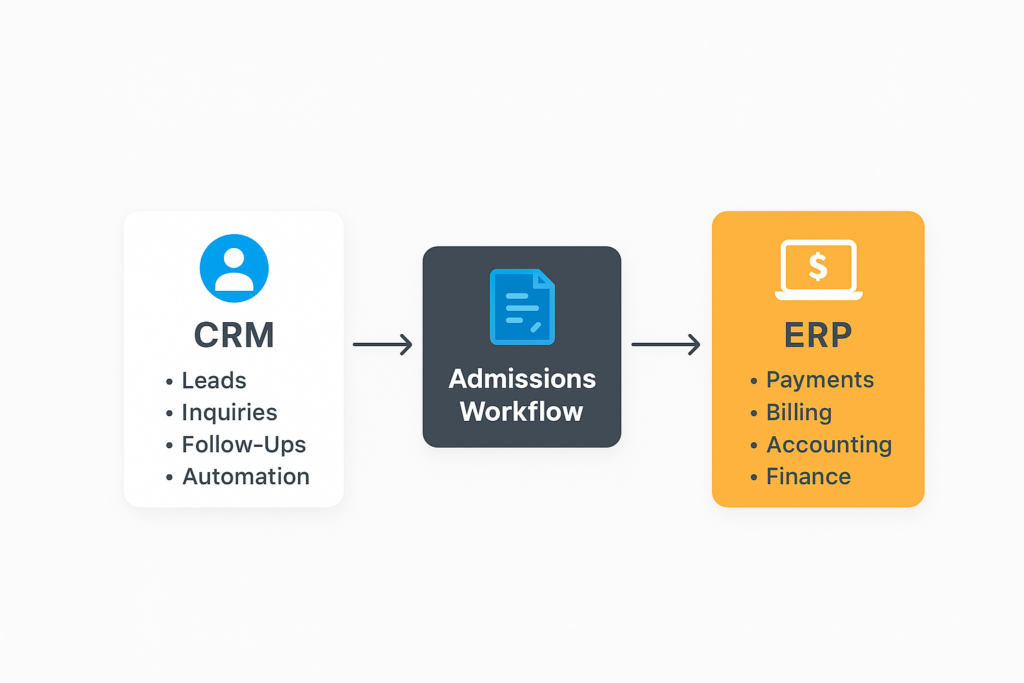
For multi-campus education groups, clarity of ownership is essential. CRM and ERP systems work best when each is responsible for what it does best.
The CRM should own pre-enrollment engagement. This includes managing inquiries and leads, tracking counsellor interactions, recording communication history, and supporting marketing attribution. The CRM is the system of action for admissions teams.
The ERP should own institutional records and transactions. This includes managing student records, finance and billing, academic structures, compliance reporting, and long-term data integrity. The ERP is the system of record for the institution.
Clear ownership prevents overlap, reduces duplication, and ensures teams trust the data they see.
Sync Failures That Kill Data
Even when institutions adopt both systems, integration is where many strategies fail.
Manual exports cause a mismatch. CSV files passed between teams introduce formatting errors, outdated records, and inconsistent updates.
Duplicate student IDs appear. Without a shared identifier, the same student can exist multiple times across systems, breaking reports and workflows.
Delayed sync breaks reports. Nightly or weekly syncs mean leadership is always looking at yesterday’s data, not today’s reality.
Partial records confuse teams. When only some fields sync, teams lose confidence in both systems and revert to shadow processes.
No error logs hide issues. Failed syncs often go unnoticed until problems escalate, making troubleshooting reactive instead of proactive.
How to Build a Clean Stack
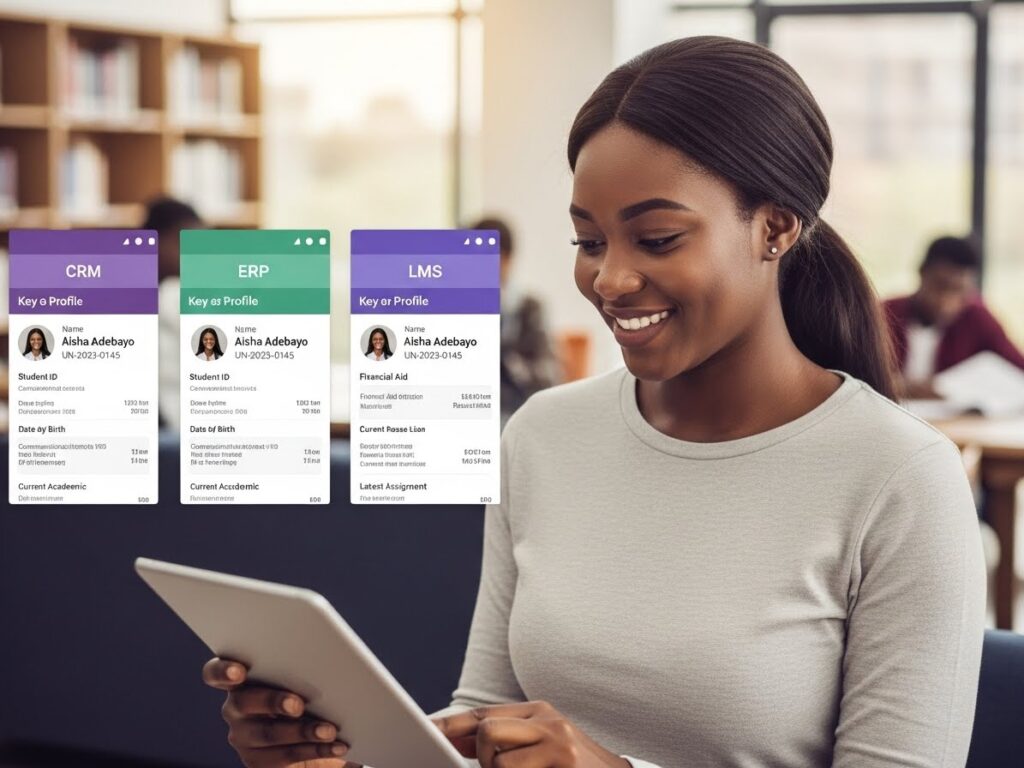
A scalable, multi-campus education stack requires intentional design.
Start with a single student ID across systems. This ensures every interaction, payment, and record maps back to the same individual.
Use API-based, real-time sync rather than manual exports. Real-time integration keeps admissions, finance, and leadership aligned.
Implement controlled access by role. Counsellors, finance officers, and administrators should see what they need, without compromising data security.
Provide unified dashboards for leadership. Executives need lifecycle visibility across campuses, not separate reports from disconnected systems.
Finally, establish governance rules that protect data quality. Define ownership, validation rules, and escalation paths to keep systems clean as the institution grows.
Choosing the Right Platforms
Many global education groups rely on established platforms such as Oracle ERP or SAP ERP for institutional operations, paired with flexible admissions solutions like Salesforce for Education for recruitment and engagement. The technology matters, but architecture and governance matter more.
What separates high-performing institutions from struggling ones is not the brand of software, but how intentionally it is deployed and integrated.
The next step is not simply buying more software. It is auditing your current workflows, identifying where data breaks, and designing integrations that reflect how your institution actually operates.
If your teams are struggling with disconnected admissions, finance blind spots, or inconsistent reporting across campuses, it may be time to rethink your system architecture. The right combination of CRM, ERP, and integration strategy can turn operational complexity into a competitive advantage.
To explore how education groups are building scalable, student-centric systems, visit Edutech Global or browse more insights on the Edutech Global blog. For tailored guidance on system strategy and integration, you can also contact the Edutech Global team.