

Where Your Data Lives Is Becoming a Strategic Decision
Data sovereignty in Africa is no longer a phrase confined to legal departments and IT compliance teams. It is a boardroom question, one that finance ministries, university councils and hospital administrators are all beginning to ask: where does our data actually sit, and who governs it once it gets there?
For years the answer barely mattered. Institutions signed up for whichever cloud platform offered the best price, often without asking which jurisdiction their servers sat in. That is changing. Governments are tightening data residency laws; Africa now enforces them more actively than five years ago, regulators are issuing real fines rather than warnings, and institutions are discovering that cloud adoption does not remove the need for data governance; it simply relocates the responsibility for it. Where data lives now shapes who can access it, which laws apply, and how much control an institution genuinely retains over its own information.
Read More: Higher Education Digital Transformation: Why Technology Alone Doesn’t Deliver Change
What Is Data Sovereignty?
Data sovereignty is the principle that data is subject to the laws of the country in which it is collected or processed, regardless of where the handling company is headquartered. It is a legal and governance concept, not a technical one, and is frequently confused with two related but distinct ideas: data residency and data localisation.
Data residency refers simply to the physical location where data is stored. Data localisation frameworks go further: they are legal requirements that certain categories of data must be stored, and sometimes processed, within a specific country’s borders. Data sovereignty in Africa sits above both, describing which government’s authority ultimately governs a dataset, including who can compel access to it, subpoena it, or restrict its transfer.
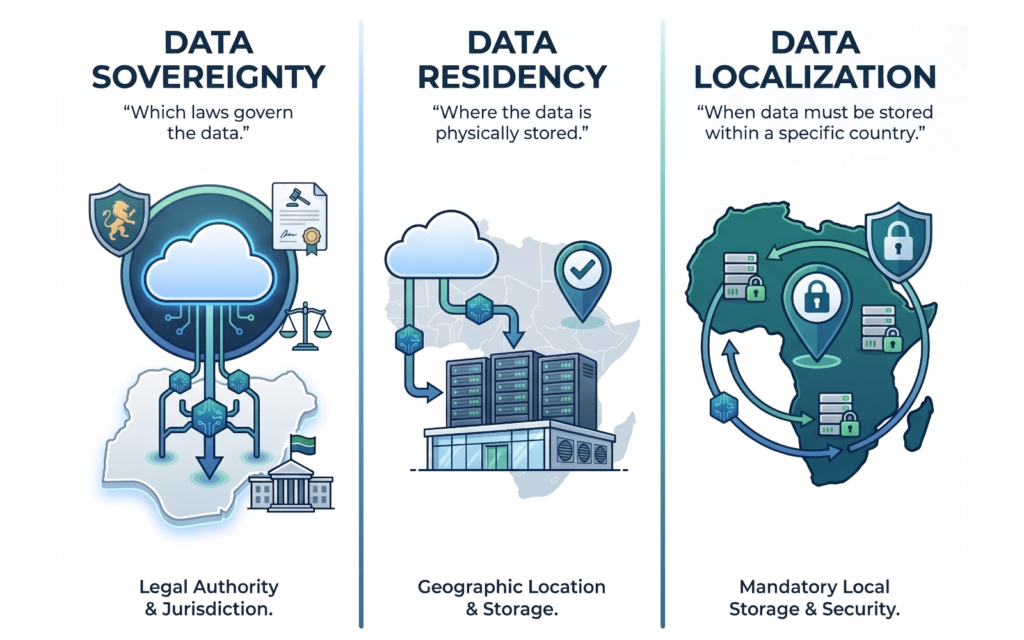
| Concept | Meaning |
| Data sovereignty | The laws governing data based on the jurisdiction where it is held |
| Data residency | The physical location where data is stored |
| Data localization | A legal requirement to store certain data within a country’s borders |
| Data jurisdiction | Which country’s courts and regulators have authority over a dataset |
Understanding these distinctions matters because institutions often assume storing data locally automatically satisfies data sovereignty requirements. It does not. A server in Lagos owned and remotely administered by a foreign entity, with keys held abroad, may satisfy data residency while leaving sovereignty questions wide open.
Why Data Sovereignty Matters for African Institutions
The stakes extend well beyond central government. Universities, banks, hospitals and public agencies all hold data whose loss or misuse carries real consequences: student records, financial transactions, health information, research findings and staff files. When that data sits on infrastructure governed by foreign law, institutions can lose the ability to guarantee confidentiality or control what happens if a vendor relationship sours.
There are also national security dimensions. Government data, voter records, national identity systems and critical infrastructure data carry a sovereignty premium that private commercial data does not, which is why data sovereignty in Africa increasingly sits inside institutional governance and data protection policy, not simply cybersecurity hygiene.
Read More: Public-Private Partnership in Education: Models and Impact
The Growth of Data Residency and Localisation Requirements
Regulatory momentum is building, though unevenly, and institutions should resist generalising one country’s rules to the whole continent. In Nigeria, the Nigeria Data Protection Act 2023 replaced the earlier NDPR compliance framework and established the Nigeria Data Protection Commission as an independent regulator with real enforcement teeth: penalties of up to 2 per cent of annual gross revenue, mandatory breach notification within 72 hours, and cross-border transfer restrictions. Local data hosting discussions in Nigeria increasingly centre on this Act, alongside guidance from NITDA, a clear example of data sovereignty in Africa becoming statute rather than aspiration.
In Kenya, the Data Protection Act 2019 goes further: it grants the Cabinet Secretary explicit power to require that data processed for the state’s strategic interest be handled only through servers located inside Kenya, enforced through the Office of the Data Protection Commissioner.
At the continental level, the African Union’s Malabo Convention on Cyber Security and Personal Data Protection finally entered into force in June 2023, once fifteen member states ratified it. It remains a framework convention rather than directly enforceable law in most countries, and several major economies, including Nigeria, have not yet ratified it, so national legislation still does the practical work. Institutions working across borders should track both the AU framework and each country’s domestic statute rather than assume continental alignment already exists.
What Data Sovereignty Means for Universities
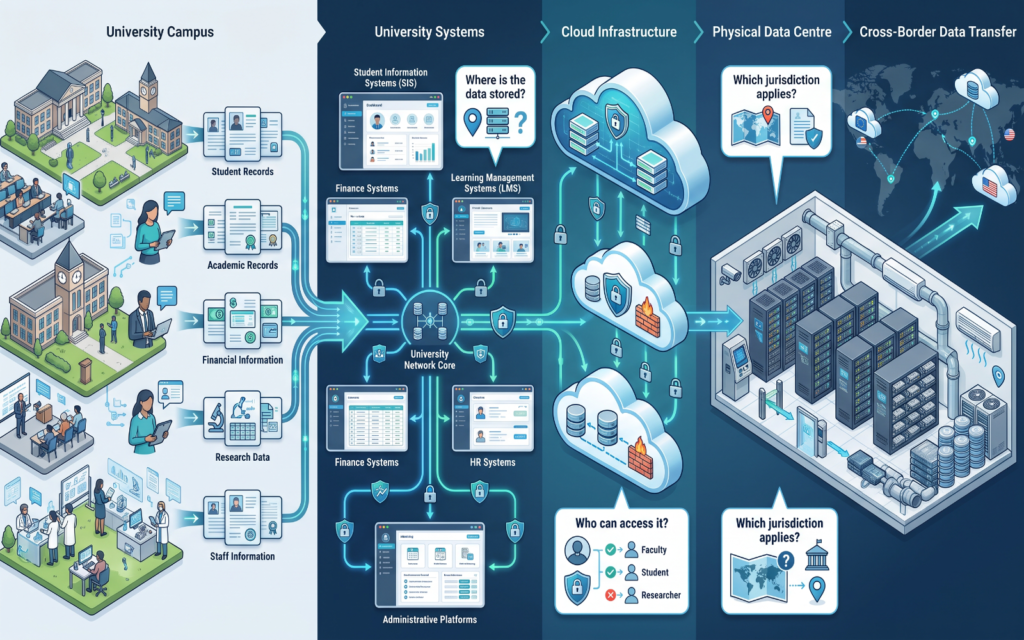
Universities sit at an unusual intersection of data types. A single institution might manage admissions data, academic transcripts, financial aid records, staff payroll, sponsored research data and a learning management platform, often through a patchwork of vendors accumulated over years of piecemeal procurement. Data sovereignty in Africa is rarely a single decision for a university; it is dozens of smaller decisions embedded in existing contracts.
University leaders should be asking a consistent set of questions before signing or renewing any technology contract:
- Where is our data physically stored, and by whom?
- Who, precisely, has administrative or support access to it?
- Which country’s laws and courts govern disputes over it?
- Can the data be transferred across borders, and under what conditions?
- What happens to our data, and our ability to retrieve it, if the vendor relationship ends?
These questions apply as much to a small learning platform as to a national student system, since sovereignty exposure accumulates across every system an institution runs.
Cloud Computing and Data Sovereignty
Cloud sovereignty is often misread as a rejection of cloud computing itself. It is not. The cloud remains one of the most efficient ways for institutions to scale digital services, and sovereign cloud infrastructure is best understood as an added governance layer rather than an alternative to the cloud. The relationship runs in a fairly direct line: infrastructure location determines jurisdiction, jurisdiction determines who can compel access, and access controls determine whether an institution can demonstrate compliance to a regulator or board. Institutions that treat these as unrelated tend to discover the gaps only after an audit or incident.
The Risks of Ignoring Data Location
The cost of treating data location as an afterthought is rarely dramatic; it tends to surface as a slow accumulation of exposure. Regulatory gaps widen quietly until an audit or a breach forces the issue. Vendor dependency deepens to the point where switching providers becomes commercially painful, even when it is clearly the right decision. Cross-border transfers that were never properly documented become difficult to justify retrospectively. And institutions that lose track of who controls their infrastructure often find they have also lost the practical ability to enforce their own policies, whatever those policies say on paper. None of this requires bad intent from a vendor; it is simply what happens when governance is not built in from the start.
Read More: Cybersecurity in Higher Education Today
Building a Data Sovereignty Strategy
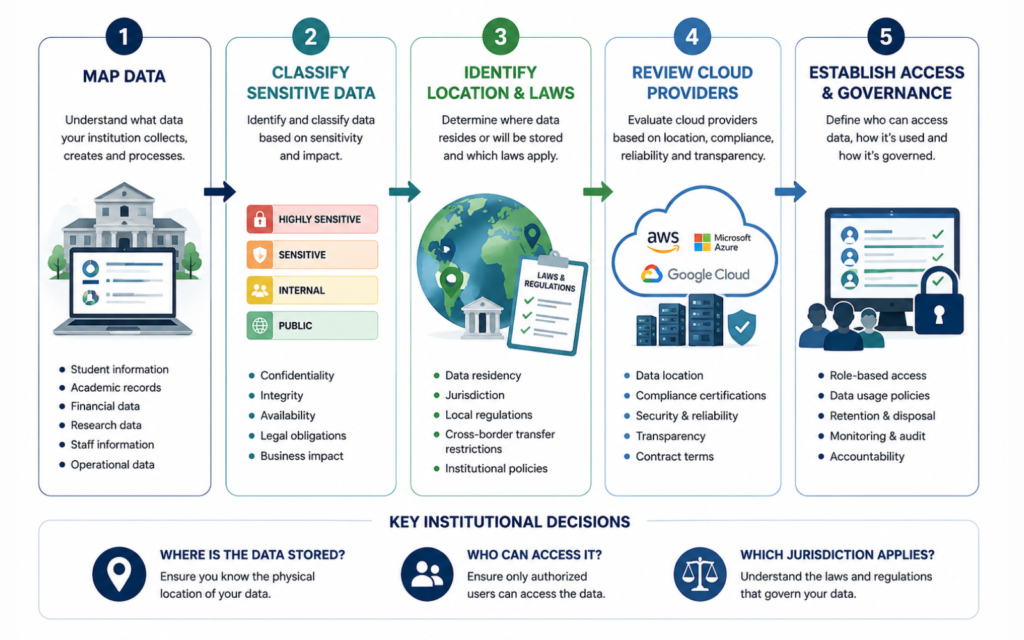
A workable strategy need not be elaborate, but it must be deliberate:
- Map what data exists across every department and system.
- Classify it by sensitivity and regulatory relevance.
- Identify precisely where each category currently sits.
- Confirm which laws apply to each category.
- Review existing cloud and vendor contracts against that picture.
- Set clear access controls and retention policies.
- Document the basis for any cross-border transfer.
- Build sovereignty requirements into future procurement.
This is a governance exercise, not a one-off IT project, and works best when data protection, legal and administrative leadership own it jointly.
What African Institutions Should Ask Technology Providers
Procurement is where sovereignty commitments are made real or quietly abandoned. Before signing with any technology provider, institutions should get clear, written answers on:
- Where data and backups are physically hosted.
- Which countries data can be transferred to, and on what legal basis.
- Who owns the data and who can access it.
- How it is encrypted, at rest and in transit.
- Which compliance standards the provider actually supports.
- How third-party subprocessors are managed and disclosed.
- What happens to the institution’s data, and its exportability, once the contract ends.
A provider unwilling to answer these plainly is telling an institution something important about the relationship it is entering.
EduTech Global and Sovereign Digital Infrastructure
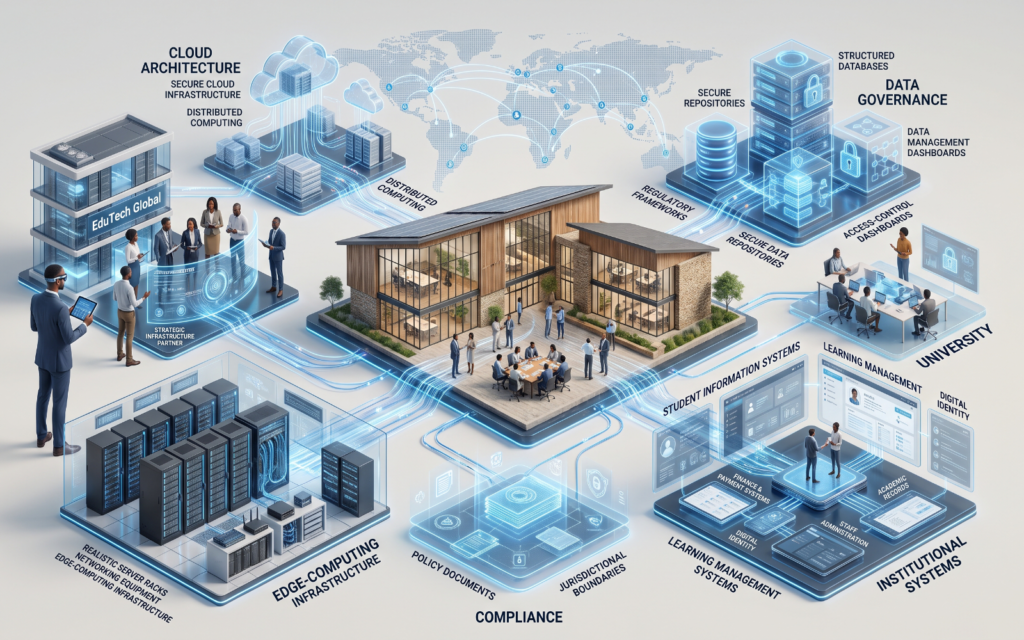
This is the territory EduTech Global works in: helping governments, banks, schools and universities move past isolated software decisions toward a coherent digital infrastructure strategy, one where cloud architecture, data governance and technology planning are designed together rather than bolted on afterwards. Sovereign digital infrastructure is not a product bought off a shelf. It is a set of architectural and governance choices, informed by local infrastructure realities and government partnerships, that give institutions durable control over their technology and data as their education ecosystems grow.
Frequently Asked Questions
What is data sovereignty in Africa? The principle that data collected or processed within an African country is governed by that country’s laws, regardless of which company handles it.
Data sovereignty vs data residency? Residency is physical storage location; sovereignty is which jurisdiction’s laws and enforcement powers apply.
Why is data localization important? It gives regulators and institutions clearer authority over sensitive government, financial and health-related records.
Does data sovereignty require local cloud hosting? Not necessarily. It requires clarity on jurisdiction, access and legal control, which local hosting can support but does not guarantee alone.
What does it mean for universities? Treating every system holding student, financial, staff or research data as a governance question, not just a procurement one.
What to ask cloud providers? Where data and backups sit, which countries it can move to, who can access it, and what happens to it after the contract ends.
How does it affect cross-border transfers? Laws like Nigeria’s NDPA and Kenya’s Data Protection Act restrict transfers unless the receiving country offers comparable protection.
Getting the Infrastructure Decision Right
Data sovereignty Africa is ultimately an infrastructure and governance question dressed in legal language. It asks institutions to know, precisely, where their data lives, who can reach it, and what recourse they have if something goes wrong, questions that cannot be answered after the fact with a compliance memo. The regulatory direction across Nigeria, Kenya and the wider continent shows this is not a passing concern; it is the shape of how digital infrastructure will be governed going forward.
Institutions that start mapping their data and building sovereignty into procurement now will be the ones with genuine options later. EduTech Global works with governments and institutions on exactly this kind of infrastructure planning. Get in touch to talk through where your institution’s data currently stands.