
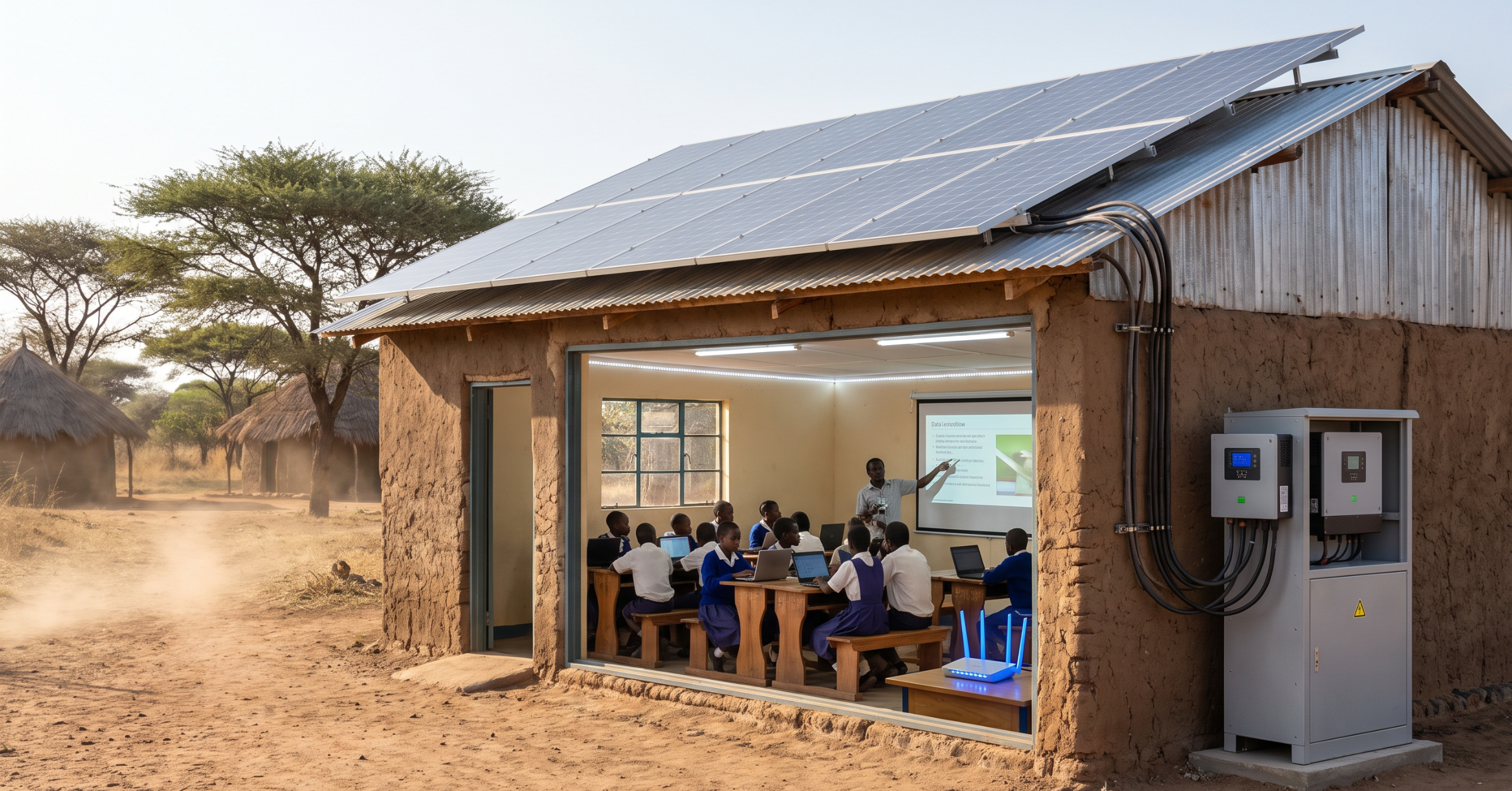
Before a School Can Go Digital, It Needs Reliable Power
Solar power for schools in Africa has moved from a development footnote to an infrastructure priority, and the reason is straightforward: no learning management system, computer lab, or internet connection works without electricity behind it. It sounds obvious once stated plainly, yet a great deal of education technology planning still starts with software and works backwards, only discovering the power gap once equipment sits unused in a classroom with no reliable current to run it.
The scale of that gap is not small. According to the International Telecommunication Union’s 2022 connectivity report, only around 40 per cent of schools across sub-Saharan Africa have electricity, and separate research published in Joule estimates that roughly a third of Africa’s school-aged children attend schools without power at all. For governments and institutions trying to expand digital education, solar offers a genuinely practical route to close that gap in places the national grid has not reached and may not reach for years. This article looks at where solar fits in the wider education infrastructure stack, what it can realistically deliver, and what it takes to make it last.
Read More: Public-Private Partnership in Education: Models and Impact
Why Electricity Access Remains an Education Infrastructure Challenge
Rural schools bear the brunt of this problem disproportionately. Grid coverage across the continent remains concentrated in urban areas: the African Development Bank puts urban electricity access at around 85 per cent, against roughly 35 per cent in rural areas, where most under-resourced schools sit. Even schools nominally connected to the grid often contend with frequent outages, forcing reliance on diesel generators that carry ongoing fuel costs, maintenance burdens and their own emissions. This is the gap that makes the case for solar power for schools in Africa so hard to ignore: grid extension alone will not reach every classroom within a useful timeframe.
This unreliability has direct educational consequences:
- Digital equipment sits idle or degrades faster under inconsistent power.
- Teachers cannot depend on lighting for early morning or evening sessions.
- Learning management systems and cloud-based tools become unusable offline.
- Schools default to paper-based processes even after investing in technology.
Rural school electrification is therefore not a peripheral concern for education ministries; it is a precondition for almost everything else on a modern school’s technology roadmap.
What Is Off-Grid Solar for Schools?
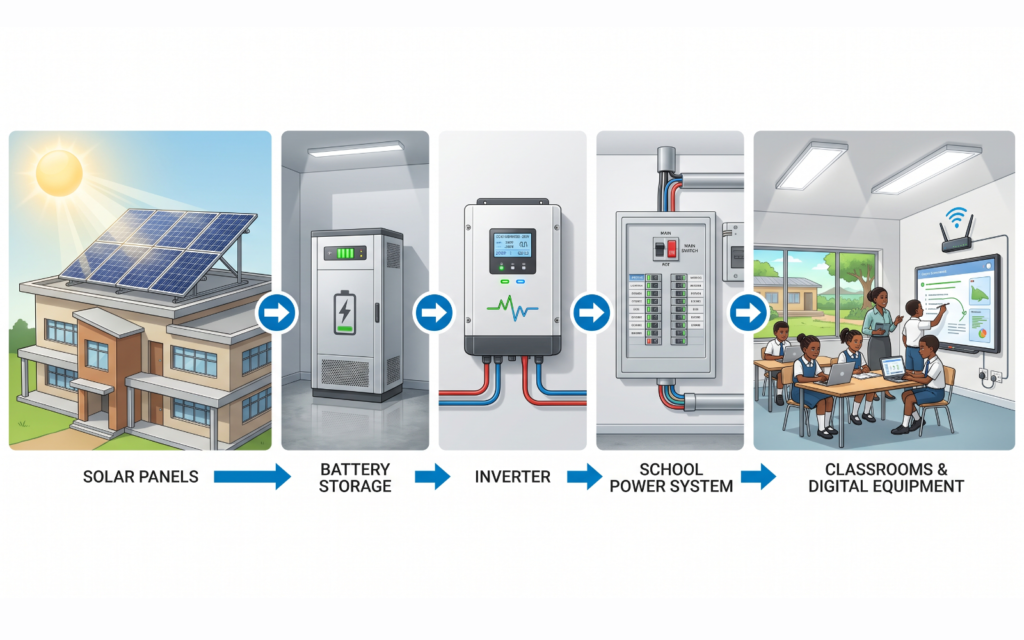
Off-grid solar education systems combine a few core components: solar panels to generate power, battery storage to hold it, an inverter to convert it to usable electricity, and an energy management system to balance supply against classroom demand. None of this requires a nearby grid connection, which is precisely the point of off-grid solar education as a category distinct from waiting on national grid expansion.
It helps to distinguish between the main configurations institutions encounter:
- Grid-connected solar supplements existing grid power and can feed excess generation back where regulations allow.
- Off-grid solar operates entirely independently, suited to schools with no practical grid access.
- Solar-plus-storage pairs panels with batteries to keep power available after sunset or during cloudy periods.
- Mini-grid systems serve a cluster of buildings, sometimes a school alongside a clinic or community centre, sharing one larger installation.
The right configuration depends on a school’s location, its existing infrastructure and its realistic power demand, not on which option sounds most advanced.
What Can Solar Power Enable Inside a School?
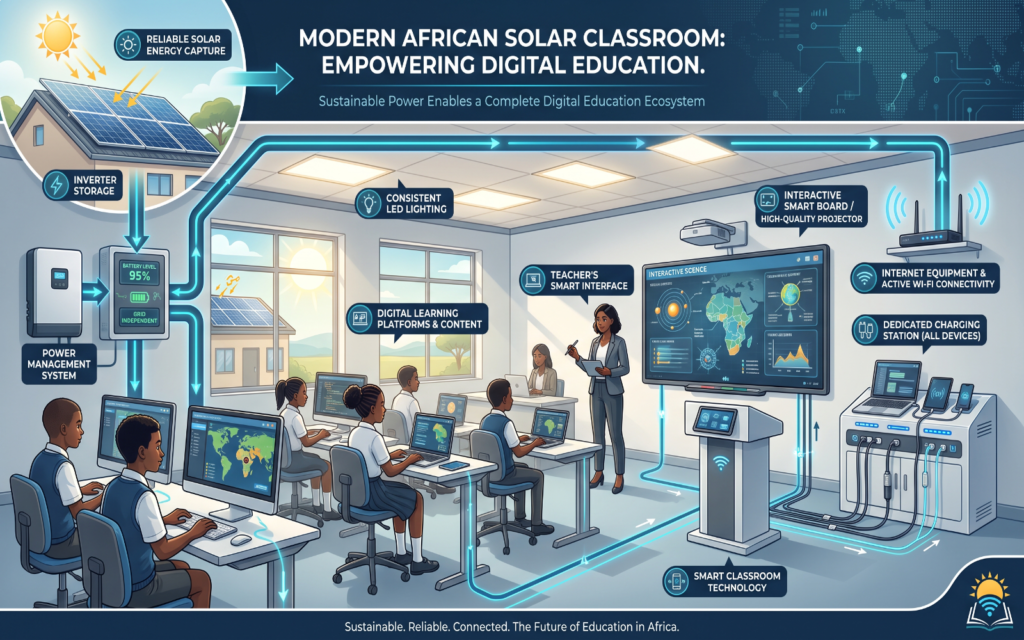
Reliable electricity, once secured, unlocks far more than lighting. It supports computer labs, internet routers and modems, projectors for shared teaching content, phone and tablet charging stations, printing and administrative equipment, basic security systems and, in some installations, water pumping. Powering African classrooms in this fuller sense means treating electricity as the foundation the rest of the digital classroom sits on, not an isolated utility bill. This is the practical, unglamorous case for solar power for schools in Africa: it is rarely the headline of an education technology strategy, yet almost everything else on that strategy depends on it working quietly in the background.
Solar Energy for Schools and Digital Education
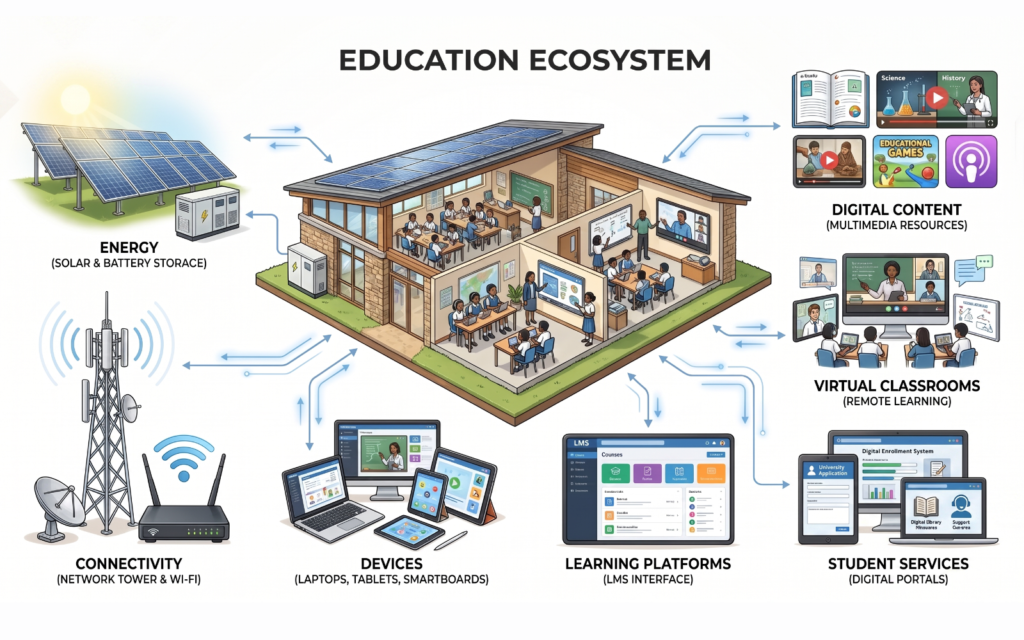
This is where solar power for schools in Africa connects directly to EduTech Global’s core message: the strategic sequence runs from energy to connectivity, then devices, then cloud platforms, then digital learning itself. A school can have excellent internet provisioning, as our piece on satellite internet for schools in Africa explores, and still fail to deliver digital education if the power behind the router is unreliable. Connectivity projects that do not budget for energy from the outset tend to underperform once installed, because the constraint was never really bandwidth. It was power.
Benefits of Solar-Powered Schools
Clean energy education infrastructure delivers several genuine advantages, provided expectations stay realistic. More consistent electricity reduces dependence on diesel generators and their recurring fuel costs. Technology can operate for longer hours, supporting after-school programmes and adult education sessions once the sun sets, where storage capacity allows. Learning environments generally improve with reliable lighting and cooling. Solar also builds resilience against grid outages that would otherwise interrupt teaching and administrative continuity.
What solar does not automatically deliver is instant cost savings. Upfront capital, battery replacement cycles and ongoing maintenance all factor into whatever a school actually pays over a system’s lifetime, and research published in Joule found photovoltaic upfront costs for African schools ranging from roughly €1,200 to nearly €50,000 depending on scale and location, a range wide enough that any blanket claim about savings deserves scepticism until it is costed properly.
Read More: Higher Education Digital Transformation: Why Technology Alone Doesn’t Deliver Change
Challenges of Solar Electrification
Solar is not a plug-and-forget solution, and treating it as one is where many well-intentioned projects falter. Initial capital costs remain a genuine barrier for under-funded schools. Batteries degrade and need periodic replacement, an expense easy to overlook at the planning stage. Systems require routine maintenance, and rural areas often lack nearby technicians with the relevant training. Theft of panels and batteries is a documented risk in some regions, requiring physical security measures. Correct system sizing matters too: an undersized system frustrates users, while an oversized one wastes budget. Financing structures and unpredictable weather add further complexity. None of this is a reason to avoid solar; it is a reason to plan for its full lifecycle rather than just its installation.
How Governments and Partners Can Finance School Electrification
Electricity access education Africa initiatives increasingly draw on a mix of financing models rather than any single source, and closing the electricity access education Africa gap at scale will likely require most of them working in parallel rather than any one silver-bullet mechanism. Government capital budgets remain foundational, often supplemented by development finance from institutions such as the World Bank and African Development Bank. Public-private partnerships, of the kind explored in our piece on public-private partnerships in education, allow private capital and technical expertise to combine with public mandate. Grants and impact investment target underserved regions where commercial returns alone would not justify investment, while energy-as-a-service models let schools pay for reliable power as an ongoing service rather than a large upfront capital outlay. Community partnerships, where local stakeholders share ownership and oversight, have also proven effective at sustaining systems well beyond the initial installation.
Designing a Complete Education Infrastructure Plan
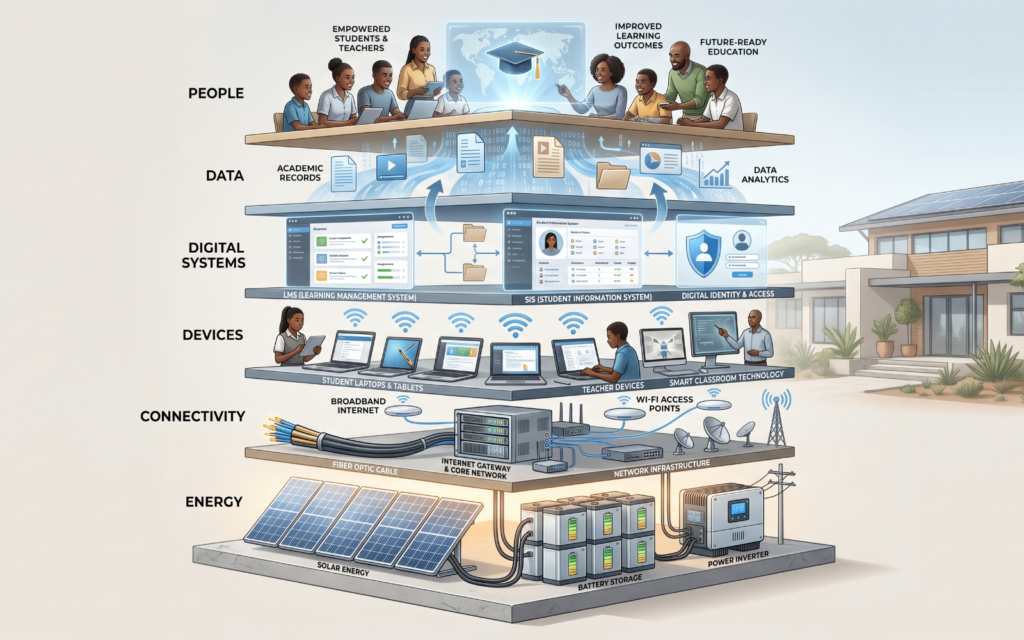
Solar power for schools in Africa only delivers its full value as part of a layered infrastructure plan, not as an isolated project. Treating a solar installation as the end goal, rather than the foundation layer, is one of the most common reasons rollouts underdeliver:
- Energy: solar, grid and storage systems providing the base layer of power.
- Connectivity: fibre, mobile and satellite links carrying data in and out.
- Devices: computers, tablets and classroom technology students actually use.
- Digital systems: learning management systems, student information systems, admissions and assessment platforms.
- Data: cloud infrastructure, analytics and governance underpinning everything above.
- People: teachers, administrators and technical support who keep it all running.
Rural education infrastructure projects that skip layers, wiring a school for connectivity without securing power, or deploying devices without training staff to use them, tend to underdeliver against their original ambition, however well-funded the initial rollout was.
How EduTech Global Supports Education Infrastructure Planning
EduTech Global approaches education technology from the infrastructure layer upward rather than starting with software alone. That means digital readiness assessments that look honestly at a school or system’s current energy and connectivity position, technology planning that sequences investment sensibly, and government partnerships that align funding with realistic implementation timelines. Renewable energy education infrastructure, digital campus planning and cloud infrastructure design all sit within the same strategic conversation, because a scalable education ecosystem cannot be built one disconnected layer at a time.
Read More: The Future of Higher Education: Ten Trends Reshaping Universities Through 2030
Frequently Asked Questions
Why is solar power important for schools in Africa? Because a large share of schools, particularly rural ones, lack reliable grid electricity, and without power, digital learning tools simply cannot function.
Can solar power run a school? Yes, with correctly sized panels, storage and inverters, solar can power lighting, devices, connectivity equipment and basic administrative systems.
What is an off-grid solar school? A school powered entirely by an independent solar system, with no dependence on national grid infrastructure.
How can solar energy support digital learning? By providing the consistent electricity that computers, internet equipment and cloud-based learning platforms require to operate reliably.
What does a school need for a solar power system? Panels sized to actual demand, adequate battery storage, an inverter, and a maintenance plan covering the system’s full lifecycle.
How can governments finance school electrification? Through a mix of public budgets, development finance, public-private partnerships, grants and energy-as-a-service arrangements.
Can solar power reduce dependence on generators? Yes, though realistic savings depend on upfront costs, battery replacement and maintenance, not on solar alone.
Building From the Ground Up
Solar power for schools in Africa is not a standalone fix; it is the first and most necessary layer of an education infrastructure stack that only works when every layer is considered together. A school with excellent connectivity but no dependable power will still struggle, just as one with panels but no maintenance plan will eventually lose them. EduTech Global works with governments, institutions and partners to think about that full chain, from energy and connectivity through to cloud systems, digital platforms and institutional data. The goal is not simply to connect a school. It is to build the infrastructure that lets digital education actually work. Get in touch to talk through where your institution’s infrastructure planning currently stands.