
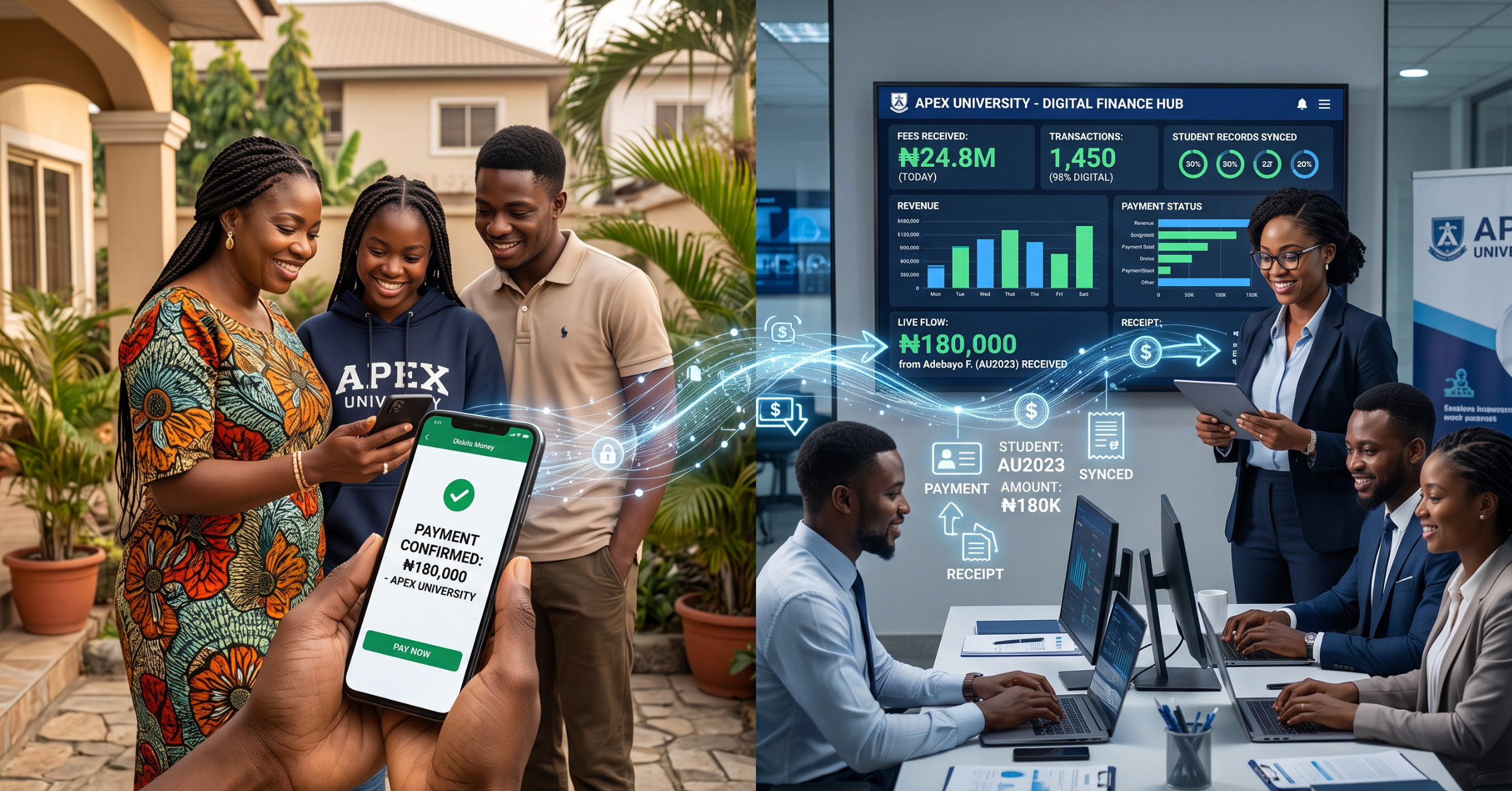
Education payment infrastructure in Africa has become a strange contradiction. A parent in Suleja can pay a market trader by phone in under ten seconds, yet the same parent may still queue at a bank branch, fill out a deposit slip and walk a stamped receipt to the school office to prove their child’s fees are paid. The gap is not appetite or technology awareness. It is how institutions have built, or failed to build, the systems behind the payment, and why education payment infrastructure in Africa deserves treatment as a strategic priority, not an administrative afterthought.
This matters because fintech has already proven the model works at scale. African mobile money providers now move more value each year than most national budgets on the continent, treating payments as infrastructure, not a feature bolted onto an existing process. Education has not made that shift. Institutions still largely treat fee collection department by department, rather than as one connected system touching enrollment, finance, reporting and the student experience. Closing that gap is less about a payment button on a school website and more about rethinking how payment infrastructure fits into an institution’s wider architecture.
Read More: The Future of Higher Education: Ten Trends Reshaping Universities Through 2030
How African Fintech Changed Everyday Payments
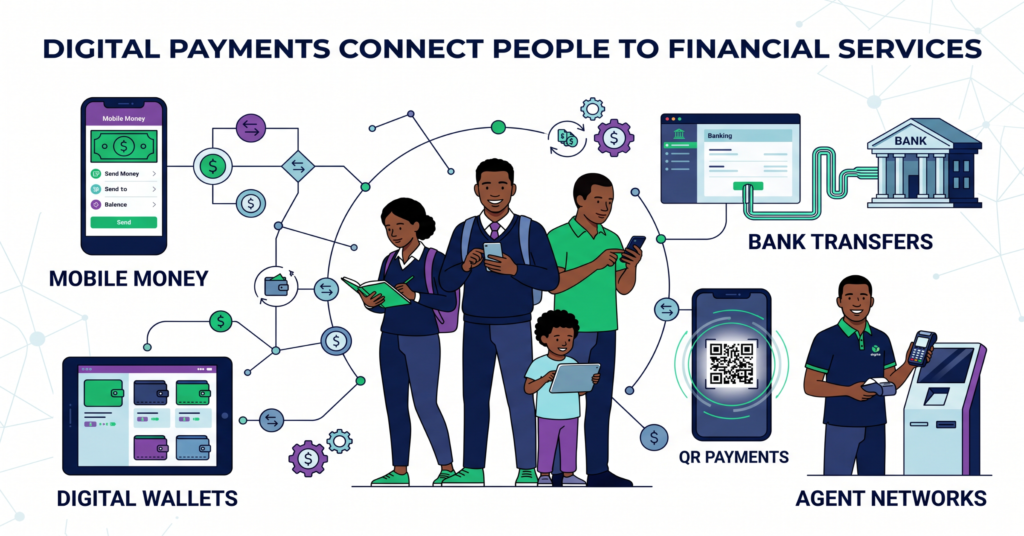
Africa’s fintech sector did not wait for traditional banking infrastructure to catch up. It built around it. Mobile money, launched most famously through Safaricom’s M-Pesa in Kenya in 2007, gave people a way to store and move money on a basic mobile phone without ever opening a bank account. The model has since scaled dramatically:
- Sub-Saharan Africa held over 1.1 billion registered mobile money accounts by the end of 2024, more than half the global total, per the GSMA State of the Industry Report on Mobile Money 2025.
- The region processed roughly $1.4 trillion in mobile money transactions in 2025, around two-thirds of the global total, per the GSMA’s 2026 report.
- Mobile money account ownership reached 40% of adults by 2024, the highest of any world region, according to the World Bank’s Global Findex 2025.
This is not a uniform story. Kenya’s mobile money penetration is unmatched on the continent, while markets such as Niger and Chad report account ownership below 25%, per the same Findex data. What unites the successful markets is that providers built payment rails first, then layered savings, credit and merchant payments on top. Fintech for education in Africa has largely skipped that first step.
Why Education Payments Remain Fragmented
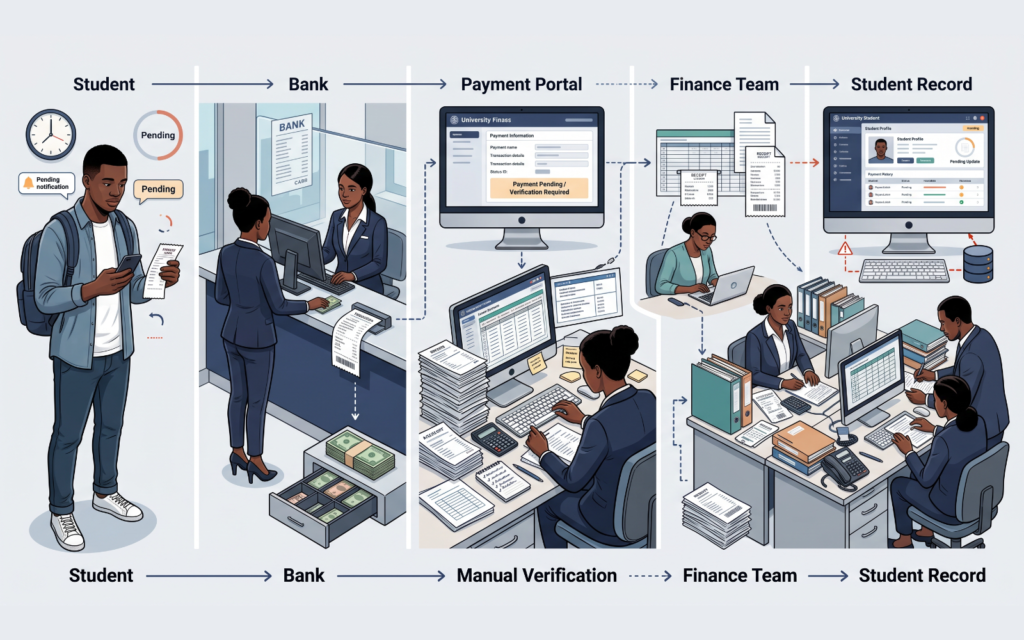
Ask a university bursar what fee collection looks like and the answer rarely involves a single platform. It usually involves several banks, a cash office, manual spreadsheets and a finance team reconciling everything by hand at term end. The reasons are structural, not a lack of effort:
- Multiple banking relationships. Larger institutions often hold accounts with several banks across campuses, multiplying reconciliation work.
- Cash payments. Many families, particularly in rural areas, still pay in cash, which requires manual entry and physical banking.
- Disconnected portals. Application, tuition, accommodation and examination fees are often collected through separate systems that never talk to one another.
- Delayed confirmation. Bank transfers and cheques can take days to clear, leaving students in limbo during enrollment.
- Cross-border friction. International students and diaspora parents often face high fees and slow processing.
The consequence is real cost: staff time chasing unmatched payments, students blocked from registering while a payment is unconfirmed, and finance teams unable to produce accurate reporting for leadership, let alone regulators.
What Modern Education Payment Infrastructure Should Look Like
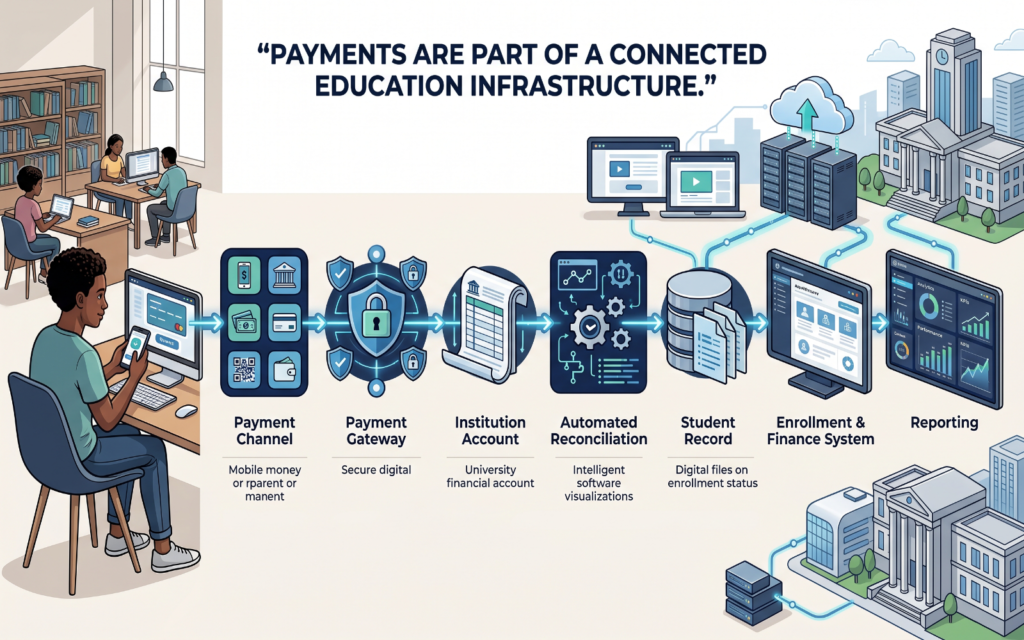
The mistake many institutions make is treating a payment gateway as the entire solution. In practice, the payment is only one link in a longer chain: the student or parent selects a payment channel, the transaction passes through a gateway, funds land in the institution’s account, the payment is automatically reconciled, the student’s record is updated, and the enrollment or finance system reflects the change instantly, with reporting generated without manual intervention. University payment systems built this way close the gaps where money gets lost, delayed or misattributed, because each step triggers the next automatically rather than depending on someone in an office noticing and typing it in.
Read More: The Digital Campus: Why Every Modern University Needs One to Stay Competitive
Mobile Money and Education Payments
Given its reach, mobile money tuition payment is a natural entry point into this wider system, and it already has a track record. In Kenya, Safaricom’s Lipa Karo na M-Pesa service, run through partner banks including Co-operative Bank and KCB, has enabled parents to make M-Pesa school fees payments directly via Pay Bill for over a decade, while M-Pesa Bill Manager adds reconciliation and e-receipting for schools. The applications extend well beyond termly tuition:
- Registration and application fees
- Examination fees
- Accommodation and boarding costs
- Short courses and continuing education
- International payments, where regulatory frameworks support them
The benefits are tangible: convenience for families without a nearby bank branch, faster confirmation than cheques or transfers, reduced cash handling for finance offices, and access for the roughly 40% of adults regionally who hold a mobile money account, many with no formal bank account at all. But mobile money alone is a channel, not a system. Its value multiplies only when it feeds directly into an institution’s broader digital fee payment infrastructure, rather than sitting as a standalone collection method.
The Missing Link: Payment and Student Information Systems
This is where most institutions lose the benefit of digitising payments. A payment made through mobile money or a card gateway still has to reach the student record and finance ledger, and in many institutions that step stays manual. Compare the two approaches. Disconnected: payment is made, a staff member verifies it against a bank statement, finance updates a spreadsheet, and the student record is amended, often days later. Connected: payment is made, confirmation is automated, reconciliation happens instantly, and enrollment status changes without anyone intervening. EdTech payment infrastructure that stops at the transaction and never integrates with admissions and finance leaves the institution doing the manual work digitisation was meant to remove.
Why Better Payment Infrastructure Can Improve Student Access
Reduced payment friction changes real outcomes for students, not just finance departments. Faster confirmation means fewer students turned away from lecture halls or exam rooms while a payment is verified. Multiple payment options mean families are not forced into one costly channel. Better visibility lets administrators spot at-risk students earlier, before a missed payment becomes a missed semester. To be precise: good school fee payment platforms make it easier to pay when funds exist and cut administrative delay, but they do not make fees more affordable. Payment infrastructure removes friction from access. It does not solve affordability on its own.
Challenges to Building Digital Education Payment Infrastructure
None of this is simple to build, and institutions should go in clear-eyed about the obstacles:
- Regulation. Payment services intersect with financial services law, which varies by country and often requires partnership with a licensed provider.
- Data security. Student financial data needs protection standards comparable to banking, not a bolt-on afterthought.
- Fraud. Any digital payment channel needs monitoring and verification controls.
- Interoperability. Institutions using multiple providers need those systems to exchange data cleanly, which is rarely the default.
- Transaction costs. Provider fees can be significant at scale and need to be modelled into institutional budgets.
- Digital literacy and rural connectivity. Not every family has reliable internet access or confidence using digital channels.
- Legacy systems. Many finance and student information systems were never designed to integrate with modern payment APIs.
Read More: Public-Private Partnership in Education: Models and Impact
Building Africa’s Next Generation of Education Infrastructure
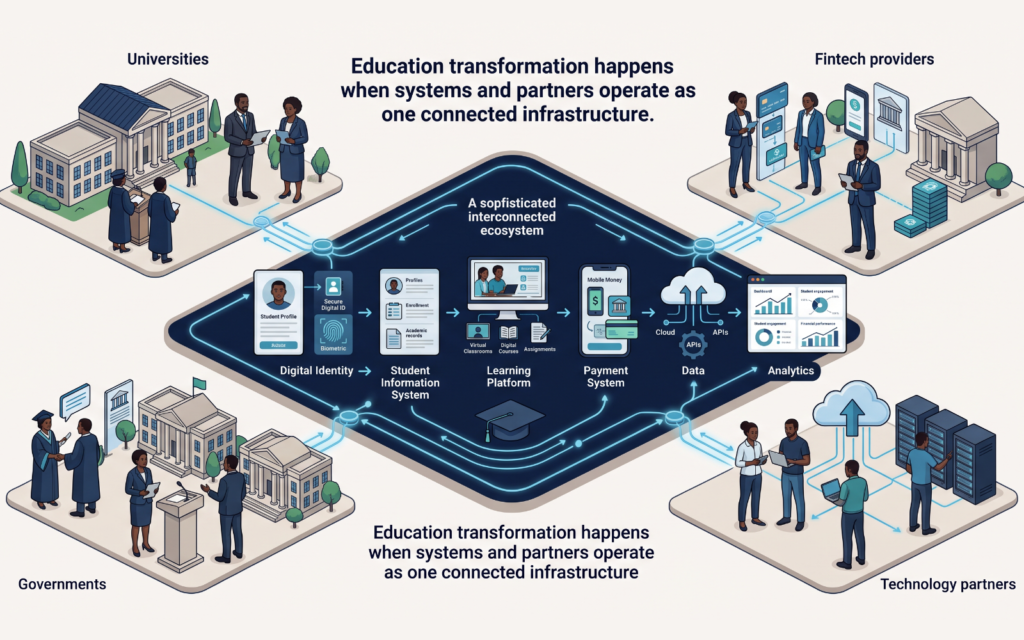
Payment systems should not be planned in isolation. They sit within a wider chain: connectivity, digital identity, student information systems, learning platforms, payment systems, data and analytics, each depending on the one before it. An institution that builds a payment gateway on top of unreliable connectivity or an unverifiable student identity system is building on a weak foundation. This is where education finance technology, and education payment infrastructure in Africa more broadly, needs planning as one layer within a digital ecosystem, not procured as an isolated purchase disconnected from everything else the institution runs.
The Role of Governments, Fintech and EdTech Companies
No single actor builds education payment infrastructure in Africa alone. Governments set the regulatory environment and can extend national payment switches and digital ID systems to education use cases. Universities define institutional requirements and own the relationship with students and parents. Banks and mobile money providers supply the payment rails. Fintech companies bring integration expertise. EdTech providers connect payment data to student and finance systems. Development organisations often fund pilots that prove a model before scale-up. This mirrors the thinking behind Public-Private Partnerships in Education, where shared investment and clearly defined roles outperform any single institution acting alone.
How EduTech Global Approaches Education Infrastructure
At EduTech Global, we help governments, banks, schools and universities treat payments as part of a wider institutional systems strategy, not a standalone feature. That means digital infrastructure planning where connectivity readiness, student information systems and payment ecosystem design work together, rather than separate procurement decisions made by different departments at different times. We are not a mobile money provider. Our role sits at the strategy and integration level, designing the architecture that connects payment channels, student records, finance systems and reporting into something coherent and built for the realities of the markets institutions operate in.
Africa’s fintech sector has already answered the hardest question in digital payments: whether large-scale, mobile-first financial infrastructure can work in markets with fragmented banking systems. It plainly can. What remains unresolved is why education, serving hundreds of millions of students and families who already use mobile money daily, still runs on manual reconciliation and disconnected portals. Education payment infrastructure is not a feature to add to a school website. It is foundational infrastructure that determines how quickly students enrol, how accurately institutions report their finances, and how much friction sits between a family and the education they are trying to access. Education payment infrastructure in Africa is the next frontier for the continent’s fintech progress. EduTech Global works with institutions, governments and technology partners to build that connected digital infrastructure. Get in touch to discuss what it could look like for your institution.
Frequently Asked Questions
What is education payment infrastructure? It is the connected system of payment channels, gateways, reconciliation processes and integrations with student and finance records that allows an institution to collect and manage fees, rather than a single payment tool in isolation.
How can mobile money be used for school fees? Services such as Kenya’s Lipa Karo na M-Pesa allow parents to pay tuition and other fees directly via Pay Bill, with schools able to reconcile payments and issue receipts through platforms such as M-Pesa Bill Manager.
Why are education payments fragmented in Africa? Institutions typically rely on multiple banks, cash handling, separate departmental portals and manual reconciliation, none of which were designed to communicate with each other or with student information systems.
Can fintech reduce university payment friction? Yes, when payment channels are properly integrated with enrollment and finance systems, confirmation and reconciliation can happen automatically rather than requiring manual verification, which reduces delays for both students and administrators.
How can institutions automate fee reconciliation? By connecting payment gateways directly to student information and finance systems through APIs, so that a confirmed payment updates the student’s record and account status without manual entry.
What role can governments play in education payment infrastructure? Governments can extend national payment switches and digital ID systems to cover education use cases, set clear regulatory frameworks for payment providers, and support public-private partnerships that fund shared infrastructure rather than isolated institutional pilots.