
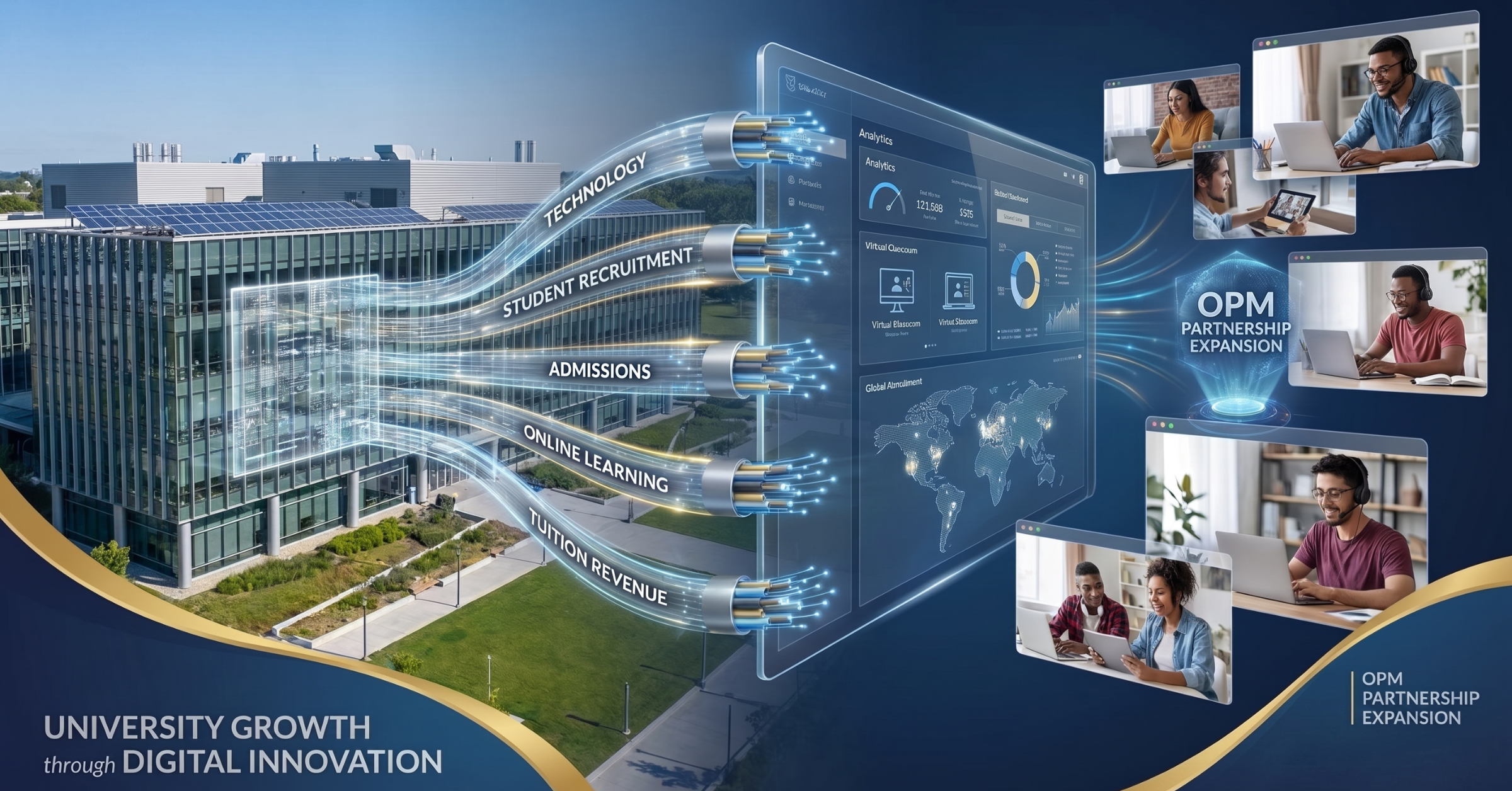
Online program management has quietly become one of the most consequential financing conversations in global higher education, and African universities are only just beginning to have it. Vice-chancellors across the continent face pressure to admit more students and generate more revenue, often with the same buildings and stretched budgets they had a decade ago.
The maths does not work in the traditional model. UNESCO estimates that the number of young Africans completing secondary or tertiary education will roughly double between 2020 and 2040, from 103 million to 240 million, while World Bank figures cited by Times Higher Education show only around 9% of school leavers in Sub-Saharan Africa reach tertiary education, against a global average near 35%. Building enough physical capacity to close that gap would take decades and capital most institutions do not have. This is where online programme delivery, and the online education partnership models that make it possible, enter the conversation.
Read More: The Future of Higher Education: Ten Trends Reshaping Universities Through 2030
What Is Online Program Management?
Online program management, often shortened to OPM, describes an arrangement in which a university partners with an external organisation to design, launch and run online degree or certificate programmes. EDUCAUSE defines it as contracting with third-party organisations that help colleges and universities develop and deliver online programmes, an option institutions turn to when they lack the in-house capacity to build that presence themselves.
An online program manager can support several parts of the journey, depending on the agreement:
- Technology platforms and learning infrastructure
- Student recruitment and marketing
- Admissions processing and enrolment support
- Curriculum design for digital delivery
- Ongoing student support services
No two OPM higher education partnerships look identical. Some universities hand over almost the entire online operation; others bring in an online program manager for one or two specific functions, such as recruitment or platform hosting, while keeping teaching and academic governance firmly in-house.
How the OPM Model Works
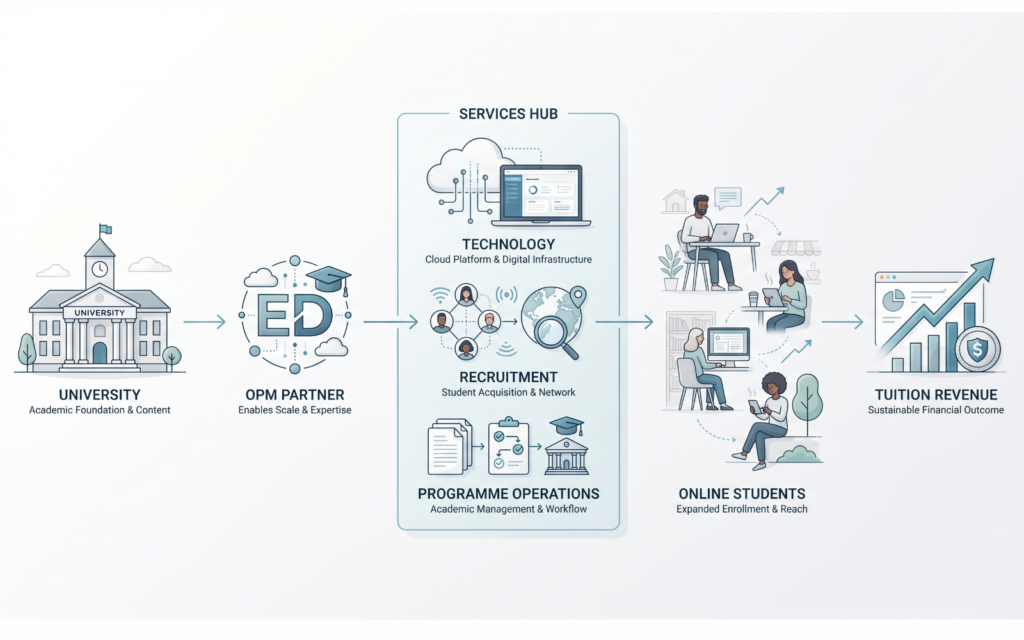
Strip away the jargon and the model is straightforward. A university partners with an OPM, which supplies the technology, recruitment and programme operations needed to reach more online learners. Those learners generate tuition revenue, split between the university and the partner on agreed commercial terms.
That split usually takes one of two forms. In a fixed-fee arrangement, the university pays the OPM directly for defined services, regardless of enrolment numbers. In a tuition revenue share model, the partner earns a percentage of the tuition generated, aligning its incentives with enrolment growth. Many partnerships blend the two.
Why Universities Are Expanding Online Programmes
The pressure to expand online is not really a technology story; it is a growth story. Working professionals want flexible study options that fit around jobs and family, and universities want to reach students beyond their immediate city or region, including the diaspora. Physical lecture halls have hard limits; a well-built online programme does not.
Several forces are pushing African universities to look seriously at this route:
- Rising demand for flexible, part-time and evening study
- Interest from working professionals seeking career-relevant credentials
- Ambitions to recruit across borders and reach diaspora learners
- Limited physical capacity relative to youth population growth
- Growing comfort among students and employers with digital credentials
- The need for new, diversified tuition revenue streams
Framed this way, university digital expansion is a strategic growth lever rather than a technology upgrade, sitting alongside broader shifts already under way in higher education digital transformation across the continent.
Read More: The Digital Campus: Why Every Modern University Needs One to Stay Competitive
Revenue Share and Zero-CapEx Models Explained
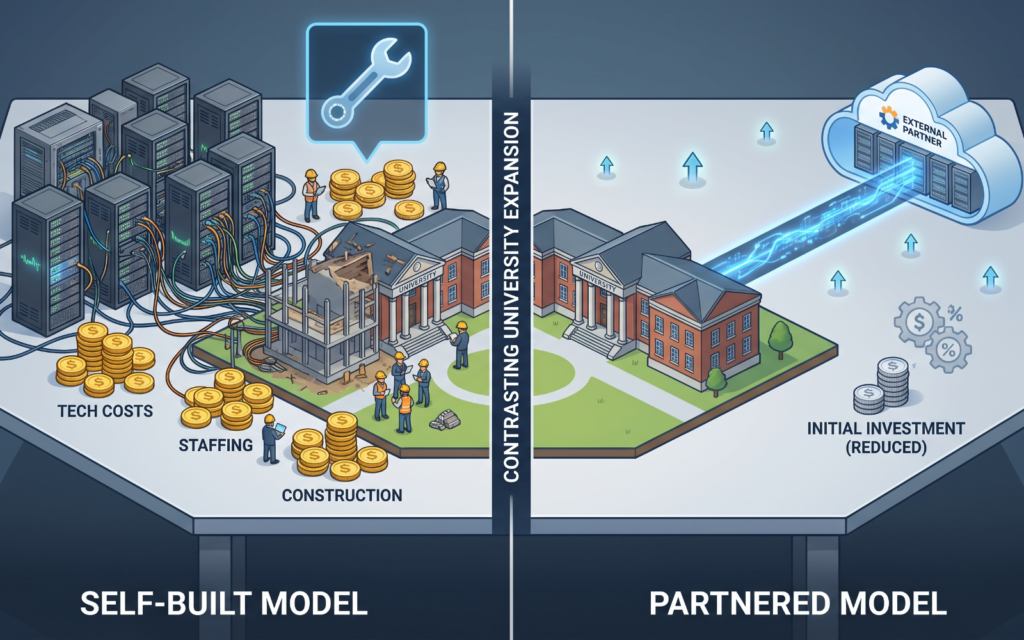
Traditionally, launching an online programme meant the university paying upfront for learning management systems, recruitment campaigns, support staff and content production, before a single student enrolled. That capital requirement has kept many otherwise capable institutions out of the online space entirely.
Revenue share and zero-CapEx models flip that sequence. The OPM partner covers the initial investment in technology, marketing and programme build-out, and recoups it from a share of tuition once students are enrolled and paying. For a university with limited reserves, this can be the difference between launching this year or waiting five years to save for it.
A lower upfront cost is not the same as a low-cost higher education revenue model over time, though. Before signing, leadership should have clear answers on:
- The exact revenue percentage and how it is calculated
- The length of the contract and any renewal or lock-in terms
- Who owns the student relationship and student data
- Who is responsible for marketing and recruitment claims made to prospective students
- Who owns the underlying technology once the contract ends
- What the exit process looks like if either party wants out
Benefits of OPM for African Universities
Done well, an online program management partnership can genuinely change what a university is able to offer. The most tangible institutional benefits include:
- Lower upfront infrastructure and technology costs
- Faster time to launch compared with building everything internally
- Access to established recruitment and digital marketing expertise
- Streamlined digital admissions and enrolment processes
- The ability to scale delivery without proportional increases in physical infrastructure
- A wider geographic footprint through university online enrollment partnership routes, including international and diaspora students
- A new, distinct revenue channel alongside traditional campus tuition
These benefits explain why online education partnership models have taken root in the United States and United Kingdom, and why they now attract serious interest from university boards and policymakers across Africa.
The Risks Universities Should Consider

None of this is one-sided, and any credible account has to say so plainly. In the United States, the scale of these arrangements has drawn direct scrutiny. A 2022 report from the U.S. Government Accountability Office found that at least 550 colleges were working with an online program manager on at least 2,900 education programmes as of July 2021, and flagged that federal oversight instructions were not detailed enough to reliably catch violations of rules against incentive-based recruitment payments.
African institutions considering an OPM higher education partnership should weigh similar concerns before signing anything:
- Long contract terms that outlast the leadership team that signed them
- Revenue-share percentages that quietly erode long-term margins
- Dependency on a single vendor for critical student-facing infrastructure
- Ambiguity over who owns student data and the ongoing student relationship
- Technology lock-in that makes switching providers costly or disruptive
- Loss of control over how the university’s brand is represented in marketing
- Unclear exit provisions if the partnership needs to end
Universities that go in with open eyes, and contracts that name these issues explicitly, are far better placed than those that treat the partnership as a simple handover.
OPM vs Building an Online Education Infrastructure In-House
Neither approach is universally right; the better fit depends on an institution’s capital position, technical capacity and appetite for control.
| In-House Model | OPM Partnership |
| Higher upfront investment | Lower upfront investment possible |
| University manages infrastructure directly | Partner provides infrastructure and technology |
| Internal recruitment team required | Partner may support recruitment |
| Longer setup and launch timeline | Potentially faster time to market |
| Greater internal control over every function | Shared responsibilities across two organisations |
| Ongoing internal technology costs | Partnership-based commercial model |
A well-resourced university with strong technical teams may reasonably choose to build its own digital campus capability. A smaller institution without that capacity may find that a partnership gets it into the online space years sooner than going it alone.
Read More: Data Sovereignty: Why African Institutions Are Rethinking Where Their Data Lives
Where EduTech Global’s Farmer Engine Fits
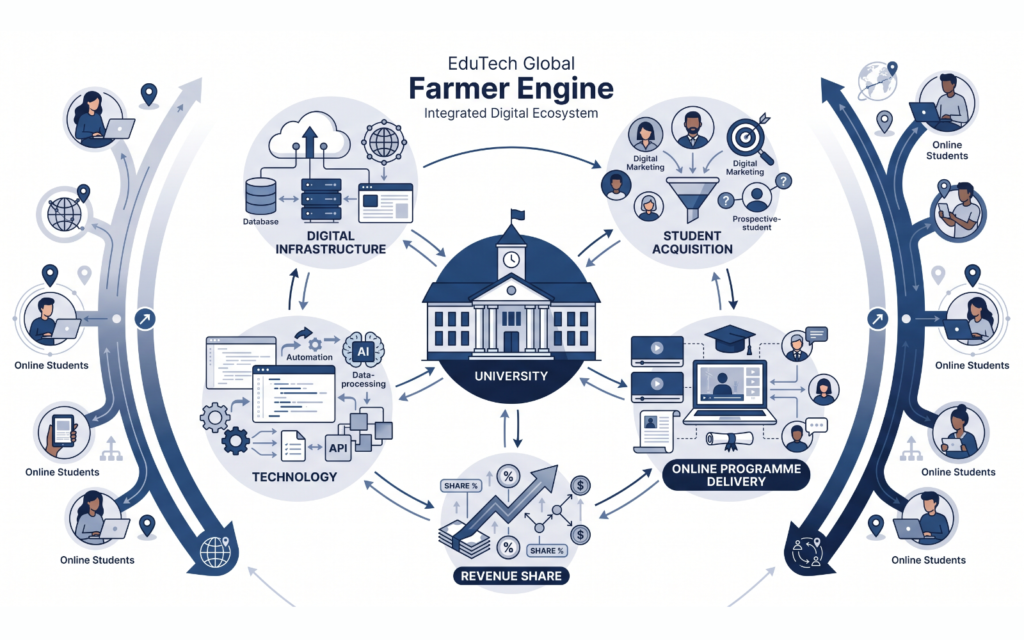
EduTech Global built its Farmer Engine model around a similar premise: that African universities should not have to construct every layer of digital infrastructure before reaching online learners. It combines an Infinite Campus platform, a revenue-share commercial structure, and zero-CapEx onboarding, so digital infrastructure, student acquisition and programme delivery sit on one operating layer rather than several separate vendors.
The intent is not to replace a university’s academic identity or decision-making, but to provide the operating layer beneath it, in the same spirit as the public-private partnerships that already underpin much of the continent’s education infrastructure. For institutions weighing university digital expansion against limited balance sheets, that layer is often the difference between a plan on paper and a programme that actually enrols students.
What Universities Should Ask Before Choosing an OPM Partner
Before signing with any online program manager, university leadership should be able to answer:
- Who owns the student data generated by the programme?
- Who owns the technology platform, during and after the contract?
- How exactly is revenue calculated and reconciled?
- What is the contract duration, and what triggers renewal?
- Who manages student recruitment, and under what claims?
- Who handles admissions decisions and academic gatekeeping?
- Who provides day-to-day student support?
- Who controls how the university brand appears in marketing?
- What happens to students and data when the contract ends?
- How will programme performance and quality be measured?
A partner willing to answer all ten in writing, before a signature is required, is telling a university something important about how the relationship will work.
The Future of Online University Expansion in Africa
The direction of travel is fairly clear. Cross-border enrolment, flexible study and revenue diversification are becoming standard features of university strategy, not side projects, sitting within a wider push, including the World Bank’s work connecting African higher education institutions to high-speed internet under the African Union’s digital transformation strategy. Online program management, whether through a full partnership or a lighter-touch arrangement, is one credible route through that shift, not the only one, and not a shortcut that removes the need for institutional judgement.
Online program management will not suit every university, and it should never be adopted simply because it looks like the fastest route to more students. But for African institutions facing genuine capacity constraints, alongside real ambitions to reach working professionals and diaspora learners, it offers a workable middle path between doing nothing and taking on debt to build infrastructure alone. The universities that get the most from this model go in asking hard questions about data, contract terms and long-term revenue share, not just launching quickly. If your institution is weighing up how to expand online without overextending its balance sheet, EduTech Global is a useful place to start that conversation.
Frequently Asked Questions
What is online program management? A partnership model in which a university works with an external online program manager to design, launch, and operate online degree or certificate programmes.
What does an OPM company do? Depending on the contract, it can provide technology, recruitment, admissions support, curriculum design and ongoing student services.
How do OPM companies make money? Most use a tuition revenue-share model, a fixed service fee, or a blend of both.
What is a revenue-share model in higher education? An arrangement where the OPM partner takes a share of tuition revenue rather than a flat fee, in exchange for covering upfront delivery costs.
Why do universities use OPM partners? Mainly to reduce upfront capital requirements, launch faster and access recruitment and technology expertise they lack in-house.
What are the benefits of zero-CapEx university expansion? Institutions can launch online programmes without large infrastructure spending, since the partner funds the build and recoups costs from future tuition.
What risks should universities consider with OPM contracts? Long contract terms, high revenue-share percentages, vendor dependency, unclear data ownership and weak exit provisions all deserve scrutiny before signing.
Can African universities use an OPM model? Yes. The model is established in the United States and United Kingdom, and more African institutions are exploring similar university online enrollment partnerships.
What should a university look for in an OPM partner? Clarity on data ownership, technology ownership, revenue calculation, contract duration and exit terms, set out in writing before any agreement is signed.