
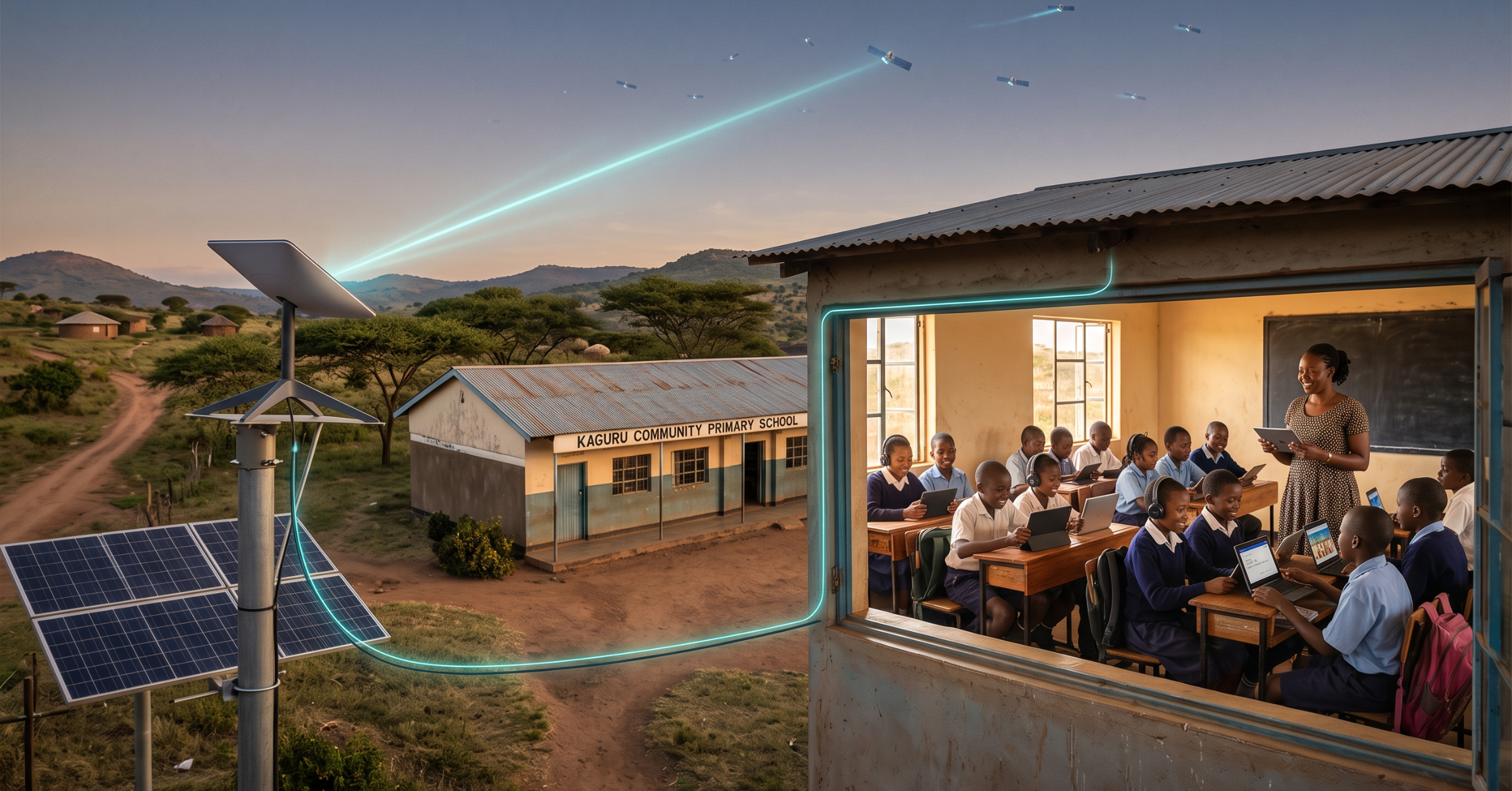
Satellite internet for schools in Africa is now a live infrastructure conversation facing ministries of education, university boards and development partners across the continent. A digital classroom, however well designed, is only as strong as the connection running through it, and for millions of learners that connection simply does not exist.
The scale of the problem is sobering. Across Sub-Saharan Africa, roughly 960 million people live within reach of mobile coverage yet do not use mobile internet, while a further coverage gap leaves tens of millions with no signal at all, according to the GSMA’s Mobile Economy Africa 2025 report. For schools sitting outside fibre routes and mobile masts, this is not an abstract statistic. It is the difference between a classroom that can stream a science demonstration and one that cannot load a single web page. Satellite internet, particularly the low-Earth orbit systems now operating across the continent, has emerged as one credible way to close that gap, though it is best understood as one part of a much larger infrastructure puzzle rather than a complete solution on its own.
Read More: The Digital Campus: Why Every Modern University Needs One to Stay Competitive
Why Many African Schools Still Struggle With Reliable Connectivity
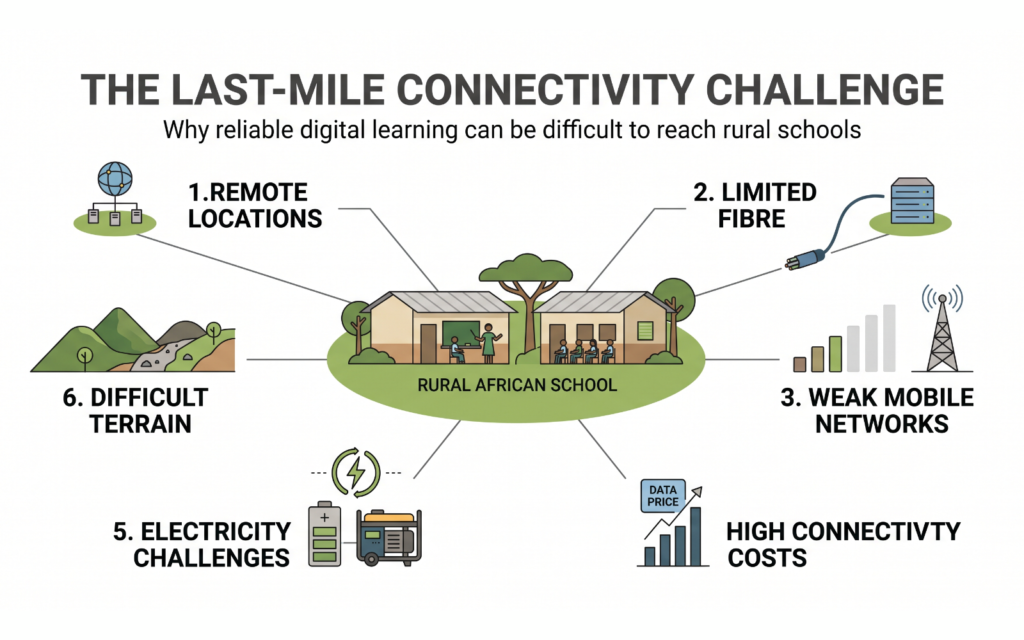
The final mile has always been the hardest part of African connectivity. Laying fibre to a school in a farming district or mountain community involves trenching and maintenance costs that rarely make commercial sense, and mobile towers face similar economics. Several factors compound the problem:
- Geography. Mountains, forests and vast distances between settlements make traditional cabling expensive and slow to deploy.
- Electricity. In Sub-Saharan Africa, only around 22% of primary schools have access to electricity, according to UNESCO’s Global Education Monitoring Report, and more than 565 million people across the region remain off the national grid, per the Giga initiative.
- Cost. Data remains expensive relative to average income, deterring both schools and households from sustained use.
- Coverage gaps. Rural adults in the region are around 48% less likely to use mobile internet than their urban counterparts, GSMA research shows.
This is the digital divide in education in its rawest form: not a lack of ambition among teachers or students, but a lack of physical infrastructure that traditional networks have struggled to reach. Rural school connectivity in Africa cannot be solved by any single technology, but it does need new options on the table, and this is where satellite broadband education has started to gain serious attention.
What Is Satellite Internet and How Does It Work?
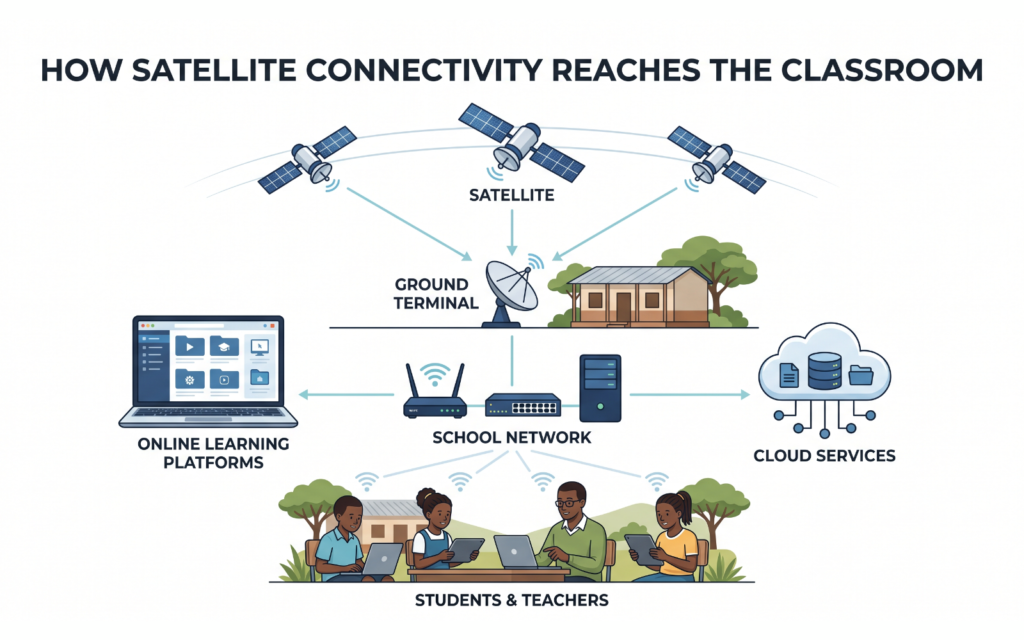
Satellite internet works by beaming a connection from orbiting satellites down to a small ground terminal installed at the school, bypassing the need for cables or nearby cell towers entirely. The newer generation of low-Earth orbit internet systems that schools now rely on, such as Starlink, positions satellites roughly 550 kilometres above the Earth rather than the 35,000 kilometres used by older geostationary systems. That proximity matters enormously: it cuts latency from around 600 milliseconds to closer to 25 to 50 milliseconds, making video calls, cloud platforms and interactive learning tools genuinely usable rather than frustratingly slow.
In practical terms, a school needs a dish, a router and a power source. Once installed, the terminal connects to a constellation of satellites that hand off the signal between them as they pass overhead, delivering coverage even to locations with no other infrastructure nearby. For education leaders weighing options, the appeal is straightforward: deployment can happen in days rather than the months or years fibre extension typically requires.
How Satellite Internet Could Change Rural School Connectivity in Africa
Once satellite internet for schools in Africa is installed, a wide range of digital learning activities become possible for the first time. These include:
- Streaming recorded lessons and virtual laboratory simulations for subjects where physical equipment is scarce
- Giving teachers access to remote training and professional development resources
- Connecting to cloud-based learning management systems and digital libraries
- Running student information systems and government education platforms that require constant connectivity
- Hosting live virtual classroom sessions with specialist teachers based elsewhere
None of this works without the underlying connection. Digital education infrastructure in Africa depends on treating connectivity as the foundation layer, the piece that everything else in a modern learning environment is built upon. Without it, an LMS is just software nobody can log into.
What Recent African Deployments Tell Us
The clearest evidence for satellite internet for schools in Africa comes from Kenya. In February 2026, CEMASTEA, a national institution under Kenya’s Ministry of Education, partnered with Grow X Education and Starlink to connect 30 schools (20 senior and 10 junior) across 30 districts, reaching more than 32,000 students and around 1,000 teachers, as Space in Africa reported. A follow-up study of the rollout found that reliance on unstable mobile data dropped from 67% of schools to just 4% within a month of the terminals going live, a shift that illustrates how quickly satellite connectivity can displace unreliable alternatives once it is actually available.
South Africa offers a more cautious lesson. Starlink has proposed a R500 million investment (roughly USD 27 to 29 million) to connect 5,000 rural schools with free service, potentially reaching 2.4 million learners, as outlined on the Starlink Help Center and reported by MyBroadband. That figure matters because only 1.7% of rural South African households currently have internet access at home, according to TechInAfrica. But as of mid-2026, the deal remains tied to unresolved local ownership regulations and has not yet been implemented. It is a pledge, not a completed deployment, and education leaders should treat it accordingly until licensing is finalised.
The Benefits and Limitations of Satellite Internet for Schools
A balanced view of satellite internet for schools in Africa matters, because no single provider or technology should be presented as a complete answer.
Benefits:
- Rapid deployment compared with fibre or new mobile infrastructure
- Coverage in remote areas that terrestrial networks are unlikely to reach economically
- Reduced dependence on local telecom infrastructure that may be unreliable or absent
- Scalability across large, dispersed school networks
Limitations:
- Upfront equipment costs and ongoing subscription fees that many ministries and schools cannot absorb without support
- A continued reliance on stable electricity or solar backup to keep terminals running
- Sensitivity to obstructions, extreme weather and signal interference
- Local regulatory approval, which, as South Africa demonstrates, can delay rollout for years
- The need for local technical support and maintenance capacity, which is not always available in remote districts
Connectivity Alone Is Not Enough
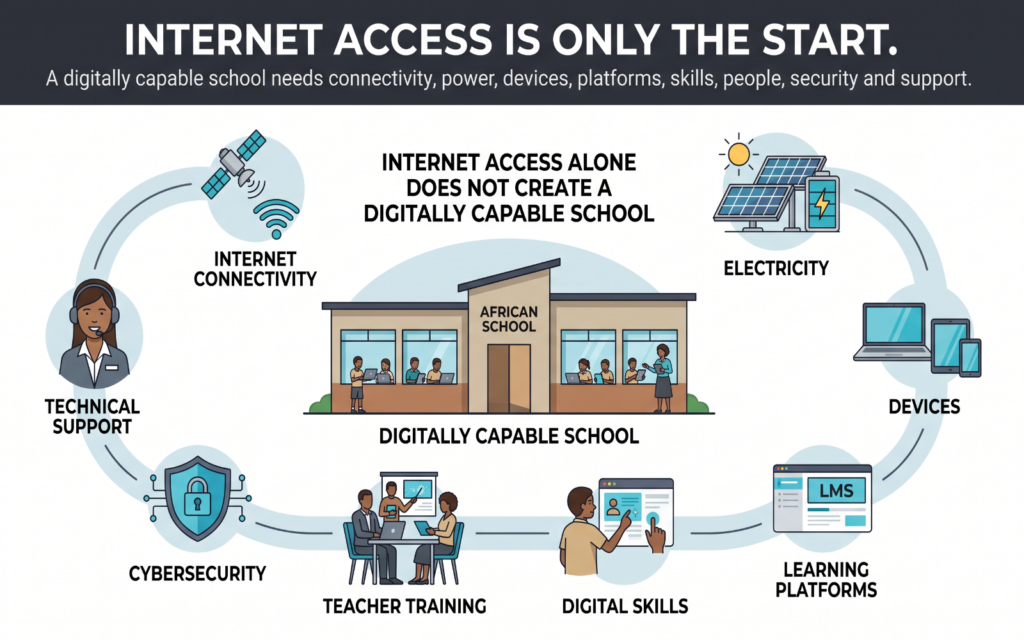
A connected school is not automatically a digitally capable one. Bridging Africa’s connectivity gap through satellite links only becomes meaningful when it sits alongside other essentials: functioning electricity, affordable devices for students and teachers, digital skills training, well-designed learning platforms, locally relevant content, ongoing technical support and proper data protection practices. A school with a Starlink dish but no laptops, no trained staff and no age-appropriate content has solved one problem while leaving several others untouched. This is the point education leaders raise most often when connectivity projects are announced without a wider implementation plan attached.
Building a Connected Education Infrastructure
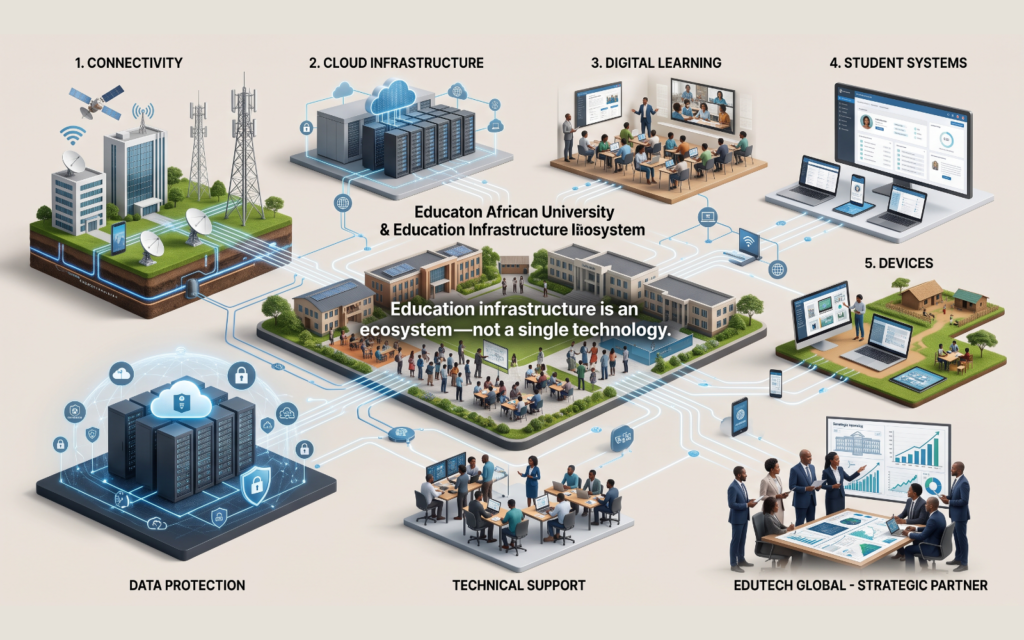
A useful way to think about this is as a chain, where each link depends on the one before it: connectivity leads to electricity, which enables devices, which support cloud infrastructure, which powers learning platforms and student information systems, which in turn require digital skills, data protection and technical support to function sustainably. Rural education technology initiatives that skip steps in this chain tend to stall once the initial excitement of installation wears off. Coordinated planning, rather than piecemeal hardware donations, is what allows a connectivity investment to translate into lasting educational value.
The Role of Governments and Private Infrastructure Partners
Closing the digital divide in education at national scale requires more than any single satellite operator can deliver alone. National connectivity programmes, public-private partnerships, telecom providers, satellite operators, education technology companies and development organisations all have distinct roles to play, from policy and financing through to on-the-ground maintenance. Kenya’s CEMASTEA deployment worked because a local institution identified the need first and then brought in technical partners, rather than the reverse. That sequencing, government or institutional ownership paired with private infrastructure capability, tends to produce more durable outcomes than technology-led pilots alone. It connects closely to the broader conversation around Public-Private Partnerships in Education.
Read More: The Future of Higher Education: Ten Trends Reshaping Universities Through 2030
How EduTech Global Approaches Education Infrastructure
At EduTech Global, our work with governments, banks, schools and universities starts from the same premise this article has tried to build: connectivity is necessary but not sufficient. We support institutions in developing digital infrastructure strategy, connectivity readiness assessments, cloud infrastructure planning and the wider digital learning ecosystems that make a connected school genuinely functional, from student information systems to data governance. Our focus stays on the full infrastructure layer required for education to scale sustainably, not just the network link at the edge of it.
Satellite internet for schools in Africa represents a genuinely useful tool for reaching classrooms that traditional fibre and mobile networks have struggled to serve, and Kenya’s early results suggest it can work well when paired with the right local partnerships. But South Africa’s stalled negotiations are a reminder that pledges and policy are not the same as delivery, and connectivity on its own cannot fix an education system’s deeper infrastructure gaps. The institutions that get the most value from satellite broadband education will be the ones that plan for electricity, devices, skills and support from day one, not as an afterthought once the dish is installed. For governments and institutions ready to think through that fuller picture, EduTech Global works alongside you to plan the digital systems, connectivity and technology foundations that make education more accessible and scalable across Africa. Get in touch to talk through what that could look like for your institution.
Frequently Asked Questions
What is satellite internet for schools? It is internet delivered from orbiting satellites to a ground terminal installed at a school, rather than through fibre cables or nearby mobile towers, making it useful for locations traditional networks cannot reach affordably.
Can satellite internet work in rural Africa? Yes. Kenya’s CEMASTEA and Grow X Education deployment connected 30 schools across 30 districts and more than 32,000 students, demonstrating that low-Earth orbit internet schools can operate effectively in remote settings.
How does Starlink support schools? Starlink provides a dish and router that connect to its satellite constellation, giving schools broadband-level speeds and low latency without needing existing fibre or strong mobile coverage nearby.
Is satellite internet affordable for schools? Equipment and subscription costs remain a barrier for many public school systems, which is why most large-scale deployments to date have relied on donor, government or provider-funded programmes rather than school budgets alone.
What infrastructure does a connected school need? Beyond the internet connection itself, schools need reliable electricity, appropriate devices, trained staff, relevant digital content and ongoing technical support to make connectivity useful for teaching and learning.
Can satellite internet close Africa’s digital divide? It can meaningfully narrow the connectivity gap for schools in hard-to-reach areas, but closing the wider digital divide in education also requires progress on electricity access, device affordability and digital skills, areas where satellite internet alone cannot help.