
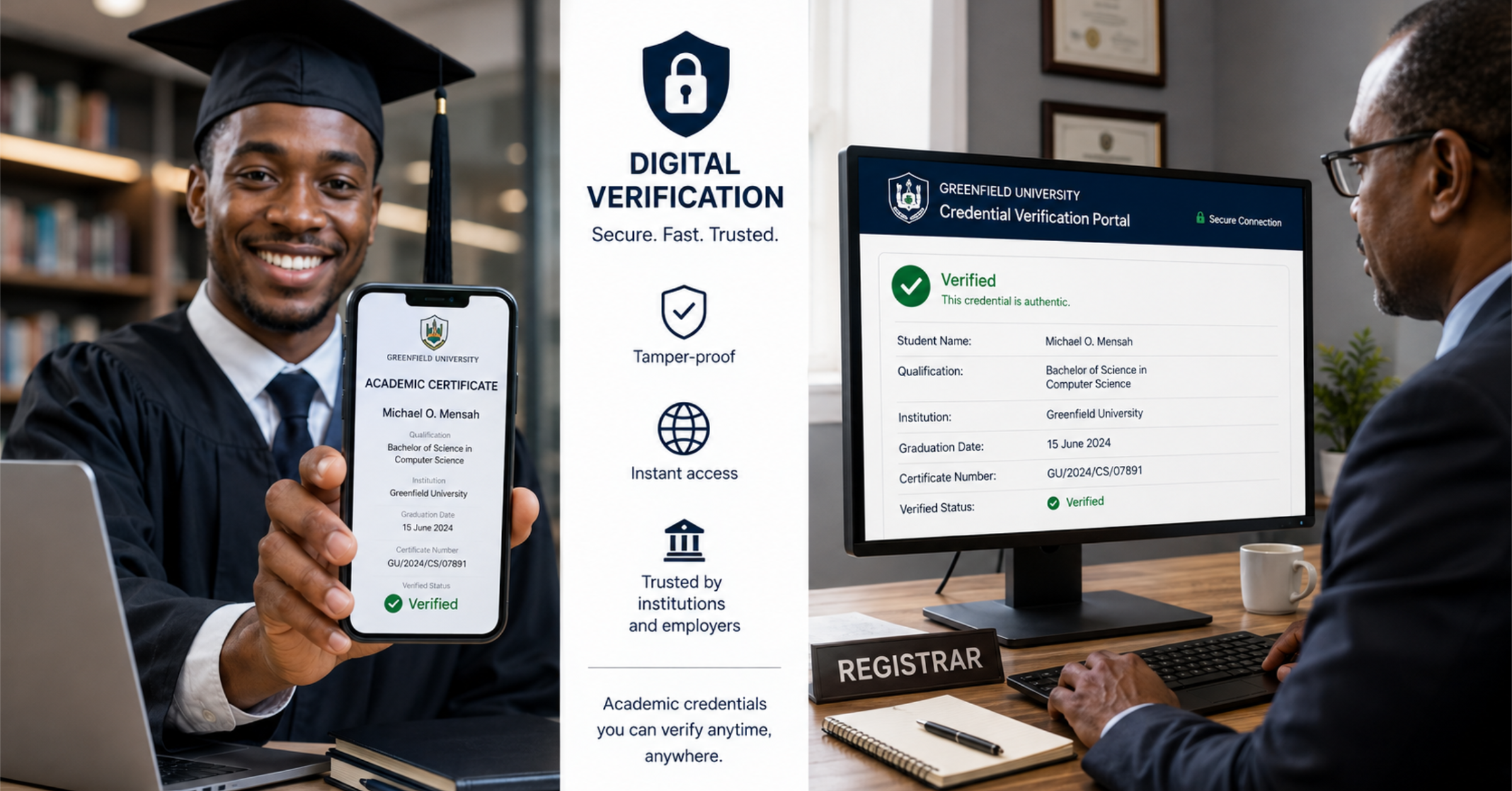
Certificate verification has quietly become one of the most urgent problems in global education. Not because degrees have changed, but because trust in what they represent is under sustained pressure.
Consider what happened across American higher education last year. The U.S. Department of Education reported that it had prevented more than a billion dollars in federal student aid fraud since January 2025, much of it tied to so-called “ghost students”: fabricated or stolen identities enrolled purely to trigger financial aid payments before vanishing. Colleges discovered course rosters that looked full but contained only a handful of genuine learners. If institutions can be deceived about whether a student is real, it should trouble every registrar, employer and government agency that a certificate might be treated with less scrutiny. A qualification is only as valuable as someone’s ability to confirm it belongs to a real person, from a real institution, for a real achievement. That confirmation is what certificate verification exists to provide, and it is rapidly becoming infrastructure rather than an administrative afterthought.
Read More: The Future of Higher Education: Ten Trends Reshaping Universities Through 2030
What Is Certificate Verification?
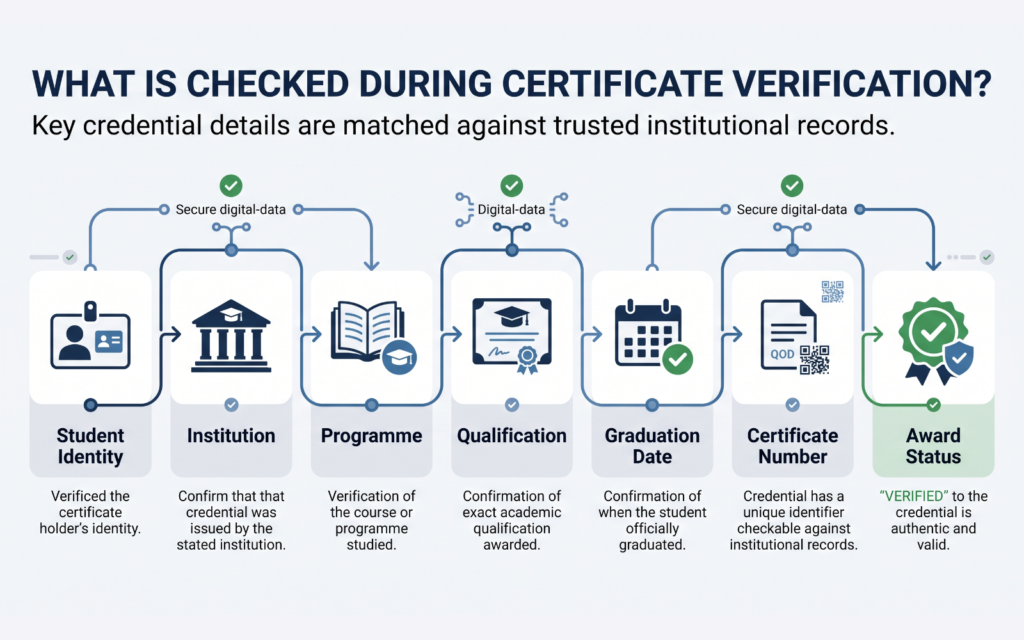
Certificate verification is the process of confirming that an academic credential is genuine: issued by the institution it claims to be from, to the person presenting it, for the programme and dates stated. In practice, this can mean checking a graduate’s identity, the issuing institution’s legitimacy, the specific programme completed, the qualification awarded, the graduation date, a certificate or serial number, and whether the award remains valid or has since been revoked.
It helps to separate related terms that often get blurred together. Certificate verification confirms a single document is authentic. Academic credential verification is broader, covering degrees, diplomas, transcripts and micro-credentials collectively. Institution verification checks that the awarding body itself is accredited and legitimate, which matters enormously given how many unaccredited operators exist. Identity verification, separately, confirms that the person presenting the certificate is who they claim to be. A robust system for verifiable academic credentials needs all four working together, because a genuine certificate from a fake person, or a fake certificate from a real institution, both cause identical damage.
Why Paper Certificates Are Difficult to Verify at Scale
None of this makes a physical certificate inherently untrustworthy. The problem is speed and consistency, not authenticity in principle. When an employer receives a paper certificate, confirming it typically means writing to the university’s registry, waiting for a human to locate a physical or legacy digital record, and hoping the response arrives before a hiring decision is due. That process struggles under a few realities:
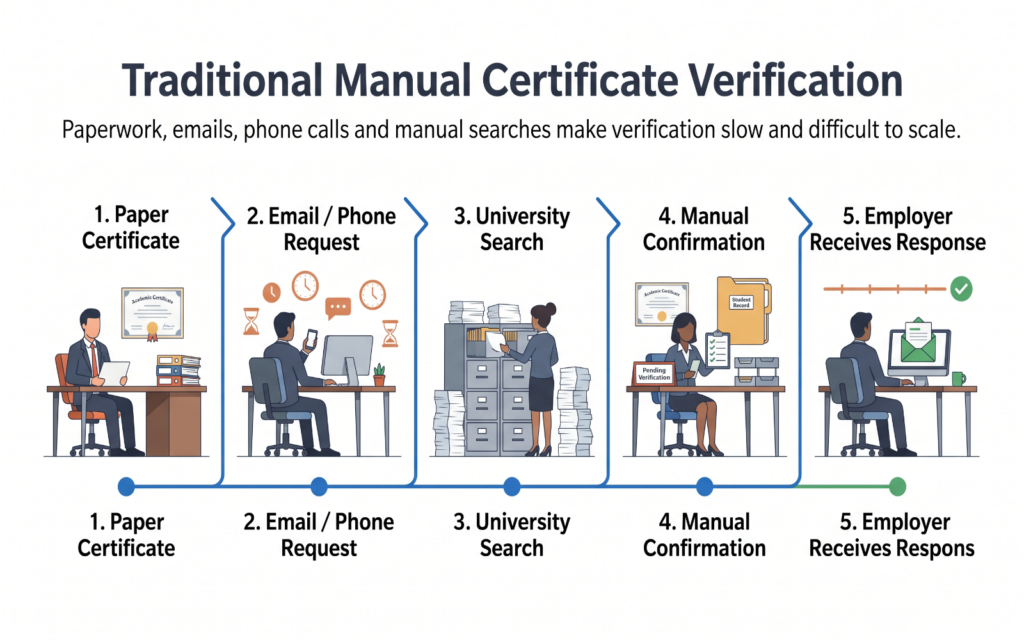
- Forgery and alteration are difficult to detect visually once printing and design tools have improved.
- Manual verification depends on registry staff who may be overwhelmed by requests, especially during admissions or recruitment peaks.
- Lost or damaged certificates create genuine hardship for honest graduates trying to prove real achievements.
- Cross-border requests slow down further when time zones, language and unfamiliar institutional structures are involved.
- Fragmented records, particularly from older graduating cohorts or merged institutions, are sometimes incomplete or scattered across departments.
For a single hire or single admission, these delays are an inconvenience. Multiplied across thousands of applicants a year, they become an operational bottleneck that paper alone cannot solve.
The Growing Problem of Fake and Misrepresented Credentials
The fraud side of the equation is not hypothetical. Nigeria’s National Universities Commission has repeatedly published lists of illegal institutions operating without a licence, warning that anyone who obtains a certificate from them does so entirely at their own risk. Globally, a 2017 World Education Services study estimated more than a thousand diploma mills operating in the United States alone, with more than double that number worldwide, describing bogus degrees as a billion-dollar industry. Beyond outright fake institutions, misrepresentation takes subtler forms too: altered transcripts, inflated grades, exaggerated programme titles, or genuine certificates presented by someone who never actually held them.
Every one of these scenarios has direct consequences. Employers risk placing unqualified people into positions of real responsibility, sometimes safety-critical ones. Universities risk admitting applicants on the strength of credentials that were never properly earned, undermining the value of every genuine degree they issue. A reliable fake certificate check is no longer a compliance nicety; it is a basic form of institutional self-defence.
Read More: Cybersecurity in Higher Education: Protecting the Modern Digital Campus
How Digital Certificate Verification Works
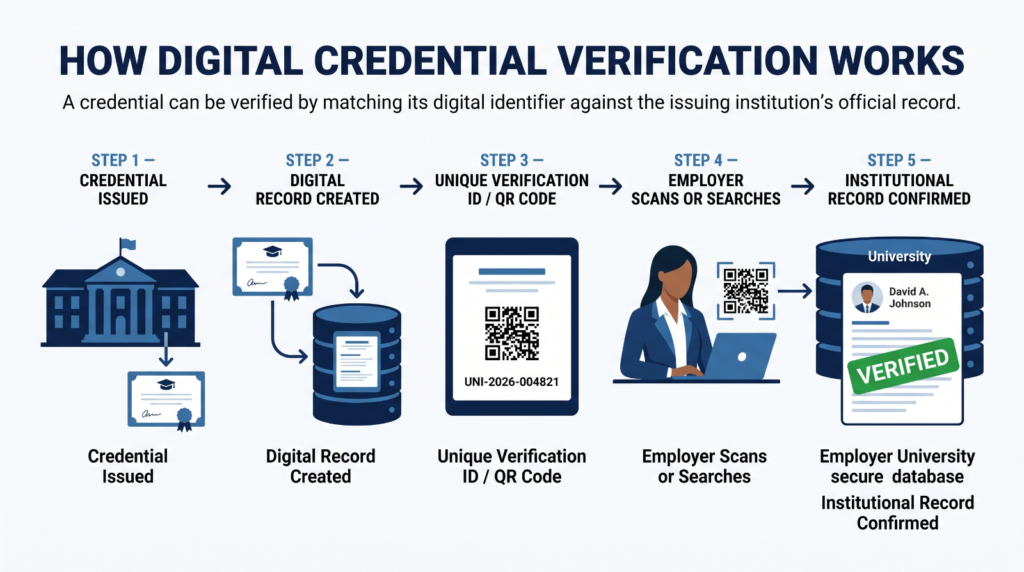
Digital certificate verification reorganises this entire process around a simple workflow. A credential is issued, a corresponding digital record is created, and that record is assigned a unique verification identifier. When an employer or institution needs to confirm it, they scan a QR code or search the identifier against the issuing body’s system, and the credential record is confirmed or flagged, usually within seconds rather than weeks.
Nigeria has already moved in this direction at the national level. Following reforms from October 2024, the Federal Ministry of Education verifies degree certificates directly, and each authenticated certificate now carries a National Credential Number linked to records in a central database, allowing foreign institutions to confirm Nigerian qualifications without contacting the university at all. A similar principle underpins NYSC certificate verification, where employers can confirm a corps member’s discharge, exemption or exclusion status online using a certificate number, rather than relying on a physical document alone. QR-based verification works well here precisely because it does not ask the checker to trust the document; it asks them to trust the issuing record the document points to.
What Makes a Digital Certificate Trustworthy?
Not every digital file labelled a “certificate” deserves confidence. A trustworthy verifiable credential typically includes the issuing institution’s identity, a unique record identifier, secure storage that resists tampering, a working verification URL, the issuance date, precise qualification details, the holder’s identity, and current status information showing whether the award has been revoked or amended since issue.
It is worth being clear that blockchain is not a prerequisite here. It is one possible technology among several, useful for certain tamper-evidence guarantees, but the defining feature of a trustworthy digital academic record is that it links back, verifiably, to an authoritative institutional source. Standards bodies such as 1EdTech have developed open frameworks like the Comprehensive Learner Record precisely so that digital academic records remain interoperable and verifiable across different platforms and institutions, rather than locked into a single vendor’s proprietary format.
Why Employers Need Faster Academic Credential Verification
For HR teams, slow verification is not a paperwork problem so much as a hiring risk. Recruitment timelines are compressed, competition for strong candidates is intense, and every day spent waiting on a registrar’s reply is a day a preferred candidate might accept another offer. The stakes rise further in regulated professions, where licensing bodies must confirm qualifications before someone practises medicine, law, engineering or education. International hiring compounds the difficulty, since verifying a foreign qualification often means navigating an unfamiliar system entirely. Faster academic credential verification also supports internal promotions and periodic compliance checks, where organisations need assurance that the qualifications on file remain accurate over an employee’s tenure. Manual, paper-based verification simply cannot keep pace with any of this.
Why Universities Need Verifiable Digital Credentials
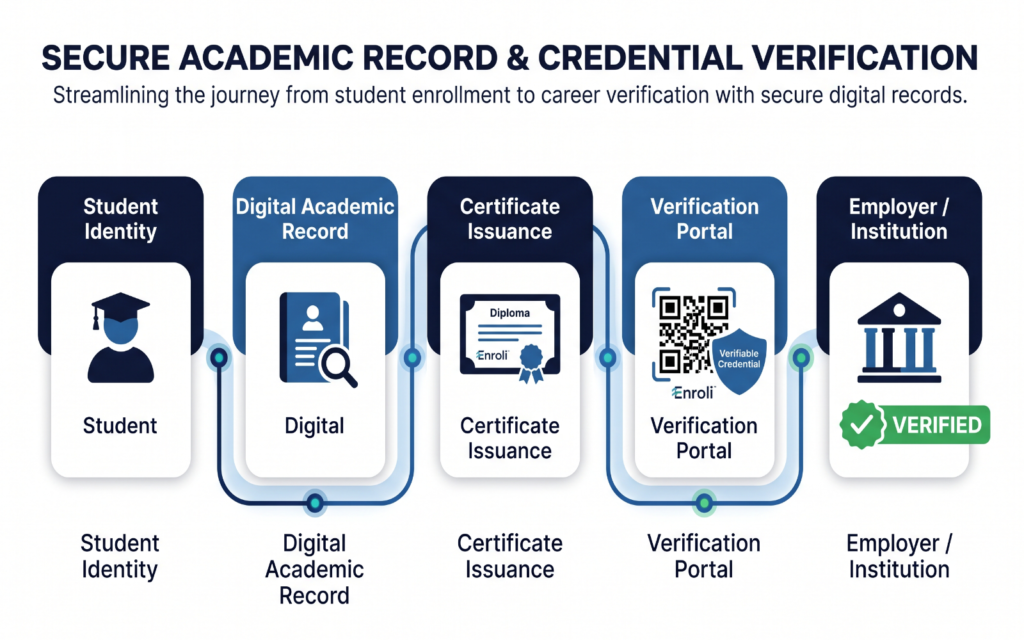
The pressure on institutions is just as real, if less visible day-to-day. Graduates increasingly move across borders for work or further study, and each of those moves generates a fresh degree verification request landing on a registrar’s desk. International applications require universities to assess incoming qualifications from institutions they have never dealt with before. Alumni frequently request transcripts years or decades after graduating, when staff and systems may have changed entirely. Meanwhile, credential fraud aimed at the institution itself, through forged transfer documents or fabricated prior qualifications, adds further administrative load. Treating verifiable academic credentials as core infrastructure, rather than a registry side task, is what allows institutions to absorb this growing volume without proportionally growing headcount.
Read More: Higher Education Digital Transformation: Why Technology Alone Doesn’t Deliver Change
How EduTech Global Can Support Verifiable Academic Credentials
This is precisely the layer EduTech Global builds toward: mission-critical infrastructure that connects digital academic records, credential issuance and identity into a single, coherent system for governments, banks, schools and universities. Rather than treating verification as an isolated tool bolted onto existing processes, EduTech Global’s approach positions credential data as part of a wider institutional record, one that can support secure issuance, structured verification workflows, and reliable links between a student’s identity and their achievements over time. For institutions exploring QR-based verifiable credentials as part of their digital campus strategy, this means credentials that are simple for a graduate to share and straightforward for any employer or institution to confirm, without reintroducing the delays paper created in the first place.
The Future of Academic Records Is Verifiable by Default
The direction of travel is clear. Digital transcripts, portable micro-credentials and lifelong learning records are increasingly expected to be verifiable the moment they are issued, not verified only when someone happens to ask. This matters as skills-based hiring grows and as cross-border education becomes routine rather than exceptional. Institutions that build this expectation into their systems now, rather than retrofitting it later, will find it far easier to support graduates moving between countries, industries and further study, echoing the same shift already underway in micro-credentials in higher education.
Trust Should Not Depend on Luck
A certificate is a promise: that a specific person did specific work, to a specific standard, at a specific institution. Paper alone can no longer carry that promise efficiently across borders, industries and growing volumes of applicants. Certificate verification, done properly through digital credential verification and clear institutional records, replaces guesswork and lengthy correspondence with confidence measured in seconds.
For universities, registrars, employers and government agencies alike, the practical next step is the same: treat degree verification as infrastructure to invest in, not an occasional favour to request. EduTech Global helps institutions build the digital education infrastructure that connects academic records, credentials, identity and verification, so that trust in a qualification never has to depend on a slow reply from a busy registry. Get in touch with EduTech Global to talk through what that looks like for your institution.
Read More: Micro-Credentials in Higher Education: The Future of Skills-Based Learning
Frequently Asked Questions
What is certificate verification? Certificate verification is the process of confirming that an academic certificate genuinely represents the person, institution, programme and achievement it claims to, rather than being forged, altered or misattributed.
How do employers verify degree certificates? Employers typically contact the issuing institution’s registry directly, use a national verification portal where one exists, or check a digital certificate’s unique identifier or QR code through a digital certificate verification system. In Nigeria, for example, NYSC certificate verification lets employers confirm a corps member’s discharge or exemption status online, rather than waiting on correspondence.
How can I verify a university certificate? Start by confirming the institution itself is accredited through the relevant national authority, such as Nigeria’s NUC list, then verify degree certificate details directly through the institution’s registry or an official digital verification system.
Can a QR code verify a degree certificate? Yes. A QR code on a digital certificate typically links to the issuing institution’s authoritative record, allowing anyone to confirm the certificate’s details instantly rather than waiting for manual correspondence.
How do universities prevent fake certificates? Universities prevent fake certificates by issuing verifiable digital records with unique identifiers, maintaining secure central databases, and publishing clear verification channels that make a fake certificate check straightforward for employers and other institutions.
What is academic credential verification? Academic credential verification is the broader process of confirming that any academic record, including degrees, diplomas, transcripts and micro-credentials, is genuine and accurately represents the holder’s achievements.
Are digital certificates more secure than paper certificates? Digital certificates are generally easier to verify quickly and consistently, since they link back to an authoritative institutional record and support faster degree verification, whereas paper certificates rely on manual checks that are slower and more vulnerable to forgery.