

AI governance in higher education has moved from a theoretical concern to an operational necessity in a single academic cycle. According to EDUCAUSE’s 2026 research on the impact of AI on work in higher education, conducted with AIR, NACUBO and CUPA-HR, 94% of staff, administrators and faculty across more than 1,800 institutions report using AI tools within the past six months, yet only 54% say they are aware of their institution’s AI policies.
That gap between adoption and oversight is not a communications problem. It is the defining institutional risk of this moment, and it explains why boards, provosts and chief information officers are now treating AI governance as a leadership priority rather than a technical footnote.
Read More: Cybersecurity in Higher Education: Protecting the Modern Digital Campus
AI Is Already on Campus, Whether Universities Planned for It or Not
Generative AI arrived in lecture theatres, admissions offices and research labs well before most institutions had a policy ready for it. Students use it to draft essays and revise arguments. Faculty use it to design courses, mark assignments and summarise literature. Administrators use it for advising, forecasting enrolment and drafting institutional communications. Global data from the Digital Education Council’s 2026 survey, drawing on more than 45,000 responses across 35 countries, found that 88% of students and 77% of faculty now use AI in their work, up sharply on the previous year.
The problem is not usage. It is the absence of structure around it. Many institutions still lack a clear AI policy for universities that defines what tools are approved, who is accountable for oversight and how risk is assessed before a new AI system touches student data. That is precisely why AI governance in higher education belongs on the desk of university leadership and not solely with the IT department. IT can manage infrastructure, but only institutional leadership can set the ethical boundaries, resource the oversight function and answer to accreditors, regulators and the public when something goes wrong.
Regulatory expectations are also tightening. Accreditors are beginning to ask how institutions document their AI decisions, and funding bodies are attaching governance conditions to grants involving AI in instruction and student support. An institution without a documented framework is no longer just behind on innovation. It is exposed.
What Is AI Governance in Higher Education?
AI governance in higher education is the set of policies, structures and accountability mechanisms that determine how an institution evaluates, approves, monitors and retires artificial intelligence tools across teaching, research, administration and student services. It is distinct from AI implementation. Implementation is about deploying a chatbot, a proctoring tool or an analytics platform. Governance is about deciding, before deployment, who is allowed to approve that tool, what data it can touch, how its outputs will be checked, and what happens when it fails.
A working framework for institutional AI governance typically rests on six pillars:
- Policy: written, accessible rules on acceptable AI use for students, faculty and staff.
- Accountability: named owners for AI decisions, from procurement to classroom use.
- Ethics: a commitment to fairness, human oversight and student wellbeing.
- Compliance: alignment with data protection law, sector regulation and accreditation standards.
- Transparency: clear disclosure of when and how AI is used in decisions that affect students.
- Oversight: ongoing monitoring rather than a one-off approval.
Global bodies have already set useful reference points. UNESCO’s Guidance for Generative AI in Education and Research calls for a human-centred approach anchored in data privacy and equity, while the OECD’s updated AI Principles, revised in 2024 to address generative and foundation models, set out accountability and transparency standards now referenced by 47 governments. These are not abstract ideals. They are the beginning of an ethical AI governance baseline that institutions will increasingly be measured against.
The Biggest AI Risks Universities Must Address
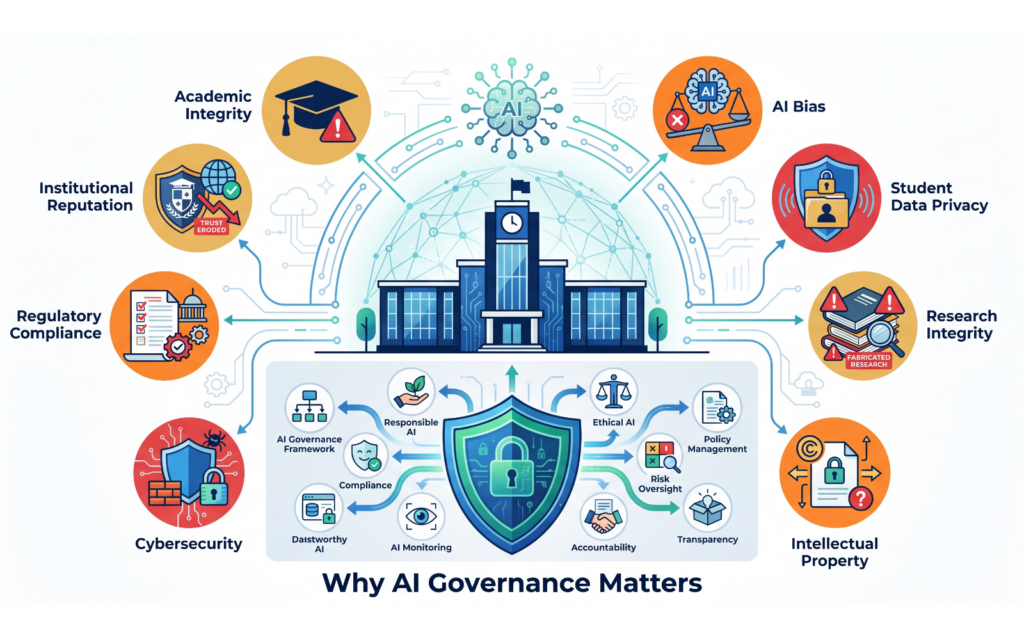
Uncontrolled AI adoption creates risk across nearly every function of the institution.
Academic integrity. Academic integrity AI concerns dominate faculty conversations, and rightly so. The HEPI/Kortext Student Generative AI Survey 2026 found that two-thirds of UK undergraduates report assessment has changed significantly because of AI, and institutions without updated assessment design are struggling to keep pace. Addressing academic integrity AI concerns properly means redesigning assessment, not simply detecting misuse after the fact.
Bias and fairness. AI tools trained on skewed data can disadvantage particular student groups in admissions scoring, plagiarism detection or predictive analytics, undermining the fairness the sector exists to protect.
Student data privacy. Many AI tools have been adopted without a formal assessment of how they handle personal data, creating direct exposure under data protection frameworks.
Research integrity. Undisclosed AI use in analysis, writing or peer review threatens the credibility of institutional research output.
Intellectual property. Ownership questions around AI-generated content, and the training data behind third-party tools, remain unresolved in many contracts.
Cybersecurity. Every new AI vendor is a new integration point, and a new potential vulnerability.
Regulatory compliance. An AI compliance framework has to track evolving national and regional rules, not just current law. Institutions that treat their AI compliance framework as a living document, revisited quarterly rather than filed away after approval, adapt far more easily as rules change.
Institutional reputation. A single mishandled AI incident, whether a biased algorithm or a data breach, can undo years of public trust.
Read More: The Digital Campus: Why Every Modern University Needs One to Stay Competitive
Building an Effective AI Governance Framework
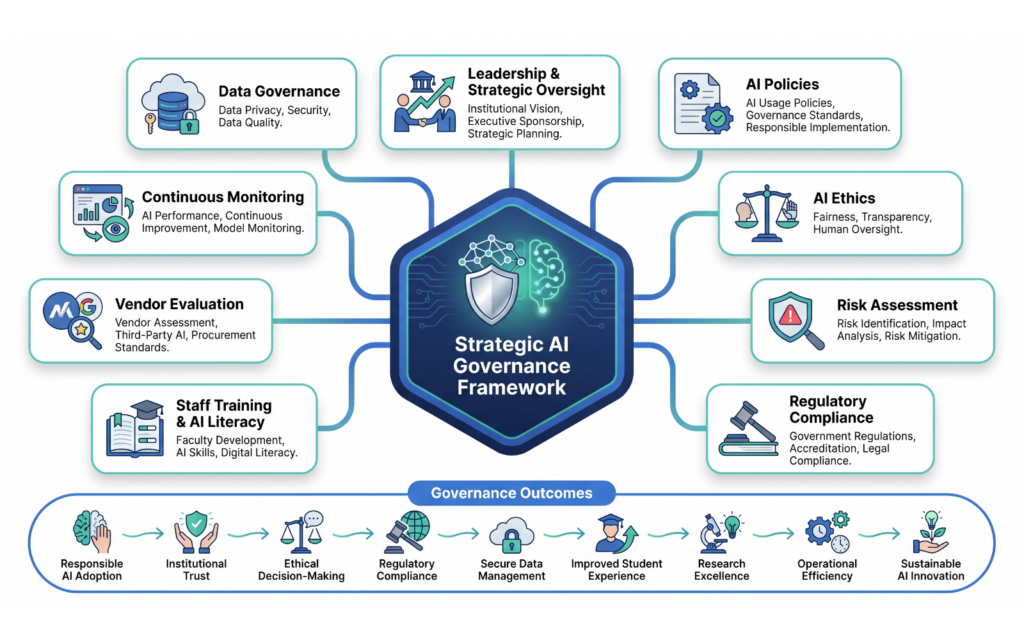
A credible AI risk management higher education strategy starts with leadership ownership. Governance cannot sit exclusively within IT; it needs a cross-functional committee that includes academic affairs, legal, data protection, student services and IT security, reporting to a senior sponsor such as a provost or deputy vice-chancellor. Effective AI risk management higher education practice also means revisiting each approved tool after deployment, since risk does not end at the point of sign-off.
From there, institutions typically build the following, in roughly this order:
- A published AI policy setting expectations for students, faculty and staff.
- A risk assessment process applied to every new AI tool before adoption.
- A standing governance committee with defined decision rights.
- An ethical review pathway for higher-risk uses, particularly in admissions and assessment.
- Staff and faculty training so policy translates into daily practice.
- A vendor evaluation process that scrutinises data handling, not just functionality.
- Continuous monitoring, since a tool approved today may behave differently after a model update.
Institutions vary widely in how far along this path they are. Some are still at the awareness stage, with informal guidance and no committee. Others have reached a managed stage, with documented policy but inconsistent enforcement. The most advanced have reached an optimised stage, where governance is embedded, monitored and reviewed on a fixed cycle. Understanding where an institution sits on that maturity curve is the first practical step towards closing the gap EDUCAUSE identified between AI use and AI policy awareness.
Responsible AI Can Accelerate Innovation

Governance is frequently misread as a brake on innovation. In practice, the opposite tends to be true. Responsible AI in education gives faculty the confidence to experiment with new teaching methods because the boundaries are clear. It gives researchers a defensible basis for using AI in their work. It gives administrators a faster, safer path to approving tools that genuinely improve student services, because the evaluation criteria already exist rather than being invented under pressure. A well-governed institution moves faster, not slower, because it is not relitigating the same risk questions with every new tool. Over time, that consistency builds the kind of institutional trust that supports long-term digital transformation rather than a series of disconnected pilots.
Preparing Universities for the Future of AI Regulation
Regulatory attention on AI is intensifying globally, from evolving data governance rules to sector-specific guidance from bodies such as EDUCAUSE and government education ministries. Institutions operating across borders, through partnerships, transnational campuses or international student recruitment, face the added complexity of reconciling multiple regulatory regimes at once. A sound university AI strategy treats audit readiness as a constant state rather than a response to a specific inquiry, keeping documentation of AI decisions current so that when a regulator, accreditor or auditor asks how a tool was approved, the institution can answer immediately. Institutions that build this discipline now will be better positioned as global AI standards continue to mature, rather than scrambling to retrofit compliance later. A resilient university AI strategy also anticipates cross-border complexity well before a transnational partnership makes it unavoidable.
How EduTech Global Supports Responsible Digital Transformation

EduTech Global works alongside governments, banks, schools and universities as a strategic advisor on institutional AI readiness, not as a software vendor pushing a single product. That distinction matters. Our role is to help institutions develop AI strategies grounded in their own risk profile, build governance frameworks that reflect their regulatory environment, and assess digital maturity honestly before recommending next steps.
In practice, that means working with institutional leadership to translate global principles, from UNESCO’s guidance to the OECD’s AI Principles, into policies that make sense for a specific campus, student population and legal jurisdiction. It means helping governance committees define decision rights instead of leaving them ambiguous, strengthening institutional AI governance at every level of decision-making. And it means supporting the broader digital transformation agenda, including digital campus infrastructure and cloud-based systems, so that governance is built into modernisation from the outset rather than added afterwards. Explore our blog for further insight, or get in touch to discuss what institutional AI readiness looks like for your institution.
AI governance in higher education is no longer optional groundwork for institutions with time to spare. It is the mechanism that determines whether AI adoption strengthens an institution’s mission or quietly erodes the trust it depends on. The risks, spanning academic integrity, data privacy, bias and compliance, are real and already present on campus. But so is the opportunity: institutions with a clear AI policy for universities, a functioning governance committee and a genuine commitment to ethical AI governance are better placed to innovate with confidence rather than caution born of uncertainty. The institutions that move deliberately now, rather than reactively later, will be the ones setting the standard for responsible AI in education. Partner with EduTech Global to develop the governance frameworks and digital transformation roadmap your institution needs.
Frequently Asked Questions
What is AI governance in higher education? It is the framework of policies, accountability structures and oversight mechanisms that guide how a university evaluates, approves and monitors AI tools across teaching, research and administration.
Why do universities need AI policies? Without clear policy, institutions lose visibility into what data AI tools are processing and who is accountable for their outcomes, creating risk around privacy, fairness and academic integrity.
Who should oversee AI governance? Effective institutional AI governance sits with a cross-functional committee, spanning academic affairs, legal, data protection and IT, reporting to a senior institutional leader rather than IT alone.
Can AI improve education responsibly? Yes. When paired with governance, AI can support personalised learning, research efficiency and administrative capacity without compromising academic standards or student trust.
How should institutions prepare for AI regulations? By treating audit readiness as an ongoing discipline: documenting AI decisions, monitoring tools continuously, and aligning policy with recognised frameworks such as the OECD AI Principles and UNESCO’s guidance.